Eleven weeks after Ruben died, his sister told me to leave our bedroom so her husband could remodel it. His mother kept eating. I smiled and asked what people would say—because the story this family told about their home left out something important about me.
Part 1
Eleven weeks after my husband died, I still slept on my side of the bed.
His pillow lay untouched beside mine. On the dresser stood the little wooden tray where he used to drop his watch, two coins, and whatever screws he had collected in his pockets during the day.
I had moved the watch into a drawer.
I couldn’t bring myself to move the tray.
That Thursday, I had worked eight hours at the medical billing office, bought groceries, and come home to find Leticia’s car parked across the driveway. Her husband, Esteban, had left muddy boot prints from the front entrance to the kitchen.
I cleaned them while the soup warmed.
There were five of us at dinner: Leticia, Esteban, Ruben’s younger brother Tomas, my mother-in-law Celia, and me.
Celia lived in the downstairs suite. Tomas had been staying in the spare room since losing his job. Leticia and Esteban lived across town but had developed a habit of arriving whenever a meal was nearly ready.
Before Ruben died, I hadn’t minded.
Afterward, their visits became longer, their conversations quieter when I entered the room.
That evening, Leticia waited until I had served everyone.
“Look, Mariana, don’t take this the wrong way,” she said, smoothing her hair behind one ear, “but it’s about time you vacated the bedroom. My husband wants to remodel it. And besides, well… Ruben is gone. You still being here just looks weird.”
Celia’s spoon paused.
Then she continued eating.
Esteban tore a piece of bread in half.
Tomas stared at his bowl.
I set down the water pitcher.
There are moments when grief makes you feel hollow, as though words pass through your body without finding anything solid to strike.
This wasn’t one of them.
I felt everything.
The word vacated. The casual mention of my bed. The suggestion that my presence had become embarrassing now that the man who loved me was no longer there to explain it.
I looked at Leticia and smiled slowly.
“Thanks for worrying about me. But I’m worried about what people might say.”
Her face tightened.
“What does that mean?”
“Which part of the story will you tell them?”
Esteban looked up.
“There’s no need to make this dramatic.”
“You’re discussing removing me from my bedroom over soup. I’d like to understand the plan.”
Leticia gave a small laugh.
“Nobody said removing. We thought you could stay with your aunt for a while. Have a change of scenery.”
My aunt lived two hours away in a one-bedroom apartment above a bakery.
“And my furniture?”
“We’d figure that out.”
“My clothes? Ruben’s things?”
“Mariana.” Celia finally spoke. “Don’t make everyone uncomfortable.”
I turned toward her.
For years, I had heard her use that sentence to end conversations about unpaid bills, missed promises, and the way Leticia spoke to the women who cleaned her office.
This time, I waited.
Celia lowered her eyes.
My husband had been gone for eleven weeks, and they were already treating the room we shared as empty space.
“When,” I asked, “did you discuss this?”
Esteban pushed his chair back.
“The workers are available Monday. If we miss that window, it could be months.”
“You hired workers?”
“I put them on standby.”
Leticia touched his arm.
I stood, carried my untouched bowl to the counter, and returned without it.
“No one is entering my bedroom on Monday.”
Leticia’s expression hardened.
“Ruben isn’t here to keep giving you special treatment.”
I looked directly at her.
“No,” I said. “So you’ll have to listen to me now.”
Part 2
Leticia folded her napkin with careful little movements.
“We’re trying to be practical.”
“Then tell me what you intend to do with the room.”
Esteban glanced toward the hallway.
“Remove the built-in wardrobes. Put in a small bathroom where that storage alcove is. Improve the entrance.”
“What entrance?”
“The side window could become a door.”
I pictured the window beside our bed, the one Ruben opened every morning because he liked hearing the woman next door call to her dog.
“Why would my bedroom need a separate entrance?”
Leticia sighed.
“Because the house needs to earn something, Mariana.”
There it was.
She described a furnished rental for traveling professionals. Nurses. Consultants. People who would stay a month or two and pay promptly.
She had already looked at listings.
“It’s wasted space,” she said. “You’re one person.”
Tomas shifted in his chair.
He occupied a room almost the same size as mine. Nobody mentioned it.
“Who would receive the rent?” I asked.
“Mother has expenses.”
Celia pressed her lips together.
I looked at the new medication organizer beside her water glass. I had collected her prescriptions that morning. The receipt was still in my handbag.
“And who would manage the rental?”
“I would,” Leticia said. “Obviously. Esteban would supervise the work.”
“Who would authorize it?”
She stared at me.
“We’re family.”
I remembered the first time she had used those words with me.
It was eight years earlier, after Ruben’s father died. The house had a leaking roof, an unpaid loan, and three adult children arguing about whether to sell it.
Ruben wanted his mother to remain in the home she knew.
Leticia wanted her share of the estate paid out.
Tomas wanted the same.
Ruben and I had spent months working through the purchase with the estate’s attorney. We had used money my mother left me for the down payment and taken out a mortgage together.
Leticia received her money.
Tomas received his.
Celia received the security of a written lifetime right to occupy her downstairs suite.
Ruben and I received the deed, the loan, and a roof that needed replacing before winter.
At the closing, Leticia hugged us.
“It stays in the family,” she said.
Over the years, that sentence had changed shape.
Our house became Mother’s house whenever she wanted to invite someone. The family house whenever a repair was needed. Ruben’s house whenever I chose paint.
At gatherings, I usually let it pass.
My name was on the paperwork. My salary paid the loan beside his. Correcting every careless phrase seemed petty while we were happy.
Now Leticia was watching me as if I were a guest who had overstayed.
“You remember the purchase,” I said.
Her jaw moved.
“That was an arrangement between siblings.”
“I was at the closing.”
“You were married to Ruben.”
“I also signed.”
Esteban stood.
“No one is having a legal argument at dinner.”
“You brought building plans to dinner.”
He looked toward Celia, expecting support.
She reached for her water.
“I am not leaving my home because you have found a way to make money from my bedroom.”
Leticia rose so abruptly that her chair struck the wall.
“We’ll see what Mother has to say about that.”
She collected her handbag and walked toward the door.
A folded sheet slipped from beneath it and landed beside my chair.
I picked it up.
At the top was a photograph of our house.
Beneath it, in bold lettering, were the words: AVAILABLE FROM NEXT MONTH.
Part 3
“Give me that,” Leticia said.
I held the page away from her.
The photograph had been taken from the garden. Sunlight fell across the bedroom window. In the glass, faintly reflected, was the shape of a person holding a phone.
Under the photograph was a description of a private furnished suite with a separate entrance, new bathroom, and access to a shared garden.
The monthly price was more than half my take-home pay.
“You advertised it.”
“It’s a draft.”
“Where?”
“Mariana, give it back.”
Esteban stepped closer.
“We’re testing interest. That’s all.”
“In a room where I am still sleeping.”
He looked irritated now.
“Nobody was going to touch your personal things.”
“You told me to remove them by Monday.”
For a moment, I thought he might argue again. Instead, he took his coat from the back of the chair.
Leticia held out her hand.
I photographed the page before returning it.
She watched me do it.
“You’ve changed,” she said.
I didn’t answer.
After they left, the house settled into a terrible quiet.
Celia carried her bowl to the sink. She rinsed it longer than necessary, turning it beneath the tap.
“She’s worried,” she said.
“About what?”
“The future.”
“So am I.”
She turned off the water.
“You’re young. You can start again.”
I looked at the back of her gray head.
I had listened to her cry through the wall during the first month after Ruben died. I had made tea at two in the morning, sat beside her bed, and let her tell the same story about his first day of school three times in one night.
She was his mother.
I had never once told her she could replace him.
“I buried my husband,” I said. “I didn’t finish a chapter in a book.”
Her shoulders stiffened.
“You think you’re the only one grieving?”
“No. That’s why I’ve been trying to be kind.”
I went upstairs before she could respond.
In our bedroom, the air smelled faintly of the lavender detergent Ruben used to complain was too strong.
I sat on the bed.
His old sweatshirt hung from the hook behind the door. I pressed it against my face and cried with the exhausted helplessness I had spent the evening holding back.
He had died on an ordinary Tuesday.
We had argued that morning about whether the car needed servicing. At lunchtime, he sent me a photograph of a crooked sandwich and asked whether it qualified as cooking.
Before five, I was following a nurse down a hospital corridor.
A sudden medical emergency. Those were the words people kept using, as if a gentler phrase might make the hours afterward less real.
There had been no last conversation about houses.
No warning that I would soon have to defend the right to keep sleeping beside his pillow.
When I finally washed my face, Tomas knocked.
He stayed in the doorway.
“I didn’t know she’d say it like that.”
“You knew she planned to say it.”
He looked down.
“She said everyone needed to discuss the future.”
“Who is everyone?”
He rubbed his palms against his jeans.
“Mother. Leticia. Esteban. Me.”
They had held a meeting about my future in my own home and decided I didn’t need an invitation.
Tomas hesitated.
“There’s something else.”
I waited.
“Esteban came on Tuesday while you were at work.”
“To take the photograph?”
“To measure.”
My eyes moved toward the wardrobe.
Across the wooden door, barely visible in the evening light, was a short blue line.
A contractor’s mark.
Part 4
I touched the blue line with my thumb.
It didn’t rub away.
Esteban had stood in our bedroom while I was answering insurance questions at work. He had measured the wall beside Ruben’s clothes and decided where to begin pulling things apart.
“Who let him in?” I asked.
Tomas swallowed.
“He has a key.”
Of course he did.
Ruben had given him one years earlier when they repaired the back steps. There had never seemed a reason to ask for it back.
“Did you come upstairs with him?”
“For a minute.”
“Did you tell him to stop?”
“No.”
The honesty hurt, but I preferred it to another explanation.
“I need you to leave my doorway now.”
He nodded.
Before going, he said, “I’m sorry.”
I closed the door.
The next morning, I called the attorney who had handled the purchase eight years earlier. Her name was Beatriz Salas, and she remembered Ruben immediately.
“He brought a notebook full of roof estimates,” she said.
“That sounds like him.”
My voice broke on the last word.
She gave me time.
Then I explained what had happened.
Beatriz asked me to bring the purchase documents, the recorded deed, the papers protecting Celia’s occupancy, and the photograph of the rental advertisement.
“Have you authorized any construction?”
“No.”
“Put that in writing today.”
She didn’t promise a spectacular confrontation or tell me to throw anyone’s belongings into the street. She asked precise questions and arranged to review the situation properly.
That steadiness helped me breathe.
At lunch, I sent Leticia and Esteban a message.
I had not authorized work, advertising, photographs, or entry into my private rooms. No contractor was to attend on Monday. Any proposed change would need my written agreement.
Leticia called seven times.
I let the calls go unanswered.
By afternoon, the family messages began.
An aunt asked why I was threatening Celia.
A cousin said grief was difficult but I should remember that Ruben’s mother had suffered too.
Someone I hadn’t spoken to in two years wrote: Don’t let property destroy a family.
I read the messages in my parked car.
Then I called my friend Ines.
“Have you eaten?” she asked after listening.
“I’m not hungry.”
“That wasn’t the question.”
She arrived at the house that evening with rice, chicken, and a folder of sticky labels.
We sat at the kitchen table sorting paperwork.
Purchase. Mortgage. Insurance. Repairs.
There was my mother’s estate statement, showing the money I had contributed.
There were the bank transfers paying Leticia and Tomas for their inherited interests.
There were eight years of bills carrying my name beside Ruben’s.
Ines looked at the growing piles.
“You’ve had all of this the whole time?”
“Yes.”
“Then why do you look surprised?”
I thought about that.
“Because I knew what we signed. I didn’t know they could look me in the face and behave as if none of it happened.”
The documents proved I belonged there. They couldn’t explain why I had spent the last eleven weeks feeling I needed permission.
Near the bottom of the insurance folder, my phone lit up.
It was a message from a woman whose name I didn’t recognize.
Hello, Mariana. Leticia said you would show me the suite on Saturday. Is ten o’clock still convenient?
Part 5
I stared at the message.
Then I typed: I’m sorry, but there has been a misunderstanding. Who gave you my number?
The woman called immediately.
Her name was Daniela. She was a physical therapist taking a temporary position at a rehabilitation center nearby.
She sounded embarrassed before I had explained anything.
“Leticia told me you were helping manage the property,” she said. “She said the room was being renovated because the previous occupant had moved.”
The previous occupant.
I closed my eyes.
“I’m the person living in that room.”
Silence.
“Oh.”
I explained that the house was not available for rental and that I had not authorized the advertisement.
Daniela apologized three times.
“You haven’t done anything wrong,” I told her.
Then she asked about her reservation payment.
I sat down.
“You paid money?”
“Leticia said there was a lot of interest. Five hundred to hold it until I saw the finished work.”
I asked her to send the correspondence to Beatriz, with her permission. I gave her the office number so she could verify it herself.
Afterward, I sat with my phone in my lap until Ines placed a cup of tea beside me.
“What happened?”
I told her.
She didn’t look surprised.
That made me angrier than anything else.
On Saturday morning, Beatriz met with me at her office.
She had reviewed the deed and the original purchase file. Ruben and I had owned the house together under the arrangement recorded at the time. She explained what his death meant for the title and what administrative steps still needed completing.
Celia’s written right to live in her downstairs suite remained protected.
Leticia and Tomas had been paid for their interests years earlier. Esteban had no authority to order construction.
“Your mother-in-law’s security does not depend on your leaving,” Beatriz said.
I felt my shoulders lower.
“They’re telling people I want to put her out.”
“Do you?”
“No.”
“Then we’ll be clear about that.”
She prepared written notices stopping unauthorized work and advertising. She would also address the payment Daniela had made, without promising a result before hearing from everyone involved.
We discussed locks and access carefully, including Celia’s protected use of her suite and shared spaces.
I wanted safety.
I did not want revenge disguised as a renovation of my own.
When I returned home, Celia was sitting at the dining table with her reading glasses in her hands.
“Leticia says you hired a lawyer against us.”
“I hired someone to help me understand what happens next.”
“We could have talked.”
I set my bag down.
“I was told to move out over dinner.”
She twisted the glasses.
“She was insensitive.”
“She took money from someone for my bedroom.”
Celia looked up.
For the first time, I saw genuine surprise.
I showed her the message.
She read it slowly.
“I didn’t know about this.”
“What did you know?”
Her eyes filled.
“She said the room would help cover my expenses.”
“You have a place here. That was never in question.”
“After Ruben…”
She stopped.
I sat opposite her.
“After Ruben died, what did she tell you?”
Celia looked down at her hands.
“She said once you understood the house was yours, you would find a way to get rid of me.”
Part 6
I heard the refrigerator motor start in the kitchen.
For several seconds, it was the only sound.
“She knew I understood the purchase,” I said finally.
Celia nodded.
“She said you might not understand what it meant now.”
“So the plan was to move me out before I asked questions?”
“She said you needed somewhere without memories.”
I looked around the room.
The dining table had belonged to Ruben’s father. The curtains were ones Celia chose before I met her son. On the wall was a photograph of her holding Ruben when he was small.
Her memories surrounded us.
Mine were apparently the ones that needed clearing away.
“Did you believe I would make you leave?”
She opened her mouth.
Then she closed it again.
“I was afraid.”
“You could have asked me.”
“I know.”
“You watched me make your meals and collect your medication. You heard me crying upstairs. And when she told me to leave, you kept eating.”
A tear slipped beneath her glasses.
“I thought if I said anything, she would start shouting.”
“So you let her say it to me.”
She nodded.
There was no answer that made that smaller.
I got up to refill the kettle because I needed something ordinary to do with my hands.
Celia remained at the table.
“I lost my son,” she whispered.
I turned.
“And I lost the person I planned to grow old with.”
She looked at me then, really looked.
“I know.”
“I don’t think you’ve wanted to know.”
We sat with that for a while.
Finally, I explained what Beatriz had confirmed. Her suite was protected. I intended to honor the arrangement Ruben and I had made. She would not need to earn her bed by allowing someone to take mine.
But there would be changes.
No one would enter my bedroom without permission.
No construction would be arranged behind my back.
And if Leticia insulted me in my home again, the visit would end.
Celia wiped her face.
“She won’t like being told.”
“I didn’t like being told to pack.”
For the first time, Celia didn’t ask me to be more understanding.
On Monday morning, I took leave from work.
Beatriz had sent the notices. Esteban had acknowledged receiving his, though his reply consisted of two sentences about unnecessary hostility.
I still didn’t trust him to cancel the workers.
At eight fifteen, a van stopped outside.
A man in paint-marked trousers rang the bell.
“Bathroom conversion,” he said, checking his phone.
I stepped onto the porch and closed the door behind me.
“That work has not been authorized. I’m sorry you weren’t told.”
He frowned.
“Esteban booked us.”
“He received written notice that he couldn’t.”
The man called him from the driveway.
I heard only his side.
“No, she’s standing right here… No, we’re not forcing entry into somebody’s house.”
He ended the call, apologized, and drove away.
My knees were shaking when I went inside.
I had spent the morning protecting the room where I was supposed to be allowed to grieve.
Half an hour later, Leticia arrived.
She didn’t knock gently.
When I opened the door, she held up her phone.
“Do you have any idea what you’ve cost us?”
Part 7
I left the screen door closed between us.
“You need to speak to Beatriz about the work.”
“I’m speaking to you.”
“Then lower your voice.”
Her eyes widened.
For years, I had answered her sharpness with explanations. I had apologized for misunderstandings she created and thanked her for invitations that arrived after the meal had already started.
She seemed offended by the unfamiliar version of me standing in the doorway.
“Esteban paid to reserve those workers,” she said.
“I told him not to send them.”
“We were trying to help Mother.”
“She has a home.”
“For now.”
“Her agreement hasn’t changed.”
Leticia glanced past me.
Celia had come into the hallway.
“Mother, tell her.”
Celia gripped the back of a chair.
“Tell her what?”
“That this is still your family’s house.”
The silence stretched.
Then Celia said, “Mariana lives here.”
Leticia laughed.
“Obviously. That’s the problem.”
“No,” Celia said.
Her voice trembled.
“It isn’t.”
I turned slightly.
Celia’s face was pale, but she didn’t look away from her daughter.
“You told me she would make me leave.”
“I said she could.”
“You told me we had to act.”
Leticia’s expression changed.
“I was protecting you.”
“You frightened me.”
A car slowed outside, then continued down the street.
Leticia lowered her voice.
“Can you at least let me inside? The neighbors can hear.”
I opened the screen door.
“You can come in if you speak respectfully. If you shout, you’ll leave.”
She brushed past me without answering.
In the dining room, she placed her handbag on the same chair she had occupied four nights earlier.
I remained standing.
“I want the advertisement removed,” I said. “I want Daniela’s payment addressed directly with her. And I want every copy of our keys returned.”
“You’re enjoying this.”
I felt something in my chest twist.
“Do I look as if I’m enjoying any part of this?”
For a moment, she seemed to see me: the sleepless face, the loose wedding ring I kept turning because I had lost weight, the woman who had made soup while everyone discussed her departure.
Then her mouth hardened again.
“Ruben would hate what’s happening.”
“You don’t get to use my husband’s voice because he isn’t here to disagree with you.”
She went silent.
Celia sat down heavily.
“Your brother paid you,” she told Leticia. “You signed the papers. We all did.”
“Years ago.”
“Yes. Years ago.”
“So now you’re taking her side?”
Celia looked at the table.
“I should have spoken at dinner.”
Leticia stared at her, then picked up her handbag.
“You’ll both regret this when she decides she wants the place to herself.”
“That’s enough,” I said.
I walked to the front door and opened it.
She hesitated, perhaps waiting for Celia to call her back.
Celia didn’t.
After Leticia left, I locked the door and leaned against it.
My hands were shaking again.
Celia stood in the hallway.
“There’s something I need to give you,” she said.
She went into her suite and returned with a small cardboard box.
Ruben’s handwriting was on the lid.
House records—keep.
Part 8
“He brought it downstairs when you painted the office,” Celia said.
I remembered.
We had cleared the little upstairs room on a rainy weekend in September. Ruben complained about carrying boxes, then spent twenty minutes choosing music before opening the paint.
He died six weeks later.
The box held ordinary things.
Receipts for plumbing work. Spare cabinet hinges. A manual for the water heater. The original estimate for the roof.
I almost smiled.
Ruben saved instructions for appliances we no longer owned.
Near the bottom was a brown envelope containing our early renovation photographs.
Me standing beneath the damaged kitchen ceiling, holding a bucket.
Ruben asleep on the floor beside a rolled-up rug.
Both of us eating takeout from the hood of his car because the dining table was covered in tools.
In one picture, he was kissing my temple while I held a paintbrush toward the camera.
I sat down.
Celia remained near the doorway.
“I didn’t open it,” she said. “I forgot it was there until this morning.”
“Thank you.”
She nodded, then left me alone.
The photographs did something the paperwork couldn’t.
They returned the house to me as a place we had lived, worked, argued, and laughed. For days, it had become a collection of rights I needed to prove.
Here was the kitchen before the new sink.
Here was Ruben’s ridiculous haircut.
Here was a home in the middle of being made.
Inside the envelope was a folded page from one of his notebooks.
It wasn’t a final letter. He hadn’t known he was dying.
It was a list we made during the first year after the purchase.
Roof before winter.
Handrail for Mom.
Pay Mariana’s savings back gradually.
Under that, he had written: She says WE bought a roof. Stop calling it her money.
I pressed the page against my knee.
I remembered the conversation now.
He had worried that I would regret using my inheritance.
I told him I wanted a home with him more than I wanted numbers sitting untouched in an account.
He had cried then, unexpectedly, and pretended the sanding dust was in his eyes.
I hadn’t bought a place in his family. We had bought a home together, and I had already paid far more than money trying to keep everyone comfortable in it.
That afternoon, Tomas asked if we could talk.
He stood in the kitchen holding an envelope.
“I found work,” he said. “It starts next week.”
“I’m glad.”
“I can contribute now.”
He placed the envelope on the table.
I didn’t touch it.
“We need an agreement about you staying here.”
He nodded.
We discussed a reasonable end date, household expenses, and the fact that I would no longer organize his life because Ruben had once asked me to help him through a difficult month.
Tomas listened without arguing.
Then he said, “I remembered the closing. I remembered getting the money. I still sat there.”
“Why?”
He looked ashamed.
“Because Leticia always sounds certain. And I didn’t want her angry at me.”
“So you let her be angry at me.”
“Yes.”
That answer was becoming familiar.
At least, finally, it was honest.
Before bed, Beatriz called.
The advertisement had been removed. Daniela’s payment had been returned, according to the confirmation Daniela supplied. Esteban had agreed there would be no work.
Then Beatriz paused.
“Leticia has asked whether you’ll meet with her,” she said.
“About what?”
“She says she wants to explain why she was so certain you would leave.”
Part 9
I agreed to meet Leticia at Beatriz’s office.
Not because I needed permission to stay, and not because an explanation would make dinner disappear.
I wanted to hear what she would say when there was no family table to hide behind.
She arrived without Esteban.
For the first few minutes, she talked about stress. Her business had lost clients. Esteban had taken on jobs that paid late. They were worried about bills.
I listened.
Then Beatriz asked her to address the bedroom.
Leticia looked at me.
“I thought you’d go back to your aunt.”
“Why?”
“Because you don’t have children. Because the house is full of Ruben.”
“It’s full of my life too.”
She looked down.
“I know that now.”
“You knew I lived there before.”
“That isn’t what I mean.”
I waited.
She picked at a seam on her handbag.
“After he died, I kept thinking everything should go back to how it was before.”
“Before what?”
“Before the sale. Before Father died. When it was just our house.”
I looked at the woman across from me.
For the first time, her certainty looked like something smaller and uglier: a wish that the years could be rearranged so she could keep the money, keep the house, and erase the person who complicated the picture.
“You received your share,” I said.
“I know.”
“Ruben and I paid the mortgage.”
“I know.”
“And you thought his death made that irrelevant?”
She didn’t answer immediately.
Then she whispered, “I didn’t think about you properly.”
The words were clumsy.
They were also the closest she had come to the truth.
“You planned around me as if I were another piece of furniture Ruben had left behind.”
Her face crumpled.
“I’m sorry.”
I sat with the apology.
I had imagined hearing it would release something. Instead, I felt tired.
“I’m glad you returned Daniela’s money,” I said. “I’m glad the advertisement is gone. But I’m not ready for you to visit.”
She nodded.
Beatriz confirmed the practical arrangements in writing. Leticia and Esteban returned their keys. Any future visit would be by invitation. There would be no property management, advertising, or construction undertaken on my behalf.
There was no dramatic punishment.
There was a door she could no longer open whenever she wished.
For me, that mattered.
Over the following weeks, the house changed in quieter ways.
Tomas found a small apartment with a coworker and moved out on the date we agreed. He carried his own boxes. Celia made him sandwiches for the journey, although he was going less than twenty minutes away.
I began seeing a grief counselor.
At first, I mostly talked about the bedroom.
Eventually, I talked about Ruben.
About the hospital.
About the argument over the car.
About how frightened I was that, if I stopped defending him, I might finally feel how much I missed him.
One Sunday, I bought new curtains.
I left them in the shopping bag for three days.
Celia noticed but said nothing.
On the fourth evening, I asked whether she could hold the stepladder.
We took down the old curtains together.
Sunlight flooded the room.
The blue mark Esteban had made was still visible on the wardrobe.
Celia touched it.
“Would you like me to help clean that?”
I nodded.
She brought a cloth, worked carefully, and didn’t stop until it was gone.
That night, while folding the old curtains, I found Ruben’s spare reading glasses caught in the hem.
I sat on the floor holding them.
Then, for the first time since the dinner, I called his mother upstairs.
Part 10
Celia stood at the doorway.
“May I come in?”
I nodded.
I was sitting beside the bed with the glasses in my hands.
“He kept losing these,” I said.
She lowered herself carefully onto the chair by the window.
“When he was little, he lost three pairs in one school year.”
“He told me two.”
“He always said two.”
A small laugh escaped me.
Then I cried.
Celia didn’t tell me to be strong. She didn’t remind me that she was suffering too. She sat beside me until I could speak again.
“I miss hearing him come up the stairs,” I said.
“I miss him opening my door without knocking.”
“He did that to you too?”
“Since he could walk.”
We stayed there until the room grew dark.
Before she left, Celia paused beside the dresser.
“I need to say something without asking you to make me feel better.”
I looked up.
She held her hands together.
“I heard Leticia. I knew she was hurting you. I let her continue because I was afraid of being alone, and because you were the person most likely to stay quiet.”
My throat tightened.
“That was wrong,” she said. “You fed me dinner, and I let my daughter tell you to leave.”
I looked at the tray on the dresser.
“Yes,” I said.
She nodded.
“I am sorry, Mariana.”
It didn’t repair everything.
But she didn’t ask whether we were finished with the subject. She didn’t reach for an embrace I hadn’t offered.
She left the door as she found it and went downstairs.
Spring arrived slowly.
I planted herbs in the cracked pots Ruben had insisted were still useful. I replaced the kitchen tap after it dripped for three weeks. The first time a contractor asked what my husband thought about an estimate, I said, “You’re discussing it with me.”
I cried in the car afterward.
Then I went home and approved the estimate I preferred.
Leticia sent a birthday card.
I thanked her by message.
Months later, I invited her for coffee with Celia. She arrived at the agreed time and left after an hour. It was awkward. It was also enough for that day.
Forgiveness, if it came, would have to grow inside those ordinary limits.
On the first anniversary of Ruben’s death, I took the day off.
In the morning, I visited the cemetery alone.
I told him about the tap, the herbs, Tomas’s new job. I told him I was angry that he had left me, even though I knew he hadn’t chosen to.
Then I sat without trying to say anything useful.
That evening, Celia made soup.
She set two bowls on the table and waited until I sat down.
“Would you like bread?” she asked.
I said yes.
We ate quietly.
Afterward, I carried my tea upstairs.
The bedroom looked different now. New curtains. A softer lamp. A photograph of Ruben laughing beneath the crooked shelves we built together.
His sweatshirt was folded in a box I could open whenever I wanted.
The little wooden tray remained on the dresser.
I placed my watch inside it.
Then I climbed into bed and reached across to turn off the lamp.
I was still Ruben’s widow. I was also Mariana, and I no longer needed anyone’s permission to remain at home.
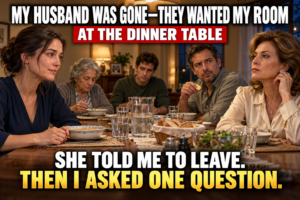
“My husband wants to remodel it,” she said. “Ruben is gone. You still being here just looks weird.”
His mother kept eating. His brother stared at his bowl.
I smiled slowly.
“Thanks for worrying about me, Leticia. But I’m worried about what people might say.”
Then I asked her one question about the room—and the plan she had already made without me.
Continue Read More…
#FamilyDrama #EmotionalStory #FamilySecrets #GriefAndHealing #OriginalFictio