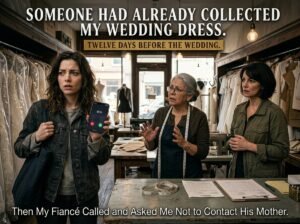
Twelve days before my wedding, someone collected my gown using my mother’s name. Mom was on a cruise. The shop’s video showed a green coat I recognized—and an alteration I never approved. When I sent my fiancé the instruction, he called: “Please don’t call my mother.”
Part 1
The seamstress smiled when she saw me.
“Your mother looked so happy when she picked it up.”
I stopped beside the fitting-room curtain.
“Picked what up?”
“Your dress.”
For a moment, I thought she meant something smaller: a fabric sample, the spare buttons, the little bag of trim she had promised to return.
“My mother is on a cruise.”
Her smile disappeared.
“She’s been away for nine days,” I added.
The shop was quiet except for a sewing machine somewhere behind the counter. I could hear the needle stopping and starting while I tried to understand the sentence. An ivory gown hung in the window, its train arranged around a vase of artificial flowers. I had walked past it three times before deciding I could afford to come inside.
My wedding was twelve days away.
I was twenty-eight, working at a veterinary clinic, and I had saved for months to buy that dress. Extra closing shifts. Saturdays when somebody needed cover. Lunches packed from whatever remained in the refrigerator.
Eighteen hundred fifty dollars for the gown. Three hundred forty for alterations.
The seamstress, Rosa, asked me to wait while she called the manager.
I put my tote on a chair because my hands had begun to hurt around its straps.
The manager brought out the collection form. Someone had shown my fitting receipt, used my mother’s name, and signed a release.
The receipt had been in a folder in the apartment I shared with my fiancé, Ben.
I called him.
“Someone collected my dress.”
“What?”
“They said it was my mother.”
“That can’t be right.”
“I know.”
He offered to come immediately. Then he said we would find a replacement if necessary.
The speed of that second suggestion bothered me before I knew why.
“I want my dress,” I said. “And I want to know who had the paperwork.”
Rosa and the manager reviewed the security footage. They showed me the relevant section as part of identifying the collection, keeping other customers’ information out of view.
The woman wore a wide hat. Her face was angled away.
Her coat was not.
Green wool. A narrow belt. Three dark buttons at each cuff.
I bought it two years earlier as a birthday present for Diane, Ben’s mother.
Before I said her name, my phone lit up.
Hope the fitting went beautifully! Send me a picture when you can. Love, Diane.
I stared at the message.
“Please save the footage,” I told the manager. “And everything connected with the collection.”
“Of course.”
I looked again at the release form.
Beneath the signature was a handwritten request to make one more change before handing over the gown.
REMOVE BLUE EMBROIDERED PANEL INSIDE BODICE. REPLACE WITH IVORY.
I had never approved that.
The blue panel was the only part of the dress I had brought to the shop myself.
I photographed the instruction and sent it to Ben.
He called almost immediately.
“Please don’t call my mother until I explain.”
I looked at the green coat frozen on the screen.
“Then start explaining,” I said.
Part 2
My grandmother embroidered the blue panel when I was fourteen.
It began as a square of fabric left from a dress she made for my mother. She kept scraps in biscuit tins, certain that every useful piece would eventually become useful again.
One afternoon, she let me choose a thread color and taught me a few uneven stitches. I complained that mine looked nothing like hers.
“They look like someone learning,” she said. “That’s what they’re supposed to look like.”
Years later, after she died, Mom found a finished version among her sewing things. Grandma had embroidered small flowers around my initials and added a line in tiny careful letters.
Choose a life you can be yourself in.
I kept it folded in tissue until I began planning the wedding.
Rosa suggested placing it inside the bodice, where it would rest against the lining without changing how the gown looked. Nobody would see it unless I chose to show them.
Diane saw it at my second fitting.
I invited her because Mom was preparing for the trip she booked long before Ben and I chose the wedding date. I wanted his mother to feel included.
Diane smiled at the gown and asked whether the blue square was necessary.
“It’s from my grandmother.”
“I understand. It just seems a shame to put an old piece inside something new.”
“It isn’t visible.”
“You’ll know it’s there.”
“That’s the point.”
She changed the subject.
I thought the conversation was finished.
Ben and I had been together for four years, engaged for fourteen months. He was kind in ordinary ways: remembering appointments, bringing me food during late shifts, making coffee before asking whether I had slept badly.
He was also very good at telling his mother what she wanted to hear while telling me I had misunderstood her tone.
I had learned to distinguish those habits less clearly than I should have.
Diane helped with the wedding because she wanted to, though she often described her contribution in a way that made every discussion sound like a favor she was extending.
I paid for my dress myself precisely because I wanted one decision that did not arrive with a committee.
Her daughter, Chloe, was thirty-one and engaged too. Chloe and Josh planned a small civil ceremony, but the arrangements kept changing. Dates, costs, who could attend. Diane said she was exhausted helping two brides at once.
I offered practical help when asked. I looked after Chloe’s dog during an appointment and lent her a work jacket when she spilled coffee before an interview.
I did not offer my wedding gown.
Two weeks before the collection, Diane mentioned that sisters sometimes shared dresses.
“Family traditions are lovely,” she said over dinner.
“Chloe and I don’t have the same style,” I answered.
“You could be surprised.”
Ben smiled at his plate and said nothing.
Now I stood in the alterations shop listening to him breathe through the phone.
“Anna,” he said, “Chloe’s ceremony is tomorrow.”
I closed my eyes.
“And?”
“Mom thought she could use your dress first.”
Part 3
I stepped away from the counter so Rosa did not have to watch every change in my face.
“Use it first,” I repeated.
“Just for the ceremony. She’d return it before our wedding.”
“Did you agree?”
Ben paused.
“Did you?”
“I said I’d speak to you.”
“When?”
“I was trying to find a good time.”
“There were enough good times to take the receipt out of our folder.”
He did not answer.
“Did you give it to her?”
“Yes.”
The sewing machine behind the counter stopped. In the sudden quiet, I could hear Rosa asking the manager to check which staff member handled the final change.
I checked the appointment message on my phone, though there was no reason to doubt the date. My shoes were still waiting in their bag. Final fitting, Thursday morning. I had arranged cover at the clinic, told a colleague I would show her photographs afterward, and brought the shoes I planned to wear. Everything I did that morning assumed I would be allowed to see the dress I owned. Looking at the message steadied me enough to ask the next question without accepting another vague answer. I was not confused about an appointment. Somebody had taken a decision out of my hands and left me to discover the result at the counter.
I sat on the chair beside my tote.
“Why is my mother’s name on the release?”
“Mom said the shop needed a family member.”
“That doesn’t explain using somebody else’s name.”
“I didn’t know she’d do that.”
“Did you tell her she could collect it?”
“I said we’d sort it out.”
“Then everybody heard an answer except me.”
He said he was leaving work and would come to the shop. I told him I would meet him somewhere nearby after I finished understanding what had happened there.
I was not ready to let his presence become the center of the room.
The manager explained the shop’s part. A woman arrived with the fitting receipt, correctly described the gown, and claimed to be my mother collecting on my behalf. A rushed handover and inadequate verification let the request go further than it should.
The additional alteration had been completed that morning by a staff member who believed the woman was authorized to approve a lining change.
I looked at Rosa.
“Is the blue piece gone?”
“Removed,” she said. “Not thrown away. Let me find the materials bag.”
My whole body seemed to lean toward the answer.
They checked the work area and found a clear bag containing the blue panel and several pieces of original lining. Rosa brought it to the counter.
The embroidery was intact.
There were needle marks where the panel had been attached, but Grandma’s words remained clear.
I held the bag with both hands.
The gown was missing. The alteration was unauthorized. The shop had failed to verify something important. None of those facts disappeared because one piece had survived.
Still, I could breathe again.
The manager apologized and began documenting the incident. She said she would cooperate in recovering the gown and address the unauthorized work and release through the proper process. We agreed on copies of the collection records, preservation of the video, and a written account of what they could verify.
I did not need her to promise that everything would be perfect by afternoon. I needed the truth before another person decided a quick replacement was enough.
Outside, Ben was waiting beneath the awning.
He looked at the clear bag in my hand.
“She removed it?” he asked.
I stopped.
“You knew that was part of the plan?”
Part 4
Ben looked toward the shop window.
“Mom said Chloe would feel strange wearing something so personal to you.”
I stared at him.
“Then Chloe could wear a dress that belonged to her.”
“I know.”
“Did you know before today?”
He took a breath.
“Yes.”
The word changed the conversation.
Until then, he could still be the man who had been careless with a receipt and too slow to ask a difficult question. Now he was a man who knew someone planned to remove my grandmother’s work from my wedding dress and let me walk into the fitting unaware.
“Why didn’t you stop it?”
“I thought it could be put back.”
“Before I noticed.”
He looked down.
“Yes.”
I held the bag closer to my coat.
A bus passed, throwing water from the gutter. People walked around us carrying shopping bags and coffee, entering ordinary afternoons while mine had become a place I did not recognize.
“Where is the dress now?”
“At Mom’s.”
“Has Chloe worn it?”
“For photographs. I think.”
“When?”
“This morning.”
I wanted to shout. Instead, I asked him to contact Diane and tell her the gown needed to be returned to the shop that day, with all accessories and packaging. I would make my own decisions about what happened next after seeing it.
He took out his phone.
“Should we go get it?”
“No. I don’t want to arrive at her house and be expected to negotiate for my own property.”
He nodded.
I called my friend Maya, who worked with me at the clinic.
“Are you free for a little while?”
“What happened?”
“I need company before I explain.”
She came within twenty minutes, carrying the lunch she had been about to eat. Before reaching us, she stopped to buy water. She handed me a bottle, asked whether I could manage the cap, and waited while I drank. Nobody had offered such a simple question since the missing gown became a series of explanations. I wanted to keep telling the story until someone found a sentence that would make it harmless. Maya let me speak, then asked which thing needed doing first. I said getting the dress back. She nodded and took out a notebook, ready to help me keep track without deciding that the rest of my life could be solved in the same afternoon. I was grateful she could hear the urgency without becoming urgent herself. That helped me slow down too. She stayed beside me while I chose the next step.
Ben stood aside while I told her the basic facts. She did not immediately insult his mother or decide what I should do about the wedding. She asked whether I had eaten and whether the shop was keeping the evidence.
“Yes to the second. No to the first.”
We sat at a nearby café.
Ben called Diane outside. Through the window, I watched him pace with one hand over his eyes. I knew that posture. It usually meant he was being told he had made someone else’s day difficult by repeating what I actually said.
He came back pale.
“She says Chloe can’t replace it by tomorrow.”
“That isn’t an answer to returning it.”
“She wants to speak to you.”
“She can write.”
My phone rang a moment later.
Diane.
I let it go to voicemail.
Then a message arrived from Chloe.
I thought you knew. Ben said it was okay. Please don’t make me take off my wedding dress.
I looked at the words until I could read them without my hands shaking.
My wedding dress.
She had already started calling it hers.
Part 5
I answered Chloe in writing.
I did not agree to lend the gown. I did not authorize collection or changes. Please return it to the shop today. We can discuss the rest separately.
She replied with a photograph.
She stood in Diane’s living room wearing my dress. The sleeves fit differently because she held her shoulders back, and the skirt was arranged around a chair covered with flowers.
For a second, I saw only the thing I had saved for: the fabric, the shape, the way the neckline sat.
Then I saw the pressure in her face.
She wanted me to look at a bride rather than at the permission she did not have.
The photograph included the shoes I had left at Diane’s house after she offered to keep some wedding things safe. Chloe had not put those on, but they stood near the chair in the background. I recognized the box beneath them. For weeks, I had thought the objects spread between our homes were signs of people helping us prepare. Now I needed to ask where every piece was and who believed they could use it. The inventory felt terribly petty beside the emotion of a wedding, and then I remembered that practical belongings still mattered. Caring about them did not make my feelings smaller or less reasonable.
Maya watched me put the phone down.
“You don’t have to answer the picture.”
“I know.”
I was grateful she said it anyway.
Ben began explaining the history of the plan. Chloe and Josh had brought their ceremony forward because a relative could attend only that week. A dress she ordered online did not fit as expected. Diane proposed mine as a temporary answer.
“She thought we’d all laugh about it later,” he said.
“Why?”
“Because it would be back before our wedding.”
“And if it tore? Or stained?”
“We’d cover it.”
“We?”
“Mom and me.”
I looked at him.
“You had a plan for the damage. You didn’t have a plan for asking.”
He said nothing.
The practical problem was not the entire betrayal. A gown could be cleaned or repaired. The harder fact was that he had treated my attachment, my money, and my choice as obstacles to manage quietly.
I asked for copies of the messages about the arrangement that he was willing and able to provide. He showed me the conversation on his phone and sent the relevant parts without handing me access to anyone else’s account.
Diane wrote that I would say no because I worried too much. Ben replied that he would talk to me. Later, when she asked whether she should go ahead, he wrote: It’ll be fine. I’ll handle Anna.
I looked up.
“Handle me.”
He closed his eyes.
“I hate that I said that.”
“Did you mean it when you said it?”
“I meant I didn’t want an argument.”
“With your mother.”
“Yes.”
“So you arranged one with me afterward instead.”
He nodded, and I could see he finally understood that postponing conflict had not prevented it. It had simply assigned the cost to a different person.
The manager called from the shop. Diane had contacted her, still insisting that a family misunderstanding should not become a formal complaint. The manager said she would deal directly with me about the gown and asked Diane to return it.
I thanked her.
Maya offered to drive me home. Ben asked whether he should come too.
“I need a few hours without explaining how I feel,” I said.
“All right.”
At the apartment, I found the wedding folder open in the drawer.
The fitting receipt was missing.
Behind it lay a printed schedule for tomorrow’s ceremony, with a line I had never seen.
Something borrowed: Anna’s gown.
Part 6
The schedule had been printed days earlier.
I looked at the date in the corner, then at the conversation Ben had sent me. There had been time to plan photographs, flowers, and a ceremony entrance. There had been time for the people involved to imagine how generous I would look.
Nobody used that time to ask me.
Maya sat at the table while I called Mom.
The connection from the ship was uneven, but she answered after I messaged that I needed to speak.
“Is everything all right?”
“No.”
I told her about the collection form, her name, the green coat, and Grandma’s panel.
She was quiet until I said the embroidery was safe.
“Good,” she said. “Put it somewhere you can find it.”
“I have.”
“Now tell me what you need.”
I nearly cried at the question.
“I don’t know what to do about the wedding.”
“Then you don’t have to decide while you’re frightened.”
“It’s twelve days away.”
“I know.”
“People have booked things.”
“I know that too.”
She did not tell me the money did not matter. It mattered a great deal. We had all worked around the costs. She said the costs were real, but they were not a reason to make a promise I no longer felt ready to make.
“I wanted this to be simple,” I whispered.
“You wanted to marry someone you trusted. That isn’t asking too much.”
We agreed she would confirm in writing that she had not collected the gown or authorized anyone to use her name. She would remain available as the connection allowed, and she asked Maya to stay until I felt steadier.
Mom asked whether I wanted her to come home early. I considered it, then said not yet. She could help me think without losing the rest of the trip she saved for. If I needed something different, I would tell her directly. Saying that felt like practicing the very thing I was asking from everyone else: an actual request instead of an expectation concealed inside worry. She agreed and gave me the times when the connection was usually reliable. We made a small plan for speaking again, and I wrote it down beside the shop manager’s number. It was the first arrangement that day nobody had to discover afterward.
After the call, I put the blue panel inside a clean box.
I could no longer treat it as a lucky object that might tell me what to do. Grandma’s words were not instructions from beyond the grave. They were words I loved, and now I needed to decide what choosing my own life meant in practice.
The shop called late that afternoon.
The dress had been returned.
Maya drove me there. Ben met us outside after asking whether I was willing to see him.
The gown hung in a private fitting area. The replacement lining was neatly done, which somehow made it worse. Someone had performed careful work on a change I had never requested.
There was a faint mark near the hem and a small pulled thread by the side fastening. The staff photographed its condition with me present and documented what they could establish. We discussed cleaning, inspection, and restoring the panel, without pretending we could reconstruct every minute after it left the shop.
I touched the skirt but did not put it on.
“Would you like to try it?” Rosa asked.
“Not today.”
She nodded.
As we left, Ben said, “We got it back.”
I looked at him.
“We got the dress back,” I answered. “That’s not the same as getting yesterday back.”
Part 7
Ben asked whether we could talk the next morning.
I agreed to meet at the apartment after arranging for Maya to remain nearby. Not because I expected violence. Because I wanted support available and a clear ending to a conversation that could otherwise become hours of me soothing him.
He arrived with coffee and no flowers.
I appreciated that. I did not want an object that might make accepting a drink seem like accepting an apology.
“I told Mom and Chloe I agreed to something I had no right to agree to,” he said.
“What did they say?”
“Mom said I was letting you make me feel guilty. Chloe said she thought I’d asked.”
“Had you told Chloe you had?”
He looked down.
“I said you were fine with it.”
I let the silence last.
“Then you owe her an accurate explanation too.”
“I gave her one.”
We talked about the gown, then about other things. The holiday he agreed to before checking my shifts. The family dinner where Diane announced we would host Christmas. The way he said he understood my point, then asked me to be the flexible one because he already knew I might listen.
I had treated those as separate frustrations. Together, they made the dress look less like a surprising exception.
“I thought being easygoing was helping,” he said.
“Easy for whom?”
He rubbed his face.
“Not you.”
“No.”
He apologized for giving Diane the receipt, for agreeing to the removal of the panel, and for offering a replacement before telling me what he knew.
Those were the first apologies that described the actual choices.
I believed he regretted them. I was not ready to stand in front of guests and promise our partnership worked the way we had said it did.
“I want to postpone the wedding,” I told him.
He stared at me.
“For how long?”
“I don’t know yet.”
“Anna, everything’s booked.”
“I know.”
He took a breath and looked toward the calendar.
“Can we fix it without postponing?”
“We can begin fixing it. That doesn’t mean I’m ready in eleven days.”
He was quiet for a long time.
Then he nodded.
“All right.”
Before making the calls, we sat with the calendar between us. I had written the old date in blue and marked several reminders around it: flowers, collection, final count. Ben asked whether I wanted him to cross it out. I said I would do that myself when I was ready. He put the pen down. It was a small moment, but I needed it. Postponing did not mean handing the whole problem to him and waiting for another finished plan to arrive. We could share the work while leaving each other room to say what was difficult. After a while, I picked up the pen and wrote a note about calling the venue.
We made practical decisions that afternoon. Contact the venue and suppliers. Learn the options rather than assume everything could be refunded. Tell guests clearly that we were postponing, without turning the announcement into a collection of accusations.
I would not let Diane announce that I was ill or overwhelmed to protect the family’s pride.
We wrote the message together.
We are postponing the wedding while we work through an important matter in our relationship. We are sorry for the inconvenience and will contact you about any future plans ourselves.
Then we sent it.
Diane called before the last reply had arrived.
Ben answered in front of me because he chose to, not because I asked him to perform the conversation.
When she began saying I had ruined Chloe’s wedding too, he interrupted.
“Mom,” he said, “Anna didn’t agree to any of this. I told you she had.”
Part 8
Diane went quiet.
I could not hear every word through the phone, and I did not need to. I watched Ben listen without turning toward me for reassurance.
Then he said, “No. The postponement is ours to decide. You’re not calling guests to explain it differently.”
When the call ended, he put the phone down.
“That should have happened before you lost your dress,” he said.
“Yes.”
I did not applaud him for finally answering his mother plainly. I did acknowledge that he had done something different, and that doing it consistently would matter.
Chloe wrote that evening.
Her civil ceremony had gone ahead in a different outfit. She said she had believed Ben when he said I agreed and had chosen not to check because she wanted the gown so badly.
I appreciated that second admission more than the first explanation.
She apologized for sending the photograph and calling it her wedding dress. She offered to cover documented damage or cleaning connected with her use, without treating money as the end of the conversation.
I said we would settle the practical costs once they were clear. I was not ready for an ordinary family visit.
She accepted that, though I knew she was disappointed.
Diane’s message arrived later.
I only wanted both girls to feel beautiful. This has been blown out of proportion.
I saved it without answering immediately.
Wanting something pleasant did not explain why she used my mother’s name or removed a piece of my grandmother’s work. The image of herself as a helpful mother required the people affected to become unreasonable whenever they objected.
I could not make her change that image by writing a longer reply.
The shop and I worked through its responsibilities separately. I received the records I needed, and the manager addressed the release and unauthorized alteration through the business’s process. Rosa inspected the gown carefully before discussing restoration.
I did not tell her to hurry because the old wedding date remained printed on invitations somewhere. There was no longer a need to make the repair fit a deadline chosen before I knew the facts.
For the time being, the gown stayed securely at the shop under clear instructions about who could approve work or collect it.
Ben stayed with a friend for a while by agreement. We were not married yet, and we needed enough space to decide what continuing the relationship would require. We arranged ordinary practical matters without changing locks or moving belongings as a surprise.
The first night alone, I went to bed early and stayed awake listening to the ordinary sounds of the building. A neighbor closed a cupboard. Someone ran water. My phone stayed quiet because we had agreed not to keep calling until exhaustion made either of us accept something we did not mean. I missed the weight of him beside me. I also liked knowing the silence was a choice we had discussed, rather than a punishment one person imposed. In the morning, I made breakfast, answered a message about the venue, and went to work. The day was difficult without needing to become a decision about the rest of my life.
Some evenings, I missed him intensely.
That did not mean postponing was wrong. It meant I loved a person whose choices had hurt me, and both facts needed room.
We began working with a couples counselor. I wanted someone who could help us examine the pattern without reducing everything to whether a gown could be replaced.
At the first meeting, Ben described the plan as a favor that went too far.
The counselor asked him when the favor became something Anna had been allowed to choose.
He looked at me.
“It never did,” he said.
Part 9
The answer did not repair everything.
It gave us a place to begin that was less slippery than a misunderstanding.
Over the following weeks, Ben practiced asking before promising. Sometimes he caught himself mid-sentence and started again. Sometimes I noticed how quickly I expected another hidden arrangement, even when there was none.
We talked about both.
I did not want a relationship in which my only safety came from checking his phone or supervising every conversation with Diane. He needed to take responsibility before I discovered a problem, not become more cooperative after I found one.
That was a harder change than saying sorry at the kitchen table.
When Diane asked him to help arrange a family weekend, he checked the dates with me before answering. When she said she had already counted us in, he told her counting was not confirmation.
Small words. Repeated choices.
I noticed them without making one good conversation cancel the bad ones.
We began noticing what happened around ordinary invitations. If a plan changed, Ben told me when it changed rather than waiting until the new version felt inevitable. If I needed time, I said how much time I could reasonably ask for instead of hoping silence would protect me. Neither habit worked perfectly every day. What mattered was whether we returned to the conversation honestly after getting it wrong. I found that more useful to watch than a promise that he would never upset me again. Any marriage would include disappointment. I needed to know disappointment would not become a reason my answer could be ignored.
Mom returned from the cruise and came straight to my apartment after resting. She brought a small bag of pastries and no speech about whether I ought to forgive him.
“I want to see you first,” she said. “Then we can talk about a dress.”
We ate at the table where I had found the ceremony schedule.
For the first time, I told her how embarrassed I felt about postponing, even though I knew the reason was not mine to hide.
“I thought people would say I cared more about a dress than a marriage.”
“What do you think?”
“I think I cared about whether I got to make decisions inside the marriage.”
She nodded.
“Then keep saying that accurately. You don’t have to convince every guest.”
A week later, I went back to Rosa.
The gown had been cleaned and checked. The small issues were addressed as agreed. She showed me the lining and asked whether I still wanted the blue panel restored.
“Yes,” I said.
She did not sew immediately. We discussed its placement and how best to protect the embroidery, and I approved the work myself.
When I finally tried the dress on, I expected to feel nothing but anger.
Instead, I recognized why I chose it.
The neckline. The weight of the skirt. The way I could move without adjusting every inch.
Someone else wearing it had not taken away my taste. Someone else’s plan did not have to decide what the gown meant forever.
I asked Rosa to keep it a little longer while I made the next decisions.
She agreed.
That evening, Ben came for dinner.
He asked whether I wanted to talk about the fitting. I said yes, and he listened without asking whether seeing the gown meant I was ready to set another date.
It was a question I had been afraid he would ask.
Not asking it told me he had finally begun to hear the difference between progress and permission.
Before leaving, he placed an envelope on the table.
Inside was a letter addressed to me—not an invitation, a booking, or a plan he had already made.
Part 10
I read the letter after he left.
Ben had not filled it with promises about becoming a different person overnight. He described the choices he made and the moments when he could have stopped.
When Diane first suggested using the gown. When she asked for the receipt. When she mentioned removing the panel. When Chloe asked whether I really knew.
At each point, he chose the answer that delayed discomfort for him and created more of it for me.
He wrote that he understood I could decide not to marry him, even if he changed. The work he needed to do was not a contract that guaranteed my return.
I put the letter down.
For months, every practical choice around the wedding seemed to arrive carrying an expectation. Approve quickly. Be flexible. Think of the guests. Think of Chloe. Think of what Diane spent.
This was the first thing he offered that did not ask me to make a decision before I was ready.
We continued seeing each other.
Not because one letter proved everything, but because the days after it began matching the words more consistently.
We dealt with the postponed bookings and the money lost. Some suppliers allowed changes. Some payments could not be recovered. We shared responsibility for the costs according to what we agreed, without describing the expense as a punishment I imposed by needing time.
I worked my clinic shifts. I helped nervous dogs onto examination tables and answered worried owners with information I could verify. Ordinary work steadied me. Animals did not ask whether the wedding was back on or whether I had forgiven anyone yet.
Maya brought dinner when I was tired and changed the subject when I asked.
Mom kept the blue-panel story private when relatives wanted every detail. It belonged to me, not to a family debate about whose feelings counted most.
Chloe and I eventually met for coffee.
She apologized again, this time without mentioning that her own dress did not fit or that the ceremony was close. We settled the practical expenses connected with her use. She did not ask me to admire the photographs.
I was grateful for that restraint.
We were not immediately close. We could be civil while trust remained unfinished.
Diane took longer to understand that I would not discuss my boundaries as though they were a temporary mood. Ben handled his own conversations with her. I did not write his responses or wait beside every call.
When she wanted to come to the apartment, we agreed on a time first. When she asked about wedding plans, we told her what we had actually decided and nothing more.
Several months later, Ben and I chose a smaller ceremony.
The date came after conversations about what we wanted, what we could afford, and what neither of us was willing to promise simply to keep somebody else comfortable.
We did not announce it until the decisions were ours.
I wore the gown.
That surprised some people. A friend asked gently whether I wanted something new, and I told her I had considered it.
“But I still like this one,” I said.
That was enough.
Rosa restored the panel as agreed. Before the final collection, the manager verified my identity and instructions directly. I signed for the dress myself and carried it out while Mom held the door.
There was no wide hat, no borrowed name, and no missing receipt to explain afterward.
At home, I hung it where I could see the bag and left the paperwork beside my other records. The simple certainty felt better than any dramatic promise that nothing would ever go wrong again.
On the wedding morning, Mom helped with the fastening.
Before she closed it, she touched the blue embroidery through the lining.
“Still there,” she said.
“I know.”
I did not imagine Grandma arranging the day from somewhere above us. I remembered her sitting at a kitchen table, letting a fourteen-year-old girl make uneven stitches without treating them as failure.
Learning took time. Choosing required information. Love did not make either unnecessary.
Ben waited outside the small ceremony room rather than insisting on a first look somebody else planned. We had agreed to walk in together.
When he saw me, he smiled.
“You look like yourself,” he said.
“I feel like myself.”
That mattered more than beautiful.
The ceremony was quiet. People heard the promises because there were not so many of them in the room. Diane sat with the family and did not control the schedule. Chloe wore a dress she chose and owned.
Afterward, Mom took a photograph of Ben and me near the window.
I looked happy. I also looked like a woman who knew she could pause, ask a question, and expect an honest answer before agreeing.
The gown had been collected once without my permission.
The life I chose inside it was mine.