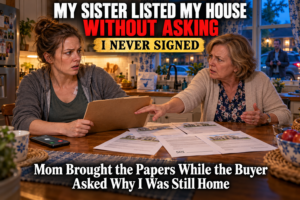
A photographer wanted my driveway empty for listing photos. I had never put my house up for sale. Then Mom arrived with a folder, my sister’s eight-thousand-dollar secret, and paperwork bearing my signature—dated while I was in the hospital. The buyer was already asking why I hadn’t left.
Part 1
The photographer was standing beside my hydrangeas when I came home from the pharmacy. He had a camera hanging against his chest and a folded sheet of paper in one hand. Before I could turn off the engine, he pointed toward the street.
“Could you move around the corner? We need the driveway clear.”
I lowered my window. “Clear for what?”
“The listing photographs. The house needs to look empty.”
For a moment I thought he meant the house next door. Mrs. Alvarez had been talking about moving closer to her son, and both our houses had white porch railings. Then he checked his sheet and read my address.
“That’s my house,” I said. “It isn’t for sale.”
His hand dropped. He introduced himself as Owen, a freelance photographer, and showed me the appointment on his phone. Someone had booked exterior photographs and a walk-through for that afternoon. The instructions said the owner would be out.
“Who hired you?”
“A woman named Beth.”
My name.
I looked at the upstairs window where my sister’s pale suitcase had been sitting for four months. When Paige arrived, she had promised she needed three weeks. Her store had closed, her apartment lease had ended, and she said she couldn’t manage another night on somebody’s couch.
I had carried that suitcase upstairs myself.
“Don’t take anything else,” I told Owen.
“I haven’t started inside.” He stepped back from the porch. “I’ll check with the person who booked me.”
I called Paige before I reached the kitchen. The curtains we had hung two days earlier moved in the open window, their little blue flowers lifting and settling against the sill.
“Why is a photographer here?”
There was a pause long enough for me to hear traffic behind her.
“Talk to Mom.”
“Paige. Is my house listed?”
“It’s complicated.”
“It’s a yes-or-no question.”
“I’m at work. Please don’t make this a scene.”
She ended the call.
I set my pharmacy bag beside the sink. Twelve days earlier, I had come home from the hospital moving carefully, one hand against my abdomen. An emergency operation had left me sore, exhausted, and grateful when Paige offered to handle the mail and groceries. I had thanked her for making recovery easier.
Now I opened our messages. There was her offer to book me a quiet weekend away. Her offer to pack. Her suggestion that she hold my keys so I wouldn’t lose them while I was tired.
At the time I had thought she was finally trying to help.
I had bought this house after six years of overtime at the warehouse. Every extra shift had gone into the deposit: Saturdays loading appliances, holiday inventory counts, mornings when the parking lot was still dark. My shoulder still clicked from lifting boxes above my head.
Paige knew all of it. She had eaten the cheap dinners I cooked when I was saving and laughed when I declined vacations.
Mom arrived just after six carrying a brown folder. She didn’t knock. Paige must have given her a key.
“She already accepted eight thousand dollars,” she said before I could speak. “Don’t embarrass this family.”
I held the screen door open and waited until she met my eyes.
“Who accepted eight thousand dollars?”
“Your sister. We need to be practical.”
I followed her to the table. She laid down the folder, smoothing it with both palms as though the paper itself needed calming.
I opened it, expecting some misguided rental arrangement. Instead, I found my name beneath a signature that looked disturbingly like mine. The document was dated during my hospital stay. Behind it were three more pages.
My phone rang before I could turn them over.
Owen sounded uncomfortable. “The buyer wants to know why you’re still there. She says you agreed yesterday.”
Mom reached for the folder.
I put my hand on it first.
Part 2
“Don’t touch that,” I said.
Mom stared at my hand. I couldn’t remember ever physically stopping her from taking something. Growing up, she had opened our mail, reorganized our drawers, and decided which belongings were worth keeping. Being her daughter had always seemed to come with an open-door policy.
I put Owen on speaker.
“Who says I agreed yesterday?”
“The buyer. Judith. She’s asking whether the furniture is included.”
“No furniture is included. I haven’t spoken to her. I haven’t agreed to sell anything.”
His voice changed. “All right. I’m canceling the photographs. Would you like me to save the booking messages?”
“Yes. Please save everything.”
Mom sat down heavily while I gave him my email address. After the call ended, she looked toward the window, where the last daylight had caught the curtain hems.
“You’re frightening people unnecessarily.”
“Someone is using my name.”
“Paige was trying to make an arrangement.”
“With my house?”
“We thought you might be open to a change.”
I turned the first page so she could see it. The heading was an authorization for marketing and sale negotiations. My printed name appeared beside my address. The signature underneath had the tall first letter I used and the long, impatient stroke at the end.
But I never connected the last two letters. Whoever had copied it had done that twice.
“I didn’t sign this.”
“Maybe you don’t remember.”
The words left her mouth easily. That frightened me more than if she had shouted.
“I remember being in the hospital.”
“You had medication.”
“Were you there when I supposedly signed it?”
She folded her hands. “Your sister explained things.”
“That wasn’t my question.”
I took photographs of every sheet before she could object. Then I carried the folder to the counter behind me, where she would have to come past my chair to reach it.
The next page described a proposed purchase. The third set out a short timetable. On the fourth, someone had promised vacant possession and listed appliances that would remain. My refrigerator. My washing machine. The small chest freezer I had bought when buying meat in bulk finally became possible.
There was a line about crediting the eight thousand dollars already paid toward the purchase price.
“Where is the money?”
Mom pressed her lips together.
“Where, Mom?”
“Paige has responsibilities.”
I looked at her until she looked away.
“Her store?” I asked.
“There were bills after it closed.”
That was the first answer that sounded like an answer. For four months, Paige had referred to her business as something she had simply outgrown. She said the lease had ended at the wrong moment. She said suppliers were unreasonable. She had never mentioned bills following her home.
“Why would selling my house pay her bills?”
“You have equity.”
I could hear the refrigerator cycling behind me. Somewhere outside, a neighbor pulled a trash bin over a crack in the sidewalk. Ordinary sounds kept arriving as if my kitchen hadn’t become a place I no longer understood.
“Equity isn’t spare money in a drawer.”
“You could get something smaller.”
“This is two bedrooms.”
“You’re only one person.”
I wanted to ask whether the number of people sleeping under a roof determined how much betrayal its owner was expected to accept. Instead, I turned back to the papers. Anger could wait until I understood what had happened.
Beneath my supposed signature on the authorization was a witness line.
Mom had written her full name there. Not an imitation. Not a digital mark someone had pasted into place. Her familiar handwriting, the same handwriting on every birthday card she had ever given me.
“You signed this,” I said.
She reached for her handbag.
I read the date aloud. That morning, I had still needed a nurse to help me stand.
Part 3
Mom stopped with her handbag halfway onto her shoulder.
“Paige said you approved the idea.”
“Then why is my signature copied?”
“I didn’t examine it.”
“You witnessed it.”
Her eyes filled, and for a second I nearly moved toward her. I knew that movement by heart: get water, lower my voice, find a softer sentence. Whenever a conversation became painful, somebody had to take care of Mom. Usually that somebody was me.
This time I stayed in my chair.
“Did you see me sign?”
“No.”
The admission was so quiet I asked her to repeat it.
“No, Beth. I didn’t.”
I wrote the time in the notes app on my phone. She watched me do it.
“You don’t have to document a conversation with your own mother.”
“Apparently I do.”
She stood. “I’ll bring Paige over. We’ll explain it properly.”
“Don’t bring anyone here tonight. Leave your key.”
Her face tightened. “That seems cruel.”
I held out my hand until she took the small brass key off her ring. After she left, I locked the door and stood with my forehead against its cool wood. The house smelled faintly of the lemon cleaner Paige liked. I suddenly wanted every window open.
Instead, I called my friend Lena.
We had worked together on the warehouse floor before she moved into scheduling. She listened without interrupting, then asked whether I had eaten. When I said no, she told me she was coming with sandwiches and her laptop.
“Don’t argue. You’re shaking. I can hear it.”
While I waited, I checked the drawer where I kept household records. The property folder was there, but its contents had been rearranged. Tax statements sat above insurance papers instead of below them. A photocopy of my driver’s license, left over from a refinancing inquiry I had abandoned the year before, was missing.
My original purchase documents were still in the bank box. I remembered Paige asking where they were while she held a curtain rod steady over the kitchen window.
“Just curious,” she had said when I asked why.
I sat on the floor beside the drawer until Lena knocked.
She didn’t tell me everything would be fine. She handed me food and said, “Show me what’s real so far.”
We made a list. A photographer. A claimed buyer. Eight thousand dollars. Four pages. A signature I denied writing. Mom’s admission that she hadn’t witnessed it.
Owen emailed screenshots of the booking. The contact used my name, but the email address wasn’t mine. Its wording was close enough to pass at a glance, with an extra initial in the middle. The phone number belonged to Paige.
One message read: My sister is recovering from surgery and might answer the door. Please keep things straightforward and contact me directly.
“She told him you were the sister,” Lena said.
I read it again. There it was: an explanation prepared in advance for why the real owner might be standing in her own doorway, asking the wrong questions.
Lena found a local attorney whose practice included property disputes and sent an inquiry through the office’s intake form. We kept the message brief and attached nothing sensitive until we knew how they wanted records submitted.
Paige came home at nine fifteen. Her key turned, met the chain, and stopped. I had left the chain on because every sound from the porch had been making me jump.
“Beth? Open up.”
I released it and stepped aside. She looked at Lena, the laptop, and the folder on the table.
“You called an audience?”
“I called a friend.”
Paige dropped her bag onto a chair. “Mom says you’re refusing to hear us.”
“Give me your phone.”
“No.”
“Then answer one question. Who spoke to Judith yesterday?”
She stared at the floor, and her silence answered before her mouth did.
Part 4
“Judith thought she was speaking to me,” I said.
Paige rubbed the side of her neck. “She knew there were family circumstances.”
“That doesn’t answer it.”
“I handled the conversation.”
“Using my name.”
She glanced at Lena. “Can we have some privacy?”
Lena closed the laptop halfway. “If Beth wants me to leave, she can ask.”
“I want her here.”
Paige sat down. She had changed from her work shoes into the slippers I had bought her at Christmas. Seeing them beneath my kitchen table hurt in a small, ridiculous way. Everything she wore, touched, and leaned against seemed to have been provided by somebody she was now asking to understand.
“I was going to tell you,” she said.
“When?”
“After there was something solid.”
“There’s apparently a woman expecting me to move out.”
“The price was good.”
“What price would make this acceptable?”
She gave me a number. It was less than comparable houses nearby, though more than I had paid several years earlier. She said it quickly, like the increase alone should have made me grateful.
“Your mortgage gets paid. You get money. I get enough to settle things. Mom stops losing sleep.”
“Where would I live?”
“We would find somewhere.”
I looked at Lena because I needed to see another person hear that sentence. Paige had taken money and promised my home to a stranger, but the place I would live afterward remained an unspecified problem for somebody else to solve.
“Show me where I agreed.”
She pushed her hair behind her ears. “You said you didn’t know how you’d keep up when you got sick.”
I remembered. In the hospital, frightened by missing work, I had said I didn’t know how I would manage everything that month. Paige had been sitting beside my bed, peeling the paper from a straw.
“I meant laundry and bills while I recovered.”
“You said the house was a lot.”
“It was a lot that week.”
Her eyes flicked to the folder. “I thought once you saw the numbers—”
“Did you write my signature?”
She stopped.
“Did you?”
“I used the one on the old form.”
Lena opened the laptop again, then simply rested her hands beside it. She didn’t need to type for Paige to understand that someone else had heard.
“The refinance paperwork?” I asked.
Paige nodded.
I took a breath that pulled uncomfortably at my healing incision. “Where is the eight thousand dollars?”
“I used part of it.”
“How much?”
“Most.”
“Who received it?”
“My old landlord. A supplier. There were deadlines.”
She began to cry, but kept explaining through it. Her business debts had been worse than she admitted. Mom had guaranteed part of the shop lease. Paige had ignored notices until the numbers grew and Mom started receiving calls. Selling my house had become their solution in a conversation I had never been invited to attend.
I asked whether a deed had been signed. Paige said no. A closing hadn’t happened. She had been collecting information because Judith wanted to move quickly.
That knowledge gave me enough room to breathe, though it didn’t undo anything on the table.
“Send me Judith’s contact details and every document you sent her,” I said. “Tonight.”
“Will you at least think about the offer?”
“No.”
“Beth, Mom could lose her savings.”
For years that sentence would have ended the argument. I would have opened my banking app while Paige watched.
Now I slid the unsigned side of the folder toward her.
“Then you both should have told me the truth before you spent somebody else’s money.”
She wiped her face. “Judith is coming tomorrow. She’s already arranged for someone to look at the house.”
Part 5
I barely slept. When the furnace started, I heard a car. When the porch boards cooled and creaked, I heard a footstep. At two in the morning, I walked through every room without switching on the lights.
The house had never felt grand. The bathroom door stuck in damp weather. One bedroom outlet worked only if the plug sat at exactly the right angle. The kitchen floor dipped near the refrigerator. I had planned to fix things gradually, when overtime and ordinary living left enough money.
Standing in that kitchen, I understood why Paige’s offer to find me somewhere else felt so brutal. I didn’t merely want a roof. I wanted the rooms in which my own decisions had begun to matter.
The attorney’s office called shortly after eight. Nora Ellis could meet that morning because another appointment had been moved. Lena drove me. I brought the folder, my identification, purchase records I could access online, and the message screenshots.
Nora read everything before giving an opinion.
“A marketing document is not a completed transfer,” she said. “But I won’t tell you what has or hasn’t happened until we check.”
She asked about my mortgage, hospital dates, who had access to my records, and whether Paige still lived in the house. I answered slowly. It was a relief to be asked questions that had actual answers.
“Can I change every lock?”
“We need to handle access and her living arrangement properly. Don’t try to solve that part by yourself today.”
She outlined the steps she proposed for my situation: preserve records, notify everyone involved that I disputed the documents and had authorized no sale, check the public property records, and address my sister’s occupancy through an appropriate written process.
Her language was careful. I found that comforting. Nobody in my kitchen had been careful with anything except the story they wanted strangers to believe.
The record check showed no new ownership transfer. Nora explained what had been checked and what would still need monitoring. I let out a breath so unexpectedly that I started crying.
Lena passed me a tissue without looking surprised.
The agency name on one sheet belonged to a small brokerage. Nora called with me present. The managing broker, Martin, asked us to forward the disputed papers through the office’s secure channel. He sounded increasingly troubled as she described the matching name and mismatched contact details.
A preliminary valuation and draft marketing material existed, he said. He would suspend the file while investigating. He had not personally met me. The booking of the photographer had been arranged separately by the person presenting herself as the owner.
“Was the deposit paid to your office?” Nora asked.
“No funds are in our account.”
Paige had called it a deposit because that sounded official. Judith had sent the money directly to her after being told it would reserve the house until paperwork caught up. Hearing that confirmed made my stomach turn.
Nora sent Judith a notice that I had not authorized the transaction and asked her to communicate through the office. I gave permission for Owen’s contact details to be included if his booking records helped establish what had happened.
By noon, my phone had eleven messages from Mom.
The last said: She is your sister before she is anything else.
I put the phone facedown.
Then Nora opened the third of the pages I had photographed and asked me to read a sentence near the bottom.
It stated that the seller had voluntarily chosen to relocate and had no continuing need to occupy the property.
Below it was another copy of my signature.
Paige hadn’t merely promised away the house. She had supplied my reasons for leaving it.
Part 6
I read that sentence three times. Every version made me feel smaller.
No continuing need to occupy the property.
I thought about the afternoon I got the keys. I had sat on the bare living room floor eating noodles from the carton because my table hadn’t arrived. Nobody had needed me that night. Nobody had asked what I could contribute or whether I could cover a shortfall. I had slept on a mattress beneath a window I owned and woken before dawn just to look around again.
Nora waited until I folded the page.
“Did you ever express anything like this to your sister?”
“No.”
“Then we’ll state that clearly.”
She asked me to prepare a factual timeline while the details were fresh. No guesses about motives, no arguments I wished I had won. Just dates, messages, documents, and what I personally remembered.
Lena helped me work through it that afternoon. My hospital admission. Paige bringing my mail. The curtain conversation. The weekend suggestion. Owen on the driveway. Mom with the folder.
Between entries I kept remembering ordinary kindnesses. Paige bringing tea. Paige carrying a laundry basket. Mom brushing hair off my forehead in the hospital. I hated that I now had to examine those memories for access and opportunity.
At three, Judith called Nora’s office back and agreed to a conversation. Nora asked whether I wanted to join. I did.
Judith’s first words were, “I’m sorry. I don’t know which of you I’ve been talking to.”
“Her name is Paige,” I said. “I’m Beth.”
Judith was quiet. Then she described a brief viewing while I was hospitalized. Paige had shown her the kitchen, the little back garden, and the room where my boxes of winter clothes were stacked. She had called that room surplus space.
“She said she was staying with her sister after an operation,” Judith told us. “She looked tired. I didn’t want to be intrusive.”
Paige had borrowed my recovery as well as my name.
Judith had sold her previous home and was staying with relatives while looking for something smaller. The house was close to her adult daughter. When Paige suggested other interested buyers might come forward, Judith had sent the eight thousand dollars to hold it. She now understood why the payment had bypassed the brokerage.
“I asked for a receipt,” she said. “I have one.”
“Please send that too,” Nora replied.
“I shouldn’t have rushed.”
Neither Nora nor I answered that with reassurance we couldn’t give. Judith had made a costly decision. My sister had encouraged it. Those facts could exist together.
Then Judith asked about the blue curtains.
“What about them?”
“She sent me a picture yesterday. Said she’d put them up for me because I mentioned blue was my favorite color.”
I was sitting beneath those curtains. Paige had stood beside me handing up the rings, asking about the deed, while I thanked her for helping make my kitchen feel finished.
I pressed my fingertips against my eyelids. The fabric brushed my shoulder when the wind lifted it. I moved my chair away from the window, angry that I now needed distance from something I had chosen with such ordinary pleasure.
“I chose them,” I said. “They’re mine.”
“I understand.” Judith’s voice softened. “I won’t come to the house. Please tell your attorney what you need from me.”
After the call, I went upstairs to ask Paige for the original receipt. Her bedroom door was open. She stood beside her suitcase with her phone in her hand.
Mom’s voice came through the speaker before Paige noticed me.
“Tell her you only did what she asked in the hospital. She can’t prove what she said.”
Part 7
Paige lowered the phone, but the damage had already been done.
“Mom,” I said.
There was a small scrape on the other end, then silence.
“I heard you.”
“Beth, you’re taking things—”
“I heard the whole sentence.”
Paige ended the call. She looked younger without makeup, standing in her socks beside an open suitcase. I remembered her at thirteen, crying because she had lost a classmate’s jacket and couldn’t afford to replace it. I had given her the money from my weekend job.
I had been sixteen. Mom had called me sensible.
For a long time I mistook that word for love.
“Were you going to say it?” I asked.
“Say what?”
“That I told you to sell the house while I was in the hospital.”
She sank onto the bed. “I don’t know.”
I waited.
“No,” she said eventually. “I don’t think I could.”
“You’ve already told people you were me.”
Her face crumpled. “I know.”
I stayed in the doorway. She had room to sit, breathe, and cry without me carrying her through the consequences of what she had done.
“Judith wants her money back,” I said.
“I don’t have it.”
“Then you need advice about how to deal with that. You need your own advice.”
“Are you reporting me?”
“I’m giving a truthful account of what happened. I won’t promise you more than that.”
Her hands tightened around the phone.
“Nora told me to preserve the records,” I continued. “Don’t delete anything. Send what I asked for through the address she provided.”
Paige looked at the suitcase. “Do you want me out?”
“Yes. We’ll arrange it properly.”
I had imagined that sentence would feel fierce. It felt exhausting. I went downstairs and sat until the room stopped tilting around its edges.
That evening Mom sent a message to our family group. She said Paige had made a mistake while trying to rescue her struggling business and I was threatening to destroy her future over a misunderstanding.
An aunt replied with a prayer emoji. A cousin asked why we couldn’t solve things privately. My uncle told me property wasn’t worth losing family over.
I started typing a paragraph explaining everything. Then I deleted it.
I sent one message: I did not authorize a sale of my house. My name and signature were used without my permission. A buyer paid Paige money. The matter is being addressed with professional help. Please don’t contact the buyer or make arrangements on my behalf.
I muted the group. The little symbol beside its name looked almost absurdly small. There was no satisfying way to explain that I wanted my family to care about what had happened before deciding how quickly I should forgive it.
The next morning, I gave a statement and copies of the records through the reporting process Nora had discussed with me. I answered questions about whether I had given Paige authority, whether I recognized the signatures, and whether any money had come to me.
“No,” I said each time.
Nobody announced a resolution. Nobody arrived to make a speech on my behalf. I received a reference number and instructions for providing additional evidence. It was slower and less satisfying than the scenes I had imagined while lying awake.
It was also real.
Later, Paige forwarded the messages and receipt. The receipt used my full name above bank details that were hers. One message asked Judith to keep communication off my regular number because I was resting and didn’t want calls.
At the bottom of the thread was a message from Mom to Paige, forwarded in the wrong place.
I stared at it until Lena asked what I had found.
Mom had written: If she sees a proper offer, she’ll give in. She always does.
Part 8
I didn’t forward Mom’s message to the family group. I sent it to Nora with the rest of the material, then put my phone in a drawer.
For years, the phrase she always does had described me accurately. I gave up a planned holiday when Paige needed help with a car repair. I covered Mom’s utility bill one winter and learned months later she had already sent that money to Paige. I let explanations take the place of repayment because asking again made dinner uncomfortable.
Each decision had seemed small enough to bear. Together, they had taught them something terrible about my limits.
On Friday, Mom asked to come over. I agreed to an hour, with Lena present. Paige was at work. I left the folder on the table but didn’t open it.
Mom arrived carrying a grocery bag.
“I brought the soup you like.”
“Thank you. Put it on the counter.”
She looked disappointed that I hadn’t taken the bag from her. We sat down.
For several minutes she described the closed store, the lease guarantee, the bills she had hidden from me. She said she had been afraid Paige would fall apart. She said she hadn’t understood how serious the paperwork was.
“Then why tell her to say I agreed in the hospital?”
Mom stopped moving her hands.
“I panicked.”
“And before that? When you signed as a witness?”
“I thought you would help.”
“You didn’t ask for help.”
“You would have said no.”
The room went quiet. She looked as surprised as I felt to hear the truth spoken so plainly.
“Yes,” I said. “I would have.”
She began to cry. I passed the tissue box across the table and left my hand beside my own cup.
“I’m your mother.”
“I know.”
“I was trying to keep us together.”
I looked at her key, lying in a small dish where I had put it the night she surrendered it. “You came here with papers saying I didn’t need to live in my own home. What did you think that would do to us?”
She didn’t answer.
I told her what I needed. No more statements in my name. No contacting Judith. No visiting without asking. No family messages describing a copied signature as a misunderstanding. Any practical communication about the documents would go through the people helping us address them.
“You make it sound like I’m dangerous.”
“I need to know what happens when I tell you no.”
Lena sat quietly at the end of the table. Her presence helped me keep speaking at an ordinary volume.
Mom asked whether I could lend Paige enough to return the money. She said that would calm Judith and give everybody time.
I looked down at the worn edge of the table. I had bought it secondhand after my first month in the house. There was a nick in the wood from the day Paige helped carry it through the door. I had wanted so much to remember that kindness without everything attached to it now.
“No,” I said.
Mom waited. She was waiting for the explanation, the apology, the smaller offer. My chest tightened with the familiar urge to make her departure easier. I let that discomfort stay where it was. It would pass without a payment from me.
I gave her none.
Before leaving, she reached into her purse and placed a folded sheet beside the tissue box. It was a list she had made of rooms I could rent nearby.
For a moment neither of us moved.
“You’re still doing it,” I said.
She looked down at the list as though she had only just understood what she had brought into my house.
Part 9
Mom took the list with her. She left the soup.
I put it in the refrigerator because throwing away food would not have made anything clearer. For once, I didn’t turn an object into an answer. I could keep the soup and still mean every boundary I had stated.
The practical work took longer than the confrontation. There were messages to preserve, accounts to secure, records to check again, and an insurance question Nora told me to direct to the appropriate office. I changed passwords from my own device and reviewed who could recover the accounts. Some of it felt painfully mundane after what had happened.
Lena stayed while I worked through it. When I apologized for the boring evening, she asked whether I wanted to apologize for sitting in my own chair next.
I laughed, then cried so abruptly that she moved the laptop away from the edge of the table.
Paige arranged to stay with a coworker. Through the separate advice she obtained, she signed a written agreement setting out when she would leave and how the return of my property and keys would be documented. I didn’t attempt to make her confession or any promised outcome a condition of collecting her clothes.
We agreed on a Saturday afternoon. Lena would be with me. Mom would help Paige move. The hours were written down so nobody could pretend we had agreed to something else.
Before that day, Judith sent a short note through Nora. She understood that I had received none of her money. She was pursuing repayment from Paige and had provided the messages requested of her. She hoped I would eventually feel comfortable in the house again.
I asked Nora to tell her I hoped she found a home near her daughter.
That was all. We didn’t become friends through the damage my sister had caused. We were two people trying to get back to lives that had briefly intersected in a lie.
Martin confirmed the brokerage file was closed to further marketing and the draft material withdrawn. He was reviewing how the identity discrepancy had reached that stage and supplied the records requested through the proper channels. His explanation wasn’t a substitute for the disruption, but it answered questions I needed answered.
The house was still mine. It had been mine throughout. Accepting that emotionally took longer than checking the records.
On moving day, I stayed downstairs while Paige packed. I had removed private documents from shared areas, but I hadn’t gone through her drawers. At two thirty, she carried down the pale suitcase.
“Can we talk for five minutes?”
I nodded toward the kitchen.
She stood where we had hung the curtains. For the first time, she looked directly at them.
“I told Judith those were for her.”
“I know.”
“I thought if everything looked settled, you’d feel like you couldn’t stop it.”
Hearing the strategy in her own voice was worse than discovering it in a message. I gripped the edge of the counter and waited until I could speak.
“You watched me measure that window.”
She nodded.
“You knew I was happy.”
“Yes.”
Outside, Mom shut the car trunk. Paige looked toward the sound, then back at me.
“I have something I need to give you,” she said.
She opened the small pocket of her handbag. For one exhausted second I expected another document, another request, another amount I was supposed to find.
She placed my missing photocopied identification on the table. Under it was the old form she had used to copy my signature.
“There aren’t any other originals,” she said. “I’ve disclosed the copies I made to my adviser.”
I didn’t take her word as the final check. But I looked at the familiar signature on the old form and understood exactly how carefully she had studied it.
Part 10
Paige left the documents on the table and stepped back.
“I’m sorry,” she said.
I had heard her apologize for late rent, missed calls, ruined clothes, and promises she had been too tired to keep. This time I needed the words to arrive without me helping them.
“For what?” I asked.
Her eyes reddened. “For using your name. For copying your signature. For taking money from Judith. For thinking I could make you give up your house if I made saying no difficult enough.”
I looked toward the window. Outside, the branches of the maple moved above the fence. I had spent months worrying that its roots were lifting a paving stone. I wanted ordinary problems back with an intensity that surprised me.
“I’m glad you said it plainly,” I told her. “It doesn’t settle it.”
“I know.”
She asked whether she could hug me. I said I wasn’t ready. Her face folded, but she stayed where she was.
That small act—accepting an answer she disliked—was the first thing she had done in weeks that left me with nothing to defend.
When she went outside, Mom stood beside the car holding a box of shoes. She looked past Paige toward me. I could almost hear the question she wanted to ask: Were we all right now?
I didn’t offer an answer she hadn’t earned. I said goodbye and closed the door after they drove away.
The quiet afterward was difficult. I had expected relief to arrive all at once. Instead, the spare room smelled of packing tape and the lavender lotion Paige used. There were dents in the carpet where her bed had stood. I found a hair tie behind the bathroom door and cried over it because I could miss my sister and still need her gone.
Lena helped me check that the agreed handover was complete. Once Paige had surrendered occupancy and I had confirmed the next steps with Nora, I arranged for the locks to be changed. The locksmith gave me the new keys in a little paper sleeve. I put one on my ring and kept the others somewhere private.
The following weeks contained no dramatic verdict. I provided additional records when asked. Judith’s repayment matter continued separately. Paige began sending what she could under the arrangements she made, and I heard about it only when there was a practical reason for me to know. I would not become the person responsible for tracking her promises again.
Mom sent one message correcting what she had told the family. She said I had never authorized a sale and that she had signed something she had not witnessed. Some relatives apologized. Others became very quiet. I stopped trying to decide what each silence meant.
I took on fewer extra shifts while I finished recovering. It felt strange to spend money on an appointment with a counselor when saving had shaped so much of my life. I went anyway. For an hour every other week, I could talk without being asked how my pain affected somebody else.
One Sunday, I washed the blue curtains. I nearly donated them. Every time I looked at their little flowers, I remembered Judith’s voice and Paige handing me the rings.
Then I spread them across the kitchen table and repaired a loose hem. I had chosen them before I knew what Paige was doing. I still liked them.
Lena came over with bread while I was putting them back up. She held the chair steady until I finished, then asked where I wanted to eat.
“Here,” I said.
We sat at my scratched table with the window open. A neighbor’s lawn mower started, stopped, and started again. I told Lena about a mistake in the new warehouse schedule. She told me about her brother’s hopeless attempt to grow tomatoes. We stayed with ordinary things until the light began to fade.
After she left, I checked the lock once and went upstairs. In the spare room, I opened a box of books I had never unpacked because somebody always seemed to need the space.
I put the first one on the shelf.