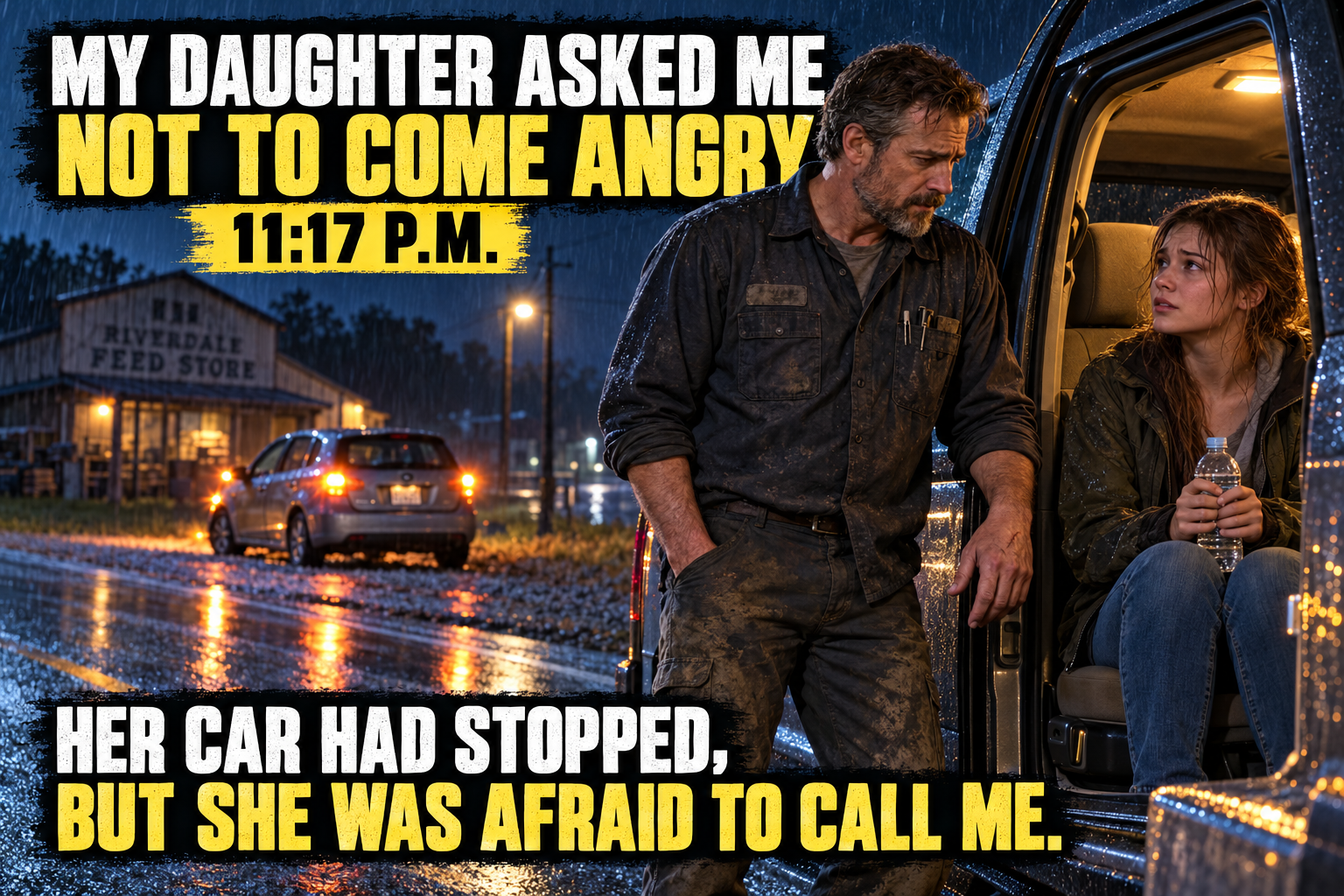
At forty-six, I could rebuild an engine without a manual. But when my daughter called from a dark roadside and said, “Please don’t come angry,” I heard every mistake I had made as a father. Before I could turn the key, I had to remember where that anger began.
Part 1
My daughter called at eleven seventeen on a Thursday night.
I was in the garage behind my rented house, trying to loosen a bolt that had probably been tightened before she was born. The radio was low. Rain ticked against the metal roof.
“Dad?”
There was something in Hannah’s voice that made me put the wrench down.
“Where are you?”
“County Road Nine. Past the old feed store. The car stopped.”
“Are you off the road?”
“On the shoulder. I put the hazards on.”
I reached for my keys.
“Are you hurt?”
“No.”
“Good. Stay in the car if you’re safely clear of traffic. Send me your location.”
She went quiet.
“Hannah?”
“Please don’t come angry.”
My hand stopped above the workbench.
She was nineteen. She had called me for help, and she was already preparing for the price of it.
“I’m coming to get you,” I said. “We’ll deal with the car.”
After we hung up, I stood in that garage longer than I should have. The rain kept falling. My keys left small dents in my palm.
There had been a time when I would have defended myself. I would have said that worrying made me sound angry, that I worked hard, that I had never meant to frighten anybody.
At forty-six, I knew intentions could not erase what someone learned to expect from you.
My father taught me that before I knew how to spell the word.
He left when I was eleven.
There was no dramatic goodbye. He took his brown suitcase, kissed the top of my head, and told me to help my mother until he got things sorted out.
For months, I listened for his truck.
My mother, Rose, stopped listening sooner. She took extra shifts cleaning rooms at the nursing home and learned which bills could wait without the lights going out.
By fourteen, I could recognize an overdue notice through an envelope.
By sixteen, I worked evenings at a grocery store and pretended the money I slid under her coffee cup was spending money I didn’t need.
She pretended to believe me.
“You need decent shoes,” she would say.
“These are decent.”
“Eli, I can see your sock.”
We laughed because laughing gave us a few seconds when neither of us had to solve anything.
At nineteen, I was working at a tire warehouse. I had a secondhand car, two unfinished night classes, and a plan to get my mother into a place where the kitchen window opened properly.
One Friday, the warehouse supervisor came looking for me.
“Your neighbor called. Your mother’s been taken to the hospital.”
I remembered being irritated that morning because Mom had asked whether I would be home for supper. I had told her I wasn’t a child and didn’t need to report my movements.
She had only said, “I made enough.”
At the hospital, a nurse led me into a small room with a tissue box and no medical equipment.
I understood before she spoke.
Still, I asked where my mother was.
Then I asked again.
Later, someone handed me a clear bag containing her watch, her purse, and the cardigan she wore when the evenings turned cool.
Her watch was still running.
I sat in the parking lot with the bag on my knees, unable to understand how an ordinary object could keep doing its job when the person who owned it was gone.
When I finally opened her purse to find her house keys, a folded piece of paper slipped out.
Across the top, in her handwriting, were the words: Things to tell Eli when he gets home.
Part 2
The list was six lines long.
The landlord was sending someone to look at the window. Our neighbor needed her casserole dish back. There was a letter from the community college on the table.
At the bottom, Mom had written: Ask about his classes. Don’t fuss.
I read those words until the parking lot lights came on.
There was no final message. No advice she had somehow known I would need. Just the ordinary business of a life she expected to continue.
For years, I thought I would have handled her death better if we had said something kinder that morning.
I built an entire punishment around that belief.
If I hadn’t been impatient. If I had come home sooner. If I had noticed she looked tired.
The doctor explained that her collapse had been sudden. He explained it more than once.
Grief listened politely and kept its own version.
After the funeral, I went back to the apartment. There was a pot in the refrigerator with enough stew for two people.
I threw it away without opening it.
Then I sat on the kitchen floor because I could not bear to put it in a bowl.
For a while, I became very good at doing only what was necessary. I went to work. Paid what I could. Sold the sofa because it was easier than moving it.
I stopped attending classes.
When people asked how I was, I said, “Keeping busy.”
They usually looked relieved.
A man named Walter Price lived two doors down. He owned a repair shop on the edge of town, and my mother had occasionally cleaned his office when business was slow at the nursing home.
He found me beneath the hood of my car one Sunday, trying to fix a cooling problem with borrowed tools.
“That hose won’t seal if you keep fighting it,” he said.
“I know.”
He watched me struggle another minute.
“Doesn’t look like knowing is helping.”
I wanted him to leave. Instead, he knelt beside the bumper and held a flashlight.
We fixed the hose. Before he went home, he asked whether I wanted Saturday work.
“Sweeping. Tires. Oil changes when I trust you.”
“I already have a job.”
“Then you can tell me no.”
I showed up the following Saturday.
Walter’s shop smelled of oil, old coffee, and warm rubber. He kept service records in cardboard folders and wrote estimates in a narrow hand that customers struggled to read.
He did not ask me to talk about my mother.
Once, when I went silent after a woman called to say she was collecting her son’s car, he handed me a broom and said, “You can take ten minutes out back.”
He said it without pity. That made it possible to accept.
Over the next two years, I learned engines. I discovered that patience could be useful instead of humiliating. A stripped bolt did not care how hard your life had been.
I also met Mara.
She came in with a sedan that made a noise she described as “a shopping cart full of spoons.”
I laughed. She smiled as though that had been part of the repair.
We married when I was twenty-two, in a courthouse with Walter holding the rings because I had no jacket pocket I trusted.
For the first time since my mother died, I began buying things for a future I expected to have.
A kitchen table. Curtains Mara liked. A decent pair of shoes.
Five years later, she waited for me after work with something small wrapped in a dish towel.
“Before I show you,” she said, “promise me you understand we don’t have to know everything yet.”
Inside the towel was a positive pregnancy test.
Part 3
I looked at that little plastic stick as though it were an instrument I had never been trained to read.
Mara watched me from the other side of the table.
“Say something.”
“Are you sure?”
“The other two in the bathroom agree with this one.”
I laughed, then sat down because my knees felt unreliable.
“We’re having a baby.”
“That’s the current understanding.”
I reached for her hand.
For a minute, joy arrived without anything attached to it. Then I started calculating.
Rent. Insurance. The car payment. The patch of damp above the bedroom window.
Mara squeezed my fingers.
“You’ve gone somewhere.”
“I’m here.”
“Your face is doing the bills.”
I wanted to give that child everything my mother had struggled to provide. A warm house. Good food. A father whose car stayed in the driveway after supper.
What I did not understand was how easily a promise to provide could become permission to disappear into work.
Hannah arrived in February during a snowstorm.
I held her in a hospital chair while Mara slept. She had a crease between her eyebrows that made her look disappointed in the arrangements.
“I’m staying,” I whispered.
It felt like a complete promise.
For a few years, I did stay in all the ways I knew how.
I learned to warm bottles, installed cabinet locks, and could assemble a crib without using the instructions as a pillow halfway through.
Hannah liked sleeping against my chest after supper. Her little hand would close around the collar of my shirt.
Sometimes I remained on the couch long after my legs went numb, afraid to lose a moment I could not earn back later.
Then Ray Mercer offered me a partnership.
Ray had worked at Walter’s before moving to a larger shop. He was quick with customers and better than I was at making an uncertain plan sound inevitable.
He had found a vacant garage with three bays.
“You do the work,” he said. “I handle the books and the front desk. We build something with our names on it.”
I was thirty-one. Hannah was four. I had enough experience to do the repairs and just enough savings to believe the risk was responsible.
Walter read the lease before I signed it.
“Have somebody qualified look over the agreement,” he told me.
“Ray already had it checked.”
“Somebody working for you, Eli.”
I heard caution and mistook it for doubt.
We opened in April.
For a while, it worked. Customers came back. The bays stayed busy. I brought Hannah in on Sunday mornings, and she sat on an upturned bucket eating crackers while I cleaned.
Mara helped paint the office.
We took one photograph beneath the new sign. Ray had his arm around my shoulders. I was grinning so hard my face looked unfamiliar.
That photograph stayed above my workbench long after I should have taken it down.
The trouble arrived as little things.
A supplier called about an invoice Ray said he had paid. A customer showed me a receipt that did not appear in the folder. Ray began taking paperwork home.
Whenever I asked, he had an answer.
“Bank delay.”
“New accounting system.”
“You want to do engines or chase paper?”
I wanted to trust the man who had called me his brother at our opening.
Then, on a Thursday afternoon, our parts supplier refused to release an order.
I called Ray.
No answer.
I drove to the bank after closing, still wearing my work shirt. The woman at the desk asked me to sit down while she printed the account activity.
I watched the pages emerge.
There were transfers I did not recognize and cash withdrawals I had never approved.
Then I saw the balance.
It would not cover the rent, much less the two paychecks due the next morning.
Part 4
I called Ray seventeen times before midnight.
On the eighteenth call, he answered.
“Tell me the bank is wrong,” I said.
He breathed into the phone.
“I was going to replace it.”
There are sentences that divide your life so cleanly you remember the temperature of the room in which you heard them.
The office was cold. I had forgotten to turn on the little heater beneath the desk.
“Replace what?”
“Things got away from me.”
I asked where the money had gone. His answers came in pieces. Personal debts. Transfers he had intended to reverse. Another promise that something would be settled soon.
I wrote down what he said because I no longer trusted myself to remember it without changing it into something less terrible.
The next morning, I told our two employees we could not open as usual.
I used what remained in our household savings to cover their outstanding wages. It was the first of several decisions I made too quickly, convinced that taking the blow myself was the only honorable thing available.
Mara learned about the withdrawal when she checked our account.
“You should have called me.”
“They needed to be paid.”
“I know. I’m talking about you making that decision without me.”
I heard criticism where there was fear.
“What did you want me to do?”
“Talk to me.”
Over the following weeks, there were appointments, records, demands, and advice I struggled to follow because every document seemed to contain another thing I should have noticed.
I reported what had happened and sought legal help. None of it produced money by Friday.
Ray was no longer a partner I trusted. He was a name on correspondence, a voice I refused to answer without someone else present, a mistake I replayed while lying awake.
We closed the shop.
I found temporary work unloading freight and told everyone it was better than sitting around.
My body was tired enough to sleep. My mind refused.
I became hard to live with in ordinary, exhausting ways.
I snapped when Mara asked whether I had eaten. I heard accusation in questions about schedules. When Hannah spilled juice, I reacted to the wasted dollar instead of the frightened child holding an empty cup.
One evening, she knocked a bowl from the kitchen counter.
It broke against the tile.
I turned too fast and shouted her name.
She froze.
I did not touch her. For years, I would cling to that fact as though it excused everything else.
She backed into the space beside the refrigerator and held her hands against her chest.
Mara stepped between us.
“Go outside, Eli.”
“I was only—”
“Outside.”
I stood in the yard beneath the porch light, furious with Ray, with the bank, with myself, with the broken bowl I could not afford to replace.
Through the kitchen window, I saw Mara crouch beside our daughter.
Hannah was crying without making much noise.
The next morning, Mara told me she was taking Hannah to her sister’s for a while.
“You’re leaving because I raised my voice?”
She looked more tired than angry.
“I’m leaving because we both keep checking what kind of evening you’re going to have before we decide how to speak.”
I wanted to tell her what I had survived. I wanted to show her the size of what had been taken from me.
Then Hannah appeared in the hallway carrying her overnight bag.
“Mom said I can call you,” she said.
“Anytime.”
She nodded, but did not come closer.
After they left, I found her favorite toy beneath the couch.
I called Mara to say I would bring it over.
She said she would collect it.
“Doesn’t Hannah want me to bring it?”
A pause.
Then Mara said, “She asked whether you’re still mad.”
Part 5
I sat on the couch with the toy in my hands.
It was a stuffed rabbit with one ear repaired in purple thread. Mara had done the sewing because Hannah insisted the rabbit needed a special scar.
I had laughed when she said it.
Now I could barely look at the thing.
For several days, I moved through the house as though the family had only gone to the store. I left Hannah’s cup by the sink. I didn’t move Mara’s shoes.
I called too often.
Sometimes I apologized. Sometimes I asked when they were coming home in a tone that made the apology useless.
Finally, Mara said, “I need you to stop asking me to make you feel better about this.”
“I’m trying to fix it.”
“Then do something you can keep doing when we aren’t there to watch.”
I did not know where to begin.
Walter found me sitting outside the closed shop a week later.
I still had the keys because the landlord had agreed on a date for collecting the last of our equipment.
“You waiting for it to open?” he asked.
“Just thinking.”
He sat beside me on the concrete step.
For a while, neither of us spoke.
Then I said, “You told me.”
“I told you to get advice. I didn’t predict a man stealing from you.”
“Feels like the same thing.”
“Most things do when you haven’t slept.”
I laughed once, without humor.
He looked through the dirty glass.
“I’ve got work.”
“I don’t need charity.”
“Good. I need a mechanic.”
I stared at my boots.
“People will talk.”
“People talk while waiting for a bus. You can’t build a life around giving them nothing to say.”
He paid me an ordinary wage for ordinary work. I hated the first morning. I hated returning to a place I had left so proudly. I hated how relieved I felt when someone told me what needed doing.
Walter did not let me punish customers for my shame.
When a man questioned an estimate, I answered too sharply.
Walter took me into the storeroom.
“He asked about a belt,” he said. “You answered like he called you a thief.”
“I’ve had a rough morning.”
“Then take five minutes before you speak to him again.”
I leaned against the shelving.
“You ever get tired of telling me what I’m doing wrong?”
“I’d rather tell you while you can still do something about it.”
That evening, I made an appointment with a counselor.
At the first session, I described Ray, the shop, the money, the empty house.
She listened, then asked what happened when I became angry.
“I work harder.”
“What else?”
“I get quiet.”
“What else?”
I looked toward the door.
Eventually, I told her about the bowl.
Saying it aloud did not make me feel brave. It made me feel exposed and ashamed.
She asked what I wanted Hannah to learn about making mistakes.
“That she can tell me.”
“What would help her believe that?”
I had no quick answer.
A month later, I met Mara at a diner while her sister watched Hannah.
I brought no flowers. No list of things I had done correctly.
“I frightened her,” I said. “And I made the house hard for you to live in.”
Mara held her coffee cup between both hands.
“Yes.”
“I’m getting help.”
“I’m glad.”
She did not promise to return.
I drove home knowing she had every right not to.
There was an envelope in my mailbox.
I recognized the handwriting before I saw the return address.
For the first time in more than twenty years, my father had written to me.
Part 6
I left the envelope on the kitchen counter for three days.
I walked around it while making coffee. Covered it with a grocery receipt. Moved it when I wiped the surface.
Finally, I opened it after a counseling appointment because I knew I could call someone if I needed to.
My father wrote that he was sorry.
He wrote that he had made mistakes, that he thought about my mother, that he had heard she died.
He had heard more than a decade late.
There was a telephone number at the bottom.
I read the letter twice, then folded it along the original creases.
At our next appointment, the counselor asked what I wanted to do.
“What am I supposed to do?”
“I asked what you wanted.”
It bothered me how often those were different questions.
I did not answer the letter.
For a long time, that was the decision.
Meanwhile, I had a daughter who was still willing to meet me at a playground.
The first visit was an hour. Mara stayed on a bench nearby.
Hannah wore yellow shoes and asked whether I remembered how she liked the swings.
“Higher after ten pushes,” I said.
She nodded solemnly.
I counted aloud.
At twelve, she laughed.
I went home and cried while washing a plate because joy could hurt when you understood how close you had come to losing access to it.
There were more visits. Then afternoons. Eventually, overnight stays.
I made mistakes during those years. I became impatient. I spoke too quickly. The difference was that I began stopping myself before asking someone else to carry the blame.
Once, Hannah knocked a glass from the table.
I saw her face change before the water stopped spreading.
“Stay there,” I said. “There might be glass by your feet.”
I brought her shoes.
We cleaned it together after I had picked up the sharp pieces.
She watched me through the whole task.
I understood that one calm response would not erase the kitchen floor she remembered.
So I kept practicing.
Mara and I eventually divorced.
We did it without pretending the paperwork was the only grief involved. There were things we still liked about each other. There were also years she could not forget simply because I had begun to understand them.
When she said she was done trying to restore the marriage, I listened.
I moved into a small rental with a garage and painted Hannah’s room the pale green she chose.
Walter helped me carry in a secondhand bed.
“You could have called a younger man,” he said halfway up the steps.
“You told me the cheap frame would wobble.”
“Being right has become physically demanding.”
We stood the bed against the wall and laughed until he had to sit down.
Life became quieter.
The losses did not reverse. I did not recover everything Ray had taken. The legal and financial aftermath required years of patient attention, and sometimes an envelope still made my stomach tighten.
But I paid what I had agreed to pay. I kept records. I learned to ask questions before signing things.
At the shop, Walter gave me more responsibility.
One afternoon, he handed me a set of keys.
“Open tomorrow,” he said. “I’ve got an appointment.”
“Doctor?”
“That would be an odd place to get my tires rotated.”
He smiled, but he looked tired.
The appointments became more frequent.
Then one Tuesday, he called me into the office and shut the door.
On the desk was a hospital folder, and Walter had turned it so I would not have to read it upside down.
Part 7
Walter was sixty-eight when he told me about the cancer.
I was thirty-nine.
By then, I had worked beside him long enough to recognize when he was trying to spare me something.
He described the treatment schedule as though we were organizing a complicated repair.
“I’ll be out Thursdays. Maybe Friday mornings. We’ll see how it goes.”
“I can drive you.”
“My daughter’s taking the first one.”
“The next, then.”
He nodded.
I drove him when he asked. I bought the crackers he could tolerate and learned which questions annoyed him.
“How are you feeling?” usually earned a look.
“Want the window open?” was more useful.
Sometimes, in the treatment center parking lot, he sat with his hands resting on his knees before he had enough strength to get out.
I waited.
Once, he noticed me watching him.
“You can stop looking like you’re trying to hold the building up.”
“I’d do it if it helped.”
“I know.”
He leaned back against the seat.
“That’s what worries me.”
During that year, I began missing things again.
A dinner at Mara’s for Hannah’s birthday. A promise to help with a school project. A Saturday outing I canceled because there was work waiting and Walter was tired.
The reasons were real.
So were the absences.
Hannah was thirteen. She had become skilled at saying “It’s okay” before I finished explaining.
One afternoon, Walter found a reminder written on the shop calendar.
HANNAH — SCHOOL PRESENTATION — 6 P.M.
He looked at the clock. Five twenty.
“Go wash.”
“I need to finish this invoice.”
“It’ll be here.”
“You shouldn’t close alone.”
“My daughter’s picking me up at six.”
I kept looking at the paperwork.
He waited until I met his eyes.
“Eli. I’m sick. That doesn’t make every other person in your life less present.”
I washed.
Hannah saw me enter the classroom two minutes before the presentation began. She tried not to smile too much.
I stayed afterward and listened while she explained the parts I had already heard, because she wanted to tell me herself.
Walter died the following spring.
There was no sentence that made it bearable.
His daughter, Ruth, called before dawn. I sat on the edge of my bed with the phone against my ear and understood that I would never again hear him complain about my handwriting.
At the funeral, I stood beside the back doors because I did not trust my legs.
Hannah found me there.
She put her hand in mine without asking what was wrong.
I cried in front of her.
It was the first time I had done that without turning away immediately.
Afterward, she said, “You really loved him.”
“Yes.”
“He knew, right?”
“I hope so.”
She looked toward the photograph near the flowers.
“You drove him to all those appointments. I think he knew.”
Ruth kept the shop open while she decided what to do with the property. She asked me to manage the work and hired someone part-time for the office.
I agreed only after we talked clearly about the hours and responsibilities.
Walter had taught me something, after all.
For months, I still turned toward his office when a customer said something ridiculous.
The chair remained empty.
One evening, while closing, I found his old flashlight in a drawer. The switch stuck. There was a piece of tape around the handle where he had written his initials.
I sat on the shop floor holding it, and all I wanted was to ask one more question.
My phone rang.
An unfamiliar number.
When I answered, a man said, “Eli? It’s your father. Please don’t hang up.”
Part 8
I did not hang up.
I also did not call him Dad.
He asked how I was.
“Walter died,” I said.
He did not know who Walter was.
I looked at the flashlight in my hand.
How did you explain a man who had held a light beneath your car, given you work twice, and taught you how to remain in a room when being there hurt?
“Someone important,” I said.
My father offered his condolences.
Then he began explaining why he had called. He had moved back into the county. He wanted to talk. He understood if I wasn’t ready.
I was tired enough to be honest.
“I’m not.”
He went quiet.
“All right.”
“And you don’t get to contact my daughter without speaking to me first.”
“I haven’t.”
“I need you to understand.”
“I do.”
I ended the call.
There was no relief afterward, but there was a little space. I had answered him without surrendering anything I wasn’t ready to give.
Years passed before we met.
By then, I was forty-five, and Hannah was eighteen. She had finished high school and chosen an automotive technology program.
“You know there are easier ways to annoy your father,” Mara told her.
Hannah grinned.
“I could date somebody who says oil changes are optional.”
She was good with her hands and better than I had been at asking why.
Watching her begin was a pleasure complicated by memory. I wanted to warn her about every dishonest person she might meet. I wanted to check every form.
Instead, I asked whether she wanted help reading the enrollment paperwork.
She said yes.
That mattered more than taking over would have.
My father and I met at a diner one Sunday afternoon.
He had become an old man while I kept him fixed at the age he left.
His hair was thin. His hands shook slightly when he lifted his cup.
For a moment, I felt sorry for him.
Then I remembered my mother checking the electricity bill at our kitchen table, and the feeling changed.
He started to explain his life.
I stopped him.
“I need to ask you something first.”
He nodded.
“Did you think I would believe it was my fault?”
His eyes filled.
“No.”
“I did.”
He looked down.
“For years,” I said. “I thought if I’d been easier, or better at school, or less expensive, you would’ve stayed.”
“Eli, it was never—”
“I know that now. I’m telling you what happened then.”
He let me speak.
It was the first useful thing he did that afternoon.
He apologized without asking me to comfort him. I did not forgive twenty years in forty minutes.
We agreed that he could write. I would decide when to answer.
When I left, I called Mara from the parking lot.
We were no longer married, but by then we could speak about Hannah without the past entering every sentence.
“How did it go?” she asked.
“I said what I needed to.”
“Good.”
“I think I finally understand something.”
She waited.
“I kept telling myself I wasn’t him because I stayed in the house.”
Mara was quiet for a moment.
“You’ve done more than that since,” she said.
I sat with those words before starting the truck.
A year later, on a rainy Thursday night, my daughter called from County Road Nine.
I heard fear beneath her careful voice.
Then she said, “Please don’t come angry,” and I realized there were still parts of me she expected to meet on the roadside.
Part 9
I drove slowly enough to arrive.
That sounds obvious. It wasn’t always how I handled fear.
Years earlier, I would have sped while rehearsing everything Hannah should have done differently. Checked the car. Left earlier. Called sooner.
That night, I concentrated on the wet road.
I called her through the truck’s hands-free system.
“Still safely off the road?”
“Yes.”
“Any smoke?”
“No.”
“Good. I’m about ten minutes away.”
She hesitated.
“I think it overheated.”
“We’ll look.”
“The temperature went up before it stopped.”
I felt the first sharp impulse to ask how long before.
I let it pass.
“Don’t open anything under the hood. Let it cool. We can talk when I’m there.”
“Okay.”
I found her car beyond the feed store, hazard lights blinking against the rain.
She had pulled well clear of the traffic lane near a gravel turnout.
I parked where I could work without standing in the road and walked to her window.
She looked younger than nineteen.
“You all right?” I asked.
She nodded.
“Get in the truck. It’s warm.”
“I can help.”
“In a minute. Warm up first.”
I checked only what was safe to inspect. There was fluid beneath the engine and a split in a hose where I could see it without removing anything hot.
It was not a repair I wanted to attempt on a dark, wet shoulder.
I called for a tow and joined her in the truck.
She had her hands wrapped around the cup of water I kept in the console.
“I’m sorry.”
“You don’t have to apologize for needing a ride.”
“I drove after the gauge went up.”
I waited.
“I thought I could make it home.”
“How far?”
“A couple of miles.”
I nodded.
“That may have made the damage worse. We won’t know until it’s checked.”
Her eyes filled.
“I know. I should’ve stopped.”
“Yes. Next time, stop somewhere safe and call.”
“I have an internship shift in the morning.”
“What time?”
“Seven.”
“I can drive you.”
“You have work.”
“I start at eight. We can manage.”
She stared through the windshield.
Rain gathered on the glass, and the wipers cleared it away.
“Are you really not mad?”
I considered the question before answering.
“I was scared when you called. I’m worried about the repair. But you’re here, and we can work out the rest.”
She wiped her face.
“I thought you’d say I should know better.”
“You’re learning. You can know something in class and still make the wrong call when you’re tired and trying to get home.”
“You would’ve stopped.”
I looked at her.
“I’ve kept going when I should’ve stopped more times than I can count.”
A small smile appeared and went away.
We waited for the tow truck.
After a while, she asked whether I remembered the bowl she broke when she was little.
“Yes.”
“I remember the sound.”
My throat tightened.
“So do I.”
“I know you’re different now.”
I kept my hands still on my knees.
“Sometimes I get scared before I remember that.”
“I understand.”
She turned toward me.
“Did your dad make you feel like that?”
“Sometimes. Mostly he made me feel like I wasn’t worth coming back for.”
Her face changed.
“You were.”
I nodded, unable to speak immediately.
She looked down at the water bottle.
“Then can I ask you something?”
“Anything.”
“Why did you keep acting like you had to earn the right to be loved?”
Part 10
I watched rainwater slide down the windshield.
There were answers I could have given her about my father, about money, about the years after my mother died.
They were all true.
None was complete.
“Because being useful felt safer,” I said at last.
Hannah waited.
“If I fixed enough things, paid enough bills, worked enough hours, I thought nobody could say I hadn’t done my part.”
“Mom knew you worked hard.”
“I know. She needed to be able to talk to me too.”
My daughter turned the bottle between her palms.
“I don’t need you to pay for everything with the car.”
“We’ll discuss the repair when we know what it needs.”
“I mean it.”
“So do I. You can take responsibility without having to be frightened first.”
The tow truck arrived in a wash of amber light.
We spoke to the driver, arranged where the car would go, and collected Hannah’s bag. Ordinary tasks. A wet signature. A receipt tucked into my glove compartment.
On the drive home, she fell asleep.
Her head rested against the passenger window, her jacket rolled beneath her cheek.
I turned the heater down so she wouldn’t wake too warm.
At my house, she paused beside the spare-room door.
It was still her room, though she had been living closer to college for months.
“You kept the little lamp.”
“It works.”
She smiled.
“Of course it does.”
Before she went in, she hugged me.
I held her carefully and let her decide when to step away.
We left at six fifteen the next morning.
I made coffee. She burned one piece of toast and ate the other standing at the counter.
At the internship garage, she gathered her bag from the truck floor.
“Thanks for coming.”
“Call when you need me.”
She looked at me for a moment.
“Okay.”
It was a small word. I understood what it cost her to mean it.
The car needed repairs. We discussed the estimate together. Hannah used part of her savings, and I helped with an amount we agreed on before anything was ordered.
There was no lecture waiting at the end of it.
A week later, she came to the shop after her shift and helped me replace a worn workbench top.
She noticed the old flashlight in the drawer.
“Walter’s?”
“Yes.”
“The switch still sticks.”
“I know.”
She worked it with her thumb until the beam came on.
“You could fix that.”
“Probably.”
She handed it to me without asking why I hadn’t.
That night, after she left, I sat in the quiet shop and thought about the man I had been.
I had used the word survivor because it was easier than admitting how much I still hurt.
I had mistaken exhaustion for virtue and silence for self-control. I had carried old losses into rooms where people were trying to love me, then wondered why they kept their distance.
The hard things had changed me.
So had Walter’s patience. Mara’s honesty. A counselor’s questions. My daughter giving me another chance without pretending the first chances hadn’t mattered.
I would never be grateful for my mother dying young. I would never say betrayal was something I needed.
But I could decide what happened after them.
I could answer a question without hearing an attack. I could admit I was afraid. I could get into a truck at midnight and bring only what my daughter needed.
Before locking up, I finally opened the flashlight.
The contact needed cleaning. A small job, once I stopped avoiding it.
I tested the switch.
The light came on without a struggle.
My phone vibrated on the bench.
A message from Hannah.
Made it home. See you Sunday?
I typed back: I’ll make enough.
Then I stood there with my mother’s words on the screen, feeling the loss of her and the life still waiting for me.
When Hannah answered with a heart, I put the phone in my pocket, turned out the lights, and went home.