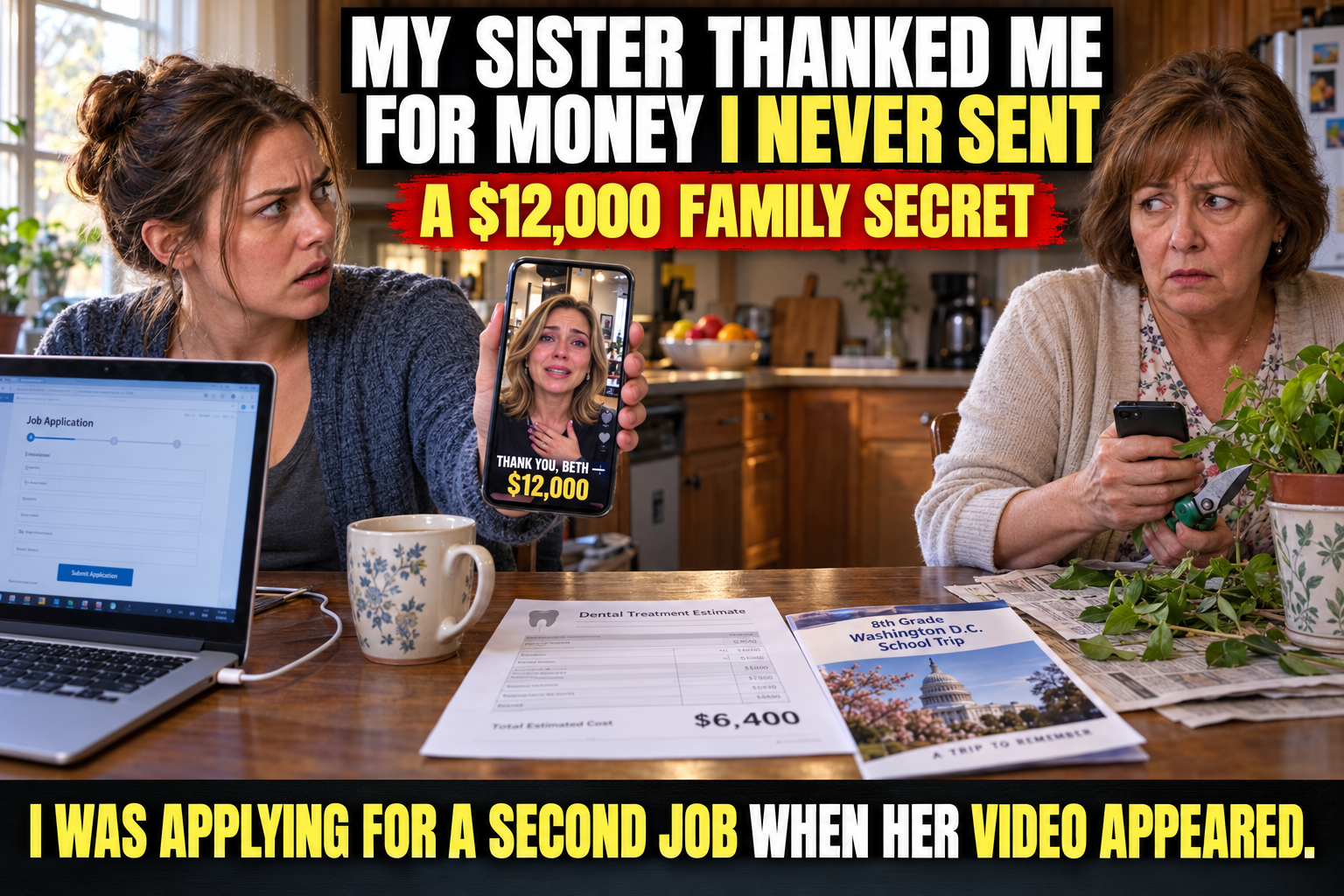
My sister thanked me online for the $12,000 that saved her salon. I hadn’t sent it. I was applying for a second job to pay for my daughter’s surgery after Mom said Grandma’s emergency fund was empty. Then a comment appeared beneath the video, and Mom finally reached for her phone.
Part 1
My sister was crying before I turned the sound on.
She stood inside her salon beneath the gold lettering she had installed above the mirrors. Her hair was pinned up, and she held one hand against her chest.
I knew that room. I had spent two weekends helping paint it.
My daughter, Ava, had folded towels while we worked.
On the screen, Lauren drew a shaky breath.
“I don’t know how to thank someone for saving the thing you’ve built your whole life around.”
I was sitting at our mother’s kitchen table with a job application open on my laptop. Evening stock assistant. Four shifts a week. Availability until midnight preferred.
My coffee had gone cold.
Across from me, Mom was clipping dead leaves from a potted plant over a sheet of newspaper.
Lauren wiped her cheek.
“My sister Beth sent me twelve thousand dollars. She didn’t ask for anything. She just wanted me to keep going.”
I stared at the screen.
Then I checked the date, as though an old video might explain what I had heard.
Posted seventeen minutes ago.
Beneath it, people were writing things about me.
What an incredible sister.
Family always shows up.
You’re lucky to have someone like Beth.
I looked at the application again. The section asking whether I could regularly lift forty pounds remained unanswered.
“Mom.”
She did not look up.
“Hmm?”
“Why is Lauren thanking me for twelve thousand dollars?”
The scissors stopped.
Only for a second.
“Oh. She posted it already.”
I turned my phone toward her.
“I haven’t sent her money.”
Mom resumed trimming.
“Call your sister. She’s had a difficult week.”
I did.
Lauren answered with that bright, breathless voice people get when relief has arrived before they have finished being frightened.
“Beth. I was going to call you properly tonight.”
“What money?”
She laughed once.
“Don’t do that. Let me say thank you.”
“Lauren, I haven’t sent you anything.”
The background noise faded. I imagined her stepping into her little office behind the wash stations.
“Mom transferred it on your behalf.”
I looked across the table.
Mom was watching me now.
“From where?” I asked.
“Grandma’s account. The emergency money.”
My fingers tightened around the phone.
Two months earlier, I had sat in that same chair with an estimate from Ava’s oral surgeon.
Six thousand four hundred dollars for the treatment we were arranging. An eighteen-hundred-dollar deposit was due before the scheduled procedure.
I had asked whether Grandma’s emergency fund could help.
Mom had shaken her head.
“Nothing left, sweetheart. I wish there were.”
Ava had been in the living room, close enough to hear.
Three days later, she canceled her school trip.
She said she had changed her mind about going.
I found the refund request in her backpack.
“Beth?” Lauren said.
“I’ll call you back.”
I ended the call and placed my phone beside the laptop.
Mom gave me a small, patient smile.
“Don’t ruin a family moment over details.”
The kitchen clock ticked above the refrigerator.
“Show me the transfer.”
“There’s no need to make this unpleasant.”
“Show me.”
She folded the newspaper inward, trapping the leaves.
“My banking is private.”
I was still looking at her when her phone rang.
Lauren’s name appeared on the screen.
Mom answered.
“What is it?”
I could hear my sister’s voice without the speaker.
“You need to look at the comments. Aunt June just wrote something.”
Mom’s expression changed.
I refreshed the video.
Underneath all the praise, Grandma’s younger sister had written: Beth, before you accept any thanks, ask your mother which envelope this money belonged to.
Part 2
“What envelope?” I asked.
Mom stood up so quickly that the chair scraped the floor.
“June has never known when to mind her own business.”
She carried the phone toward the back door.
I followed.
“You said there was nothing left.”
“Keep your voice down.”
“There’s nobody here but us.”
She stopped with her hand on the door handle.
For most of my life, that would have been enough. Her expression. The warning in her voice. I would have stepped back and tried again later, using gentler words.
That afternoon, I thought of Ava folding the school-trip brochure and putting it in the recycling.
I stayed where I was.
Mom told Lauren she would call her back.
Then she set the phone facedown on the counter.
“Your sister had a real emergency.”
“And my daughter didn’t?”
“That isn’t what I said.”
“It’s what you decided.”
She pressed her lips together.
Lauren’s salon had suffered a plumbing failure. I knew that much. Water had damaged cabinets and equipment, and the work needed to reopen had cost more than she expected.
I had listened to her worry about appointments, rent, and the two women who rented chairs from her.
I had offered to help clean.
None of that explained why the help had been given in my name.
“Why did she think I sent it?”
Mom looked toward the kitchen window.
“Because I told her you wanted to help.”
“Why?”
“You two haven’t been close lately.”
I almost laughed.
Lauren and I had been tired, busy, and living different lives. We were not estranged.
Mom had taken the ordinary distance between two adult sisters and used it as an empty space in which to put her own story.
“Show me the account.”
This time, she picked up her phone.
She opened the banking application with small, irritated movements, as though I were making her find a receipt for something inexpensive.
Then she held out the screen.
A transfer.
Twelve thousand dollars.
Recipient: Lauren Mitchell.
In the note field were four words.
Beth portion for salon.
I read them twice.
“What does ‘Beth portion’ mean?”
“It was easier to keep track.”
“Of what?”
“Your grandmother liked to organize things.”
I held out my hand.
Mom pulled the phone back.
“You’ve seen it.”
“I’ve seen one transfer. I haven’t seen where it came from.”
“I’m not handing you my phone.”
“Then email me the record.”
She looked offended.
I had never asked her for proof before. Not when she said Grandma’s belongings had been divided. Not when she said certain expenses had used up the family reserve.
Trust had always meant accepting the account she gave me.
Now she seemed to think my request was the betrayal.
I returned to the table and closed my laptop.
“Where are you going?”
“To speak to Aunt June.”
“She’ll make this worse.”
I put the laptop into my bag.
“Worse for whom?”
Mom did not answer.
In the car, I called June.
She answered immediately.
“Are you alone?”
“Yes.”
“Did you authorize that transfer?”
“No.”
June sighed.
It was not the sound of someone surprised. That frightened me more than the comment had.
“Come over,” she said. “I’ve got copies of what Ruth wrote.”
“What did she write?”
“Instructions. Letters. Things your mother was supposed to give you.”
I looked back at Mom’s house.
She stood behind the curtain beside the front door.
June’s voice softened.
“Beth, did you ever receive a letter from your grandmother after she died?”
“No.”
“Then we need to start there.”
Part 3
Aunt June lived in a small brick duplex with a porch too crowded with plants.
When Grandma was alive, the two of them argued about which pots needed more sun. After she died, June kept moving them anyway.
She opened the door before I knocked.
“Tea?”
“I don’t think I can drink anything.”
“Sit, then.”
There was a folder on her dining table.
Nothing dramatic. Blue cardboard, softened at the corners, with a rubber band around it.
I sat where Grandma used to sit when we visited.
June put on her reading glasses.
“Your grandmother gave your mother money to hold after her estate was settled. Twenty-four thousand dollars.”
I stared at her.
Mom had always referred to it as a little emergency account.
Little was a word that could hold almost any amount if nobody asked.
“Twelve thousand for each of you,” June continued. “That was Ruth’s intention. It’s written here.”
She slid a copied page across the table.
I recognized the handwriting immediately.
Grandma wrote capital B’s with a loop that dipped below the line.
For Beth: twelve thousand.
For Lauren: twelve thousand.
Keep available for an important need. Tell them it is there.
I touched the paper.
“Why didn’t she leave it directly to us?”
June took a breath.
“She trusted your mother to manage it. She thought keeping it separate would make you less likely to spend it on ordinary bills.”
“Did she say that to you?”
“Yes. And I told her to get proper advice instead of relying on family understandings.”
June looked down at the folder.
“She said Denise knew what she wanted.”
For a moment, I could hear Grandma saying it. Certain. Dismissive of complications. Loving people enough to assume they would behave well.
“Is this legally mine?” I asked.
“I don’t know what these papers would establish. I won’t pretend I do. I know what your grandmother intended, and I know what your mother agreed in front of me.”
The distinction mattered, even through my anger.
There would be no magical document that turned the afternoon simple.
June took out another sheet.
It was a record Mom had sent her the previous year after Lauren needed help with the salon’s lease and opening expenses.
Lauren’s allocation released: $12,000.
Beth’s allocation remaining: $12,000.
The date was fourteen months earlier.
“Lauren already received hers?”
June nodded.
I sat back.
I remembered that year. Lauren had invited us to the salon opening and thanked Mom for believing in her.
I had stood near the refreshment table, proud of my sister, wearing a blouse I bought on clearance.
I had never asked where the money came from.
“Why didn’t you tell me?”
June took off her glasses.
“Your mother said she had. I believed her.”
“And the letters?”
“Ruth asked me to keep copies. She worried things would get lost.”
June handed me a page marked with my name.
It began: My Beth.
I had not heard Grandma call me that in three years.
My eyes filled before I reached the second line.
I was still holding the letter when Lauren called.
I let it ring once, then answered.
“I took the video down,” she said.
“Why did you think I had twelve thousand dollars to give?”
“Mom said it was from your share.”
I looked at June.
“You knew there were shares?”
Lauren’s breathing changed.
“Beth?”
“I didn’t.”
A long silence followed.
Then my sister said, “Mom told me you knew. She said you asked her to send it because Ava’s treatment had already been covered.”
Part 4
I asked Lauren to come to June’s.
“Now?”
“If you want to understand what happened, yes.”
She arrived twenty-five minutes later in leggings and the salon sweatshirt she wore for cleaning days.
There was dried paint on one sleeve.
Ordinarily, I would have asked whether she had eaten. I would have found a plate, made room, helped her settle.
That afternoon, I stayed in my chair.
She noticed.
“I didn’t know,” she said.
“Tell me exactly what you did know.”
Lauren sat opposite me.
Mom had called her four days earlier, after the repair company gave her the final estimate.
She said I had offered my unused allocation. She said Ava’s treatment was covered and I wanted Lauren to reopen without taking on more debt.
“Why didn’t you call me?”
Lauren looked ashamed.
“Mom said you didn’t want a fuss. I thought the video would be a nice way to thank you.”
“You could have thanked me privately first.”
“I know.”
She did not defend that part.
June showed her the pages.
Lauren recognized the earlier payment and pulled the confirmation from her email.
There it was. Her twelve thousand dollars, received fourteen months before.
No mystery. No misunderstanding about the amount.
“Mom called it my early inheritance,” she said.
“She called mine an empty account.”
Lauren looked down.
I unfolded Grandma’s letter.
She had written about ordinary things first. Ava’s habit of asking how everything worked. The time I fixed her porch screen with the wrong-colored mesh because it was all the store had.
Then the words changed.
You have always tried to make your needs smaller so other people can be comfortable. I hope this money helps you do something useful without first proving you have exhausted yourself.
I stopped reading.
June pushed the tissue box toward me.
I shook my head, then took one anyway.
Grandma had seen something I had mistaken for my personality.
Ever since Dad died when I was nineteen, I had been the reliable daughter. The one who could collect a prescription, rearrange a shift, understand why someone else needed more help.
Lauren had been sixteen then. I did not blame her for needing care.
But somewhere along the way, being older became a permanent reason to need less.
“You should’ve told me about Ava,” Lauren said quietly.
I looked at her.
“I did.”
She opened her mouth.
“At your birthday dinner,” I continued. “I told you we’d seen the surgeon. You said you hoped insurance would sort it out.”
Lauren closed her eyes.
“I remember.”
“I wasn’t asking you for money. But I did tell you.”
She nodded.
For a while, the only sound was June’s refrigerator starting in the kitchen.
Then I checked the time.
Ava would be home soon.
I gathered the copies and put Grandma’s letter carefully between two blank sheets so the corners would not bend.
“What do we do?” Lauren asked.
“I’m going home.”
“Beth—”
“I can’t decide everything while I’m sitting here.”
At home, Ava was at the kitchen counter with her backpack still on.
“Aunt Lauren called,” she said. “I didn’t answer.”
“That’s okay.”
Her eyes moved to the folder.
“Did Grandma find the money?”
I put my bag down.
“We’re figuring out what happened.”
She nodded, then reached into her backpack.
“I thought of something else that might help.”
In her palm lay the little gold bracelet Grandma had given her.
“Do you think we could sell this?”
Part 5
I took the bracelet gently from Ava’s hand.
One of its tiny links caught against my thumbnail.
“No, sweetheart.”
“I don’t wear it much.”
“You don’t have to sell it.”
She shrugged, trying to make the offer seem smaller.
“I just thought, if it helped with the deposit—”
I pulled out a chair.
“Sit with me.”
She sat.
At thirteen, she had already learned how to watch my face before asking for something. That realization hurt in a place my mother’s explanations had not reached.
I had tried to keep the financial worry away from her.
But children could hear a lowered voice through a wall. They could see the calculator beside the grocery list.
They knew when a parent said “Maybe later” too quickly.
“Your treatment is my responsibility,” I said.
“I know, but—”
“You can help at home. You can put your dishes away and remind me when I forget to buy toothpaste. You don’t have to sell things you love to make sure you get care.”
She looked at the bracelet.
“Grandma said everybody has to make sacrifices.”
I kept my voice steady.
“Adults make those decisions. You’ve already given up something you wanted.”
“The trip wasn’t that important.”
“It was important to you.”
Her mouth trembled.
I reached across the table.
She let me hold her hand.
That evening, after she went to her room, I called the surgeon’s office to confirm the payment deadline.
I left a message. Then I checked my budget again.
The emergency fund might be restored. It might not. Ava’s appointment could not depend on whether Mom found a version of events she was willing to admit.
I kept the second-job application open.
But I did not submit it that night.
Instead, I wrote down the questions I needed answered.
How much had remained when I asked?
Why had Mom said it was gone?
Why had she told Lauren the surgery was covered?
How did she intend to replace the money?
Mom called at nine.
“You’ve upset your sister.”
I looked at the list.
“I didn’t transfer the money or post the video.”
“She’s embarrassed.”
“So am I. Hundreds of people saw my name attached to a gift I never made.”
“The video is down.”
“People shared it.”
“You can’t control everything people say.”
“You controlled what you told Lauren.”
Mom sighed.
“I was trying to help.”
“You need to tell me why you said the account was empty.”
“Because you always manage, Beth.”
I did not answer immediately.
She continued, taking my silence for agreement.
“You have a steady job. You make a plan. Lauren was about to lose the salon.”
“I asked you for help with my daughter’s surgery.”
“And you were handling it.”
I looked toward Ava’s closed bedroom door.
“I was applying to work until midnight.”
“Plenty of people work two jobs.”
There it was.
No confusion about dates. No missing statement.
She had known what I needed. She had decided my ability to keep going meant she could refuse me.
“I’m ending this call,” I said.
“Don’t be dramatic.”
“Send me the account records and your plan for restoring the twelve thousand dollars. We can talk after that.”
I hung up before she could answer.
My phone vibrated almost immediately.
A message from Lauren.
Mom says you agreed to record a new video with me so people understand.
Part 6
I stared at Lauren’s message.
Then I called her.
“I haven’t agreed to any video.”
She swore softly.
“I thought I should check.”
“Please keep checking.”
“I will.”
It was a small change. A necessary one.
For years, Mom had been the person who explained one sister to the other.
Beth’s busy.
Lauren’s sensitive.
Don’t bring that up today.
She didn’t mean it that way.
We had allowed her to become the person through whom too many conversations passed.
Now Lauren and I spoke directly, and the difference was uncomfortable.
There was nowhere for either of us to hide behind what Mom supposedly meant.
“How much of the money is left?” I asked.
Lauren told me.
She had paid the repair contractor and ordered replacement equipment. The money had arrived just before invoices were due.
I felt anger rise, then made myself ask another question.
“Can any of those payments be reversed without creating more trouble?”
“Some. Not all.”
“Don’t make another rushed decision tonight.”
“I can sell things.”
“Lauren, I need us to understand what happened before everybody starts selling things.”
She went quiet.
I thought of Ava’s bracelet.
I was tired of the first solution always being somebody giving up something important while Mom kept control of the explanation.
The next morning, the surgeon’s office returned my call.
The appointment was still scheduled. The deposit deadline remained Friday.
I thanked the woman, wrote everything down, and called Mom.
“I need a concrete answer today.”
“I’m looking into it.”
“What does that mean?”
“It means I’m looking into it.”
“Are you replacing the money?”
She paused.
“I have savings, but that money was for the house.”
I closed my eyes.
The house.
For months, she had shown us samples for new kitchen cabinets. I had admired them while calculating whether I could postpone replacing my tires.
I did not know how much she had saved, and I did not want to invent an amount in my head.
“Then tell me what you can do,” I said.
“It isn’t as simple as moving money around.”
“It was simple enough when you moved mine.”
She ended the call by saying she would speak to the bank.
At lunch, Lauren sent me a draft statement.
My previous video was inaccurate. Beth did not authorize the transfer I received. I thanked her publicly before speaking to her, and I should have checked. I have removed the video and apologize for using her name without her consent.
There was nothing about Ava’s diagnosis. Nothing about our bills.
I read it twice.
“That’s fine,” I wrote back. “Please ask people not to speculate.”
She added that sentence.
Some viewers responded kindly. Others asked questions she did not answer.
I did not go through the comments.
That evening, Lauren came over carrying dinner in ordinary takeout containers.
“May I come in?” she asked.
I stepped aside.
Ava joined us at the table but stayed quiet.
Lauren looked at her.
“I’m sorry you’ve had to worry about this.”
Ava pushed rice around her plate.
“Did you know about my surgery?”
“I knew you needed treatment. I was told the payment had been taken care of.”
Ava looked at me, then back at her aunt.
“It wasn’t.”
“I understand that now.”
My phone lit up beside my plate.
Mom had finally sent a message.
Meet me at the bank tomorrow morning. I can put it back.
Part 7
I did not feel relieved when I read the message.
I felt suspicious of the relief trying to arrive.
For two months, I had counted dollars and postponed purchases. For two days, I had tried to understand how my mother could watch me apply for work while letting strangers praise a gift I had not made.
Now seven words asked me to believe the problem could be settled.
I replied that I would meet her at ten.
Then I asked her to send the account records before we arrived.
She did.
The statements showed twelve thousand dollars available when I had asked for help.
It had remained there until the transfer to Lauren.
I saved the files.
I did not call Mom that night.
At the bank, she waited near the entrance in the navy coat she wore to appointments she considered important.
She looked tired.
I noticed and resisted the familiar impulse to make things easier for her.
“Morning,” she said.
“Morning.”
She glanced at the folder beneath my arm.
“You brought all that?”
“Yes.”
We sat with a bank employee in a small office. Mom explained that she wanted to transfer money from her personal savings to my account.
There was paperwork. Identification. Questions to confirm the transaction.
The employee was polite and uninterested in our family history.
I was grateful for that.
The amount was twelve thousand dollars.
Mom reviewed it, confirmed it, and signed where she was asked.
I requested a copy of the confirmation.
Outside, she stood beside my car.
“There. It’s done.”
I put the document into the folder.
“Thank you for restoring it.”
Her face changed slightly.
She had expected a different word.
Gift. Help. Generosity.
“I’ve had to change my plans,” she said.
“I understand.”
“The kitchen work will have to wait.”
I looked at her.
“Ava’s treatment was waiting too.”
Mom tightened her grip on her handbag.
“I didn’t think you were in such a desperate position.”
“I showed you the estimate.”
“You didn’t seem—”
She stopped.
“Desperate enough?” I asked.
She looked away.
Cars moved through the parking lot. Someone pushed a stroller toward the entrance.
I had imagined asking her these questions for two days. Now that we stood there, I felt mostly tired.
“I need you to understand something,” I said. “Being calm when I ask for help doesn’t mean I don’t need it.”
“I know.”
“I don’t think you did.”
She rubbed her forehead.
“I was worried about Lauren.”
“You could have used your own savings to help her.”
That was the question beneath everything.
Mom had money she could move. She had simply chosen to protect her plans by spending the portion Grandma intended for me.
“I thought we could sort it out later,” she said.
“You told me there was nothing left.”
Her eyes filled.
“Yes.”
I waited.
“And I shouldn’t have.”
It was the first sentence she gave me without attaching my behavior to it.
I opened my car door.
“We need some space.”
“How much?”
“I don’t know yet.”
“Can I at least see Ava?”
“I’ll talk to her. Please don’t call her to explain before I do.”
Mom nodded, although I could see she disliked being asked to wait.
I drove to work with the radio off.
At a red light, June called.
“Did she restore it?”
“Yes.”
“Good.”
I let out a breath.
“I keep thinking that should make me feel better.”
“The money was one part.”
I looked at the folder on the passenger seat.
June spoke gently.
“Have you finished reading Ruth’s letter?”
“Not yet.”
“When you’re ready, read the last page.”
Part 8
I read the rest of Grandma’s letter that night.
Ava was doing homework in the living room. The dishwasher made a low, steady noise behind me.
For the first time in weeks, I had paid the deposit without deciding which other bill would have to wait.
I should have felt triumphant.
Instead, I unfolded the pages carefully and prepared to miss someone.
Grandma had written about Dad.
About the year after his death, when Mom struggled to leave the house and I learned to manage groceries, school forms, and appointments.
You were nineteen, she wrote. Everybody kept saying how well you were handling it. I wish we had asked more often whether you wanted to.
I put the page down.
There were things people praised in a young woman that they would have recognized as too much if she had been less capable.
I remembered getting Lauren to school on a morning when I had an exam.
I remembered telling a professor I was sick because explaining the truth would have taken too long.
I remembered Mom saying, “I don’t know what I’d do without you.”
At the time, I thought those words were proof that I mattered.
They were also a job description I never learned to put down.
Grandma’s letter did not excuse Mom.
It did not ask me to forgive her.
It simply named things I had learned to call normal.
Near the bottom, she wrote: When you use this money, I hope you tell me about it out loud, even if I’m not there to answer. I’ll like knowing it made something easier.
I covered my mouth.
Ava looked up from the sofa.
“Mom?”
“I’m okay.”
She waited.
I corrected myself.
“I’m sad. But I’m okay.”
She came to sit beside me.
“Is it about Grandma Ruth?”
I nodded.
“Can I read it?”
“Some of it. There are things about when I was younger that I want to explain first.”
We read the parts about Ava together.
Grandma had remembered her insisting that worms needed rescuing from the sidewalk after rain.
Ava smiled.
“They did.”
“I know.”
She traced the copied handwriting.
“She really meant the money for you?”
“Yes.”
“Then why did Grandma Denise say it was gone?”
I had been thinking about how to answer without asking my daughter to carry my anger.
“She made a choice she didn’t want to explain honestly. That was wrong.”
“Does she know?”
“She knows I believe it was wrong. She’s returned the money.”
Ava sat with that.
“Do I have to call her?”
“No.”
Her shoulders eased.
“I don’t know what to say.”
“You can take your time.”
The following day, Lauren asked whether she could bring something for Ava before the procedure.
She asked me first.
It was such a modest courtesy that I almost missed how important it was.
We agreed on a few practical things from the list the clinic had provided.
No surprise gift. No photograph. No post.
Lauren came by with a small bag and stayed for twenty minutes.
Before leaving, she asked me to step into the hall.
“I’ve been thinking about the video.”
I leaned against the wall.
“I wanted people to see how loved I was,” she said. “I didn’t stop to ask what it had cost you. Even when I thought you’d agreed.”
I looked at her.
“I needed you to call.”
“I know.”
She hugged me only after asking.
The night before Ava’s procedure, I packed the appointment folder, set out her comfortable clothes, and checked the alarm.
Then she appeared in my bedroom doorway.
“Mom, if they find something that costs more tomorrow, will you tell me?”
Part 9
I moved the folded clothes off the bed so Ava could sit.
“I’ll tell you what you need to know about your treatment,” I said. “And if a cost changes, I’ll handle it with the office.”
She picked at a seam in her pajama trousers.
“I don’t want you to pretend everything’s okay if it isn’t.”
I understood why she asked.
For weeks, I had said I was fine while looking at bills after she went to bed. Then she had learned that her grandmother had said an account was empty when it wasn’t.
Too many adults had used reassuring words while hiding the thing she was worried about.
“I can tell you the truth without asking you to solve it,” I said.
She looked at me.
“We have enough set aside for the treatment we’ve planned. I paid the deposit. The office knows how the remaining payment will be made.”
“You don’t need the night job?”
“No.”
Her eyes filled so suddenly that I reached for her.
“I didn’t want you driving home that late.”
I held her against me.
I had thought she worried only about the surgery.
She had been imagining me on dark roads after midnight while she slept at a neighbor’s or stayed awake waiting.
“I’m sorry you were carrying that.”
She nodded into my shoulder.
We sat until she was ready to go back to bed.
At the clinic the next morning, the waiting room smelled faintly of coffee and disinfectant.
Ava leaned against me while we waited to be called.
She was frightened, but she kept trying to make jokes about the soft food waiting at home.
I laughed where she wanted me to.
When the nurse called her name, she stood, then turned back.
“You’ll be here?”
“Right here.”
After she went through the door, I sat down and finally allowed myself to feel how tired I was.
My phone stayed silent for twenty minutes.
Then a message arrived from Mom.
Thinking of Ava. No need to answer now.
I read it.
There was no question about whether she could come. No request that I reassure her.
I put the phone away.
June arrived later with coffee and a book neither of us opened.
She sat beside me without filling the waiting with advice.
When I began to cry, she handed me a tissue and kept sitting.
The procedure was completed, and the clinical team explained Ava’s care and follow-up before we left.
I listened, asked questions, and wrote down what I needed to remember.
Money did not enter that conversation.
For once, I could pay attention to my daughter without calculating in the background.
At home, I settled her on the sofa with the things the clinic had recommended nearby.
Lauren left a message offering to collect groceries if we needed them.
June washed the cups, checked that I had eaten, and went home when I said we needed quiet.
By late afternoon, Ava was sleeping.
I stood at the kitchen sink, watching sunlight reach the edge of the counter.
The second-job application was still saved on my laptop.
I opened it, looked at the hours one last time, and closed it.
Then I deleted the reminder I had set to finish it.
It was not a celebration.
It was a task I no longer had to do.
My phone vibrated.
Mom.
I’m outside. I brought soup. I won’t knock if she’s sleeping. May I leave it at the door?
I looked through the front window.
She stood on the path holding a covered container.
From the sofa, Ava stirred.
“Who’s here?”
Part 10
“Grandma,” I said. “She brought something for us.”
Ava looked toward the window.
“Is she coming in?”
“She asked whether she could leave it at the door.”
My daughter considered that.
“Can you tell her thank you?”
“Of course.”
I went outside and closed the door gently behind me.
Mom lifted the container.
“It’s for you, mostly. I wasn’t sure what Ava could manage.”
“Thank you.”
She handed it over.
For a moment, we stood in the narrow space between the door and the porch step.
“How is she?”
“Resting. We have the follow-up arranged.”
Mom nodded.
I could see questions waiting behind her expression.
When could she visit? Was I still angry? Had we told anyone else?
She asked none of them.
“Tell her I love her,” she said.
“I will.”
She walked back to her car.
I watched until she had driven away, then took the soup inside.
It did not make us even.
It was still a kind thing to bring.
I was learning that I could recognize one without using it to erase the other.
Recovery settled into appointments, reminders, ordinary meals, and the familiar relief of seeing Ava become annoyed about homework again.
The school trip had already taken place.
I could not give her those days back.
When she showed me photographs her friends had sent, I listened. I did not rush to promise something bigger to cover the disappointment.
“I’m sorry you missed it,” I said.
She nodded.
“Maybe next year.”
“We can plan for it.”
We began with a small amount in a separate savings pot, where she could see it grow.
The remainder of Grandma’s money stayed in an account I controlled. I kept a clear record of what went toward Ava’s treatment and what remained.
Some evenings, I still opened the banking application simply to confirm that the balance was there.
Trust did not return because a transfer had been reversed.
My relationship with Mom changed slowly.
At first, we spoke only about practical things.
When she said, “You know I love you,” I answered, “I know you do. We still need to talk about what happened.”
Eventually, she stopped asking me to accept love as the whole explanation.
One afternoon, she said, “I assumed you would find a way, and I used that to justify not helping.”
I let her finish.
“Then I lied because I didn’t want you to know I had chosen.”
There was no immediate forgiveness waiting in me.
But I heard her.
Lauren and I began calling each other more often.
Sometimes we talked about the salon. Sometimes about Ava. Sometimes we disagreed.
We stopped sending those disagreements through Mom.
When Lauren mentioned my name in a post about helping repaint a shelf, she sent me the photograph first and asked whether I minded.
I said it was fine.
It was a small thing. Small things were how we would have to rebuild.
Three months after the video, Ava brought me Grandma’s bracelet.
“Can you help with the clasp?”
I fastened it around her wrist.
She turned her hand, watching the little links catch the light.
“I’m glad we kept it.”
“Me too.”
That evening, I put Grandma’s letter into a protective sleeve in my desk drawer.
Before closing it, I read the last page once more.
Then, feeling a little foolish and missing her badly, I spoke into the quiet kitchen.
“It helped, Grandma. Ava got what she needed.”
From the living room, my daughter called to ask whether I wanted to watch a movie.
I closed the drawer.
“Choose one,” I called back.
“You always fall asleep when I choose.”
“Then choose a louder one.”
She laughed.
I left the dishes until morning and went to sit beside her.