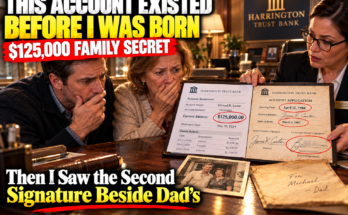
Two months after Dad died, a $27,500 cashier’s check fell from his Bible. It was made out to a woman I’d never heard of. Then she called, knew exactly when and where I was born, and said Dad owed her family a 34-year-old debt.
Part 1
Two months after my 71-year-old father died, I donated most of his books to our church. While sorting the last box, his old Bible fell open and a cashier’s check for $27,500 slid onto the floor. It was dated only nine days before his death and made payable to a woman named Teresa Morgan. I had never heard her name.
My father had been a retired school custodian who counted every dollar. He still clipped grocery coupons and complained when coffee went above $8. There was no reason for him to quietly give someone $27,500. My younger brother insisted the check meant nothing and told me to destroy it because Dad had never mailed it.
I called the bank instead. The manager confirmed Dad had purchased the check personally. Then she asked whether I had found the envelope that went with it. I hadn’t. That evening, I searched Dad’s desk and found an empty envelope labeled “Teresa — after March 12.”
March 12 was my birthday.
The next morning, Teresa called me before I could locate her. She knew my full name, my age, and the hospital where I was born.
“I heard your father passed away,” she said quietly. “He promised he would finally tell you this year.”
I asked what the $27,500 was for.
She paused.
“That money wasn’t meant to pay me,” she said. “It was meant to repay something your father took from my family thirty-four years ago.”
I sat down at Dad’s kitchen table.
“What did he take?”
Teresa went silent long enough that I checked whether the call had disconnected.
“Before I answer,” she finally said, “I need to know something. Did your father leave you a brown envelope?”
“I found an empty one.”
Another silence.
“Empty?”
“Yes.”
“What was written on it?”
“Your name. And ‘after March 12.’”
She exhaled slowly.
“That envelope wasn’t supposed to be empty.”
“What was inside?”
“A letter.”
“From Dad?”
“Yes.”
“About you?”
“About all of us.”
I looked across the kitchen toward the hallway. My younger brother, Kevin, was in Dad’s bedroom packing clothes for donation.
“Who is ‘all of us’?”
Teresa ignored the question.
“Is Kevin there?”
The fact that she knew my brother’s name made my skin prickle.
“Yes.”
“Don’t discuss this in front of him yet.”
“Why?”
“Because your father told me Kevin didn’t know.”
“Know what?”
Before she could answer, Kevin entered the kitchen carrying a cardboard box.
He saw the phone against my ear.
“Who are you talking to?”
I didn’t answer quickly enough.
His expression changed.
“It’s her, isn’t it?”
Teresa must have heard him.
“Daniel,” she whispered, “your brother knows more than your father thought.”
I stared at Kevin.
He put down the box.
“Give me the phone.”
“Why?”
“Because that woman has caused enough trouble.”
I covered the phone with my hand.
“You told me you’d never heard of Teresa Morgan.”
Kevin’s jaw tightened.
“I said the check didn’t matter.”
“No. You said you didn’t know who she was.”
He looked toward Dad’s desk.
Then toward me.
And suddenly I understood something that hadn’t occurred to me before.
The envelope hadn’t necessarily been empty when Dad died.
“Kevin,” I said slowly, “where is Dad’s letter?”
Part 2
Kevin denied taking it.
At first.
He paced across Dad’s kitchen, insisting that I was turning an old check into a conspiracy because grief had made me suspicious.
But he wouldn’t look at me.
Teresa was still on the phone.
“Ask him about St. Matthew’s,” she said.
I repeated the words.
Kevin stopped pacing.
St. Matthew’s was the hospital where I had been born.
Dad had told the story dozens of times.
Mom had gone into labor late on March 11. Dad drove through a freezing rainstorm, parked in the wrong hospital lot, and nearly missed my birth shortly after midnight.
It was one of those family stories that became polished through repetition.
Except Teresa knew it too.
“What happened at St. Matthew’s?” I asked.
“Nothing,” Kevin said.
Teresa heard him.
“Then ask him why your father went there three weeks ago.”
I looked at Kevin.
“Dad went back?”
He sat down.
Nine days before Dad died, he had purchased the $27,500 cashier’s check.
Two days later, according to Kevin, Dad asked him for a ride to St. Matthew’s.
Dad hadn’t been seriously ill. His death came unexpectedly from a cardiac event at home.
Kevin drove him but claimed he stayed in the car.
“What did Dad do inside?”
“I don’t know.”
“How long was he there?”
“Maybe forty minutes.”
“And you never thought to mention this?”
“Why would I?”
“Because nine days before he died he bought a $27,500 check for a woman who knows everything about my birth, then went back to the hospital where I was born.”
Kevin rubbed his forehead.
“I knew this would happen.”
“What would happen?”
“You’d start digging into something that doesn’t matter anymore.”
Teresa spoke through the phone.
“It mattered to your father.”
I put her on speaker.
Kevin looked at the phone as if it had insulted him.
Teresa told us she was 62.
Thirty-four years earlier, when she was 28, she lived with her parents and younger brother, David, outside Dayton.
Her father, Walter Morgan, worked as a maintenance technician.
Dad knew him.
“How?” I asked.
Teresa hesitated.
“They worked together.”
“That can’t be right. Dad worked for the school district.”
“So did my father.”
I had never heard Walter Morgan’s name.
Dad had worked at Jefferson Middle School for twenty-eight years. He repaired lockers, replaced lights, cleared snow, fixed boilers and seemed to know every teacher and custodian in the district.
Teresa said Walter had been assigned to Jefferson too.
Until 1992.
“What happened?”
“He was accused of stealing.”
I glanced at Kevin.
“Stealing what?”
“Money.”
The school held cash from athletic events, student activities and fundraising drives in a locked administrative office before deposits were made.
One Monday morning, $27,500 was missing.
Exactly $27,500.
My eyes went to the cashier’s check.
Teresa continued.
“The district believed my father took it.”
“Did he?”
“No.”
“How does my father fit into this?”
Teresa didn’t answer immediately.
“Walter lost his job. People stopped speaking to him. My mother had to take a second job. We nearly lost our house.”
“And Dad?”
“Your father kept his job.”
I understood the implication.
“You think Dad stole the money?”
“No.”
That surprised me.
“Then what did he take from your family?”
Teresa’s voice softened.
“The truth.”
She explained that Walter died twelve years ago without ever clearing his name.
Dad contacted Teresa after the funeral.
He apologized.
But he still wouldn’t tell her everything.
Over the next decade, they spoke only a handful of times.
Then, three months ago, Dad called her.
“He said he was finished being afraid.”
“Afraid of what?”
“He told me March 12 mattered.”
“My birthday.”
“Yes.”
“Why?”
“He said once you reached the age he had been when it happened, you’d understand why he made the choice he made.”
I calculated it.
I had just turned 46.
Dad had been 46 in 1992.
Kevin looked down.
I asked Teresa what Dad intended to tell me.
She answered carefully.
“He wanted you to know why Walter Morgan was blamed for stealing $27,500.”
I looked at the check again.
“And who really took it?”
Teresa drew a breath.
Before she could answer, Kevin stood.
“I have the letter.”
The kitchen went silent.
He walked into Dad’s bedroom.
When he returned, he was carrying a brown envelope.
But instead of handing it to me, he said:
“Daniel, before you read this, you need to understand why Dad spent thirty-four years protecting the person whose name is inside.”
Part 3
The letter was six pages long.
Dad had written my name across the first page.
**Daniel,**
**If you’re reading this after March 12, then I waited too long.**
I recognized every curve of his handwriting.
Dad apologized before explaining anything.
Not to me.
To Walter Morgan.
In February 1992, Jefferson Middle School hosted a regional basketball tournament. Ticket sales, concessions and fundraising brought in $27,500 over the weekend.
The money was locked in a steel cabinet until Monday’s bank deposit.
Dad and Walter both had access to the maintenance corridor behind the administrative office.
Monday morning, the money was gone.
Police interviewed employees.
Walter became the primary suspect because a spare maintenance key was found in his truck.
He insisted someone had planted it.
No criminal charge was filed because investigators couldn’t prove he had taken the cash.
But the district terminated him.
Dad kept working.
“I don’t understand,” I said.
Kevin pointed farther down the letter.
Dad knew Walter hadn’t taken the money.
Because Dad had seen someone else enter the office Sunday night.
He was working late after a heating problem in the gym.
At 10:17 p.m., he saw a person leave the administrative hallway carrying a canvas deposit bag.
Dad recognized the person.
The next morning, when he heard the money was missing, he knew what he’d witnessed.
“Why didn’t he tell the police?” I asked.
Kevin said nothing.
I kept reading.
Dad confronted the person privately.
They denied stealing anything.
Then Dad threatened to go to the superintendent.
The person broke down.
The money had already been used.
Not spent on a car.
Not gambled.
Not hidden.
Used.
Dad wrote that the thief had been desperate.
Someone they loved needed help.
Dad believed the money would be returned before anyone noticed.
It wasn’t.
When Walter became the suspect, Dad faced a choice.
Tell the truth and destroy one person.
Or stay silent and hope investigators discovered Walter was innocent.
They never did.
I lowered the letter.
“Dad let an innocent man lose his job.”
Teresa answered from the phone.
“Yes.”
There was no anger in her voice.
That made it worse.
Dad’s silence cost Walter almost everything.
After losing his job, Walter couldn’t find comparable work.
The Morgans fell behind on their mortgage.
Teresa postponed nursing school.
Her younger brother left college and took construction jobs.
Her parents’ marriage suffered.
And Dad watched it happen.
“Why didn’t he confess later?”
“He tried,” Teresa said.
Dad visited Walter in 1997.
Walter refused to see him.
In 2000, Dad wrote a letter.
It was returned unopened.
After Walter died, Dad contacted Teresa.
But even then, he withheld the thief’s name.
“He said it wasn’t his secret alone to reveal.”
I looked at Kevin.
“You know the name?”
He nodded.
“How long?”
“Three weeks.”
Dad told Kevin shortly before he died because he needed help returning to St. Matthew’s.
“What was at the hospital?”
“Records.”
Dad believed documents from 1992 still existed in archived administrative files.
“Hospital records?”
Kevin nodded.
That made no sense.
The theft happened at a school.
Why would evidence be at a hospital?
I returned to Dad’s letter.
On page four, he described the night of the theft.
The person he saw had come to Jefferson after spending most of the evening at St. Matthew’s.
Dad knew because he had been there too.
My chest tightened.
“Why was Dad at St. Matthew’s?”
Kevin looked at me.
“Because of Mom.”
Our mother, Patricia, had died eight years earlier.
She had worked as an elementary-school secretary.
She was 43 in 1992.
I remembered that year only vaguely.
I had been twelve.
Kevin was nine.
Mom disappeared from family photographs for several months that spring.
We’d been told she’d had surgery.
“What happened to Mom?”
Kevin slid another paper toward me.
A hospital billing record.
March 1992.
Patient: Patricia Reynolds.
The amount due was almost exactly $27,500.
I read the name again.
Then looked at Dad’s letter.
And suddenly the story Teresa had told me changed shape.
“Dad didn’t see someone stealing money for a stranger,” I said.
Kevin shook his head.
“No.”
“He saw someone stealing it for Mom.”
Kevin nodded.
“But Dad wasn’t protecting Mom.”
He reached for the final page.
“He was protecting the person who paid her hospital bill.”
Part 4
Mom had been seriously ill.
Not the routine surgery we’d been told about as children.
In early 1992, doctors discovered a cardiac condition requiring a procedure Dad’s insurance initially refused to cover fully.
The family owed more than they could pay.
Dad earned a custodian’s salary.
Mom had missed weeks of work.
Bills accumulated.
They borrowed against the house.
Dad’s letter described sitting in St. Matthew’s billing office while a clerk explained they needed to make financial arrangements.
Dad went home that night feeling helpless.
Someone else knew.
Dad’s older brother, Raymond.
Uncle Ray.
I hadn’t seen him in eighteen years.
As children, we thought of Ray as the exciting uncle.
He drove used Cadillacs, told loud stories and always carried cash.
Then, sometime after I graduated from college, Dad stopped speaking to him.
Nobody explained why.
“Ray stole the school money?” I asked.
Kevin nodded.
Dad had mentioned Mom’s medical bills to Ray.
Ray decided to “solve” the problem.
He knew Jefferson’s routines because he had occasionally worked temporary security for district events.
He knew where weekend cash was stored.
He also knew Dad’s maintenance schedule.
He entered the school Sunday night using a copied key and took the deposit bag.
Dad saw him leaving.
Ray admitted everything when confronted.
He had already delivered most of the money toward Mom’s medical debt.
Dad demanded he return it.
Ray couldn’t.
Then Walter Morgan was blamed.
“Dad could have told the police,” I said.
“Yes.”
“He should have.”
“Yes.”
Kevin wasn’t defending him.
Neither was I.
Dad had loved Walter enough to know he was innocent and loved his family enough to become a coward.
That contradiction hurt.
Teresa spoke quietly.
“My father always believed someone at the school knew.”
I apologized.
It felt inadequate.
“I know saying I’m sorry doesn’t—”
“Daniel, you didn’t do it.”
“My father—”
“Your father made a terrible decision. But he spent the rest of his life knowing that.”
I looked at the cashier’s check.
“Is that why you won’t take the money?”
“It isn’t mine.”
“It should have been Walter’s.”
“Yes.”
“Then it’s yours.”
“No.”
Her certainty surprised me.
“My father didn’t want repayment.”
“How do you know?”
“Because your father tried once before.”
In 2000, Dad saved $18,000 and attempted to give it to Walter.
Walter returned it.
Teresa still had the letter her father wrote.
**Money can’t return the years when everyone looked at me like a thief. If you want to make this right, tell the truth.**
Dad didn’t.
Not then.
That was the part Teresa struggled to forgive.
“Why did Dad wait until now?”
“Because something changed.”
“What?”
“Raymond called him.”
Uncle Ray was still alive.
I hadn’t known.
He lived in Kentucky.
For years, Dad told us only that Ray had “chosen his own life.”
Three months before Dad died, Ray contacted him.
He was ill and wanted to confess.
Dad refused to let him confess privately.
He wanted the district to clear Walter’s name publicly.
Ray agreed.
That’s why Dad returned to St. Matthew’s.
The hospital records could establish where the stolen money had gone.
Kevin had driven him there to request archived billing documentation.
“Did he get it?”
“Yes.”
Kevin went to Dad’s desk and removed another folder.
Inside were copies of billing records.
The payment was there.
$26,840.17.
Paid two days after the school theft.
Payment source: cashier’s instrument.
The remaining money had covered prescriptions and related expenses.
Ray had taken $27,500.
Nearly all of it went toward Mom.
I felt sick.
For thirty-four years, Dad had carried a secret that had kept my mother alive while destroying Walter Morgan’s reputation.
But one thing still didn’t fit.
“Why did Dad write ‘Teresa — after March 12’?”
Teresa answered.
“Because he wasn’t planning to send me the check.”
“Then why was your name on it?”
“He wanted you to bring it to me.”
“Why?”
“So I could take you somewhere.”
“Where?”
“To see my brother.”
David Morgan.
The son whose college plans had ended after Walter lost his job.
Teresa gave me an address.
It was only forty minutes from Dad’s house.
I thought David would tell me more about Walter.
Instead, when Kevin and I arrived the next afternoon, David opened his front door, looked at my face, and said:
“You look more like Raymond than your father.”
Part 5
I had heard variations of that sentence my entire life.
“You’ve got Ray’s smile.”
“You’re tall like your uncle.”
“Daniel looks more like Raymond’s side.”
I’d never thought much about it.
Families repeat observations until they become background noise.
But David Morgan said it differently.
Not casually.
Like it meant something.
“How did you know Raymond?”
David invited us inside.
He was 58, broad-shouldered, with gray hair and a slight limp.
His living room contained photographs of Walter and Teresa.
On a bookshelf sat a framed picture of Jefferson Middle School.
“My father talked about your family until the day he died,” David said.
“Probably not kindly.”
“Not always.”
He surprised me by smiling.
“Walter was angry at your father. But anger isn’t simple when you’ve once trusted someone.”
David knew more than Teresa had told me.
After Walter lost his job, he spent years investigating the theft himself.
He collected bank records, old school memos and statements from former employees.
Eventually, he became convinced Ray had taken the money.
“But he never proved it?”
“He got close.”
In 1998, Walter confronted Ray.
Ray denied everything.
Then Walter made a discovery that caused him to stop investigating.
“What?”
David walked to a filing cabinet.
He removed a photograph.
It showed Mom outside St. Matthew’s in 1992.
Dad stood beside her.
So did Uncle Ray.
I was there too.
Twelve years old.
Seeing my childhood face beside three adults carrying this secret felt strange.
David turned the photograph over.
Walter had written:
**The boy cannot be made to pay for this.**
“What does that mean?”
David looked at Kevin.
My brother stared at the floor.
“You know, don’t you?” I asked.
“No.”
But his voice lacked conviction.
David opened another folder.
Inside was a copy of a letter Walter had written but never mailed.
It was addressed to Dad.
**Thomas,**
Dad’s name was Thomas Reynolds.
**I know why you stayed silent. I know what Raymond told you about Daniel. I won’t use a child to punish either of you. But someday that boy deserves the truth.**
I stopped reading.
“What did Ray tell Dad about me?”
David didn’t answer.
Instead, he asked a question.
“Have you ever seen your original birth certificate?”
“Of course.”
“Original?”
I thought about it.
I had used certified copies for passports and licenses.
I had never seen the hospital original.
David continued.
“Walter found something while investigating Raymond’s finances.”
“What?”
“A payment.”
The year was 1980.
My birth year.
Ray had made regular payments to Mom beginning four months before I was born.
They continued for almost two years.
My first reaction was practical.
Maybe Dad needed help.
Maybe Ray was lending his brother money.
But David had another document.
A letter Ray sent Mom in 1981.
He wouldn’t let me read it yet.
“Why not?”
“Because your father wanted to be the one to tell you.”
“My father is dead.”
“I know.”
“Then stop protecting me.”
David studied me.
“I think everyone in this story spent too much time protecting people by hiding things.”
He handed me the letter.
Ray’s handwriting was large and slanted.
Most of the first page concerned money.
Then I reached a sentence that made me read it twice.
**Tom is raising Daniel as his own, and I will respect that, but pretending I feel nothing doesn’t make the truth disappear.**
The room seemed suddenly too quiet.
Kevin whispered my name.
I didn’t respond.
I read the sentence again.
Then the next one.
**When he’s old enough, he deserves to know why his uncle has always looked at him like a father.**
Part 6
I didn’t believe it.
That was my first reaction.
Not anger.
Not grief.
Rejection.
Dad was my father.
He taught me to ride a bicycle.
Sat beside me in the emergency room when I broke my wrist.
Drove six hours to help when my first car died.
Held my infant daughter with tears in his eyes.
A letter couldn’t rewrite forty-six years.
David agreed.
“It doesn’t.”
I looked at him.
“What?”
“Whatever that letter means, Thomas Reynolds was your father.”
That mattered.
More than he probably realized.
Kevin sat beside me.
“I didn’t know this part.”
I believed him.
Dad had told Kevin about the school theft but apparently stopped before explaining Ray’s connection to me.
I called Teresa.
She already knew.
Walter had told her before he died.
“Why didn’t you say anything?”
“Because it wasn’t my secret to reveal over a phone call.”
I almost laughed at the irony.
Everyone in this story had a reason for silence.
I was tired of silence.
“Was Raymond my biological father?”
“I believe so.”
“Did Dad know?”
“Yes.”
“Did Mom?”
“Yes.”
According to Walter’s investigation, Mom and Ray had a brief relationship during a separation from Dad in 1979.
Dad and Mom reconciled before I was born.
Ray offered to leave town.
Dad told him to stay away from decisions concerning me.
Ray agreed.
For years, he remained Uncle Ray.
Then Mom became ill in 1992.
Ray’s guilt, love and unresolved attachment resurfaced.
When he learned Mom needed expensive treatment, he stole the $27,500.
Dad discovered him.
And suddenly the choice Dad faced became even more complicated.
If he reported Ray, the police would investigate where the money went.
Mom’s hospital payments would surface.
Ray feared questions about why he had risked prison for his brother’s wife.
He threatened to reveal my paternity if Dad exposed him.
I felt anger rise.
“He blackmailed Dad?”
“Not exactly,” Teresa said.
“What would you call it?”
“Panic.”
That didn’t make it better.
Dad stayed silent.
Walter paid the price.
And I grew up never knowing.
“What changed thirty-four years later?”
“Ray got sick,” Teresa said.
“And developed a conscience?”
“Maybe.”
I wasn’t ready to grant him that.
David gave me Ray’s Kentucky address.
I drove there alone the next morning.
The house was small, surrounded by bare trees and an old wire fence.
A woman in her seventies answered.
Her name was Linda.
Ray’s wife.
When I introduced myself, she didn’t look surprised.
“He’s been waiting.”
Ray was 74.
He looked much older.
Illness had reduced the loud uncle of my childhood to a thin man beneath a blanket.
But his eyes were the same.
And, seeing him after reading Walter’s letter, I noticed similarities I’d spent a lifetime ignoring.
He looked at me for a long time.
“Tom didn’t get to tell you.”
“No.”
Ray closed his eyes.
“I thought he’d have more time.”
“You’ve had forty-six years.”
He accepted that.
I placed a copy of the $27,500 check on the table beside him.
“Dad bought this nine days before he died.”
Ray stared at it.
“He finally did it.”
“Did what?”
“Saved enough.”
“For Teresa?”
Ray shook his head.
“No.”
“Then who was the money really for?”
Ray’s eyes filled.
“Walter’s grandson.”
I didn’t know Walter had a grandson.
Ray continued.
“And if Tom followed the plan we made, the boy has no idea why a dead school custodian left him $27,500.”
Part 7
Walter’s grandson was named Ethan.
He was 24.
Teresa’s son.
That surprised me because Teresa had never mentioned having children.
Ethan had grown up hearing that his grandfather Walter had lost his job after being accused of theft.
He knew the accusation had never been proven.
He didn’t know Dad’s role.
“He’s in graduate school,” Ray said. “Teaching.”
Walter had once wanted to become a teacher himself.
After losing his job, he never had the financial stability to return to school.
Teresa became a nurse, but only after delaying her education for years.
David never returned to college.
The theft had created consequences that spread across generations.
Dad couldn’t restore Walter’s reputation while Walter was alive.
He couldn’t return Teresa’s lost years or David’s abandoned plans.
So he saved.
After retirement, he put aside money month after month.
The final amount reached $27,500.
Exactly what had been stolen.
Dad made the check payable to Teresa because he wanted her to decide whether Ethan should receive it.
“He didn’t consider it repayment,” Ray said. “He called it restoration.”
“Why didn’t he simply tell Teresa?”
“Because he wanted the truth public first.”
Dad had planned three things after March 12.
Tell me Ray was my biological father.
Give Teresa the documents clearing Walter.
Then accompany Ray to the school district and formally confess what happened.
Dad died before any of it occurred.
“Why March 12?”
Ray looked at me.
“Because you turned forty-six.”
The age Dad had been when he made his decision.
“He said he spent years wondering what he should tell you. Then he realized he wanted you to reach the same age before judging him.”
“That sounds convenient.”
“It probably was.”
At least Ray didn’t defend it.
I asked why he had waited.
His answer was uglier.
“Cowardice.”
No excuses.
He stole the money.
He let Walter take the blame.
He threatened Dad with the truth about me.
Then he spent thirty-four years building a life on silence.
“I sent Walter money once.”
“He returned it?”
“Yes.”
“I tried to confess in 2006.”
“What stopped you?”
“Myself.”
Ray looked toward the window.
“I always found a reason to wait.”
I understood that part more than I wanted to.
He had contacted Dad three months ago because doctors told him his illness was advancing.
Dad refused to let him die with the secret intact.
They created a plan.
Then Dad died first.
“What do you want from me?”
“Nothing.”
“Forgiveness?”
“No.”
“Then what?”
“I want Walter’s name cleared.”
That answer was at least the right one.
The following week, Teresa, David, Kevin and I met with representatives from the school district.
Ray joined by video because he was too weak to travel.
He confessed.
The district had already reviewed Dad’s preserved records and hospital documents.
There was enough corroborating evidence to conclude Walter had been wrongly blamed.
The superintendent prepared a formal statement.
Walter Morgan would be publicly exonerated.
Teresa cried when she read it.
David left the room for several minutes.
I thought that was the end of the hardest part.
Then the district attorney’s representative asked Ray whether anyone else had known about the theft in 1992.
Ray hesitated.
Dad’s letter named no one else.
Walter’s files suggested no one else.
But Ray said yes.
“Who?” the representative asked.
Ray looked directly at the camera.
“Patricia Reynolds.”
My mother.
Then he said something none of us expected.
“Patricia knew where the $27,500 came from before the hospital ever accepted it.”
Part 8
Mom had known.
Dad’s letter made it sound as though Ray acted alone and Mom learned the truth later.
Ray said otherwise.
He told Mom what he planned to do before he stole the money.
She begged him not to.
Then, after he brought it to her, she used it anyway.
That distinction mattered.
Not legally anymore—the events were decades old and everyone except Ray had either died or suffered the consequences—but emotionally, it changed how I saw Mom.
“Why would she accept stolen money?”
Ray answered with another question.
“What would you do if someone told you treatment could save your life, but your family couldn’t afford it?”
I didn’t know.
Neither did Teresa.
Mom had two young sons.
She was frightened.
She told herself Ray would replace the money before Monday.
Ray believed he could borrow from his business.
The loan fell through.
Then the theft was discovered.
Walter was blamed.
Mom wanted to confess.
Dad stopped her.
That surprised me most.
“Why?”
“Because by then the money was gone,” Ray said. “Tom believed confessing would destroy the family without helping Walter.”
He was wrong.
He knew it eventually.
But every month that passed made confession harder.
Then years passed.
Then decades.
Silence hardened into family history.
Teresa listened without interrupting.
When Ray finished, she said, “My father would have forgiven Patricia.”
Ray looked shocked.
“How do you know?”
“Because he knew.”
Walter had figured it out in 1998.
That was why he stopped investigating.
He discovered Mom’s illness.
He found the hospital payment.
He learned Ray’s relationship to me.
And he decided exposing everything would hurt two children who had done nothing wrong.
Me and Kevin.
Walter had been protecting us.
The man Dad failed to protect had eventually protected Dad’s children.
That realization broke something open in me.
For weeks, I had viewed Walter as the victim and Dad as the coward.
Both were true.
But Walter had also been something larger than what happened to him.
He had made his own moral choice.
One Dad apparently spent the rest of his life trying to live up to.
Teresa finally accepted the cashier’s check.
But not for herself.
She endorsed it into a new education account for Ethan.
She told him everything.
I asked if I could be there.
She said that decision belonged to Ethan.
He agreed.
We met at Teresa’s house on a Sunday afternoon.
Ethan was tall, quiet and initially overwhelmed by the number of strangers connected to his grandfather’s story.
Teresa gave him the check.
“This isn’t a gift,” she said. “And it isn’t payment for Grandpa’s suffering.”
“Then what is it?”
“A choice.”
He could use it for graduate school.
Or establish something in Walter’s name.
Or refuse it.
Ethan stared at the check.
“Why exactly $27,500?”
Teresa told him.
He didn’t speak for a long time.
Then he looked at me.
“Your father saved this?”
“Yes.”
“Why?”
“Because he couldn’t undo what happened.”
Ethan folded his hands.
“Did Grandpa forgive him?”
Nobody knew.
Teresa went upstairs.
She returned carrying Walter’s old Bible.
Inside was a letter dated four months before Walter died.
Addressed to Dad.
Unlike the earlier letter, this one had never been sent.
Teresa hadn’t read it until after Walter’s death.
She handed it to me.
Walter had written only two pages.
The final paragraph answered Ethan’s question.
**Tom, I spent years waiting for you to tell the truth. Eventually I realized I was letting your silence decide what kind of man I became. I forgive you, but forgiveness is not the same as pretending nothing happened. If you want peace, stop trying to pay me and tell your sons the truth.**
My eyes blurred.
Dad had never seen those words.
Teresa touched my arm.
“He knew anyway.”
“How?”
“Because I read them to him.”
“When?”
“Nine days before he died.”
The same day Dad purchased the check.
I looked at her.
“You saw him that day?”
She nodded.
“At the bank.”
Then she told me the detail she had withheld since our first phone call.
Dad hadn’t gone there alone.
Someone had been sitting beside him.
A woman.
And Teresa said that woman had another envelope addressed to me.
Part 9
The woman was Linda.
Ray’s wife.
She had known for years.
Not about the theft initially.
About me.
Ray told her before they married that there was a possibility I was his biological son.
Linda agreed to marry him anyway.
She never contacted me because Ray promised Dad he wouldn’t interfere in my life.
But after Dad and Ray began planning their confession, Linda became involved.
Dad gave her a second envelope.
“What happened to it?” I asked.
Teresa didn’t know.
I called Linda.
She asked me to return to Kentucky.
This time Kevin came with me.
Linda met us at the door carrying a white envelope.
My name was written across it.
Inside wasn’t another confession.
It was a letter Dad had written shortly before he died.
**Daniel,**
**Biology is a fact. Fatherhood is a life. I don’t know whether learning about Raymond will make you question what you and I were to each other. I hope it doesn’t. But you have the right to know where you came from, even if I was selfish enough to delay telling you.**
I stopped.
Kevin put his hand on my shoulder.
Dad wrote about the day I was born.
He knew there was a possibility I wasn’t biologically his.
He went to the hospital anyway.
He held me.
He signed my birth certificate.
And from that moment, he never considered me anything except his son.
He admitted resenting Ray.
He admitted resenting Mom.
Then he admitted something more difficult.
When Ray stole the $27,500, part of Dad’s silence had not been noble.
He wanted Ray gone.
If Ray disappeared under the weight of his own crime, Dad thought perhaps the complicated truth about me would disappear with him.
But Walter was blamed instead.
An innocent man absorbed the punishment.
Dad’s choice became unforgivable to himself.
**I told myself I was protecting Patricia and you boys. Sometimes I was. Sometimes I was protecting myself. A man should know the difference.**
That sentence stayed with me.
Dad wasn’t asking me to see him as a hero.
He wasn’t asking me to excuse him.
He was asking me to see him accurately.
A loving father.
A frightened husband.
A loyal brother until loyalty became cowardice.
A man who made one terrible decision and spent decades trying to repair damage that couldn’t be completely repaired.
At the bottom of the envelope was another document.
A notarized statement.
Dad had signed it before his death.
It described everything.
Ray’s theft.
Mom’s medical bills.
Walter’s wrongful accusation.
Dad’s silence.
It was the statement that ultimately allowed the district to issue a full public correction even after Dad was gone.
Several weeks later, Jefferson Middle School held a small ceremony.
They installed a plaque honoring Walter Morgan’s twenty-one years of service and formally acknowledged that his 1992 dismissal had been based on an accusation now shown to be false.
Teresa stood beside the plaque.
David stood on her other side.
Ethan held Walter’s photograph.
Kevin and I stayed behind them.
That seemed right.
This was Walter’s moment.
Not ours.
Afterward, Ethan approached me.
He still hadn’t deposited the $27,500.
“I decided what to do with it.”
“What?”
“Grandpa wanted to teach.”
He smiled.
“So I think the money should help somebody else become one.”
He planned to establish a small scholarship for school employees—custodians, cafeteria workers, aides and maintenance staff—who wanted to continue their education.
“Your dad worked in a school too,” he said. “Maybe both names should be on it.”
I shook my head.
“Walter’s.”
“Why?”
“Because Dad would agree.”
Teresa heard us.
She smiled.
“He would.”
That evening, Kevin and I returned to Dad’s house for the final time before selling it.
Most rooms were empty.
Only Dad’s Bible remained on the kitchen table.
Kevin picked it up.
“There was something else inside when I found the envelope.”
My stomach tightened.
“What?”
He opened the back cover.
Tucked beneath the lining was a small photograph.
Dad, Mom, Ray and Walter.
All four were young.
On the back, Dad had written:
**Before everything went wrong, we were friends.**
Beneath that was a date.
March 12, 1980.
My birthday.
And under the date, Dad had written one final line:
**This was the day Walter made me a promise I never understood until years later.**
Part 10
The photograph had been taken outside St. Matthew’s only hours after I was born.
Walter wasn’t family.
There was no obvious reason for him to be there.
Teresa finally explained.
Dad had called Walter from the hospital.
Not Ray.
Not another relative.
Walter.
Dad knew there was a possibility Ray was my biological father, and in those first hours he was overwhelmed by anger, fear and humiliation.
Walter drove to the hospital.
He sat with Dad in the cafeteria.
Dad told him everything.
Then Dad asked a question he would later be ashamed of.
“What if I can’t love the boy?”
Walter had two children of his own.
He told Dad that a newborn hadn’t betrayed anyone.
Whatever had happened among the adults belonged to the adults.
“If you walk into that room and decide you’re his father,” Walter said, “then be his father every day after that.”
Dad returned upstairs.
He held me.
He chose.
Twelve years later, Walter was falsely accused of stealing $27,500 because Dad remained silent about a crime committed by the man who may have biologically fathered me.
The irony was painful.
Walter had once helped Dad become my father.
Dad later failed Walter when Walter needed him to be brave.
That was the promise Dad hadn’t understood until years later.
Fatherhood wasn’t only about loving your child.
It was also about becoming the kind of man your child could someday understand.
Dad had succeeded in some ways and failed badly in others.
So had Mom.
So had Ray.
Walter wasn’t perfect either, Teresa told me.
But on the two days that mattered most to my family’s story, he chose not to make children pay for adults’ mistakes.
That became the part I carried with me.
Ray died seven months after Dad.
I visited him three times before the end.
Our relationship never became father and son.
I didn’t need it to.
Thomas Reynolds was my father.
Biology didn’t erase forty-six years of breakfasts, arguments, Christmas mornings, scraped knees, graduations, phone calls and ordinary Tuesdays.
But Ray was part of my history.
I allowed myself to know him.
That was enough.
Before he died, he donated $27,500 of his own money to Ethan’s scholarship fund.
Teresa almost refused it.
Ethan convinced her otherwise.
“He can’t fix Grandpa’s life,” Ethan said. “But the money can help someone else’s.”
The Walter Morgan Education Fund awarded its first scholarship the following spring.
The recipient was a 38-year-old cafeteria employee studying to become a special-education teacher.
The second was a custodian taking evening classes.
When Teresa told me, I thought about Dad clipping coupons at his kitchen table.
Saving quietly.
Counting every dollar.
I finally understood why the cashier’s check had been hidden inside his Bible.
Dad could have left it in his desk.
A bank envelope.
A safe-deposit box.
Instead, he placed it inside the book he opened almost every morning.
I don’t think he was trying to hide the money.
I think he was trying to put it beside the one thing he still hoped existed for people who had waited too long to do what was right.
Grace.
We sold Dad’s house that summer.
I kept only a few things.
His pocketknife.
A coffee mug.
The photograph from St. Matthew’s.
And the Bible.
The cashier’s check was eventually deposited into Walter’s scholarship fund.
For years, $27,500 had represented one stolen weekend deposit.
A man’s ruined reputation.
A family’s medical crisis.
A brother’s crime.
A father’s silence.
A secret about my birth.
But money is only a number until people decide what it means.
Dad spent thirty-four years wishing he could change what that number meant.
He couldn’t change 1992.
He couldn’t give Walter his job back.
He couldn’t erase the whispers Walter endured.
He couldn’t return Teresa’s delayed education or David’s abandoned plans.
And he couldn’t make his silence honorable simply because fear had helped create it.
What he could do was finally tell the truth.
He died before he could say it aloud.
But he left enough behind for us to finish.
A check.
A letter.
Hospital records.
A photograph.
And a Bible that fell open at exactly the right moment.
For most of my life, I thought Dad’s greatest gift to me was that he treated me as his son even when biology may have told a different story.
I was wrong.
His final gift was more difficult.
He allowed me to learn that someone can love you deeply and still fail another person terribly.
That good people can make cowardly choices.
That regret means little without truth.
And that forgiveness does not require pretending the damage never happened.
On March 12 the following year, I visited Walter’s plaque at Jefferson Middle School.
Teresa met me there.
We stood quietly for a while.
Then she smiled.
“Your father finally paid the $27,500.”
I looked at Walter’s name.
“No,” I said. “I don’t think that was the debt.”
She understood.
Neither of us said anything else.
Because after thirty-four years, the money had finally been returned.
But the truth was what our fathers had owed each other all along.
A grieving son finds a $27,500 cashier’s check hidden inside his late father’s Bible, leading to an unknown woman, an old accusation, and a family secret buried for thirty-four years.