I’ve waited tables at the same diner off Route 9 for six years. I’m 27, I’m saving for nursing school, and I know what a good tip looks like. Twenty percent is good. Thirty is a great day. So when an elderly couple left $5,000 on a $38 check last Tuesday, I assumed it was a joke.
It wasn’t. It was a personal check, signed in shaky handwriting, with a note on a napkin: “For Hannah. You don’t remember, but we do.” I didn’t recognize them. I’d never served them before that morning. They were already gone by the time I found it.
My manager told me to deposit it before anyone could change their mind. Two days later, before the check had even cleared, their son walked into the diner. He was polite, but he was clearly upset. He said his father, 84, had early dementia, and that he was sorry, but he needed me to give the money back.
Part of me wanted to. It felt wrong to keep it. Part of me thought about my tuition and how long I’d been saving. I told him I needed a day to think.
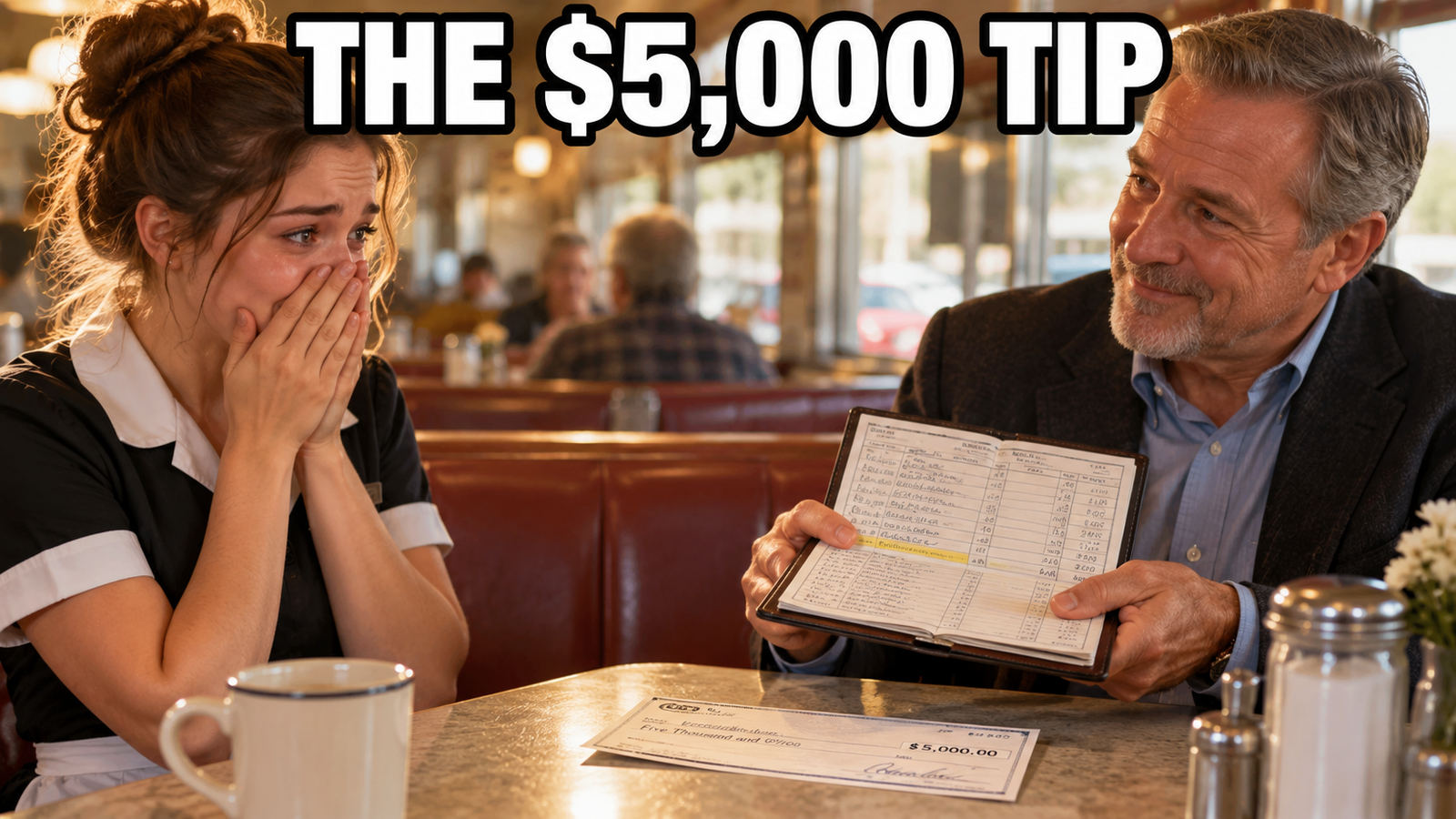
He nodded and sat down across from me in the booth. Then he pulled out his father’s old checkbook register and opened it to a page he’d marked with a sticky note. The same $5,000 had gone out once a year, every year, since 1979. Every payment went to a different name, and every memo line said exactly the same thing.
PART 1 — THE MEMO LINE
The memo line on every entry said the same two words. *For stopping.*
I ran my finger down the page of the old checkbook register. Greg Albright had marked it with a yellow sticky note and set it on the table between us in the back booth of the Route 9 Diner, next to my order pad and his untouched cup of coffee. The register was the old-fashioned kind, a little vinyl folder with lined pages, the ink faded to brown on the earliest ones.
*March 3, 1979. Check #1102. Peggy Lund. $5,000.00. For stopping.*
*March 3, 1980. Check #1340. Raymond Ortiz. $5,000.00. For stopping.*
*March 3, 1981. Check #1588. Ellen Choi. $5,000.00. For stopping.*
Every payment went to a different name, and every memo line said exactly the same thing.
It went on like that. Forty-seven years. A different name every year, every single year, on or near March third. Five thousand dollars each time. The handwriting changed slowly as the decades went by, from a young man’s firm print to an older man’s careful script to, in the last few years, a wavering, shaky hand that was hard to read.
The last entry, at the bottom of the page, was from last Tuesday.
*Hannah. $5,000.00. For stopping.*
He hadn’t even known my last name.
I looked up at Greg. He was in his fifties, tall, with his father’s long face and a wrinkled button-down shirt like he’d driven straight from work. He’d come in angry. I could tell. Polite, but angry. Now he just looked lost.
“I didn’t know about any of this,” he said quietly. “Fifty-four years old, and I never knew. I found this in Dad’s desk last night.” He rubbed his eyes. “Miss, I don’t think my father’s confused at all. I think I am.”
PART 2 — THE $38 CHECK
I’ve waited tables at the Route 9 Diner outside Saratoga Springs, New York, for six years. I’m twenty-seven. I’m saving for nursing school, and I know what a good tip looks like. Twenty percent is good. Twenty-five is great. Thirty percent means somebody’s either in a really good mood or trying to impress a date.
So when an elderly couple left a personal check for five thousand dollars on a thirty-eight dollar breakfast tab last Tuesday, I assumed it was a joke.
They’d come in around eight-thirty. A tall, thin man in his eighties with a cane and a tweed cap, and a small, white-haired woman with bright eyes and a pink scarf. They sat in booth six, by the window. He ordered the lumberjack special and she ordered a short stack and two eggs over easy. They were sweet. They held hands across the table while they waited for their food. They asked me my name twice.
They held hands across the table while they waited for their food. They asked me my name twice.
I’d never served them before that morning. I was sure of that. I remember faces. It’s half the job.
When they left, I went to clear the booth. Under the edge of his plate was a check, made out to *Hannah* with no last name, signed in a shaky hand by someone named Russell Albright. Five thousand dollars. And folded under it, a paper napkin with a note in the same wavering handwriting.
*For Hannah. You don’t remember, but we do.*
I ran out to the parking lot. They were already gone.
I stood there in the cold in my apron for a full minute, holding the check and the napkin, while a truck driver honked at me to get out of the way. When I came back in, Brianna took one look at my face and asked if somebody had stiffed me. I just handed her the check. She read it twice, out loud, the second time much louder, and the whole counter turned around to look. Old Mr. Danforth, who has eaten the same oatmeal at stool three every morning for eleven years, said, “Well, I’ll be.” It was the most I’d ever heard him say.
PART 3 — WHAT EVERYONE SAID
My manager, Sal, looked at the check for a long time and then said, “Deposit it before anybody changes their mind.”
My best friend from work, Brianna, said, “Oh my God, Hannah, that’s like a semester of nursing school.”
My mother, on the phone that night, said, “Honey, that has to be a mistake. People don’t do that.”
I didn’t know what to think. I stared at the napkin for a long time. *You don’t remember, but we do.* I went through every shift in my head, every customer, every face, every strange encounter in six years at the diner. I couldn’t place them. I’m sure I would have remembered.
I went through every shift in my head, every face, every strange encounter in six years. I couldn’t place them.
I did deposit the check. I’ll be honest about that. Wednesday morning, at the bank’s mobile app, with my heart pounding. Five thousand dollars was more than I’d ever had at one time in my life. I’d been saving for nursing school for three years and had $6,200. This would almost double it. I could start in the fall instead of waiting another two years.
But the bank put a hold on it. Five business days, the app said, for a check that large.
Two days later, before it had even cleared, their son walked into the diner.
PART 4 — GREG
He asked for me by name at the hostess stand. Sal pointed him to my section. He was polite, but I could see he was upset. His jaw was tight. He kept turning his car keys over in his hand.
“My name is Greg Albright,” he said. “My parents were in here on Tuesday. Russell and Evelyn.” He took a breath. “I’m really sorry to do this. But my father is eighty-four, and he has early dementia. He was diagnosed last year. He’s been doing strange things with money. Last month he tried to buy a riding lawnmower, and they live in a condo.” He tried to smile. It didn’t work. “I need to ask you to give the money back.”
“My father has early dementia. He’s been doing strange things with money. I need to ask you to give the money back.”
I stood there with a coffee pot in my hand.
Part of me wanted to say yes immediately. It felt wrong to keep it. It felt like taking advantage of a confused old man. I’d seen my own grandfather go through dementia, the slow fading, the bad decisions he didn’t understand he was making. I’d have been furious if a stranger had cashed a five-thousand-dollar check from him.
But part of me thought about the napkin. *You don’t remember, but we do.* That didn’t sound like confusion. That sounded like someone who knew exactly what he was doing.
And part of me, honestly, thought about my tuition.
“Can I have a day to think about it?” I said. “Please. I’ll call you tomorrow. I promise.”
Greg nodded slowly. Then, instead of leaving, he sat down in the back booth. He reached into his jacket and took out the checkbook register.
“Before you decide,” he said, “I think you should see this. Because I don’t understand it.”
I almost didn’t sit down. The breakfast rush was building, and Sal was already giving me looks from behind the register, and every part of me that had been raised to be polite and not make trouble wanted to just say *of course, here’s your money back, I’m so sorry.* But there was something in his voice that stopped me. He didn’t sound like a man trying to protect his father’s money. He sounded like a man who’d just found out his father was somebody he didn’t know. I slid into the booth across from him and set the coffee pot down on the table between us.
PART 5 — FORTY-SEVEN NAMES
We sat in that booth for an hour. Sal covered my tables and kept glaring at me from behind the counter.
Greg had found the register in his father’s desk the night before, while he was looking for a bank statement. It was in a locked drawer he’d never seen opened. There were actually three registers, rubber-banded together, covering 1979 to the present. Forty-seven entries. Forty-seven names. Forty-seven checks for exactly five thousand dollars.
Greg had done the math on the drive over. Two hundred and thirty-five thousand dollars.
“My parents aren’t rich,” he said. “Dad was a high school shop teacher in Glens Falls for thirty-eight years. Mom was a church secretary. They drove the same Buick for twenty years. They clipped coupons. When I was a kid, we went camping for vacation because we couldn’t afford hotels.” He shook his head. “Where did this come from?”
“Dad was a shop teacher for thirty-eight years. Mom was a church secretary. Where did this come from?”
“You never noticed?”
“They kept their own accounts. Dad always did the finances. I never looked.” He ran his hand over the faded pages. “I don’t understand any of it. Who are these people? Why March third? What does *for stopping* mean?”
I looked at the first entry again. *Peggy Lund. March 3, 1979.*
“Greg,” I said slowly, “do you know anything that happened to your family on March 3, 1979?”
He thought about it. Then he frowned. “I was seven,” he said. “That’s the year I was really sick.”
PART 6 — EVELYN
I called Greg the next morning and asked if I could meet his parents. Not to give back the money, not yet. Just to ask them.
He drove me to their condo in Glens Falls that afternoon. It was small and tidy and smelled like lemon furniture polish. Russell was asleep in a recliner in the living room. Evelyn met us at the door in her pink scarf, and when she saw me, her whole face lit up.
“Hannah,” she said. “Oh, Greg, you brought Hannah.”
She sat me down at the kitchen table with a cup of tea and a plate of shortbread cookies. Greg sat across from us, looking exhausted. And Evelyn, who was eighty-one and, it turned out, sharp as a needle, told us everything.
“Greg doesn’t remember much about that night,” she said. “He was too sick. March of 1979. He had a fever of a hundred and five and he wouldn’t wake up properly. We were living out past Corinth then, way out in the country. Our doctor said get him to the hospital in Saratoga, right away. So we put him in the back seat of the Buick and Russell drove like a madman down Route 9.”
“He had a fever of a hundred and five and he wouldn’t wake up properly. So Russell drove like a madman down Route 9.”
“And the car broke down,” Evelyn said. “Right in front of the diner. Your diner, Hannah. Snowing, ten o’clock at night. The radiator. Russell got out and lifted the hood and steam came pouring out, and I was in the back seat holding Greg, and I didn’t know what we were going to do.”
She stopped and pressed her napkin to her mouth for a moment.
“And a girl came running out of the diner,” she said. “A waitress. In her apron, no coat, in the snow.”
PART 7 — PEGGY
“Her name was Peggy Lund,” Evelyn said. “She was nineteen. She’d seen us through the window. She ran out to the car and looked in the back seat and saw Greg, and she said, ‘Get in my car.’ Just like that. She had a little Volkswagen Beetle parked by the dumpster. She didn’t ask her boss. She didn’t get her coat. She just took her keys out of her apron pocket and drove us to the hospital in Saratoga, eleven miles, in the snow, going about seventy.”
Greg was staring at his mother.
“She stayed with us in the waiting room until four in the morning,” Evelyn said. “Until the doctors came out and said Greg would be all right. It was meningitis. They said if we’d been an hour later…” She didn’t finish. “And then she drove back to the diner to get her coat, and she got fired for walking off her shift.”
“She stayed until four in the morning. Then she drove back to the diner to get her coat, and she got fired for walking off her shift.”
“Fired?” I said.
“Fired. Walked off in the middle of the dinner rush. The owner didn’t care why.” Evelyn shook her head. “Russell found her a week later. Went to her parents’ house and tried to give her money. She wouldn’t take it. She said, ‘Mister, I didn’t do anything anybody wouldn’t do.'”
Evelyn looked at me.
“But that wasn’t true, Hannah,” she said softly. “Six cars drove past us before she came out. Six. We counted. Russell never forgot that. So we decided that every year, on the night she stopped, we’d find somebody else who stopped. And we’d thank them. The way she wouldn’t let us thank her.”
PART 8 — WHAT I DID
“But I didn’t stop for anybody,” I said. “I’ve never seen you before Tuesday. I don’t understand.”
Evelyn smiled. She got up from the table, went into the living room, and gently woke her husband. Russell came into the kitchen slowly, leaning on his cane, blinking. When he saw me, his face broke into a huge grin.
“There she is,” he said. “There’s my girl.”
“Russell,” Evelyn said, “tell her about January.”
Russell sat down beside me. He took my hand in both of his. His hands were big and rough and warm, a shop teacher’s hands.
“I got lost,” he said simply. “In January. I drove to the pharmacy in Saratoga, and when I came out, I didn’t know where I was. I didn’t know where my car was. I didn’t know my own phone number.” He shook his head. “I was standing in the parking lot of your diner. I don’t know how I got there. It was snowing.“
“I was standing in the parking lot of your diner. I don’t know how I got there. It was snowing.”
And then I remembered.
A cold night in January, near closing. An old man in a tweed cap standing in the parking lot, turning in slow circles. No coat. I’d seen him through the window and gone out. He was confused and embarrassed and kept saying he was fine. I brought him inside, sat him in a booth, gave him coffee and a piece of pie, and found his wallet. There was an emergency contact card inside with his wife’s name and number. I called her. I sat with him for an hour and a half, after my shift ended, talking about woodworking and the Yankees, until a taxi came for him. I never saw his wife. I never got his name. I’d forgotten all about it by the next week. I’d thought it was just a nice thing to do.
“You stopped,” Russell said. “Six cars didn’t stop for us in 1979. You stopped for me.”
PART 9 — THE FIRST NAME
I gave Greg back the money.
I want to be clear about that. I went to the bank the next Monday, and I had them reverse the deposit, and I drove the check back to the condo in Glens Falls. I didn’t feel right keeping it. Russell had dementia, whether he knew what he was doing or not, and five thousand dollars was a lot of money for two retired people living on a shop teacher’s pension.
Greg wouldn’t take it.
He’d spent the weekend reading every name in the registers. He’d called the bank. He’d sat down with his parents and their financial advisor and gone through every account. And he’d learned that his parents had set aside a little money every month since 1979 in a separate savings account, specifically for March third. There was enough in it for nine more years.
His parents had set aside a little money every month since 1979, in a separate account, specifically for March third.
“I owe my life to a nineteen-year-old waitress I never met,” Greg said. “And my parents spent forty-seven years trying to pay it forward. I’m not going to be the one who breaks the chain.” He pushed the check back across the kitchen table to me. “Besides, Dad would never forgive me.”
Russell, from the living room, said loudly, “You bet I wouldn’t.”
Then Greg asked me for one more thing. He asked if I’d help him find Peggy Lund.
It took us three weeks. Peggy was sixty-six now and had married and changed her name. She’d spent thirty-one years as an emergency room nurse at Saratoga Hospital, the same hospital she’d driven Greg to in her Volkswagen. She retired in 2022. She lived in a little house in Ballston Spa with two cats and a garden.
When Greg called her, she didn’t remember him at first. Then she did. She said, “The little boy in the Buick? With the fever?” And then she was quiet for a long time.
PART 10 — FOR STOPPING
We met Peggy at the Route 9 Diner on March third. All of us. Russell and Evelyn in booth six, by the window, in the same seats as that Tuesday. Greg and his wife and their two teenage daughters. And Peggy, small and gray-haired, in a red coat, sliding into the booth across from the man she’d saved forty-seven years earlier.
Russell held her hand across the table and couldn’t talk. Evelyn did the talking for both of them. Peggy cried, and then laughed, and then cried again. She said she’d become an ER nurse because of that night. She said she’d driven to that hospital in her Volkswagen thinking she didn’t know anything about saving anyone, and she’d decided right there in the waiting room at four in the morning that she wanted to learn.
Peggy said she’d become an ER nurse because of that night.
I told her I was going to nursing school. In the fall. With Russell’s five thousand dollars, and my six thousand, and a scholarship I’d applied for with a recommendation letter from a retired ER nurse in Ballston Spa.
Peggy reached across the table and squeezed my hand. “Good,” she said. “We need people who stop.”
Sal, my manager, came over to the booth at the end of the meal. He’d heard the whole story by then. Everybody at the diner had. He told everyone their breakfast was on the house. Then he said something I’ll never forget. “The guy who fired Peggy in 1979 was my father,” he said. “He was wrong. I’m sorry.”
Peggy laughed. “Honey, he did me a favor.”
I start at the nursing program at Adirondack Community College in September. I’m keeping two shifts a week at the diner. And I’ve already decided what I’m doing next March third.
Greg’s taking over the registers now. Russell can’t write checks anymore. But they’re going to keep finding names. Every year, on March third, somebody who stopped.
And next year, I’m going to help them look. I’m going to sit by the window in booth six and watch the parking lot. Because it turns out that’s where most of it happens. In parking lots and on roadsides, in the snow, when everybody else drives past.
The memo line is already written. Greg showed me the first blank page of the new register. In his own handwriting, under the date, he’d written two words and left the name blank.
*For stopping.*