My father was the most careful man with money I’ve ever known. He kept receipts in labeled envelopes. He drove a 1998 Buick until the floor rusted through. When he died in January at 76, I expected to find a tidy estate and a simple will. I’m 49, the oldest son, and I was the executor.
What I found was a pattern in his bank statements. On the first day of every month, for thirty-one years, he withdrew exactly $1,200 in cash. Every month. No exceptions. Not even the month he had his heart surgery in 2014. That’s $446,400 that simply disappeared.
My mother had no idea. She cried when I showed her. She said they’d fought about money their whole marriage, and she’d always thought he was just stingy. My sister thought he’d been gambling. My brother thought it was another woman.
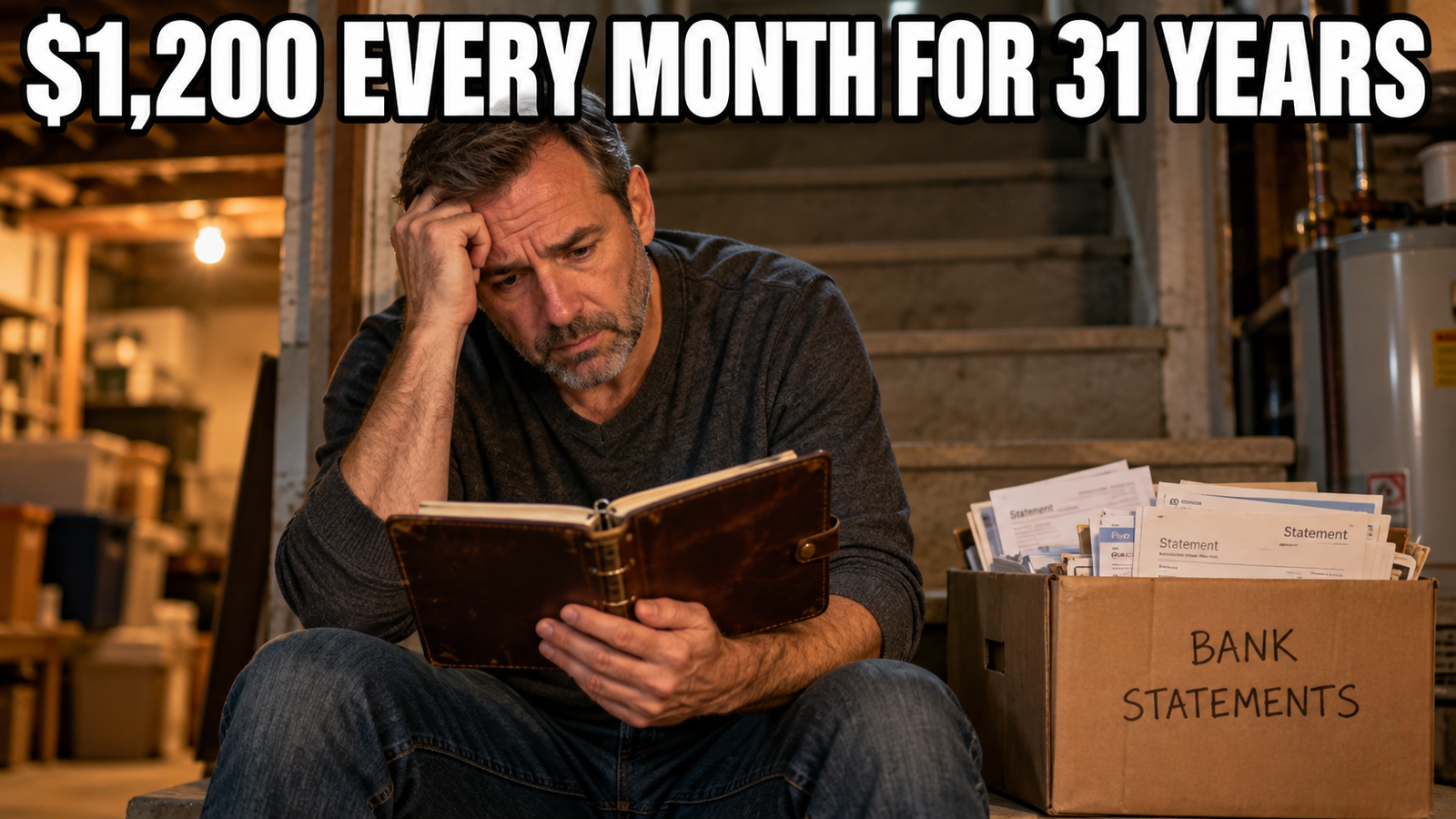
I didn’t know what to think, until I found his old day planners in a box in the basement. Every first of the month, there was the same entry in his tiny, cramped handwriting. A time, 10:00 a.m., and an address. It took me a minute to recognize it. Then I had to sit down on the basement stairs.
It was 88 Hawley Street. The house I grew up in until I was seventeen. The house we lost to the bank in 1994, when my father’s business failed and we moved into a rented duplex across town. The house he’d never once driven past again, as far as I knew.
PART 1 — 88 HAWLEY STREET
I knew the house before I’d finished parking.
The same white clapboard two-story. The same green shutters, though somebody had repainted them a darker green since 1994. The same front porch with the same swing hanging from rusty chains at the left end, where my mother used to sit and shell peas on summer evenings. The same oak tree in the front yard, bigger now, with a crack running down the trunk where lightning hit it the summer I was twelve.
88 Hawley Street, Binghamton, New York. The house I grew up in until I was seventeen.
I sat in my car at the curb with my father’s day planner open on the steering wheel. *January 1. 10:00 a.m. 88 Hawley.* He’d written it in his tiny, cramped handwriting on the first of every month for thirty-one years. The last entry was for this month. He’d died on January 14th. He’d been here thirteen days before he died.
He’d written it on the first of every month for thirty-one years. The last entry was for this month.
I’m forty-nine. I’m a high school chemistry teacher in Syracuse, divorced, with two teenage daughters. I’m the oldest of three. I’m the executor of my father’s estate because I’m the one who’s good with spreadsheets. And for two weeks, I’d been staring at bank statements, trying to figure out what my careful, frugal father had done with almost half a million dollars.
Now I knew where he’d taken it. I just didn’t know why.
I got out of the car and walked up the front walk. My legs felt strange. The last time I’d walked up these steps, I’d been carrying a cardboard box of my baseball trophies to a rented U-Haul.
I knocked.
PART 2 — THE CAREFUL MAN
My father, Walter Brenner, was the most careful man with money I’ve ever known.
He kept every receipt in labeled envelopes in a filing cabinet in the basement. He balanced his checkbook every Sunday night at the kitchen table with a mechanical pencil. He drove a 1998 Buick LeSabre until the floor rusted through in 2019, and then he bought a used 2011 one from a man at church. He cut his own hair. He reused aluminum foil. When my daughters were little, he gave them each a dollar for their birthdays and a lecture on compound interest.
So when he died in January at seventy-six, I expected a tidy estate. A simple will. A modest savings account and a paid-off condo.
The will was simple. The condo was paid off. But the bank statements were not what I expected.
On the first day of every month, for thirty-one years, he withdrew exactly twelve hundred dollars in cash.
On the first day of every month, for thirty-one years, he withdrew exactly $1,200 in cash from his checking account at the M&T Bank on Front Street. Every month. No exceptions. Not the month my mother had her gallbladder out. Not the month he had his own heart surgery in 2014. I found a withdrawal slip from February 1, 2014, signed in his handwriting. He’d had a triple bypass on January 28th. He’d been out of the hospital for one day.
I added it up on the kitchen table in his condo. Thirty-one years. Three hundred and seventy-two months. Four hundred and forty-six thousand, four hundred dollars.
Gone. In cash. No record of where.
PART 3 — WHAT EVERYONE THOUGHT
My mother had no idea. She’s seventy-four, and she cried when I showed her. She said they’d fought about money for their whole marriage. She said she’d always thought he was just stingy. She’d begged him for years to take her on a real vacation, to Florida, to Ireland, anywhere. He always said they couldn’t afford it.
“Four hundred thousand dollars,” she kept saying. “Four hundred thousand dollars, Doug. And he wouldn’t buy me a new winter coat.”
My sister Karen thought he’d been gambling. There’s a casino forty minutes away, in Vernon. My brother Phil thought there was another woman. He actually said it out loud at the kitchen table, in front of Mom. I kicked him under the table.
My brother Phil thought there was another woman. He actually said it out loud at the kitchen table, in front of Mom.
I didn’t know what to think. Gambling didn’t fit. My father thought lottery tickets were a tax on people who couldn’t do math. Another woman didn’t fit either. He’d held my mother’s hand in church every Sunday for fifty-one years.
But four hundred and forty-six thousand dollars doesn’t just disappear.
I spent a week trying to trace it. I called the bank and asked if there was any record of what he did with the cash. There wasn’t. I went through his credit card statements looking for anything unusual. Groceries. Gas. Church donations. A subscription to *Popular Mechanics.* Nothing. I checked whether he’d opened any other accounts, rented a safe deposit box, bought property anywhere. Nothing. For a man who wrote down every oil change for fifty years, he’d left no trail at all for the single largest expense of his life. That was the part that frightened me most. It meant he’d done it on purpose.
Then, in the second week of February, I went down to his storage unit to start sorting through his things, and I found the day planners.
PART 4 — THE DAY PLANNERS
There were thirty-one of them, one for every year from 1995 to 2025, plus this year’s, all identical, black vinyl with gold lettering, stacked in a cardboard box in the order he’d used them.
My father used day planners for everything. Dentist appointments. Oil changes. My daughters’ birthdays. Church committee meetings. He wrote it all down in his tiny, cramped handwriting.
And on the first of every month, in every planner, for thirty-one years, there was the same entry.
*10:00 a.m. 88 Hawley.*
On the first of every month, in every planner, for thirty-one years, there was the same entry.
It took me a minute to recognize it. Then I had to sit down on the floor of the storage unit.
88 Hawley Street was our house. The house where I grew up. The house I lived in from the day I was born until the spring of 1994, when I was seventeen and a senior in high school, and my father’s lumber business failed, and the bank took the house.
I remember that spring. I remember my mother crying in the kitchen while she wrapped dishes in newspaper. I remember my father standing in the front yard under the oak tree for a long time on the last morning, not saying anything. I remember we moved into a rented duplex across town on Robinson Street with thin walls and a landlord who smelled like cigars.
My father never drove past 88 Hawley Street again. That’s what we all believed. He told my mother once, a few years later, that he couldn’t bear to see it. That it would be like visiting a grave.
He’d been there three hundred and seventy-two times.
PART 5 — THE WOMAN AT THE DOOR
The woman who opened the door was about eighty, small and round, with short white hair and a face full of laughter lines. She was wearing a purple sweatshirt with a picture of a cardinal on it, and reading glasses on a beaded chain around her neck.
She looked at me for a long moment. Then her whole face changed, crumpled, the way a child’s face does right before they cry.
“You’re Walter’s boy,” she said. “Douglas. You’re the oldest.”
“Yes, ma’am.”
She put one hand on the door frame to steady herself. “I knew somebody would come,” she said. “When he didn’t come on February first, I knew. I’ve been watching that window for three weeks.” She looked at me with wet eyes. “Is he gone?”
“When he didn’t come on February first, I knew. I’ve been watching that window for three weeks.”
“He died in January,” I said. “His heart.”
She closed her eyes and pressed her hand against her mouth. She stood there in the doorway of my childhood home for a long time, crying silently, while I stood on the porch and didn’t know what to do with my hands.
Finally, she opened her eyes and stepped back.
“Come in, honey,” she said. “My name is Rosa Kearney. I think it’s time somebody told you about Hank.“
PART 6 — THE FIRE
The living room was different. New carpet, new wallpaper, a recliner where our couch used to be. But the fireplace was the same. The built-in bookshelves were the same. The little notches on the kitchen doorframe, where my mother measured our heights every birthday, were still there. Somebody had painted around them, carefully, for thirty years. They’d never painted over them.
Rosa sat me down at the kitchen table, in the same corner where ours used to be, and poured me a cup of coffee.
“My husband, Hank, worked for your father,” she said. “Night watchman at the lumber yard on Clinton Street. Eleven years. Your father thought the world of him.”
“My husband, Hank, worked for your father. Night watchman at the lumber yard. Eleven years.”
I remembered Hank. Barely. A big man with a gray mustache who used to give me butterscotch candies when I came to the yard with my father on Saturdays.
“On the night of February 8, 1994, there was a fire at the lumber yard,” Rosa said. “Started in the main warehouse. Faulty wiring in the old electrical panel. Hank called the fire department. Then he went back in to make sure nobody else was inside.” She paused. “There was a young man from the night crew who’d been sleeping in the break room. Hank got him out. But Hank didn’t make it back out himself.”
I’d known there was a fire. Everyone in Binghamton knew there’d been a fire. It’s why the business failed. The insurance didn’t cover the full loss, and the bank called in my father’s loans, and we lost everything. But I was seventeen and angry and selfish, and I never asked who’d been hurt. My father never talked about it.
I remembered the morning after. My father came home at six a.m. smelling like smoke, with his eyebrows singed. He sat down at the kitchen table in his coat and didn’t take it off. My mother made him coffee, and he held the mug without drinking it until it went cold. When I came downstairs for school, he looked up at me with an expression I’d never seen before and didn’t see again until the day my mother told him his own father had died. I thought he was upset about the business. I asked him if we were going to be okay. He said, “We’ll be fine, son. Go to school.” Then he put his face in his hands.
PART 7 — WHAT MY FATHER CARRIED
“Your father blamed himself,” Rosa said. “Completely. The electrician had told him the year before that the old panel in the warehouse needed replacing. It would have cost four thousand dollars. Your father kept putting it off. Business was slow. He thought he had time.”
She folded her hands on the table.
“He came to Hank’s funeral,” she said. “He stood at the back. Afterward, he came to our apartment. I had four children, Douglas. The youngest was three. Hank’s life insurance was five thousand dollars. The company’s insurance fought me on the rest.” She looked at me steadily. “Your father sat at my kitchen table and cried. And he told me it was his fault. He said he would take care of us. For as long as it took.“
He said it was his fault. He said he would take care of us. For as long as it took.
“But he’d lost everything too,” I said.
“He had,” Rosa said. “That spring, the bank took his business and his house. This house. And they put it up at a foreclosure auction in October.” She almost smiled. “Your father found out I’d been evicted from our apartment. He came to the auction with my oldest boy and me. He’d borrowed money from his brother in Scranton for a down payment, in my name. I bought your family’s house for forty-one thousand dollars.“
I couldn’t speak.
“He said if he couldn’t keep it for his family,” Rosa said quietly, “he wanted it to go to Hank’s.”
PART 8 — TWELVE HUNDRED DOLLARS
“The mortgage was four hundred and ten dollars a month,” Rosa said. “I couldn’t pay it. I was working at a laundromat. So your father paid it. In cash, on the first of every month, at ten o’clock in the morning. And the rest was for groceries and shoes and school clothes for my kids.”
“Twelve hundred dollars,” I said.
“It was always twelve hundred,” Rosa said. “From the very first month. He said that was exactly what Hank brought home in a month at the lumber yard, and he wasn’t going to pay Hank’s family a dollar less. He paid for my oldest boy, Michael, to go to community college. He paid for my daughter’s braces. When my youngest, Danny, needed surgery on his knee in 2003, your father paid the hospital directly.” She shook her head slowly. “I tried to stop him a hundred times. When the kids were grown. When the mortgage was paid off in 2009. He wouldn’t stop. He said Hank would have worked another twenty years, and that was twenty years of paychecks my family should have had.”
He said Hank would have worked another twenty years, and that was twenty years of paychecks my family should have had.
“And after twenty years?”
Rosa smiled sadly. “In 2014, I told him, Walter, it’s been twenty years. You’ve paid it all. You can stop now.” She wiped her eyes. “He said, ‘Rosa, I’m not paying anymore. Now I’m just visiting.’ He came every first of the month after that too. He’d fix whatever was broken. He’d have a cup of coffee. He’d sit right where you’re sitting. And he’d leave an envelope on the counter when I wasn’t looking.“
I looked down at the kitchen table. At the corner where we used to eat dinner. Where my father used to balance his checkbook every Sunday night with his mechanical pencil.
Rosa got up and went to the window over the sink. “He always parked right there,” she said, pointing at the curb. “Same spot. Ten o’clock on the dot. My grandkids used to wait on the porch for him. They called him Mr. Walt. He brought them butterscotch candies.” She turned around. “Hank used to carry those in his pocket. Your father started carrying them after the fire.”
PART 9 — WHY HE NEVER TOLD
“Why didn’t he tell us?” I said. My voice cracked. “My mother begged him for a vacation for thirty years. We all thought he was cheap. We thought he didn’t care.”
Rosa reached across the table and put her small hand over mine.
“He was ashamed, honey,” she said. “Not of helping us. Of the panel. Of the four thousand dollars he didn’t spend. He thought if your mother knew, she’d know that the fire was his fault. That Hank was gone because he’d waited. He thought you’d all look at him differently.” She squeezed my hand. “He told me once that the only thing harder than living with it was the idea of his wife and children knowing.”
“He told me once that the only thing harder than living with it was the idea of his wife and children knowing.”
I thought about my father under the oak tree on our last morning in 1994. Not saying anything. I’d thought he was grieving the house.
He’d been grieving Hank.
“There’s something else,” Rosa said. She got up slowly and went to a drawer by the stove. She came back with a manila envelope and set it in front of me. “He left this with me in December. He said if anything happened to him, I should give it to whichever one of his children came looking. He said it would probably be you.” She smiled through her tears. “He said you were the one who could never leave a column of numbers alone.”
Inside the envelope was a letter in my father’s tiny, cramped handwriting. Six pages. It started: *Doug, if you’ve found Rosa, you’ve found the numbers. Here’s what they add up to.*
PART 10 — WHAT IT ADDS UP TO
I read the letter in my car outside 88 Hawley Street. Then I drove straight to my mother’s condo and read it to her out loud at her kitchen table, with my brother and sister there too.
My mother cried through all six pages. When I finished, she didn’t say anything for a long time. Then she said, very quietly, “He should have told me. I would have helped him. I would have gone to that auction with him.”
“I know, Mom,” I said.
“Thirty-one years,” she said. “Thirty-one years of me thinking he didn’t want to take me to Ireland.” She laughed, a broken, wet sound. “And he was paying for somebody’s braces.”
“Thirty-one years of me thinking he didn’t want to take me to Ireland. And he was paying for somebody’s braces.”
In March, my mother drove to 88 Hawley Street with me. She sat in her old kitchen with Rosa Kearney for four hours. They cried and laughed and looked at the notches on the doorframe. Rosa showed her the rosebush my father planted by the back steps in 2002. My mother showed Rosa where she used to hide the Christmas presents, in a crawl space behind the upstairs closet. There was still a roll of 1993 wrapping paper up there.
Rosa’s son Michael came that afternoon.
He came straight from his shift, still in his navy department T-shirt, and stood in the kitchen doorway looking at my mother and me for a long moment before he said anything. Then he crossed the room and hugged my mother so hard her feet came off the floor. “Mrs. Brenner,” he said. “I’ve wanted to thank your family for thirty years.” He’s forty-four now. He’s a captain in the Binghamton Fire Department. He told us he became a firefighter because of the night his father died. And because of the man who came to their house every month after that and never once let them go without.
In June, Michael and his brothers organized something. They raised money from the fire department and the neighborhood and Hank’s old friends. On the first of July, at ten o’clock in the morning, they dedicated a small brass plaque on the side of the new fire station on Clinton Street, where the lumber yard used to be.
*In memory of Henry Kearney, who went back in. And Walter Brenner, who never stopped going back.*
My mother took her first trip to Ireland in September. My siblings and I paid for it. She took Rosa with her.
And on the first of every month, at ten o’clock in the morning, I drive to 88 Hawley Street. I have a cup of coffee at the kitchen table. I fix whatever’s broken. And when Rosa isn’t looking, I leave an envelope on the counter.
It doesn’t have twelve hundred dollars in it. It has a photograph. Every month, a new one. My father under the oak tree. My father at my wedding. My father holding my daughters.
Rosa says it’s the best part of her month.
I think my father would agree.