We bought the old Hartwell house in Galena, Illinois, in March. It’s a brick Victorian on a hill, built in 1890, and it had been empty for six years after the last owner, Mrs. Agnes Hartwell, died at 97. I’m 36, my husband is a carpenter, and fixing it up has been our dream.
In June, my husband was measuring the upstairs hallway and noticed it was four feet shorter than the room below it. He tapped on the wall at the end, behind a built-in bookcase. It sounded hollow. He found a latch under the bottom shelf, and the whole bookcase swung out like a door.
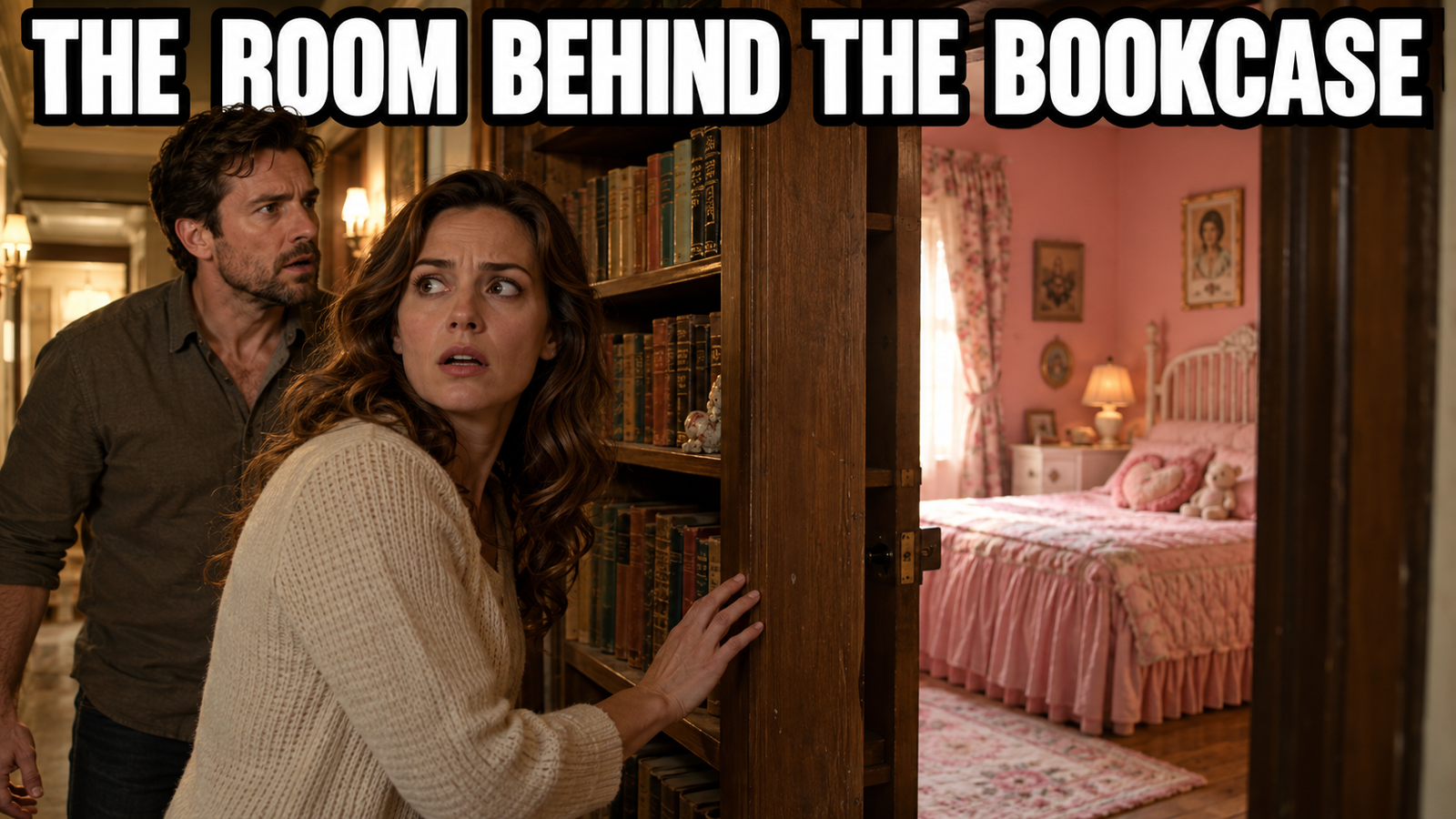
Behind it was a child’s bedroom. A narrow bed with a pink chenille spread. A dollhouse. A calendar on the wall from August 1968. Everything was covered in dust, but nothing had been touched. On the pillow was a stuffed rabbit with one ear sewn back on.
On the little desk, there was a school photograph in a cardboard frame. A girl of about seven, with a gap-toothed smile and a plaid dress. I picked it up, and my knees nearly gave out. Because I had the same photo. The exact same one. It was in my grandmother’s album, labeled in her handwriting: “Mary, second grade.”
My grandmother always told me her sister Mary had died as a baby. I called my mother. She said that was impossible. Then I sent her a picture of the photo, and she called me right back, and her voice was shaking. “Read me the name on the back,” she said.
PART 1 — THE HARTWELL HOUSE
We bought the old Hartwell house in Galena, Illinois, in March. It’s a red brick Victorian on the hill above Main Street, built in 1890 by a lead-mining family, with a wraparound porch, a turret, and eleven-foot ceilings. It had been empty for six years after the last owner, Mrs. Agnes Hartwell, died in 2020 at ninety-seven. Her estate had been tied up in probate, and by the time it was settled, the house had raccoons in the attic and a maple sapling growing out of one gutter.
I’m thirty-six. I teach fourth grade at the elementary school in Elizabeth. My husband, Matt, is a finish carpenter who specializes in old houses. We’d been driving past the Hartwell house for ten years, dreaming. When it finally went on the market, at a price nobody else wanted to pay for that much work, we didn’t even sleep on it.
We’d been driving past the Hartwell house for ten years, dreaming.
The first three months were demolition and plumbing and more raccoons. By June, Matt had moved on to the second floor. He was measuring the upstairs hallway one Saturday morning, planning to refinish the oak floors, when he called me up from the kitchen.
“Tess,” he said. “Something’s off.”
The upstairs hallway, he showed me, was four feet shorter than the dining room directly underneath it. The hall ended at a tall built-in bookcase, full of moldy Reader’s Digest Condensed Books. Behind that bookcase, according to his tape measure, there should have been another four feet of house. But there was no door. No room. Just a wall.
Matt rapped on the back panel of the bookcase with his knuckles. It sounded hollow.
PART 2 — THE LATCH
It took him twenty minutes to find it. A small brass latch, painted over the same cream color as the bookcase, tucked up under the bottom shelf where you’d never see it unless you were lying on the floor. Matt lay on his back and worked it loose with a flathead screwdriver.
It clicked. And the whole bookcase swung out from the wall like a door, on hinges so well-made they barely creaked.
Behind it was a child’s bedroom.
Behind it was a child’s bedroom.
Not a closet. Not storage. A real bedroom, small and narrow, with a window that had been covered from the outside with a board. In the light from the hallway, I could see a narrow white iron bed with a pink chenille bedspread. A braided rag rug. A child’s desk and chair. A dollhouse on a low table, a Victorian dollhouse, a little copy of this very house, with its own turret and its own tiny porch.
A wall calendar from a Galena bank hung above the bed. It was turned to August 1968. Nothing after that.
Everything was covered in a thick gray blanket of dust. But nothing had been touched. Nothing had been moved. On the pillow, propped up as if someone had just made the bed that morning, was a stuffed pink rabbit with one ear sewn back on by hand.
Matt and I stood in the doorway for a long time without speaking. It felt like walking into a church. Somewhere in the house, a pipe ticked as it cooled. Outside, a car went by on the hill. In that little room, nothing moved at all. Even the dust seemed to be holding its breath.
PART 3 — THE PHOTOGRAPH
I went in first. Carefully. I didn’t want to disturb anything.
On the little desk were a few school things. A box of eight Crayola crayons. A Dick and Jane reader. A pencil box with a cartoon on the lid. And a school photograph in a cardboard frame, the kind every kid used to bring home in the fall.
A girl of about seven, with a gap-toothed smile, a short brown pixie cut, and a plaid dress with a white Peter Pan collar. She was looking straight at the camera, delighted with herself.
I picked it up. And my knees nearly gave out from under me.
I had the same photograph. The exact same one.
Because I had the same photograph. The exact same one. Same plaid dress, same gap-toothed grin, same little cardboard frame. It was in my grandmother’s photo album, the brown leather one that sat on the bookshelf in my parents’ living room in Dubuque. I’d looked at it a hundred times as a kid. It was on a page by itself, held in with little black paper corners, labeled underneath in my grandmother’s neat schoolteacher handwriting: Mary, second grade.
My grandmother, Anne Kearney Sullivan, died in 2018 at seventy-four. She was the oldest of five children. And she always told me her baby sister, Mary, had died when she was very little. “She was just a baby, Tessie,” she’d say, and close the album. “I don’t like to talk about it.”
But this wasn’t a baby. This was a seven-year-old girl in a second-grade picture. In a secret bedroom, in a house twenty miles from where my grandmother grew up.
PART 4 — MY MOTHER
I called my mother from the hallway with the photograph in my hand.
My mother, Peggy, is sixty-two. She lives in Dubuque. When I told her what we’d found and described the photograph, she said, “That’s impossible, honey. Aunt Mary died as a baby. Mom always said so.”
“Mom,” I said. “Look in Grandma’s album. The page with Mary, second grade.”
She was quiet. I heard her walk across her living room. I heard her pull the album off the shelf. And then I heard her stop breathing.
“I’ll send you a picture of this one,” I said. I sent it.
She called me back in less than a minute. Her voice was shaking.
“Tessa,” she said. “Read me the name on the back.”
“Read me the name on the back.”
I hadn’t thought to look. I turned the little cardboard frame over. On the back, in faded blue ballpoint, in a grown woman’s careful cursive, someone had written:
Mary Kearney Hartwell. Second grade, Galena Elementary. September 1967. Our girl.
My mother made a sound I’d never heard her make. Then she said, very quietly, “Kearney. That was Mom’s maiden name. Oh, Tessa. What did they do?”
PART 5 — THE LETTERS
My mother drove down from Dubuque that afternoon. Matt had pried the board off the outside of the little bedroom window, and by the time she arrived, the late afternoon light was coming through the glass for the first time in fifty-eight years, falling across the pink bedspread and the dusty rabbit.
My mother stood in the doorway and cried. She’d grown up with that album. She’d turned those pages as a girl, the same way I had, and asked the same questions, and gotten the same answer. She was just a baby. She said later that standing in that doorway felt like finding out a door in her own childhood home had been locked her whole life, and somebody had finally handed her the key.
We went through the room together, slowly, carefully, wearing cotton gloves Matt found in his truck. In the bottom drawer of the little desk, under a stack of construction-paper drawings, we found a bundle of letters tied with pink yarn.
We found a bundle of letters tied with pink yarn.
There were twenty-two of them. Every one was addressed in the same careful cursive as the back of the photograph. Every one began the same way. My darling Mary. And not one of them had ever been mailed. They were dated once a year, every August, from 1969 to 1990.
The first one said:
My darling Mary. It has been a year today since they came for you. I have not opened your room. I won’t, not until you come home. Your rabbit is on your pillow. Your dollhouse is waiting. Henry says I must stop hoping, but I cannot. I will write to you every year until I find you. You will always be our girl. Mama Agnes.
My mother sat down on the edge of the little white bed and read it three times. “Mama Agnes,” she said. “Mrs. Hartwell. She raised her. Mary lived here.”
PART 6 — WHAT GRANDMA NEVER SAID
It took us most of the summer to piece it together. There were weekends I wanted to give up. There were nights I lay awake wondering whether some secrets are better left behind walls. County records in Galena. Old newspapers at the library. And one long afternoon with my grandmother’s last living brother, my great-uncle Jim Kearney, who’s seventy-nine and lives in a care home in Platteville, Wisconsin.
My grandmother’s family had been dirt poor. Five kids in a three-room farmhouse outside Hanover. Their mother died of a stroke in 1964, when Mary, the baby, was three. Their father, Leo Kearney, drank. The older kids were old enough to fend for themselves. Mary wasn’t.
“Dad couldn’t take care of a three-year-old,” Uncle Jim said. “He couldn’t take care of himself.”
“Dad couldn’t take care of a three-year-old,” Uncle Jim said, looking out his window at the bird feeder. “He couldn’t take care of himself. The county stepped in. They placed Mary with a couple in Galena who couldn’t have kids of their own. The Hartwells. Rich folks, but kind. Annie was twenty, just married. She wanted to take Mary herself, but her husband said no, they couldn’t afford it.”
So Mary grew up in the Hartwell house from 1964 to 1968. Agnes and Henry Hartwell loved her like their own. They let my grandmother visit every few months. Agnes gave her a copy of every school picture. My grandmother pasted them in her album and labeled them in her schoolteacher hand.
“So what happened in August 1968?” I asked.
Uncle Jim was quiet for a long time.
“Dad got sober,” he said finally. “For a while. Married a woman from Iowa. And he decided he wanted his little girl back.” Uncle Jim’s eyes filled. “Annie’s the one who told him where she was. She didn’t mean any harm. She thought he’d just visit. But he went to a judge. In those days, a father’s rights came first, no matter what. In August of ’68, a social worker came and took Mary out of that house. Dad and his new wife moved to California the next week. Nobody ever heard from any of them again.”
PART 7 — ANNIE'S GUILT
“Annie never forgave herself,” Uncle Jim said. “Never. She wrote to every address she could find in California for ten years. Nothing came back. After a while, she just couldn’t bear it. She started telling her kids that Mary died when she was little.” He shook his head. “I think in her heart, it was easier to grieve her than to keep looking for her.”
“It was easier to grieve her than to keep looking for her.”
I thought about my grandmother closing that album every time I asked about Mary. She was just a baby, Tessie. I don’t like to talk about it. Fifty years of carrying that by herself.
And I thought about Agnes Hartwell, alone in this big brick house on the hill. Henry died in 1979. Agnes lived another forty-one years. She never remarried. She never moved. She never opened the door behind the bookcase. And every August for twenty-two years, she wrote a letter to a little girl and put it in the desk drawer, because she didn’t know where else to send it.
The last letter, from August 1990, was shorter than the others. Her handwriting had started to shake.
My darling Mary. You would be twenty-nine now. A grown woman. Maybe a mother yourself. I hope someone loves you the way I did. I am going to close up your room for good now. Not because I’ve stopped hoping. Because I can’t bear to keep looking at the door. If you ever come back, the latch is under the bottom shelf. You always knew where it was. You helped Henry build it. Mama Agnes.
PART 8 — FINDING MARY
Mary would be sixty-five. If she was alive.
I’m not a detective. But I’m a fourth-grade teacher, and I know how to be stubborn. I spent August on it. Every evening after Matt went to bed, I sat at the kitchen table with my laptop and a legal pad and a pot of coffee. I made lists of every Leo Kearney in California. I called county clerks in Kern and Fresno and Tulare. Most of them were kind. Some of them were not. One woman in Stockton hung up on me twice. I kept going anyway. I kept thinking about twenty-two letters in a desk drawer, and a woman who never stopped. Birth and marriage records in California. Old city directories. A genealogy forum where a retired librarian in Fresno took pity on me and spent three weeks helping.
We found her in September. Mary Kearney had married in 1981 in Bakersfield. She was Mary Delgado now. She’d been a pediatric nurse for thirty-five years and had just retired. She had three grown children and five grandchildren. She lived in Sacramento. Her husband, Manny Delgado, had passed away four years before. Her obituary for him, in the Sacramento Bee, mentioned that she’d volunteered for twenty years at a children’s hospital program that matched foster kids with mentors. I read that line three times before I could keep going.
She’d been a pediatric nurse for thirty-five years and had just retired.
I wrote her a letter. It took me four drafts. I kept trying to explain everything, and every version came out too long or too strange. In the end, I just wrote down what we’d found, as plainly as I could, and let it speak for itself. A real one, on paper, because it seemed right. I told her who I was. I told her about the house, and the room, and the rabbit, and the dollhouse. I told her about the twenty-two letters. I sent a photograph of the room with the light coming through the window.
She called me eight days later, on a Thursday night. I knew who it was before I picked up.
Her voice was warm and a little hoarse, with a California flatness to it. “Is the dollhouse still there?” she said. That was the first thing. Not hello. “The little one with the turret. Is it still there?”
“It’s still there,” I said. “Everything’s still there.”
She was quiet for a long time. Then she said, “I thought I made it up. All my life. A big brick house, and a pink room, and a lady who sang to me. My father told me I dreamed it. He said I’d never lived anywhere but with him.” She started to cry. “I used to draw that house in school. Over and over. The teachers thought I was making it up.”
PART 9 — MARY COMES HOME
Mary flew to Chicago in October, and we drove her out to Galena. Her daughter came with her. My mother came down from Dubuque. Great-uncle Jim came in his wheelchair from Platteville, and he held Mary’s hand in the back seat of my car the whole way from the airport and didn’t let go.
When we pulled up in front of the house, Mary sat in the car for a long moment, looking up at the turret and the brick and the wraparound porch. Her daughter, Elena, reached over from the back seat and squeezed her shoulder. Uncle Jim still hadn’t let go of her hand.
“It’s real,” she said softly. “It was always real.”
“It’s real,” she said softly. “It was always real.”
I’d asked Matt not to change anything in the little room. He’d only cleaned it. Washed the windows, dusted the dollhouse, vacuumed the rag rug, and laundered the pink chenille spread. Everything else was exactly as Agnes left it in 1968.
Mary walked up the stairs slowly, holding the railing. At the end of the upstairs hallway, she stopped in front of the bookcase. Then, without anybody telling her, she knelt down, slid her hand under the bottom shelf, and found the latch on the first try.
“Henry let me help him put it in,” she said, laughing and crying at the same time. “He said it was a secret door, just for me. I was six.”
She swung the bookcase open and walked into her room for the first time in fifty-eight years. She picked up the pink rabbit from the pillow. She held it against her face. And she sat down on the edge of the little iron bed, a sixty-five-year-old retired nurse with gray hair, and rocked back and forth like a child.
PART 10 — OUR GIRL
Mary read all twenty-two of Agnes’s letters that night, sitting at our kitchen table, with my mother on one side and her daughter on the other. It took her three hours. When she finished, she folded them carefully back into their bundle and retied the pink yarn.
“She never stopped,” Mary said. “Twenty-two years.”
“Neither did my grandmother,” my mother said quietly. And she gave Mary the brown leather album, with all of Mary’s school pictures in it, each one labeled in my grandmother’s neat hand. Mary, first grade. Mary, age 5. Mary, second grade.
“She never stopped,” Mary said. “Twenty-two years.” “Neither did my grandmother.”
Mary held the album in her lap for a long time. She turned the pages slowly. Kindergarten, with a missing front tooth. A summer picture on the Hartwells’ porch, in a sun hat. Her first communion, in a white dress Agnes had sewn. At each one she stopped and touched the face, as if she were saying hello to a little girl she’d been told all her life was imaginary. Then she said the thing that made all of us cry.
“Everybody thought they lost me,” she said. “Annie. Agnes. Everybody. And I thought I’d lost them. But I was never lost. I was just in the wrong place.” She smiled at my mother through her tears. “I’m not lost anymore.”
Mary stayed with us for a week. She slept in her old room, in the narrow white iron bed. Matt built her a new mattress for it, but everything else stayed the same. The dollhouse. The rag rug. The rabbit with one sewn-on ear. She’s promised to come back every August, for two weeks, for as long as she’s able. Her grandchildren are coming next summer. She wants them to see the latch.
On her last morning, we all went up to Greenwood Cemetery together. Mary, my mother, me, Matt, Uncle Jim in his wheelchair, and Mary’s daughter. We stopped first at my grandmother’s grave, and then at Agnes and Henry Hartwell’s, side by side under a big white oak with its leaves just turning gold.
Mary had written a letter of her own the night before, at our kitchen table. She read it out loud and left it on the stone, tucked under a small rock. It was very short.
Dear Mama Agnes. I found the latch. I came home. Your girl, Mary.