I read the obituaries every morning with my coffee. It’s a habit I picked up from my late husband, Ray, who said it was the only section of the newspaper that never lied. Ray died three years ago. I’m 74, and I still read them for him.
On a Thursday in April, I read one for a woman in Duluth, Minnesota, named Hazel Lindqvist, 96. Retired schoolteacher. Loved her garden and her church choir. Preceded in death by her husband, Arvid. And then, at the very bottom: “Preceded in death by her beloved son, Raymond, whom she never stopped looking for.”
That could be anyone, I told myself. There are a lot of Raymonds. But the obituary listed his birthday. March 3, 1949. My husband’s birthday. And his birthplace, Duluth. Ray told me he was born in Chicago and raised by an aunt after his parents died in a car accident. He said there were no photographs. He said it hurt too much to talk about.
I called the funeral home in Duluth. I told them who I was. The director put me on hold for a long time. When she came back, she said Mrs. Lindqvist’s daughter would like very much to speak with me. She said the family had been looking for Raymond for nearly sixty years.
Then she said something else. She said that every year on March 3, for as long as anyone could remember, a birthday card had arrived at Hazel Lindqvist’s house with no return address, postmarked from my town.
PART 1 — THE ONLY HONEST SECTION
I read the obituaries every morning with my coffee. It’s a habit I picked up from my late husband, Ray, who read them every day of the forty-eight years we were married. He used to say it was the only section of the newspaper that never lied. “Nobody spins an obituary,” he’d say, folding the paper back. “It’s just who you loved and who loved you back.”
Ray died three years ago, in January of 2023, at seventy-three. A heart attack, shoveling snow off our front walk, which I’d begged him not to do. I’m seventy-four. I still live in our little blue house in Eau Claire, Wisconsin. And I still read the obituaries every morning, in his chair, with his reading glasses, because it makes me feel like he’s still sitting across the table.
“Nobody spins an obituary. It’s just who you loved and who loved you back.”
I read them online now, too. The local ones, and sometimes ones from towns we used to visit. Duluth, where we went for our honeymoon. Minneapolis, where our son lives. Ray always said the obituaries were the best way to learn about a place. You found out who the town loved.
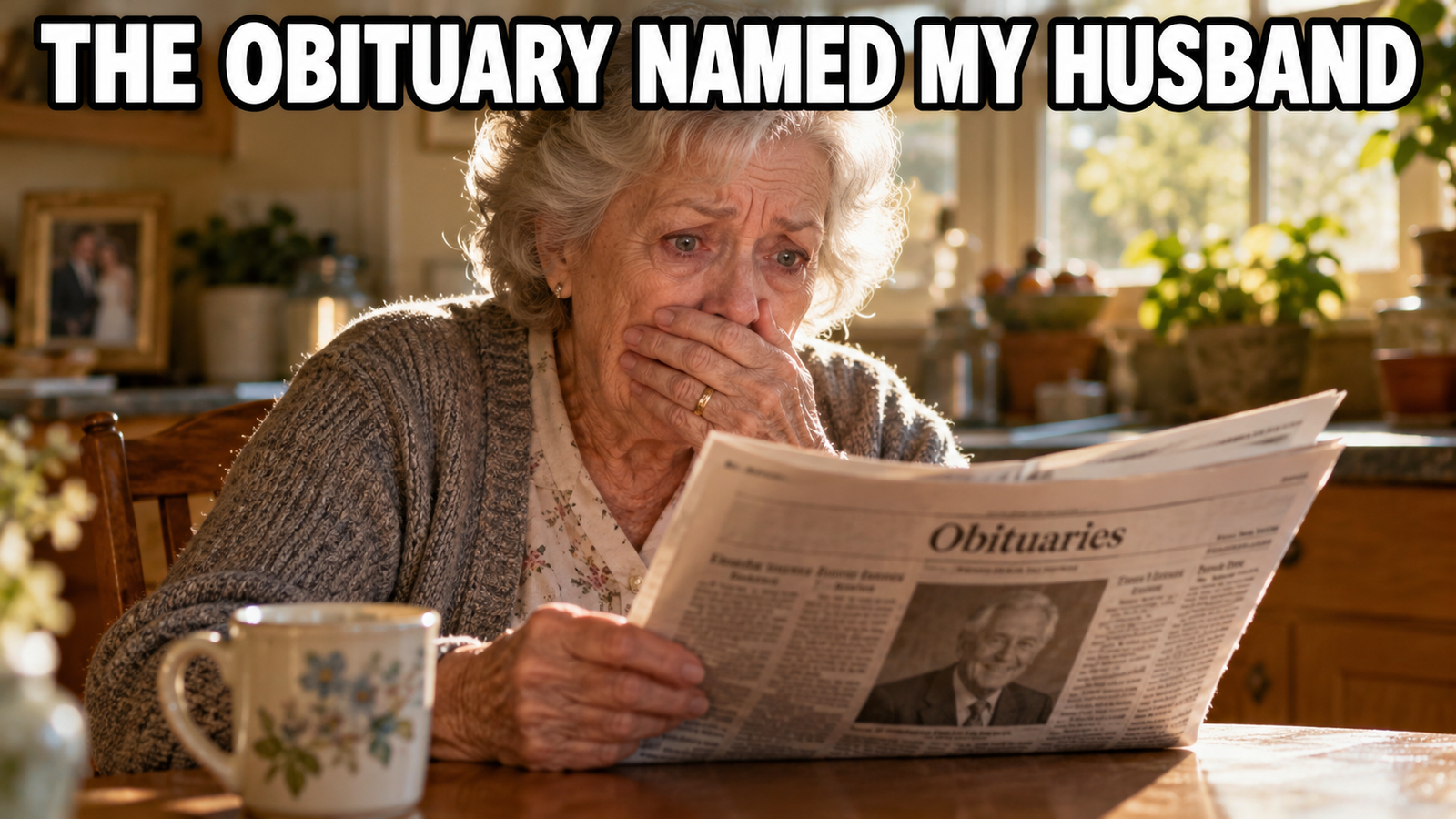
On a Thursday morning in April, I was scrolling through the Duluth News Tribune when I came to one for a woman named Hazel Lindqvist, ninety-six.
It was a lovely obituary. The kind Ray would have read out loud to me. Retired third-grade teacher at Lester Park Elementary for thirty-eight years. Sang alto in the choir at Glen Avon Presbyterian for seventy. Grew prize-winning dahlias. Loved her grandchildren, her garden, and Lake Superior in every season. Preceded in death by her husband, Arvid Lindqvist, in 1989.
And then, at the very bottom, one last line.
She was also preceded in death by her beloved son, Raymond Arvid Lindqvist, born March 3, 1949, whom she never stopped looking for.
PART 2 — MARCH THIRD
I read that line four times.
There are a lot of Raymonds. I knew that. I told myself that out loud, sitting in Ray’s chair with his glasses on. There are thousands of Raymonds in Minnesota. It was a common name for boys born in 1949.
But March 3, 1949, was my husband’s birthday.
But March 3, 1949, was my husband’s birthday.
Ray told me he was born in Chicago. He told me his parents died in a car accident on an icy road when he was twelve, and he’d been raised by an elderly aunt in Gary, Indiana, who passed away before I ever met him. He said there were no photographs. He said there was no family left. He said it hurt too much to talk about, and after a while, I stopped asking. I didn’t want to hurt him. When our daughter was in sixth grade and had to make a family tree for school, Ray helped her draw it on poster board. On his side, he drew only his own name, with two empty boxes above it. Julie asked why the boxes were empty. Ray said, “Some trees lose branches in a storm, sweetheart,” and kissed the top of her head, and went out to the garage. I remember thinking it was the saddest thing I’d ever heard him say.
I met Ray in 1974, in Eau Claire. He was twenty-five, working construction, a big, quiet, gentle man with sandy hair and a laugh you could hear across a parking lot. He’d come to Wisconsin, he said, because he liked the lakes. We married in 1975. We had two children. He built half the houses on our street. He was the best man I ever knew.
And I realized, sitting there at my kitchen table, that I had never once seen his birth certificate.
When we got our marriage license in 1975, he’d brought a Wisconsin driver’s license and a Social Security card. I’d never thought about it. Why would I?
PART 3 — THE FUNERAL HOME
I called the funeral home listed at the bottom of the obituary. Williams Lobermeier Boettcher, in Duluth. A young woman answered. I told her my name, Nancy Larson. I said I’d read Mrs. Lindqvist’s obituary, and I thought I might have known her son.
She put me on hold. It was a long hold. Long enough that I almost hung up.
When she came back, her voice had changed. Softer. Careful.
“Mrs. Larson,” she said, “Mrs. Lindqvist’s daughter is here at the funeral home right now, making arrangements. She’s asked if she could speak with you. Would that be all right?”
“She’s asked if she could speak with you. Would that be all right?”
Before I could answer, she said something else.
“I should tell you, ma’am, that the family has been looking for Raymond for a very long time. Nearly sixty years. And there’s one more thing.” She hesitated. “Mrs. Lindqvist’s daughter says that every year on March third, for as long as she can remember, a birthday card arrived at her mother’s house. No return address. No signature. Just a card. And it was always postmarked Eau Claire, Wisconsin.”
I couldn’t speak.
“The cards stopped three years ago,” the young woman said gently. “The family says that Mrs. Lindqvist told them, the March there wasn’t one, ‘Well. He’s gone, then.’ And she never mentioned it again.”
PART 4 — INGRID
Ray’s sister’s name is Ingrid. She’s seventy-two. I’ll never forget her voice the first time I heard it on the telephone. Low and careful, with that soft northern Minnesota lilt, and so much like Ray’s that I had to sit down on the kitchen floor.
“Mrs. Larson,” she said. “Nancy. Can you tell me what he looked like?”
I told her. Six foot two. Sandy hair that went white early. A scar through his left eyebrow. A crooked front tooth he refused to get fixed.
“The scar’s from the dock at Brighton Beach,” she said. “He fell off when he was eight. I pushed him.”
There was a long silence. Then Ingrid laughed, and cried, at the same time.
“The scar’s from the dock at Brighton Beach,” she said. “He fell off when he was eight. I pushed him.” She took a breath. “Nancy, I think you’d better come to Duluth. And bring every picture you’ve got.”
I drove up the next morning. I barely slept that night. I lay in our bed in the dark and went through forty-eight years of marriage, one memory at a time, looking for the seams. There were more than I’d ever noticed. The way he always changed the subject when someone asked where he went to high school. The way he refused to fly, ever, because you had to show identification. The way he got quiet every spring, around the beginning of March. Two and a half hours north, through pine forests that still had snow in the shadows. My son, Mark, drove up from Minneapolis to meet me. I hadn’t told him much on the phone. I didn’t know how.
Ingrid Lindqvist Moe lives in a small yellow house on a hill above Lake Superior, with a view of the lift bridge. She opened the door before we knocked. She was tall and silver-haired, with Ray’s exact blue eyes and Ray’s exact way of tilting her head when she looked at you. She looked at me for a long moment. Then she looked at my son.
“Oh,” she said softly, and put her hand over her mouth. “Oh, he looks just like Dad.”
PART 5 — 1967
We sat in Ingrid’s kitchen with coffee and a plate of Swedish ginger cookies, and she told us who my husband had been, before he was mine.
Raymond Arvid Lindqvist was born in Duluth on March 3, 1949, the first child of Arvid and Hazel Lindqvist. Arvid was a foreman at the steel plant in Morgan Park and a decorated veteran of the Battle of the Bulge. Hazel taught third grade. Ingrid came along in 1954.
“Ray was the golden boy,” Ingrid said, smiling. “Captain of the hockey team at Duluth East. Straight A’s. Everyone in Lakeside knew him. He wanted to be an architect. He drew houses all the time, on napkins and notebook paper. Dad was so proud of him he could hardly stand it.”
“He wanted to be an architect. He drew houses all the time, on napkins and notebook paper.”
I thought of Ray, sitting at our kitchen table, sketching floor plans on paper napkins for the houses he built. I’d never once asked why.
“In the spring of 1967,” Ingrid said, “Ray turned eighteen. And his draft notice came that fall.” She was quiet for a moment. “He didn’t believe in the war. He’d read everything. He and Dad argued about it every night at supper for months. Terrible fights. Dad had fought in Belgium in the snow. He couldn’t understand it. He said a Lindqvist doesn’t run.”
On the night of December 2, 1967, after the worst fight of all, Arvid told his son that if he refused the draft, he was no son of his. That he should never come home again.
“Ray went upstairs and packed a bag,” Ingrid said. “He came into my room and kissed me on the forehead. I was thirteen. He told me to take care of Mom. And he walked out the front door into the snow, and we never saw him again.”
PART 6 — RAY LARSON
My son had gone very pale.
“Dad was a draft resister?” Mark said slowly. “Dad?”
I understood it all at once. Ray had gone underground in 1967. He’d become someone else. Raymond Lindqvist from Duluth became Ray Larson from Chicago, with a dead set of parents and an aunt in Gary who never existed. A common Scandinavian name. An ordinary face. In 1967 and 1968, thousands of young men did it. Some went to Canada. Some just disappeared into the middle of the country, under new names, and built quiet lives.
Raymond Lindqvist from Duluth became Ray Larson from Chicago.
In 1977, President Carter pardoned all the draft resisters. I remember it being in the news. I remember Ray reading the paper that morning at our kitchen table, and folding it up without a word, and going out to the garage. He stayed there all day. He told me he was fixing the lawnmower.
“He could have come home then,” Ingrid said. “After the pardon. Mom prayed he would. She wrote letters to every newspaper in the Midwest, asking if anyone knew him.” She shook her head. “But Dad was still alive. And I think Ray couldn’t face him. And by then he had you, Nancy. A wife. A baby. A whole life built on a different name. How do you walk into that and tell everyone you’ve been lying for ten years?”
I thought about the night Mark was born, in 1977. Ray had held him in the hospital and cried and cried. I’d thought it was just happiness. Now I wondered if he’d been thinking about his own father. About a door in Duluth he could never walk back through.
PART 7 — THE BOX OF CARDS
Ingrid went to the hall closet and came back with a shoebox. A Minnetonka moccasin box, soft and faded. She set it on the table in front of me.
Inside were birthday cards. Fifty-five of them. One for every March third from 1968 through 2022.
Every one had been mailed in a plain white envelope with no return address. Every one was postmarked Eau Claire, Wisconsin. And every one was a birthday card for a boy. A boy turning nineteen. A man turning thirty. A man turning fifty. Inside, there was never a message. Never a signature. Just the card, sent on his own birthday, to the only person in the world who’d know what it meant.
Just the card, sent on his own birthday, to the only person in the world who’d know what it meant.
“Mom got them every year,” Ingrid said. “She’d set the card on the windowsill over the kitchen sink, where she could see the lake. She’d leave it there all month. She never said a word about it to Dad. After he died in 1989, she’d talk about it with me. She said, ‘He’s telling me he’s alive, Ingrid. Every year. He’s telling me he’s still here.'”
My hands were shaking so badly that Mark had to hold the box steady for me. Fifty-five cards. Fifty-five trips to a drugstore, fifty-five plain envelopes, fifty-five stamps, fifty-five walks to a mailbox, every one of them made in secret, every one of them while I was right there beside him, never once suspecting a thing. I’d been married to the most faithful man in Wisconsin, and his great secret turned out to be a birthday card for his mother. I picked up the last card. March 2022. A big, cheerful cartoon card with a cake on it, the kind you buy at Walgreens. Happy 73rd Birthday!
Ray had been in Walgreens that February with me. I remembered it. He’d wandered off to the card aisle while I picked up my prescription. I’d asked him what he was looking for. He’d said, “Just looking.” And he’d come back empty-handed. Or so I’d thought.
PART 8 — HAZEL'S LETTER
Hazel Lindqvist knew her son was gone in March of 2023, when no card came. Ingrid said she sat at the kitchen window looking at the lake all day. She didn’t cry. She just said, “Well. He’s gone, then.” And the next morning she got up and went to choir practice.
But she’d left something for him. Or for whoever came looking.
Ingrid handed me a sealed envelope from the shoebox. On the front, in a shaky, old-fashioned teacher’s cursive: For Raymond’s family, if they ever come.
On the front, in a shaky teacher’s cursive: For Raymond’s family, if they ever come.
I opened it at Ingrid’s kitchen table, with my son’s hand on my shoulder.
To whoever loved my Raymond,
I don’t know your name. I’ve imagined you for fifty years. I hope he married someone kind. I hope he had children. I hope he built houses, because he always wanted to.
Please tell his children that their grandfather was a good man who said a terrible thing in anger, and spent the last twenty years of his life wishing he could take it back. Arvid kept Raymond’s hockey jersey in his dresser until the day he died. He asked for him at the end. He said, “Tell Ray I was wrong. Tell him I’m proud of him.” I have been waiting thirty-seven years to deliver that message.
And please tell Raymond, wherever he is now, that I got every card. Every single one. He never missed a year. Not one. I knew he was out there, and I knew he was thinking of me, and that was enough to carry me.
With all the love I never got to give him, Mom.
PART 9 — THE FAMILY
My son, Mark, sat at Ingrid’s kitchen table and cried with his face in his hands. He’s forty-nine. A civil engineer. He builds bridges. Ingrid told him, later, that his grandfather Arvid had wanted to be an engineer too, before the war.
My daughter, Julie, drove up from Madison that night. She’s forty-six. She has Ray’s laugh. When Ingrid heard it in the doorway, she had to sit down.
When Ingrid heard it in the doorway, she had to sit down.
We stayed in Duluth for a week. Ingrid wouldn’t hear of us staying in a hotel. She put me in her guest room, which had a quilt on the bed that Hazel had made in 1960. Mark slept on the pullout couch in the den, under a framed photograph of the Duluth East hockey team from 1966. Ray was in the back row, grinning, with his helmet under his arm. Mark lay awake half the night looking at it. In the morning he said, “I always wondered why Dad knew so much about hockey for a guy from Chicago.” Ingrid showed us everything. The house on Jay Street where Ray grew up, white with green shutters, and the window of his old bedroom, the one he walked out of in 1967. The rink at Duluth East where he played hockey. The dock at Brighton Beach where his sister pushed him in. Hazel’s grave and Arvid’s grave, side by side at Forest Hill Cemetery, looking out over the lake.
There were cousins. So many cousins. Ingrid’s three children, and their children. Arvid’s brother’s family, out in Two Harbors. Thirty-one people came to a potluck at Glen Avon Presbyterian in our honor on the Sunday after Hazel’s memorial service. They brought hotdish and lefse and seven-layer bars, and every single one of them wanted to hear about Ray.
I told them. I told them all of it. The houses he built. The way he sang off-key in the car. The way he read the obituaries every morning and said they were the only honest section of the newspaper.
Ingrid laughed when I told her that. “Of course he did,” she said. “He was waiting to read hers.”
PART 10 — MARCH THIRD
I changed something in our family this year.
Last week I drove to Walgreens in Eau Claire. I went to the card aisle, the same one Ray wandered down in February of 2022. I picked out a big, cheerful birthday card with a cake on it. Happy 78th Birthday.
It’s in my kitchen drawer now, in a plain white envelope with no return address, already stamped. On March third, Ray’s birthday, I’m going to mail it to Ingrid Lindqvist Moe, on a hill above Lake Superior, in Duluth, Minnesota. I’m not going to write anything inside. I’m not going to sign it. She’ll know.
On March third, I’m going to mail it to Ingrid Lindqvist Moe, on a hill above Lake Superior.
When I told her my plan on the phone, she was quiet for a long moment. Then she laughed and cried at the same time.
“It’ll go on the windowsill over the sink,” she said. “Where Mom always kept them. Where I can see the lake.”
In September, we went back to Duluth, all of us, and we put up a small stone at Forest Hill, beside his parents. Ray is buried in Eau Claire, next to the plot I’ll share with him someday, and I won’t move him. But he deserved a stone at home too. So he has one. We chose the words together, Ingrid and Mark and Julie and me, around Ingrid’s kitchen table.
Raymond Arvid Lindqvist. 1949–2023. Known as Ray Larson. Builder of houses. He never missed a birthday.
I still read the obituaries every morning, in Ray’s chair, with his glasses. Some mornings, I read them out loud, the way he used to. The cat doesn’t mind. Ray would have laughed at that. He never liked cats. I read the Duluth ones now too. It feels like his town is my town now.
And every once in a while, I think about what he used to say. The only honest section of the newspaper. Just who you loved and who loved you back.
He was right. It just took me forty-eight years and his mother’s obituary to understand how much he meant it.