When my grandfather moved into assisted living last month, I was the one who cleaned out his workshop in the garage. I’m 29, I live closest, and nobody else wanted the job. Grandpa Hal is 91 and was a machinist for forty years. The workshop was full of coffee cans of screws and jars of nails.
On the top shelf, behind a row of paint cans, was a small tin box. It once held throat lozenges. I almost tossed it with the junk. Then I shook it and heard something rattle, and I opened it.
Inside were baby teeth. Eleven of them. Tiny and white, wrapped in a square of cotton. On the inside of the lid, scratched into the tin with something sharp, were a name and two dates. “Danny. 1958–1964.”
My father’s name is not Danny. Neither is my uncle’s. My grandfather had two sons, and they are both alive and well and in their sixties. I’d never heard of anyone in our family named Danny.
I brought the tin box with me when I visited Grandpa Hal on Sunday. I set it on the table next to his bed without saying anything. He looked at it, and then he looked out the window for a long time. Then he asked me to close the door. He said, “Your grandmother made me promise I’d never say his name again. She’s been gone eight years now.” He picked up the box and held it in both hands. “But somebody should know what happened at the quarry that summer.”
PART 1 — THE WORKSHOP
When my grandfather moved into assisted living last month, I was the one who cleaned out his workshop. I’m twenty-nine. I live closest, in a rental on the south side of Bedford, Indiana, and I’m the only grandchild who wasn’t busy, or at least the only one who couldn’t come up with a good enough excuse.
Grandpa Hal is ninety-one. He was a machinist at the RCA plant and then at a tool-and-die shop in Bloomington for forty-one years. He can build anything. He built the porch swing at my parents’ house, the cradle my little cousins all slept in, and a wooden dollhouse for me when I was six that I still have in my closet. His workshop was a detached garage behind his house on Sixteenth Street, and it was exactly what you’d expect from a man who’d been a machinist since Eisenhower.
His workshop was exactly what you’d expect from a man who’d been a machinist since Eisenhower.
Coffee cans full of screws, sorted by size. Baby food jars of nuts and washers nailed by their lids to the underside of a shelf, so you could unscrew a jar and leave the lid hanging. A pegboard with the outline of every tool traced in black marker, so you’d always know where it went back. A wood stove in the corner. A calendar from a Bedford hardware store, still turned to 2019, the year my grandmother’s last calendar ran out.
My grandmother, Lois, died in 2018. After that, Grandpa spent most of his waking hours out there. My dad worried about it. He said it wasn’t healthy for an old man to sit alone in a garage all day. But Grandpa said it was the only place he could think.
It took me three Saturdays. I sorted, I labeled, I hauled boxes to my car for Goodwill. I set aside anything that looked like it might matter to somebody. A box of my grandmother’s canning jars. A coffee can of wheat pennies. A hand-drawn blueprint for a birdhouse, dated 1971, in Grandpa’s neat draftsman’s printing. Every so often, I’d find something that made me stop and sit down for a while. A Mother’s Day card in my father’s second-grade handwriting, tucked inside a drawer of drill bits. A photo of my grandparents at a dance in 1956, young and laughing, my grandmother’s red hair pinned up in curls. On the third Saturday, in late September, I finally got to the top shelf above the workbench.
PART 2 — THE TIN BOX
The top shelf was all old paint cans. Gallons of it, decades old, rusted shut, in colors with names like Avocado and Harvest Gold. I took them down one by one and set them on the floor for the county hazardous waste day.
Behind the last can, pushed all the way to the back against the wall, was a small tin box.
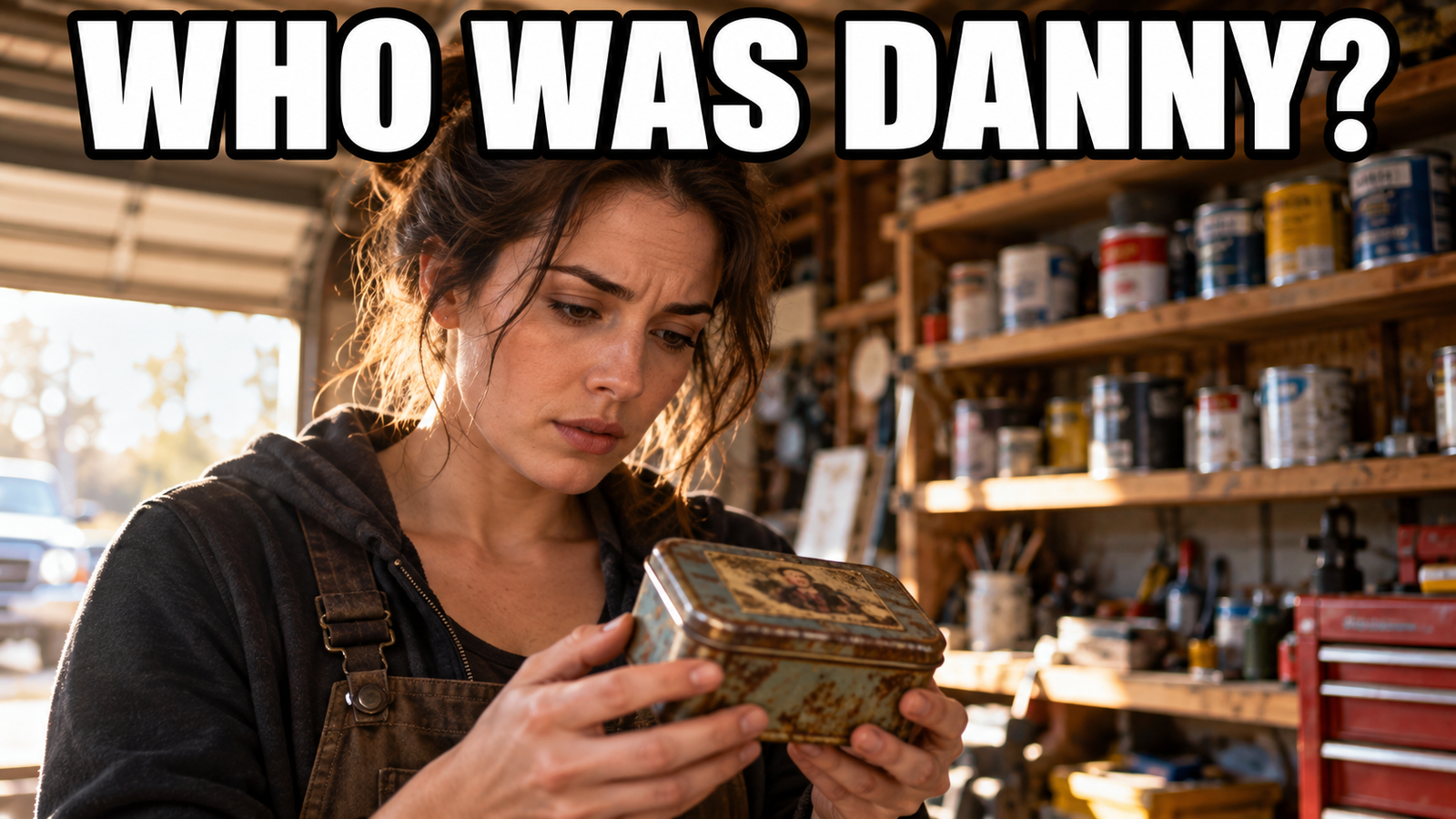
It was the size of a deck of cards, with a hinged lid. The paint on top was mostly worn off, but you could still see that it had once held throat lozenges. Smith Brothers Cough Drops. Two old-fashioned bearded men on the lid.
I almost tossed it with the junk. Then I shook it, out of habit, and heard something rattle inside. Something small and light, like dried beans.
I almost tossed it with the junk. Then I shook it, and heard something rattle inside.
I opened it.
Inside, nested in a folded square of yellowed cotton batting, were baby teeth. Tiny and white. I counted them twice. Eleven.
And on the inside of the lid, scratched into the tin with the point of something sharp, a nail or a scribe, in careful, square block letters, were a name and two dates.
DANNY. 1958–1964.
I sat down on an overturned five-gallon bucket in the middle of the workshop and held that little box in my lap for a long time.
My father’s name is Tom. My uncle’s name is Rick. My grandfather had two sons, and both of them are alive and well and in their sixties. Dad’s sixty-one. Uncle Rick’s sixty. I had never, in twenty-nine years, heard anyone in my family say the name Danny.
PART 3 — SUNDAY
I didn’t call my dad. I don’t know why. Something about the careful way the letters had been scratched into that lid told me this was Grandpa’s to tell, not mine to ask about behind his back.
So on Sunday afternoon, I drove out to Hickory Creek, the assisted living home on the east side of town, with the tin box in my coat pocket.
Grandpa Hal was sitting in the chair by the window in his room, the way he always was, in a flannel shirt buttoned to the top and suspenders, watching the bird feeder my dad had hung outside for him. He’s still sharp. His knees are gone and his hearing is going, but his mind is a steel trap. He was doing the newspaper crossword in pen.
He was doing the newspaper crossword in pen.
“Kara,” he said, pleased, and set down the paper. “You finish the shop?”
“Almost,” I said.
I sat down in the chair across from him. I didn’t say anything. I just took the tin box out of my pocket and set it on the little table between us, next to his crossword and his reading glasses.
He looked at it.
He didn’t move for a long time. Then he turned his head and looked out the window at the bird feeder for even longer. A cardinal came and went. A pair of chickadees.
When he finally spoke, his voice was very quiet.
“Close the door, would you, honey?”
PART 4 — THE PROMISE
I closed the door. I sat back down. Out in the hallway, somebody’s television was playing a game show too loud. A nurse’s aide went by with a cart, humming. Inside the room, it was very quiet. I could hear the clock on his nightstand ticking. Grandpa picked up the tin box in both of his big, scarred machinist’s hands and held it against his chest, the way you’d hold a small bird.
“Your grandmother made me promise,” he said, “that I’d never say his name again. In front of her or anybody else. Not ever. I kept that promise for sixty-two years.” He swallowed. “She’s been gone eight years now. And I’m ninety-one. And I think somebody in this family ought to know he was here.”
“I think somebody in this family ought to know he was here.”
“Who was he, Grandpa?” I asked.
“Daniel Harold Wade,” my grandfather said. “Our first boy. Born April 9, 1958. Seven pounds even. He had your grandmother’s red hair and my ears, poor kid, they stuck straight out.” He almost smiled. “He was the happiest child I ever saw. Laughed at everything. Laughed at the dog. Laughed at the rain. Laughed in his sleep.”
He opened the lid and looked down at the little teeth on their cotton.
“Your grandmother kept every tooth he lost,” he said. “Tooth fairy left a dime. Lois kept the tooth. She said someday she’d make him a necklace out of them for his wedding day, just to embarrass him.” He closed the lid again, very gently. “He’d lost eleven by that summer. He was so proud of the gap.”
PART 5 — THE QUARRY
Bedford, Indiana, is limestone country. The Empire State Building is made of stone cut from quarries outside our town. When the old quarries get worked out, they fill up with groundwater, deep and green and cold, and every summer since forever, kids have snuck in to swim in them. Every summer, the town tells them not to. Every summer, they go anyway.
On the Fourth of July, 1964, the families from Grandpa’s church had a picnic at an old quarry on the edge of town. It was legal back then, that one. They’d built a little dock. Grandpa was twenty-nine. Danny was six. My grandmother was home with a summer cold.
“There were thirty grown-ups standing around that water,” Grandpa said. “Thirty.”
“There were thirty grown-ups standing around that water,” Grandpa said, looking at the bird feeder. “Thirty. Everybody thought somebody else was watching.”
Danny went off the end of the dock with a little girl from church named Patsy Moore. She was five. They were holding hands and jumping in together, over and over, in the shallow part near the ladder, with all the other kids. And then somehow, they drifted out past the drop-off, where the stone ledge ends and the water goes down sixty feet.
My grandfather saw it from the picnic table. He was the first one in.
“I could only reach one of them in time,” he said. His voice broke. “The water was so cold. And they were six feet apart. I got Patsy first because she was closer. By the time I went back for Danny…” He stopped. He didn’t finish. He didn’t need to.
I put my hand over his. His hand was shaking. Neither of us said anything for a long time. Outside, the cardinal came back to the feeder, bright red against the gray October sky, and my grandfather watched it until it flew away.
PART 6 — LOIS
“Your grandmother never forgave me,” Grandpa said, after a long time. “I don’t blame her. I never forgave myself either.”
They buried Danny at Green Hill Cemetery, on July 7, 1964. My grandmother didn’t speak for three weeks. When she finally did, the first thing she said to my grandfather was this: “Don’t you ever say his name to me again. I can’t bear it. I can’t bear to hear you say it.”
“Don’t you ever say his name to me again. I can’t bear to hear you say it.”
So he didn’t.
They packed up Danny’s room. They gave away his clothes and his toys. They put away every photograph. My father, Tom, was born in 1965, and my Uncle Rick in 1966, and they grew up in a house where nobody ever said the name Danny. Not once. Not on his birthday. Not on the Fourth of July. My grandparents just stopped going to fireworks, and told everybody they didn’t like the noise.
My grandfather kept only one thing. The little tin box of teeth. He’d found it in my grandmother’s jewelry box when they packed up Danny’s things, and he couldn’t bear to throw it away. He scratched Danny’s name and dates into the lid with a scribe from his toolbox, the night after the funeral, sitting alone in the garage. He told me it took him four hours. He kept stopping. His hands wouldn’t stay steady, and he refused to let a single letter come out crooked. Then he put it on the top shelf behind the paint cans.
“I used to take it down sometimes,” he said. “When your grandmother was asleep. I’d sit out there in the shop and hold it. That’s all. Just hold it.”
“For sixty-two years,” I said.
“For sixty-two years,” he said.
PART 7 — PATSY
“Grandpa,” I said, after a while. “The little girl. Patsy Moore. What happened to her?”
He was quiet for a long time. Then something changed in his face. Almost a smile.
“You know her,” he said.
I stared at him.
“She married a fellow named Gene Holloway,” Grandpa said. “In 1981. You knew her as Miss Pat.”
“You knew her as Miss Pat.”
I couldn’t breathe.
Miss Pat taught me to swim. She taught every kid in Bedford to swim. For forty-five years, every summer, at the public pool on Fifteenth Street, Miss Pat Holloway ran free swimming lessons for any child in Lawrence County who wanted them. No fee. No forms. You just showed up at eight in the morning in your swimsuit, and she’d be standing at the edge of the shallow end in her red Speedo and her whistle, and she’d say, “Get in, I’ve got you.” Hundreds of kids. Thousands, probably. She taught my father. She taught me. She taught my little cousins.
I remembered the name of the program, painted on a wooden sign over the pool entrance. I’d walked under it every summer morning from the time I was five until I was twelve. I’d never once thought about what it meant.
The Daniel Fund Swim School. Est. 1981.
PART 8 — THE DANIEL FUND
I went to see Miss Pat the next day. I almost didn’t. I sat in my car at the end of her street for twenty minutes with the engine running, trying to think of what I’d say. How do you walk up to someone’s door and tell them you know the worst day of their life? In the end, I didn’t have to say much of anything.
She’s sixty-seven now, retired from teaching at last, but still lean and tan and strong, with short white hair and a face that’s spent fifty summers squinting into the sun. She lives in a small brick ranch house on the north side of town, with a pool in the backyard, of course. When she opened the door and saw me, she smiled.
“Kara Wade,” she said. “You never could keep your face in the water.”
Then she saw the tin box in my hand. And her smile went away.
Then she saw the tin box in my hand.
We sat at her kitchen table. I told her what my grandfather had told me. She listened without saying a word. When I finished, she was quiet for a long time, looking out her back window at the pool.
“I remember his hand,” she said finally. “Danny’s. Holding mine. We were jumping off the dock together. He was laughing. He was always laughing.” She swallowed. “And then I remember your grandfather’s arm around my chest, pulling me up the ladder. And then I don’t remember anything else for a long time.”
She’d grown up knowing. Her mother told her when she was ten. That a man had saved her life and lost his own son doing it. “I’ve spent my whole life trying to deserve that,” she said. “Every single day. I don’t think I ever have.”
When she was twenty-two, in 1981, fresh out of college with a degree in physical education, she started the swim school with her own savings. Free lessons for every child in Lawrence County. She named it after the boy who’d been holding her hand.
“So no child in this town would ever go off a dock without knowing how to swim,” she said. “That’s all. That’s all I could do.”
PART 9 — THE TEACHER AND THE MACHINIST
“Did my grandfather know?” I asked. “About the swim school?”
Miss Pat smiled, very sadly.
“Honey,” she said, “who do you think built the dock at the public pool?”
“Who do you think built the dock at the public pool?”
In 1981, when the city gave her permission to use the pool every summer morning, a man showed up with a truck full of lumber and tools and built her a teaching platform in the shallow end, so the littlest kids could stand. He never said a word. He didn’t sign anything. When she tried to pay him, he shook his head and drove away.
Every spring after that, for thirty-eight years, the platform got repaired. Every winter, somebody stored it in their garage. Every Memorial Day weekend, it was back in the pool, freshly painted, before she even asked.
“He never said his name,” Miss Pat said. “He didn’t have to. I knew who he was. And he knew I knew.” She reached across the table and touched the tin box. “We never talked about it. Not once in forty-five years. Every summer, he’d come sit on the bleachers for an hour on the first day of lessons. He’d watch the little ones go in the water. Then he’d leave.”
I remembered him on those bleachers. Grandpa Hal, in a ball cap, with a thermos of coffee, on the first morning of swim school every June. I’d thought he just came to watch me.
PART 10 — FIREWORKS
I took Miss Pat to see my grandfather the next Sunday.
I wasn’t sure it was a good idea. But she asked. And I thought it was his to decide, so I called him first. He was quiet on the phone. Then he said, “I’d like that.”
She walked into his room at Hickory Creek carrying a small bouquet of black-eyed Susans from her garden. My grandfather tried to stand up out of his chair, the way he always did for a lady, and she said, “Don’t you dare, Hal Wade,” and bent down and put her arms around him.
She bent down and put her arms around him.
They held on to each other for a long time. Neither of them said anything. Then she sat down in the chair beside him, and they talked. About Danny, mostly. About his red hair and his ears and his laugh. About the gap in his teeth. They talked for two hours. It was the first time my grandfather had said his son’s name out loud to another living person in sixty-two years.
Then I called my father. I’d been dreading it. My father is a quiet, careful man, a retired high school shop teacher, a lot like his own father. I didn’t know how you tell a sixty-one-year-old man that he had a big brother he never knew about. In the end, I just told him to come to Hickory Creek, that Grandpa had something to tell him, and that it was important.
Dad came over that evening. He sat with his father for a long time, alone, with the door closed. When he came out, his eyes were red, and he hugged me in the hallway and didn’t say anything at all. Uncle Rick drove down from Indianapolis the next day.
Two weeks later was homecoming at Bedford North Lawrence, and the high school sets off fireworks over the football field after the game every year. The whole family went. All of us. Grandpa in his wheelchair, with a blanket over his knees, at the end of the bleachers. Dad and Uncle Rick and their wives. My cousins and their kids. And Miss Pat and her husband, Gene, sitting right beside us, wrapped in a stadium blanket against the October cold.
Before the fireworks started, my grandfather asked for the tin box. I’d brought it, because he asked me to. He held it in his lap. And when the first rocket went up and burst gold over the football field, he said, very quietly, so only those of us closest could hear:
“That one’s for you, Danny.”
Nobody in our family is going to skip the Fourth of July fireworks anymore. Grandpa has already told the staff at Hickory Creek that somebody needs to have his good jacket pressed by July third. And on the first morning of swim school next June, at eight o’clock sharp, there’ll be a whole row of Wades on the bleachers at the pool on Fifteenth Street, under the wooden sign, watching the little ones go in.