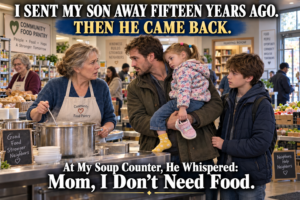
In 2010, I sent my eighteen-year-old son away with $250 after he told me his girlfriend was pregnant. For fifteen years, I said he was doing fine. Then he appeared at my soup counter with two children and whispered, “Mom, I don’t need food. I just need someone…”
Part 1
The little girl had one yellow sock slipping below her ankle.
That was what I noticed first. Her shoe dangled from a small hand resting against the man’s shoulder, and the other shoe was already missing. She leaned into him with the trusting weight of a child who expected to be carried wherever she needed to go.
The boy beside him held the hem of his coat.
I stood behind the soup counter at the Maple Street food pantry, holding a ladle above an empty bowl. Steam rose between us. A volunteer at the bread table was explaining that the cinnamon loaves needed to be used quickly because they had no preservatives.
Then the man lifted his face.
“Daniel?”
My voice came out so quietly that the woman beside me did not hear it.
He did.
He had my father’s eyebrows, a pale scar near his chin, and the same way of holding his jaw when he was trying to remain calm. But the boy who had left my house was gone. This man looked tired in a way sleep alone would not cure.
He recognized me immediately.
I saw it happen. His hand tightened around the little girl’s back, then relaxed. He glanced at the boy, measuring what could be said within hearing distance.
“Hello, Mom.”
The ladle struck the edge of the pot.
Beside me, Ruth looked up.
“Marianne?”
I set it down before I dropped it.
The girl lifted her head. Her hair was gathered into two uneven ponytails, one fastened with a blue elastic and the other with pink. She studied me without the smallest idea of what my face meant to her father.
“Is this the soup lady?” she asked.
Daniel swallowed.
“This is someone I know.”
The boy looked at him sharply. He was older than the girl by several years, old enough to hear the carefulness in that answer.
Ruth stepped around the counter.
“Would you children like to help me choose some biscuits?”
She did not know the story. She knew only that something had happened, and that two children were watching it.
Daniel nodded.
The boy hesitated until his father said, “I’m right here, Ben.” Then he went with Ruth, keeping his younger sister’s hand in his. Daniel put her down slowly, adjusted her sock, and watched them reach the table before turning back to me.
For fifteen years, I had imagined meeting him in an airport, a grocery store, perhaps at somebody’s funeral. In every imagined meeting I had prepared questions. Where had he been? Why had he never called? Did he understand what losing him had done to me?
Now every question sounded unbearable.
“Are you hungry?” I asked.
He shook his head.
“Mom,” he whispered, “I don’t need food. I just need someone.”
I looked at the children. Ben was placing a biscuit on his sister’s napkin before choosing one for himself.
“Someone for what?”
Daniel pressed his palm against his forehead, then lowered it as though even that small display was more than he intended to allow.
“I wouldn’t have come unless I had to.”
The sentence should have hurt. Instead, it sounded like something I had taught him to say.
“You can tell me.”
His eyes filled, but he did not look away.
“I need someone to stay with my children for a few hours.”
“Of course.”
He glanced toward the biscuit table again.
“Someone who won’t make them feel like a burden.”
Part 2
In 2010, Daniel stood in my kitchen with both hands hidden in the pockets of his sweatshirt.
He was eighteen. There was still a school photograph on the refrigerator, one corner held by a magnet shaped like an apple. His shoes were damp from the rain, and he kept looking at the chair opposite mine as if waiting for permission to sit.
“Hannah’s pregnant,” he said.
I remember the refrigerator starting its familiar rattle. I remember moving a cup away from the edge of the table. Small details stayed clear because I spent years avoiding the larger one.
“How far along?”
“About three months.”
“And you’re just telling me now?”
“We were trying to figure out what to do.”
“We?”
He flinched at my tone.
“She’s scared, Mom.”
“So am I.”
That was true. I was forty-two, working long shifts at a grocery store, paying a mortgage that seemed to grow heavier whenever the roof or the car needed attention. Daniel’s father had been gone for years. I had raised my son while telling myself that discipline was the only protection I could afford to give him.
I was afraid he would leave school. Afraid of bills. Afraid neighbors would ask questions I could not answer with pride.
Those fears explain the room I was standing in. They do not excuse what I did inside it.
Daniel said he had found extra hours at the repair shop. Hannah had an aunt who might let them stay temporarily. He spoke quickly, offering a plan before I could accuse him of having none.
“I’m not asking you to raise the baby,” he said.
“What are you asking?”
“I don’t know. I thought you should know.”
I could have told him to sit down. I could have made tea, asked whether Hannah was safe, or said I needed a night to think. I could have been frightened without turning that fear into a door closing.
Instead, I opened the drawer where I kept emergency cash.
There were five fifty-dollar bills inside an envelope.
I put them on the table.
“If you want to be a man, build your own life.”
He stared at the money.
“Do you want me to leave?”
I had a chance to correct myself then. Even after the words were out, there was room to say I was angry and did not mean that he had lost his home.
“You’ve made your decision,” I said.
He stood there for another moment. Then he picked up the bills and went upstairs.
I heard the wardrobe open. A drawer shut. His footsteps crossed the ceiling above me. Less than half an hour later, he came down carrying one duffel bag.
At the door, he looked back.
“I love you, Mom.”
I turned toward the sink.
“Lock the door behind you.”
He never called. For years, I repeated that as though it settled who had abandoned whom.
When people asked, I said he was doing fine somewhere across the country. I mentioned work, travel, independence. None of it came from him. I was describing a life that made my own behavior easier to live with.
Standing at the soup counter in 2025, I saw the result of that choice in his careful face.
“What happened?” I asked.
He looked down at his phone. A new message lit the screen, and something in him seemed to fold inward.
“Hannah,” he said. “It’s Hannah.”
Part 3
He showed me the message without handing over the phone.
Please come when you can. She’s asking for you.
Below it was a nurse’s name and the name of a hospice unit across town.
I looked at the words, then at Daniel.
“Hannah is your wife?”
“Yes.”
The word held fifteen years I had not earned the right to hear described in detail.
I remembered the girl who had stood beside him all those years ago, though I could no longer remember whether she had smiled when I opened the door. I had spent so much time resenting a future I had never bothered to learn its details. Now even the simplest question exposed how little I knew.
“What happened to her?”
“Cancer.”
He said it simply. I could see how often he must have said it recently: to employers, teachers, medical staff, friends asking what they could do. There was no energy left for cushioning the answer.
“She’s there now?”
He nodded.
“The children stayed with a neighbor yesterday. She had to go to work today. Everybody who usually helps is working or already stretched thin. I thought I could bring them with me, but Hannah asked for a little time alone.”
He stopped.
“Alone with you?”
“Yes.”
I glanced toward Ben and the little girl. Ruth had brought them paper and crayons, and the girl was drawing with her whole arm. Ben watched the front counter between bites, tracking how far away his father stood.
“How old are they?”
“Ben’s fourteen. Lucy’s five.”
Fourteen. The baby Daniel had told me about was the boy who now looked old enough to understand a conversation people were trying to hide.
I had been a grandmother for fourteen years without ever holding my grandson.
“Why here?” I asked softly.
Daniel looked around the pantry.
“A friend volunteers here. He said you worked Tuesdays.”
“You knew I was here?”
“I wasn’t sure I’d come in.”
“How long were you outside?”
“A while.”
I imagined him sitting in his car with a message from the hospice unit on his phone and two children in the back seat. I imagined him deciding which risk was smaller: asking me for help or admitting he had no one available.
“I can stay with them,” I said.
He did not immediately relax.
“I need to be clear about something.”
“Anything.”
“They don’t know you. Lucy doesn’t understand who you are. Ben knows we haven’t been in contact. Please don’t make them explain that.”
“I won’t.”
“And don’t tell them their mother will get better.”
My throat closed.
“They’ve been told what’s happening in words they can understand,” he continued. “I need you to follow what we’ve said.”
“All right.”
His face was strained with the effort of turning a desperate request into instructions. I recognized the work behind it: the father remembering what his children needed while everything else threatened to overwhelm him.
“What do they call you?” I asked.
“Marianne, for now. Let them decide anything else later.”
I nodded.
Ruth approached with a cup of water and set it beside him.
“We can use the little reading room,” she said. “It’s quiet. I’ll stay nearby.”
I thanked her, almost unable to get the words out.
Daniel went to the children. Lucy lifted both arms, and he picked her up immediately. Ben stood without being asked, folding the drawing paper as if packing quickly had become a habit.
“I’m going to see Mom,” Daniel told them. “Marianne and Ruth are going to stay with you.”
Ben looked at me for a long moment.
Then he asked the question his father had avoided.
“Is she the grandma who didn’t want us?”
Part 4
Daniel closed his eyes.
“Ben.”
“It’s okay,” I said, though nothing about the question was okay. “He can ask.”
The boy held the folded paper against his chest. I recognized Daniel’s stubbornness in the set of his shoulders, but I also saw something my son had not had at that age: the certainty that he could ask a difficult question without being sent away.
“I treated your dad very badly,” I told him. “That happened before you were born.”
“So you didn’t know us.”
“No.”
“Then why didn’t you come later?”
There were answers I could give a child and answers I could give myself. Neither included blaming his father.
“I should have tried harder. I was wrong.”
He searched my face for an excuse. I offered none.
Lucy tugged at Daniel’s collar.
“Can Mommy have my picture?”
“Of course.”
Ben gave his father the folded sheet. Inside was a drawing of four people outside a house, with a yellow sun pressed into one corner. Lucy had colored most of the sky green. Ben had written their names carefully below the figures.
Daniel put it in the inside pocket of his coat.
“I’ll show her.”
He kissed Lucy’s forehead, then put her down beside her brother. Ben reached for her hand.
“How long?” the boy asked.
“I’ll call. You can call me whenever you need to.”
“Even if you’re talking to Mom?”
“Even then.”
I wanted to tell Daniel I was proud of him. The words felt too large and too late to place between him and the door.
“Go,” I said. “We’ll be here.”
He hesitated once more.
“They’ve eaten breakfast. Lucy might want something small later. Ben has my number in his phone. Her jacket’s in the bag.”
“I’ll listen to them.”
That seemed to matter more than promising I knew exactly what to do.
He left.
I watched through the glass as he crossed the parking lot. He moved quickly, but stopped before opening his car door and leaned one hand on the roof. He stayed that way for several seconds.
I had made my eighteen-year-old son prove he could carry a life alone. Now I was watching the thirty-three-year-old man still trying not to let anyone see the weight.
In the reading room, Lucy sat on the rug with a box of wooden animals. Ben chose the chair closest to the door.
Ruth brought water, apple slices, and the bag Daniel had left. She did not ask for the story. When I whispered that Hannah was dying, she squeezed my shoulder and said she would cover my counter.
I sat on a low stool.
“What would you like to do?”
Lucy held up a wooden rabbit.
“He needs a house.”
I found some blocks and put them within reach.
Ben watched me.
“You don’t have to pretend,” he said.
“Pretend what?”
“That this is normal.”
I put my hands in my lap. The room held the ordinary sounds of the pantry: a cupboard closing, a trolley wheel catching on the threshold, someone asking where to put empty cartons. It felt strange that my life could change so completely while everyone else still needed to find space for bread. I listened to those sounds until I trusted my voice again.
“You’re right. It isn’t.”
“My dad almost didn’t come.”
“I know.”
“No, you don’t.”
I let the correction stand.
He looked down at his shoes.
“He said you might tell us to go.”
Lucy stopped arranging blocks.
She looked at the door, then at me.
“Are we going?”
“No,” I said. “You’re staying right here.”
But Ben kept watching the door as though promises from me were not enough to close it.
Part 5
The first hour passed in small tasks.
Lucy built a house with no roof because, she explained, the rabbit wanted to see the stars. Ben checked his phone every few minutes. I asked whether he wanted the sound turned up so he would hear his father’s call, and he nodded.
We read a picture book. Lucy corrected me when I used the wrong voice for the fox. Ben did not join us, but he listened from his chair.
At noon, Ruth brought sandwiches.
“Your dad said these were all right,” she told them, setting the plate down.
She had called him to check, sparing me the temptation to prove myself by making assumptions. I thanked her again.
Ben cut Lucy’s sandwich into smaller pieces.
“She can do some of that herself,” I said gently.
“I know.”
His tone made me stop. He did not need a stranger correcting the way he kept his sister settled during the worst week of his life.
“I’m sorry. You know what helps her.”
He shrugged, but his shoulders loosened a little.
Daniel called shortly after lunch. Ben answered immediately and turned slightly away. Lucy climbed onto the chair beside him, reaching toward the phone.
I moved to the other end of the room, close enough to help and far enough not to listen deliberately.
“Did she see it?” Ben asked.
A pause.
“Did she like the green sky?”
Lucy smiled.
Then Ben’s expression changed.
“All right. We’re okay.”
He handed me the phone.
Daniel sounded exhausted.
“Can they stay another hour?”
“Yes.”
“Maybe longer. I don’t know.”
“You don’t need to choose a time for my sake.”
He was quiet.
“Thank you.”
I almost said he never needed to thank me. But he did need to, because help from me had once come with a price, and pretending otherwise would not erase it.
“You’re welcome,” I said.
After the call, Lucy wanted to know whether her mother had smiled at the picture. Ben said yes, and helped her place the wooden rabbit beneath a folded napkin for a blanket.
When she became sleepy, Ruth brought a cushion. Lucy lay down, still holding one animal in her hand.
Ben waited until her breathing slowed.
“Mom used to help here,” he said.
“At the pantry?”
“Not this one. Another place near our old apartment. She said everybody needs help sometimes.”
I looked toward the empty soup bowls being carried past the door.
“How long has she been sick?”
“A long time.”
“I’m sorry.”
He rubbed a frayed seam on his sleeve.
“People say that a lot.”
“I imagine they do.”
He glanced up, surprised I had not tried to add something wiser.
“Dad works at the apartment buildings. Fixes stuff. He used to work at night too.”
“Does he still?”
“Not now. He needs to be with Mom.”
I had assumed, for a moment at the counter, that the pantry meant my son had failed. Even after fifteen years, my first instinct had been to measure his life by the doorway where I found him.
Now his son was describing a man who worked, cared, and asked for help when caring became more than one person could do.
Ben took a photograph from his phone and turned the screen toward me.
Hannah stood beside Daniel at a park. Lucy sat on his shoulders. Ben leaned into his mother, trying to look older than he was.
“She’s nice,” he said.
I looked at the young woman I had once reduced to a problem.
“She looks it.”
“She wanted to meet you.”
“When?”
He swallowed.
“Before she got too tired to ask.”
Part 6
I had met Hannah once in 2010.
Daniel brought her to the house for dinner before he told me about the pregnancy. She wore a green cardigan and offered to help wash the dishes. I asked about school, then interrupted her answer to remind Daniel he had an early shift the next morning.
At the time, I thought I was being practical.
Looking at the photograph on Ben’s phone, I remembered Hannah drying a plate with the wrong towel and apologizing. She had been nervous in my kitchen. I had done nothing to make that easier.
“Did your dad tell you much about me?” I asked.
Ben put the phone away.
“Not really.”
“That’s fair.”
“He said you worked hard when he was little.”
I looked at him.
“He said you used to come home with sore feet.”
My son had given his children a kinder account of me than I had given other people of him.
For years, I described his silence as stubbornness. I told friends that young men sometimes forgot their mothers once they had families of their own. I accepted their sympathy without telling them about the money on the table or the last words at the door.
“He worked hard too,” I said.
“Yeah.”
Ben looked toward Lucy.
“He still does.”
Ruth offered to drive us to my house if Daniel approved. The reading room would be needed later, and Lucy would be more comfortable on a couch. I was grateful she made the suggestion as an option rather than assuming a grandmother’s house was automatically safe.
Before dialing, I looked at the children and asked whether they wanted to move. Lucy wanted to know if the rabbit could come. Ben asked how far it was from the hospice. Neither asked about my furniture or my garden. Their entire day was organized around remaining reachable, and I began to understand why a familiar place could matter more than a comfortable one.
I called Daniel and explained.
“No,” he said immediately.
My face grew hot.
“All right.”
He took a breath.
“I’m not ready for that.”
“I understand.”
“You don’t have to agree. Just don’t argue.”
“I won’t.”
We arranged to stay in a nearby community room that Ruth could open. Daniel knew the building; the children had been there for school events. The familiar place mattered.
Before moving, I wrote down his instructions. Contact numbers. The children’s routines. What they had been told about Hannah. I asked rather than guessed.
Ben watched me write.
“Dad writes lists like that.”
“He always liked making things clear.”
“Did you?”
I thought about how often I had treated obedience as understanding.
“I’m learning.”
He nodded, still deciding whether to believe me.
By late afternoon, Lucy woke and wanted her father. We called. He answered, listened to her tell him about the rabbit’s open roof, and said he loved her.
When she passed the phone to Ben, Daniel asked to speak to me afterward.
“Can you bring them here?” he said.
“To the hospice?”
“Yes. Hannah wants to see them.”
“We can come.”
“I’ll meet you downstairs. Ruth can drive, if she’s able.”
“She’s here. I’ll ask.”
His voice broke on the next sentence.
“She asked whether you came.”
I held the phone more tightly.
“What did you tell her?”
“That you stayed.”
Outside the community-room window, the light was fading. I watched Lucy fit the rabbit into her coat pocket for the journey.
“Daniel, would she want to see me?”
He did not answer immediately.
Then he said, “I need to ask her. This can’t be about making you feel better.”
Part 7
He was right.
I wanted to meet Hannah. I wanted to apologize for a kitchen she might barely remember and an abandonment she had lived with for years. I wanted to tell her I knew, finally, that she had not ruined my son’s life.
But wanting to say those things did not give me a claim on the time she had left.
“I know,” I told Daniel. “Ask only if it won’t wear her out.”
Ruth drove us across town. Ben sat beside Lucy in the back seat. I held the bag on my lap, feeling the outline of the spare clothes Daniel had packed with such care.
At a traffic light, Lucy asked whether Mommy would come home with us.
Ben looked at me in the mirror.
I repeated the words Daniel had told me to use.
“Mommy is very sick. Today we’re going to see her where people are helping her feel comfortable.”
“But later?”
I did not invent an answer to make the drive easier.
“We can ask Daddy together.”
She leaned against her brother.
I wished I could protect them from what was happening. I could protect them only from having to carry it without steady adults nearby.
Daniel waited in the lobby.
Lucy ran toward him, and he crouched despite the tiredness visible in every movement. Ben hugged him more carefully, one arm around his shoulders.
“How is she?” he asked.
“She’s ready to see you.”
Daniel looked at me.
“She said you can come after. Just for a minute.”
I nodded.
A receptionist showed us where to wait and offered directions to the bathroom. Ben thanked her, using the careful manners of a child who had become familiar with unfamiliar buildings. I wished someone could hand him a school afternoon instead: homework he disliked, a misplaced shoe, a mother calling from another room. I could not give him that. I could make sure he did not have to find the bathroom alone.
Ruth stayed with me while he took the children upstairs. I sat on a bench near a window overlooking a courtyard. People passed carrying bags, flowers, takeaway cups. Everyone seemed to be bringing something useful, and I had arrived with empty hands.
“You brought yourself,” Ruth said when I admitted it.
“That wasn’t useful fifteen years ago.”
“Then make it useful now.”
She said it plainly, without trying to excuse me.
When Daniel came back, Ben and Lucy were with him. Lucy’s eyes were red. Ben held the drawing flat against a folder so it would not crease.
“Mom likes the rabbit,” Lucy told me.
“I’m glad.”
“She said he needs rain boots.”
I smiled because Hannah had found a way to remain Lucy’s mother even inside a room full of things none of them could control.
Ruth took the children to a quiet seating area. Daniel led me upstairs.
Outside Hannah’s room, he stopped.
“She gets tired. Don’t ask her a lot of questions.”
“I won’t.”
“And Mom?”
I looked at him.
“Don’t tell her you’ll take care of everything. You don’t know what that means.”
“All right.”
He opened the door.
Hannah looked smaller than the woman in the photograph. Her hair was short, and a light blanket covered her legs. There were pictures arranged where she could see them: the children, Daniel, a dog I did not recognize.
She turned toward me.
“Hello, Marianne.”
I moved closer, slowly.
“Hello, Hannah.”
Her mouth curved in a faint smile.
“Daniel said you stayed with them.”
“Yes.”
“Thank you.”
I began to cry, quietly enough that I hoped it would not make her feel responsible.
“I’m sorry,” I said.
“I know.”
I was about to apologize again when she lifted her hand slightly.
“There’s something I need you to understand about my husband.”
Part 8
Hannah looked toward Daniel, who stood beside the window.
“He’s very good at keeping things going,” she said. “People see that and assume he doesn’t need anything.”
Daniel lowered his eyes.
“I’m right here,” he murmured.
“I know.” She smiled at him, then looked back at me. “That’s why I’m saying it.”
I sat in the chair beside her bed. There was a bookmark on the table, a folded tissue, and a cup with a bendable straw. I looked at those ordinary objects while finding words, aware that this was her room and her time. I had no place there except the one she chose to give me. She rested briefly, her eyes on the window. I waited until she was ready rather than filling the silence with my own need to explain.
“He needs sleep. He needs somebody to remember there are ordinary things even when everything feels terrible. Laundry. School forms. Bread.”
“I can help with those.”
“Ask him first.”
“I will.”
She paused, gathering her strength.
“And Ben isn’t a second parent. He loves his sister, but he’s fourteen.”
I thought about the sandwich cut into pieces and the boy watching every doorway.
“I understand.”
“I hope you do.”
There was no cruelty in her words. She was telling me what mattered while she still could. I respected her enough not to demand gentleness on top of it.
“I’m sorry for sending Daniel away,” I said. “And for leaving both of you to manage afterward.”
She looked at me for a long moment.
“We managed,” she said. “Some days badly. Some days very well.”
Daniel moved closer to the bed.
She took his hand.
“He was frightened,” she continued. “He came to you because he was frightened, not because he wanted someone else to live his life.”
I nodded, unable to speak.
“I know that now.”
“Good.”
Her eyes closed briefly. Daniel touched her shoulder and asked whether she wanted me to leave.
“Soon,” she said. “One more thing.”
I waited.
“The children don’t owe anybody happiness for helping them. Some days they’ll be angry. Lucy might shout. Ben might not talk.”
“They can feel whatever they feel.”
“Remember that when it’s inconvenient.”
I looked at Daniel. He had spent his childhood learning that my exhaustion decided whether his feelings were acceptable.
“I will try,” I said. “And when I get it wrong, I’ll listen.”
Hannah’s expression softened slightly.
“That’s more believable than a big promise.”
I did not ask her to forgive me. I did not say everything had happened for a reason. Nothing in that room needed an explanation that made suffering useful.
Before I left, she asked me to hand her a photograph from the table. It showed Daniel at about twenty, holding a newborn Ben against his bare chest, his face full of astonishment.
“He thought he would break him,” she said.
Daniel smiled through tears.
“He was so small.”
“You were gentle.”
I looked at the baby in the photograph and remembered the five bills I had placed on the kitchen table. I had called it a lesson in responsibility. My son had learned responsibility while carrying the additional lesson that asking his mother for help could cost him her love.
Outside the room, I held the railing until I could breathe evenly.
When Daniel joined me, he looked older than he had at the pantry.
“Will you stay with them downstairs?”
“Yes.”
“Just until I can come.”
“I’m not leaving.”
He nodded and went back to Hannah.
Near midnight, my phone lit up with his name.
For several seconds, I could not make myself answer.
Part 9
When I answered, Daniel said my name instead of Mom.
“Marianne?”
“I’m here.”
“She’s gone.”
I closed my eyes.
In the seating area, Lucy slept curled beside her brother. Ben was awake, watching me. He knew before I found words. His face changed, and I held out my free hand without reaching for him.
He took it.
Daniel said he would come down shortly. I asked whether there was anything he needed first.
“No. Just stay.”
“I will.”
I told Ben that his father was coming and would speak with them. I did not ask him to be strong for Lucy. I did not tell him his mother would want him to smile. He was a boy whose mother had died, and that was enough work for one moment.
When Daniel arrived, he sat between his children.
I moved away, giving them room without leaving the area.
He woke Lucy gently. He spoke in clear, quiet words. She cried, then asked the same question again. He answered again. Ben leaned into him, no longer trying to look capable.
Ruth, who had returned after going home briefly, brought water and tissues. There was no perfect sentence. We made ourselves available and let the children need what they needed.
In the early hours, Daniel asked Ruth to drive them home.
He looked at me before we left.
“Could you come for a little while?”
I nodded.
His house was small, with shoes by the door and a school timetable fixed to the refrigerator. A row of mugs hung above the kitchen counter. Hannah’s cardigan lay over the back of a chair, as ordinary and devastating as a person stepping out of a room and never returning.
I stayed in the doorway until Daniel said where I could put my coat.
The children went upstairs with him. Ruth helped me make tea neither of us expected anyone to drink. She left after arranging to return later if needed.
Daniel came down alone.
He stood beside the sink, looking at a bowl with dried cereal along the edge.
“I was supposed to wash that yesterday.”
“I can do it.”
He shook his head.
“I know. It’s just there.”
I understood enough to leave it alone until he moved away.
He sat at the table.
For a long time, neither of us spoke.
Then he asked, “Why didn’t you come?”
I looked at him.
“After I left. Why didn’t you try?”
I could have said I thought he wanted distance. I could have reminded him that he never called. I had used those explanations so often that they waited automatically behind my teeth.
“Because I was ashamed,” I said. “And I let my shame matter more than finding out whether you needed me.”
He looked toward the stairs.
“I thought you meant it.”
“Meant what?”
“That if I couldn’t manage, I shouldn’t come back.”
I covered my mouth, then lowered my hand because he deserved an answer he could hear.
“I was wrong, Daniel.”
He nodded slowly.
“You can’t fix fifteen years this week.”
“I know.”
“But you can wash the bowl.”
So I did. The water ran warm over my hands. I washed the bowl, rinsed it, and set it on the drying rack without rearranging anything else. Upstairs, a floorboard creaked. Daniel looked toward the ceiling, listening for one of the children. When he stood to check, I stayed at the sink. He did not need to supervise me or thank me. For once, I could finish a simple task without making it a lesson.
Later, while putting a clean tea towel beside the sink, I noticed a blue envelope standing behind the bread bin.
It had my old address written on the front in Daniel’s handwriting.
Part 10
I did not open the envelope.
I brought it to Daniel and asked whether he wanted it moved somewhere safer.
He looked at it for a moment.
“I wrote that before Ben was born.”
“You sent a letter?”
“No. I kept changing it.”
I waited.
“I wanted to tell you we’d found a place. That I was working. That Hannah was doing all right. I thought if I could make it sound good enough, maybe you’d want to see us.”
His thumb moved along the sealed edge.
“Then I thought about you reading it and putting it down. So I never mailed it.”
For fifteen years, I had told myself his silence meant he did not need me. He had been trying to write a life good enough to deserve a reply.
“I would like to read it,” I said. “Only if you want me to.”
“Not tonight.”
“All right.”
I set it where he asked.
The next days did not turn us into a healed family. They made us a grieving household with practical things to do. Daniel handled decisions I had no right to take over. I asked where help belonged.
Sometimes it belonged in the kitchen. Sometimes in the school pickup line. Sometimes it meant sitting quietly while Lucy cried because she could not remember how her mother pronounced a word in a favorite book.
Ben asked me to stop telling him he was thoughtful every time he helped.
“It makes it sound like that’s my job.”
I thanked him for explaining and stopped.
I got other things wrong. I folded shirts into the wrong drawers. I bought biscuits Lucy disliked. Once, when Daniel looked exhausted, I began a sentence with “You should,” and saw him stiffen before I finished.
I started again.
“Would it help if I stayed while you rested?”
Sometimes he said yes. Sometimes no. I learned not to treat either answer as a verdict on my worth.
At Hannah’s funeral, I sat where Daniel asked me to sit. I listened to people speak about the woman who had made ordinary life warmer: lending a coat, remembering birthdays, bringing a meal without needing applause for it.
I had missed knowing her. That loss was mine to carry, not a reason for her children to comfort me.
Afterward, Lucy fell asleep on a couch while Ben talked with a school friend outside. Daniel stood beside the photograph display, his hands in his pockets.
“She would have liked that picture,” he said, pointing to one of her laughing in the rain.
“I’m glad you chose it.”
He nodded.
When people asked who I was, I did not tell them Daniel and I had always been close. I said I was his mother, and that we were beginning again after a long time apart.
Back at the pantry, I told Ruth the truth I had spent years avoiding.
“I sent him away.”
She let me finish.
“I told everyone he was fine because it was easier than admitting I didn’t know.”
“What will you tell them now?”
“The truth.”
I did not make a public confession that turned my son’s grief into a performance. I corrected the people I had misled when the subject came up. I stopped accepting praise for raising an independent man as though independence and abandonment were the same achievement.
Over the following months, Daniel allowed me a place in his children’s lives. It was a place with limits, and those limits were useful. We agreed on visits. I followed the routines he chose. I asked before bringing gifts, posting photographs, or changing plans.
Ben began calling me when he needed a ride from practice. The first time, he said, “Dad’s busy. Ruth said you might be available.”
“I am,” I said.
I did not tell him how much the call meant until much later. He needed a ride, not the responsibility of reassuring me that I belonged.
Lucy took longer to understand who I was. One afternoon, while we sorted crayons, she asked whether all grandmas arrived late.
“No,” I said. “Some arrive on time.”
“Why were you late?”
“I made a bad decision, and then I took far too long to change it.”
She thought about that.
“Can you be on time now?”
“Yes.”
She handed me a blue crayon.
“Then don’t forget Tuesday.”
I wrote Tuesday on my calendar.
Daniel gave me the letter in the blue envelope near the end of that winter. He did not watch me read it. He said I could take it home and call when I was ready.
The letter was full of small details. The apartment had unreliable heating, but the landlord had promised to repair it. Hannah had found a secondhand crib. Daniel was learning to cook more than pasta. He hoped the baby would have her eyes.
Near the end, he wrote: I’m trying, Mom. I don’t know if that’s what you meant by building a life, but I’m trying.
I put the letter down and cried in my own kitchen, where no child had to manage what the tears meant.
Then I wrote back.
I did not fill the page with reasons. I told him he should never have needed to prove himself worthy of a home. I told him I was sorry for the money on the table, the closed door, and the years afterward. I told him he could decide how much room to make for me now.
He read it and called the next evening.
“Thank you,” he said.
That was all. It was enough for that day.
The following Tuesday, I finished my shift at the pantry and arrived at Daniel’s house five minutes early. Lucy opened the door with Ben behind her.
“You remembered,” she said.
“I did.”
From the kitchen, Daniel called, “Come in, Mom.”
I stepped inside.
There was no speech, no sudden forgiveness that made the past harmless. Ben needed help finding a permission slip. Lucy wanted somebody to hold the paper while she painted. Daniel was making dinner, with Hannah’s photograph beside the window and an extra place set at the table.
I hung my coat where he had shown me.
Then I stayed.