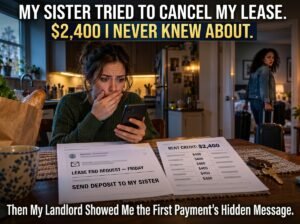
My landlord received an email ending my lease and sending my deposit to my sister. I hadn’t written it. Then he found $2,400 in unexplained rent credits—and a note attached to the first payment. I recognized the sender. Suddenly, Friday wasn’t just a moving date.
Part 1
My landlord called while I was carrying groceries up the stairs.
I wedged the bag against the banister and answered because Mr. Harris rarely phoned without a reason. In four years, his calls involved plumbing, annual inspections, or a package left in the wrong place.
This time he asked whether I had found somewhere nice.
“Somewhere nice for what?”
“To live. I was surprised you were leaving.”
I looked at my apartment door.
“I’m not leaving.”
There was a pause.
“Then we need to discuss an email.”
He read it aloud. The message came from my account, used my usual greeting, and requested that my lease end on Friday. It said I would be traveling and that my sister, Megan, would handle the keys and inspection.
Then came the payment instructions.
Please send the security deposit and any remaining credit to Megan. She has my permission to receive them.
I sat on the stairs.
“I didn’t write that.”
“I wondered. You usually call before making a major change.”
“I didn’t authorize anybody to end my lease.”
“All right. I haven’t processed the requested payment. Let me forward what I have.”
I thanked him, though my mouth had gone dry.
I was twenty-nine. That apartment was where I learned to live alone after a long relationship ended, where I built a steady routine around work at a medical-supply office, and where I finally stopped feeling I had to justify spending a Sunday reading on the couch.
My sister stayed there for six weeks after her divorce.
She arrived in mid-February with two suitcases and a story about needing somewhere to breathe. I gave her the spare room, a key, and access to more ordinary parts of my life than I thought about at the time.
She used my laptop when hers would not charge. She collected my mail. She knew which drawer held the lease because she helped me find the Wi-Fi paperwork beside it.
She moved out in March.
It was June now.
I carried the groceries inside and called Mr. Harris back from my own kitchen.
“Please don’t change anything based on that email.”
“I’ve noted that you dispute it. We’ll verify any instructions directly before taking action.”
“Thank you.”
Then he mentioned the credit.
“What credit?”
“Four hundred dollars a month. There have been six payments since January, alongside your own rent.”
I opened my banking app and looked at the transfers I had made. Full rent, every month, exactly as agreed.
“Why didn’t I know?”
“I should have contacted you directly when the extra payments began. I received an explanation that you were aware and wanted the balance carried forward.”
“From whom?”
“Your email address.”
I closed my eyes.
Six payments. Two thousand four hundred dollars. Enough to matter very much to someone who had recently begun asking whether I could lend her money again.
“Who sent the payments?”
He searched the original reference, then fell silent.
“Mr. Harris?”
“There’s a message with the first payment. I think you should read it before you call your sister.”
The screenshot arrived a minute later.
The sender was my father.
Beneath his name, in the note he sent with the payment confirmation, were the words:
For Leah’s housing only. Megan is not authorized to collect refunds.
Part 2
I had not spoken to my father in almost three years.
His name was Samuel Bennett. He lived abroad for work, then remained there after retiring because the life he had built seemed easier to maintain than the one he left behind.
That was the explanation I had carried.
Our relationship had not ended with a single terrible argument. It thinned through missed calls, birthdays answered late, and conversations in which I felt like a visitor being offered a few minutes between more important things.
After Mom died, Megan became the person who spoke to him most.
She told me he did not want emotional conversations. He wanted updates, not blame. He could help her handle paperwork, but he had nothing available when I needed support moving into my own apartment.
I accepted some of that because it sounded like him.
That was the dangerous part. Her story did not need to be entirely false. It only needed to fit the disappointments I already knew.
I opened Mr. Harris’s screenshot again.
The note was not a mysterious code. It was a clear limit written by a man who apparently believed my sister might ask for the money.
There was also a date in the short accompanying email my landlord forwarded: Friday, June 26.
Dad said he would be in town then and wanted to check the payment record while visiting me, if I agreed. He asked the landlord to confirm that the money had reached the tenancy account and said he would speak to me directly about future arrangements.
Megan’s requested lease ending was the same Friday.
She wanted the account closed before he could ask questions at the address where he expected to find me.
I could see the outline. I did not yet know all the details.
First, I dealt with what I controlled.
I changed my email password from a device I trusted, reviewed the recovery details and active sessions, and checked for forwarding rules and filters I had not created. I found several messages from Dad and the landlord diverted into a folder with an ordinary name I never used.
I preserved them before changing the settings.
I did not delete everything in anger or call Megan while I still needed to understand what she could access.
A message from Dad in January said he hoped the monthly support would make rent easier. It asked me to say if I would rather he stop or send it another way.
Below it was a reply from my account.
Thanks, Dad. Megan’s helping me sort things. This works.
I had not written it.
My sister had not moved in until February, but she had visited in January to help scan some of Mom’s old papers. I remembered leaving her with my laptop while I went out for dinner supplies.
I had treated being family as an access setting.
Mr. Harris forwarded the remaining correspondence. Some messages used my address. Others came from Megan’s own account, identifying her as the person helping coordinate while I was busy.
Busy had become a useful word. It explained why nobody needed to hear directly from me.
I found Dad’s current number in the messages and compared it with the one already in my contacts. It matched.
I called.
He answered on the fourth ring.
“Leah?”
I gripped the phone.
“Did you send four hundred dollars toward my rent every month?”
“Yes,” he said. “Megan told me you knew.”
Part 3
I asked Dad not to contact Megan yet.
He began to ask why, then stopped when I explained the email ending my lease.
“She’s asking for the deposit?”
“And the whole credit.”
He exhaled sharply.
“I was afraid of something like this.”
“Then why didn’t you call me?”
“I did.”
I looked at the diverted emails.
“Not enough,” I said.
“No,” he answered after a moment. “Not enough.”
I was grateful he did not argue over which of us had made the last unsuccessful call. There would be time to examine our relationship. I needed the facts about the rent first.
He began making payments in January after hearing I was struggling with increased expenses. Megan offered to get the landlord’s details. Dad preferred to contribute directly toward housing, and she said I had agreed.
“Why the warning about refunds?” I asked.
“She asked whether unused money could come back through her. I said no.”
“When?”
“Before the first transfer.”
“So you suspected her.”
“I thought I was making the arrangement clear.”
“To everybody except me.”
He was silent.
“I understand,” he said.
I told him my own full payments had continued, leaving the extra amount on the account. I had no idea there was a credit to use.
He thought Megan had been helping me reduce each month’s payment. In later messages, she sent him updates saying the arrangement had eased the pressure and that I was grateful.
“Did she send receipts?”
“Yes.”
“Please preserve them. And send me copies of what concerns my rent.”
“I will.”
Then he explained Friday.
He was returning for several weeks. He had asked whether we could meet and talk about the support, our mother, and the years we had allowed to become so quiet.
The reply from my account said I was nervous but willing. It gave Friday afternoon as a good time.
“I didn’t send that either,” I told him.
“I see.”
He sounded older than I remembered.
I wanted to comfort him, but I had just learned how easily other people’s discomfort could turn into another job for me.
“Don’t come straight to the apartment,” I said. “Let’s confirm a meeting ourselves.”
“All right.”
I was not refusing to see him. I was choosing an invitation that belonged to me.
Before ending the conversation, I asked whether there were any other arrangements in my name that I needed to know about. Dad said not to his knowledge, then offered to check the messages rather than rely on memory. I was glad he made the distinction. We had both spent too much time accepting confident summaries. I told him we could speak again after he checked, and he agreed not to send money, make promises, or contact my sister to solve something before we had discussed it ourselves. It felt strange to need those words. It also felt steadier once they were said.
After the call, I wrote down a timeline.
January: first payment and false acknowledgment. February: Megan moved in. March: she moved out. June: six payments on the account, followed by an unauthorized instruction to end the lease and redirect the funds.
Then I added what Dad had said about the refund question.
She had been thinking about access to the money before staying with me.
The realization hurt more than I expected. I had been imagining an impulsive decision made after divorce, a frightened woman discovering a possible way to cover a bill.
The timeline suggested something more deliberate.
That evening, Megan called.
I let it go to voicemail.
“Hey,” she said brightly. “Are you going anywhere this weekend? I might need to pop round Friday and grab a couple of things.”
I looked at the key hook by my front door.
Her spare key was not there.
Part 4
I contacted Mr. Harris about the key before replying to Megan.
I told him I could not be sure she had returned it. We arranged an authorized lock change and confirmed how the new keys would be managed. I did not want another argument in my kitchen simply because I was too embarrassed to ask for a practical repair.
He also confirmed in writing that I had not authorized the requested lease ending or payment redirection. Any legitimate questions about the credit would be handled separately, with the sender and relevant records verified.
A phone call had interrupted the problem. A clear record would help prevent it from being restarted in another form.
At work, I asked for a little flexibility around appointments. I did not explain the whole family history to colleagues who only needed to know I had a personal matter to handle.
My friend Priya noticed anyway.
“You’ve checked your phone eight times since lunch,” she said.
I showed her the landlord’s message, keeping private payment details out of view.
She read it and looked at me.
“What do you need?”
“Somebody to tell me I’m not overreacting.”
“You’re not.”
I nearly cried at the speed of the answer.
Priya offered to be at my apartment when the lock was changed and to stay while I called Megan, if I decided to call.
I accepted.
While waiting for the lock appointment, I walked through the apartment and tried to remember everything Megan borrowed. A charger, a coat, my work headphones for a video call. None of those ordinary favors proved anything was wrong. I did not want to turn every memory of generosity into evidence against myself. The important questions were narrower: what access remained, which messages I had not sent, and what needed securing now. Priya helped me write those questions down. A small list of verifiable tasks was easier to live with than imagining that my sister had reached into every part of my life.
That evening, I went through the email account more carefully. Alongside the diverted messages were draft replies I had never written and a forwarding address added during the period Megan used my laptop.
I saved the evidence and took the security steps appropriate to the account. I checked other accounts I owned for unfamiliar changes, without assuming every problem in my life had the same cause.
My sister knew personal details, but knowing them did not mean she had successfully used all of them. I needed to verify, not panic.
Priya sat across the table while I made notes.
“Do you want me to read the messages?”
“Only this one.”
It was Megan’s first email asking Mr. Harris about the deposit.
She wrote that I was overwhelmed by decisions and had asked her to coordinate. She described herself as the family member who could be relied upon to follow through.
I remembered the six weeks she stayed with me. I cooked when she was too tired. I listened while she talked about the divorce. I lent her a dress for a work interview and said she could return it whenever she was settled.
She had used my kindness as evidence that I needed managing.
Priya put down the printout.
“That doesn’t sound like you.”
“It sounds like the version of me she gives people when I’m not there.”
We sat quietly for a while.
Then Megan sent another message.
Please answer. Dad’s been asking weird questions. I think he may turn up Friday and upset you. I can handle him if you’re away.
I read it aloud.
Priya looked at the timeline.
“She still thinks she controls who talks to whom.”
I typed a short reply.
I’m not away. We need to discuss the emails you sent about my lease.
The call came before the message showed as read.
Part 5
I answered with Priya beside me and my notes on the table.
I did not record the call secretly or pretend a family conversation could replace the records already preserved. I wrote down what I needed to remember afterward.
Megan began quickly.
“Before you get upset, I was going to explain.”
“Explain why you ended my lease?”
“It wasn’t ended.”
“Because Mr. Harris called me.”
“I asked about a possibility.”
“You wrote from my account that I was leaving Friday.”
She paused.
“You left yourself logged in.”
“That isn’t permission.”
“I know, but don’t make it sound like I broke into something.”
I looked at Priya, then back at the notes.
“You used my name. You asked for money to go to you. I didn’t agree.”
“I was going to settle everything.”
“With whose money?”
Megan sighed.
“Dad’s money, mainly.”
“His note specifically says you aren’t authorized to collect refunds.”
For the first time, she went quiet long enough for me to hear traffic through her open window.
“He showed you that?”
“Mr. Harris sent it.”
“Of course he did.”
“Why did you want the lease ended before Friday?”
“I thought you’d stay with me for a little while. You’re always saying the apartment costs too much.”
“I’ve never agreed to live with you.”
“It would have helped both of us.”
“You didn’t ask.”
She tried another explanation. She needed to repay something. Her divorce had left expenses. Dad would misunderstand if he saw the credit and believed she had handled it badly.
“What did you tell him?” I asked.
“That I was helping you.”
“You told him I knew about the payments.”
“I thought you would be glad.”
“I never got to decide.”
She sounded angry now.
“You make everything so official.”
“Somebody tried to cancel my home.”
“That’s dramatic.”
“No. It’s the thing you requested.”
Priya remained still, allowing me to hear my own answer without interruption.
Megan lowered her voice.
“Please. Just don’t let Dad come to the building. I can pay you back over time.”
“I’m not arranging another story to protect the first one.”
“You don’t know what he’s like.”
“I know parts of what he’s like. I also know what you did.”
There was room for both. Dad’s failures did not make her the owner of my choices.
I told her she no longer had permission to access my accounts, contact the landlord as my representative, or enter my apartment. Any belongings she needed to collect would be arranged at a specific time with somebody present.
She began crying.
She reminded me of the evening she arrived with her suitcases, when I told her she would always have somewhere to go. I remembered it clearly. I had meant that she could ask for help, and that I would answer honestly about what I could provide. I had not promised that she could turn my account into hers or decide I should leave my own apartment. Saying that difference aloud made her cry harder. I kept my voice steady. I waited without changing it. Priya slid a glass of water toward me, and I drank because I needed something ordinary to do while resisting the urge to repair the conversation at any cost.
I felt the familiar pull to solve the immediate feeling before dealing with the behavior.
Instead, I said we could speak about practical arrangements in writing and ended the call.
A minute later, Dad sent the receipts Megan had given him.
Each appeared to show four hundred dollars credited against my monthly payment.
But the tenant contribution printed underneath was not what I had actually paid.
Part 6
The receipts said I had paid four hundred dollars less each month.
My bank statements showed the full amount leaving my account. Mr. Harris’s ledger showed both payments arriving and the surplus building.
Megan’s documents made it look as though Dad’s help had been passed through exactly as intended.
I sent copies to Mr. Harris and asked him to identify which, if any, were documents his office had produced. He confirmed the accounting records he could verify and said the versions Dad received did not match his ledger.
I did not decide on my own how the pages were made. I described the differences and kept the originals we had.
Dad called.
“I should have checked with you.”
“Yes.”
“She said you didn’t want to feel watched.”
“Then you could have asked whether I wanted support. Instead, you agreed with her about what I needed without hearing from me.”
He was silent.
“I thought sending it directly to the landlord would be safer.”
“It protected the money better than sending it to Megan. It didn’t make the conversation happen.”
“You’re right.”
I appreciated hearing it. I did not treat it as enough to repair three years.
We agreed to meet Friday at a café near the station. Mr. Harris could provide the relevant payment record separately. There was no reason to turn my apartment doorway into a family hearing.
Meanwhile, I sought appropriate advice about the impersonation, attempted payment redirection, and access to my accounts. I provided an accurate account, including what had happened and what had been stopped before completion.
Nobody promised that my sister would be arrested by evening or that one report would solve every issue. The immediate task was to protect my tenancy and information, preserve the records, and decide what formal steps were appropriate.
I continued paying what was properly due under arrangements confirmed with the landlord. The credit would be reconciled clearly rather than treated as free money somebody could claim by writing the fastest email.
Mr. Harris apologized for not verifying the extra payments with me in January.
“I accepted an email confirmation when I should have spoken directly,” he said.
“I’m glad you called this time.”
“So am I.”
We agreed how future major instructions would be verified. I wanted the procedure to work even if somebody knew my writing style or had an address that looked familiar.
I made myself finish an ordinary evening before checking the records again. There were groceries to put away, laundry to fold, and a work report I needed to send before morning. I had nearly allowed the false moving date to become the center of every hour in the apartment. Doing the familiar tasks helped me remember that nothing had been packed because I had never planned to leave. The place still held my life. I did not have to wait for every financial question to be resolved before using my kitchen, watering the plant, or sleeping in the bed I had chosen.
On Thursday afternoon, Megan arrived at my building without an appointment.
I was home with Priya. We heard her key move in the lock, then stop.
She knocked.
“Leah? What did you do to the door?”
I stood a few feet inside, feeling my heart race.
“The lock was changed with Mr. Harris’s agreement.”
“You didn’t have to do that.”
“You tried to enter after I said you didn’t have permission.”
“I just need my things.”
“We can arrange that in writing.”
Her voice sharpened.
“You’re letting Dad turn you against me.”
I looked at the door I had paid rent on for four years.
“No,” I said. “You gave him information to hide from me. Then you tried to take the place where I could have heard it.”
Part 7
Megan stayed outside for several minutes.
She knocked again, then called my phone. I did not answer while she could hear me through the door. Priya asked whether I wanted her to contact the landlord or seek immediate help if the situation escalated.
“Not yet,” I said. “Stay here.”
She did.
Eventually, we heard footsteps on the stairs.
I waited until she had gone before sitting down.
My legs were shaking. I had stated every boundary clearly, but my body still reacted as though refusing my older sister would make something terrible happen.
Priya brought water.
“You don’t have to feel calm for it to count,” she said.
I laughed once, then wiped my face.
After Priya left that evening, I wrote down the attempted visit while it was fresh. I recorded what I had heard, what I said, and when Megan left. Then I put the notes away instead of rereading them until midnight. I had done the useful part. Replaying her voice through the door would not make the next conversation clearer. I ate the dinner Priya had helped prepare, washed the plate, and read a few pages of a book. I understood almost none of them, but sitting in my own chair was still better than standing guard over the phone all night.
We arranged the collection of Megan’s remaining belongings through the landlord’s agreed process, at a time I chose and with someone present. The items were small: a coat, a box of books, an umbrella I had assumed was mine.
She collected them without coming farther into the apartment than we had arranged. She returned the old key. Returning it did not remove the need for the new lock.
Before leaving, she looked toward the kitchen.
“I thought you’d understand why I needed the money.”
“I can understand needing money. I can’t agree that it made this acceptable.”
She pressed her lips together.
“You never used to talk like this.”
“I used to let you finish the conversation for both of us.”
She looked away.
There was no triumphant speech after she left. I checked that the door was secure and made tea for Priya and myself.
Friday still waited.
I had almost forgotten what meeting Dad would mean beyond the financial questions. I knew his voice. I knew photographs and the version of him supplied by my sister. I did not know whether I could sit across a table from him without becoming the daughter who waited for a call he forgot to make.
He texted to confirm the café and asked whether I wanted anyone with me.
I asked Priya to come for the first few minutes, then remain nearby.
Dad agreed.
At the café, he stood when he saw me.
He had more gray in his hair. His jacket looked too formal for the room, and he held his phone with both hands as though reminding himself not to use it.
“Leah.”
“Hi, Dad.”
We did not hug immediately. He asked, and I said not yet.
He sat down without making the refusal into another injury I needed to manage.
Priya introduced herself, made sure I was comfortable, and moved to a nearby table.
Dad placed a folder beside his cup.
“The payment records. Only the ones about your rent.”
“Thank you.”
He did not begin by criticizing Megan. He began with his own failure.
“I let somebody else tell me what kind of father I was allowed to be.”
I looked at him.
“You could have called again.”
“I know.”
“Or written something without waiting for her to approve it.”
“Yes.”
Then he took a folded sheet from the folder.
“There’s one email I need to ask you about,” he said. “Did you write this?”
Part 8
The email was dated February 19, when Megan was living in my spare room.
It came from my account.
Please stop asking to see me. I don’t want you visiting. Helping with rent doesn’t buy you a relationship.
I read it twice.
“No.”
Dad looked down at the table.
“I thought it sounded like something you had a right to say.”
“I did have a right to say it. That doesn’t mean I did.”
He nodded.
That distinction hurt in a way I could not explain quickly. Megan had not written something obviously absurd. She had taken a legitimate boundary and used it to build a wall I had never chosen.
“You were still allowed to verify that it came from me,” I said.
“I should have.”
He explained that he kept paying because the money was intended as help, not a fee for contact. He believed I wanted distance. Then, later, messages from my account suggested I was willing to meet Friday.
“Why did she change the story?” I asked.
“I told her I was returning to town and would ask the landlord for a current account statement before deciding about future payments.”
I looked at the date of the lease-ending request.
It followed that conversation by a day.
Friday was not a magical deadline or a condition that would transfer my life to somebody else. It was the day two sets of records were about to be compared in person.
Megan needed the money released and the account closed before questions became harder to manage.
“She told me you were thinking about moving,” Dad said. “She said she could arrange somewhere with less pressure.”
“She told me you might upset me, and she could handle you if I went away.”
He closed his eyes.
We sat with the two stories between us.
Neither of us had to declare the other blameless for Megan’s actions to be wrong. Dad had withdrawn too easily. I had accepted my sister’s explanations without checking some things myself. She had used those gaps deliberately.
“I was angry with you before this,” I said.
“I know.”
“I’m still angry about some of it.”
“That’s fair.”
“I don’t want discovering her lies to mean pretending you never let me down.”
He met my eyes.
“I won’t ask you to.”
For the first time that morning, I believed a conversation might continue without somebody needing a final verdict on our family.
A server brought fresh water, giving both of us a moment to stop. Dad asked whether I wanted to keep talking. I said yes, but slowly. He put the folder back into his bag so the records no longer occupied the space between our cups. The facts were important. They were also not the whole reason I had agreed to meet him. I wanted to know whether we could stay in a difficult conversation without handing it to Megan or ending it with a promise neither of us understood. For a little while, we managed exactly that.
We talked about Mom. About the week after the funeral, when he left sooner than I expected. About the birthday he missed and the explanation I had accepted because asking for another felt humiliating.
He apologized for specific things. I listened without promising that an apology could return the time.
When we left the café, he asked whether he could call the following week.
“Yes,” I said. “Ask me about a time.”
He smiled cautiously.
“I will.”
At home, Mr. Harris had sent the corrected statement and an explanation of how the existing credit could be reconciled with Dad’s written agreement and my tenancy records.
Then another message arrived.
Megan had written to both of us.
I just wanted one part of my life to work out. You have no idea what the divorce cost me.
Part 9
I read Megan’s message without replying immediately.
The divorce had cost her a great deal. I had seen the paperwork spread across my kitchen table and the way she sometimes stared at her phone before turning it facedown.
Those memories were real.
So were the messages she wrote in my name.
I had spent too long treating one truth as a reason the other could not be discussed.
Dad replied first, keeping it brief. He said he understood she was struggling, but his payments were intended for my housing and he had never authorized her to collect them. Further questions about the funds needed to be resolved with accurate records.
I wrote separately.
I’m sorry you’ve had a difficult year. I did not authorize you to use my account, end my lease, receive my deposit, or request the credit. I’m keeping the arrangements already put in place. Please contact me only in writing about necessary practical matters for now.
She called it cold.
I did not send a warmer version that changed the meaning.
The account reconciliation took time but was straightforward once the instructions came from the actual people involved. The six supplemental payments were documented. Dad confirmed the support was a gift toward my housing and did not expect repayment from me. Mr. Harris recorded how the balance would be applied under the arrangement we agreed, with statements I could understand.
The security deposit remained connected to my continuing tenancy. It was not a fund available for my sister to direct simply because she had stayed there.
The attempted impersonation and access issues were handled through the appropriate advice and reporting channels. I kept the distinctions clear: some instructions were attempted and stopped, some messages had been sent, and the money had remained on the account.
Being precise did not make the behavior less serious. It kept anger from turning into claims I could not support.
I checked the revised account statement against my own payments and kept a copy of the agreement about the credit. It was not exciting work. There was no final screen on which every betrayal turned green and disappeared. But the figures now described what had actually happened, and the instructions came from people who had the authority to give them. That mattered. I could look at the balance without guessing whether someone else had already promised it away. I closed the folder when I finished and put it beside the lease, with both documents finally telling the same story about where I lived.
At work, my concentration returned slowly. I stopped opening email with the expectation that another person might already have answered as me. I checked the security settings again when needed, then allowed myself to stop checking every hour.
Priya came for dinner one evening after the main arrangements were settled.
“Does it feel like your apartment again?” she asked.
“Mostly.”
“What’s missing?”
I looked toward the spare-room door.
“For a while, every good thing I remembered about having Megan here felt fake.”
“Was it all fake?”
“I don’t know.”
“You don’t have to decide tonight.”
I was grateful for permission I should not have needed.
Dad kept his promise about calling. He suggested a time, waited for an answer, and asked how work was before discussing any family problem.
Some conversations were awkward. One was short because I was tired. He did not treat the shorter call as evidence I had rejected him forever.
That helped more than another payment would have.
A month later, Megan sent an apology that finally named what she had done without beginning with the divorce.
I saved it.
I was not ready to answer.
That Friday evening, I stood by my front door holding the new spare key.
I knew exactly who I wanted to give it to—and what I needed to ask first.
Part 10
Priya stared at the key, then at me.
“Are you sure?”
“Yes. But I want us to be clear about what it’s for.”
She smiled slightly.
“Emergency plants?”
“And actual emergencies. Not collecting mail unless I ask. Not letting someone in because they say we discussed it.”
“Understood.”
“If you don’t want the responsibility, that’s all right.”
“I’m happy to hold it.”
I put the key on the table between us.
It was an ordinary conversation. It should always have been possible to have it.
For weeks, I had been tempted to decide trust itself was the mistake. Never lend a device. Never share a key. Never let somebody stay long enough to learn where the important papers were.
Some practical limits needed to change. But I did not want my sister’s choices to turn every offer of help into something I could never make again.
I could be generous and specific. I could love somebody and keep my own accounts private. I could hear an apology without immediately restoring access.
The apartment settled back around those decisions.
I moved the spare-room furniture to a different wall, not because the room needed to be purified of memory, but because the desk fit better near the window. I put my documents somewhere secure and stopped leaving devices open when somebody else used the room.
I also bought a small lamp I had been postponing while money felt tight.
The rent credit helped with the housing costs it was intended to support. It did not become a reward for discovering wrongdoing or an excuse to spend without thinking. I could plan more easily because I finally knew the actual balance.
Dad and I kept rebuilding contact at a pace we both chose.
During his stay in town, we met for lunch twice. Once, I invited him to the apartment. He asked before coming upstairs and waited while I finished a work call.
He looked around the kitchen as though seeing the ordinary life he had allowed someone else to describe for him.
“It’s a good place,” he said.
“I know.”
He smiled.
I was glad I could answer without needing him to approve the furniture, the neighborhood, or the way I lived.
Before he left town, he asked whether I wanted the monthly support to continue.
I considered my budget rather than giving an answer designed to prove independence.
“For a little while, if it still works for you,” I said. “But the statements come to me, and we talk directly.”
“Agreed.”
We wrote down the arrangement clearly. He was free to change what he could afford with notice and a conversation. I was free to decline. Neither of us would use money as a substitute for knowing what the other wanted.
The practical clarity made the relationship feel less fragile, not less loving.
Megan remained at a distance.
I answered her apology after several weeks. I said I appreciated her naming what happened and that I needed time. I was not ready to resume visits, share access, or discuss Dad through her.
She wanted to know how long.
“I don’t know yet,” I wrote.
It was an honest answer. I did not turn it into a deadline because uncertainty made her uncomfortable.
Some relatives heard pieces of the story and offered advice. I corrected important inaccuracies without sending everyone the screenshots. My sister’s wrongdoing did not make my account records public property.
When someone said she was still family, I said I knew. That was why it hurt. Family could explain the closeness that made the betrayal possible; it could not erase what she did with it.
Months later, Mr. Harris called about a routine inspection.
“Just confirming the time we agreed,” he said.
I looked at the email already in my inbox.
“Yes. Tuesday at ten.”
“Thank you.”
The call lasted less than a minute. I stood in the kitchen afterward and realized I had not felt afraid when his name appeared.
The systems around me were working in the ordinary way: people asking, people confirming, and instructions meaning what the person giving them intended.
That Friday, Priya came over with dinner. We ate at the table where I had first read the false email, talking about work and a film neither of us could remember the name of.
After she left, I checked the door and put my phone down.
There were no bags packed by the stairs. No inspection arranged by somebody else. No money waiting to be sent to a person who had decided my home was a useful balance to close.
I opened the window and listened to the familiar sounds of the street.
My landlord once called to ask why I was moving out.
I was still there.
This time, everybody knew it was my decision.