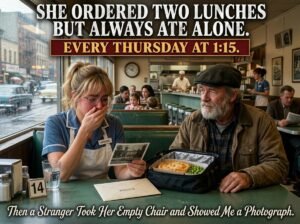
For eight months, June ordered two lunches and waited until 1:15 before taking the second home. Then a delivery driver arrived in her place with a warm meal, a letter, and a photograph from twenty-three years ago. The woman outside our diner’s window was my mother.
Part 1
I put the second glass on table six before I checked the clock.
It was a little after noon, the Thursday lunch rush had begun, and someone at the counter wanted more coffee. Usually, by then, June would be taking off her coat and smoothing the folded edge of her handbag.
Her table stood beside the front window. She liked the chair facing the street. The other chair faced the counter, where I could see it whenever I turned from the kitchen doors.
For nearly eight months, I laid two place settings there every Thursday.
June arrived alone, ordered chicken pie with peas twice, and asked us not to move or touch the second plate until precisely one fifteen. At that time, she would look at the empty chair, nod slightly, and ask for a box.
She paid for both meals.
Her tip was always three dollars. Three one-dollar bills, flattened carefully beneath the edge of her cup. When the lunch price went up, she apologized for not changing the tip.
I told her she did not need to explain.
I had worked at Miller’s Diner for four years. At twenty-nine, I knew which regulars wanted conversation, which wanted quiet, and which hoped we could offer company without naming the need.
June liked a little of both.
She asked about the weather, my shifts, and the old clock above the till. Once, she asked whether I had always lived nearby. I said yes, mostly, and she looked as though the answer mattered more than I understood.
Eventually, I asked whether she was expecting someone.
“Not yet,” she said.
I stopped asking and kept setting out the second glass.
That Thursday, she did not come.
At twelve twenty, I checked the reservation book. Her name was there in my handwriting. At twelve thirty, I wondered whether the bus was late.
Then a man wearing a delivery-company jacket entered carrying a small insulated bag.
He stood near the door until I looked up.
“Are you Maggie?”
“Yes.”
“The waitress who saves table six?”
I glanced toward the window.
“Is June all right?”
“She asked me to bring this.”
He set the bag on the table. Inside was a container holding chicken pie and peas, still warm, and an envelope with my first name across the front.
“Is she ill?”
He looked at the empty chair.
“May I sit?”
“Of course.”
He chose the chair June always left untouched.
For some reason, that frightened me. I had watched it remain empty so often that seeing a man pull it out felt like someone interrupting a sentence I did not know how to finish.
He took an old photograph from his jacket pocket and placed it beside my hand.
“Before you open the letter,” he said, “June asked me to tell you why she chose this diner.”
The photograph showed our front window twenty-three years earlier. Different paint. An older sign. The same narrow step near the door.
A woman stood outside holding a paper bag.
My mother.
I knew the coat, the tilt of her head, the way she curled one hand around a strap when she was waiting.
She had died five years ago.
Beside her stood a thin young man I had never seen before.
The delivery driver touched his chest.
“That boy,” he said, “was me.”
Part 2
I looked at the photograph until the diner blurred around it.
My mother’s name was Laura. In the picture, she was younger than I was now, wearing the green coat I remembered from childhood. One cuff had been repaired with thread a shade darker than the fabric.
I used to put my fingers through that repair while waiting for a bus beside her.
“How did you know her?” I asked.
The man looked toward the kitchen doors.
“Is there somewhere we can talk without making your day harder?”
I had three tables waiting for orders and a coffee pot nearly empty. Grief did not pause a lunch shift simply because an old photograph arrived.
I asked my manager, Annie, to cover me for ten minutes. She knew my face well enough not to ask questions in front of a stranger.
“Take the back booth,” she said. “I’ll sort it.”
The driver introduced himself as Michael Ward. He was forty-one, eighteen in the photograph. June was his mother.
“Your mum helped me,” he said.
“With what?”
“With being hungry first. Other things afterward.”
I looked back at the bag in Laura’s hand.
“She worked here then?”
“She did.”
I knew that much. Mom had several jobs when I was little, including shifts at the diner. It was part of why I applied there years later, though I rarely told customers. I liked working in a place she remembered fondly.
Annie had worked alongside her for a short time before becoming manager. She told me Mom was quick on her feet and terrible at remembering where she left her own cup.
I had thought that was all the diner held of her.
Michael folded his hands on the table.
“I was having a bad year. I’d left home after an argument and made it very difficult for people to find me. I was sleeping in different places. Sometimes on a friend’s floor. Sometimes nowhere I could stay twice.”
“June didn’t know?”
“She knew I was missing from her life. She didn’t know where.”
He did not describe the whole argument or ask me to choose a side. I appreciated that. My mother’s photograph did not entitle me to every private part of his family.
“One Thursday, I came in here,” he continued. “I had enough for tea. I thought I could stay near the radiator until someone asked me to go.”
I glanced at the radiator under the window. It still made a clicking sound when the heat came on.
“Mom served you?”
“Yes.”
“She noticed?”
“She noticed a lot.”
I smiled despite the pressure in my throat.
Michael said she brought tea, then a plate of lunch. When he said he could not pay, she told him somebody had ordered extra and it would be wasted.
“Had somebody?”
“I don’t know.”
He smiled slightly.
“She left me my pride. I didn’t argue.”
The envelope lay between us. I had not touched it.
“And the next Thursday?” I asked.
“She asked whether I’d come back.”
“Did you?”
“Yes.”
He looked toward table six.
“She said she could keep that chair for me until one fifteen.”
Part 3
Michael came back the following Thursday.
My mother served lunch and asked whether he had somewhere safe to sleep that night. He said he did. He later admitted to her that he had not been certain.
She did not drag his story out of him in front of the room.
“She asked what I wanted help with,” he said. “Not what she thought I ought to want.”
Over several weeks, he told her more. He had argued with June, left in anger, and become too ashamed to admit how little control he had over what happened afterward.
June had tried to contact him. He ignored some messages and changed where he stayed. By the time he wanted to hear her voice, making the call felt like confessing every mistake at once.
My mother knew what pride could do to a hungry person.
She did not tell him returning home would automatically make everything simple. She offered the diner telephone and a quiet time to use it.
“One fifteen was when the rush eased enough for her to step away,” Michael said. “She told me I could eat first and decide afterward.”
I remembered waiting beneath that same counter as a child, drawing on spare order pads while Mom finished serving. She sometimes placed a plate beside me and asked whether I could be patient for five more minutes. I used to think she belonged entirely to the version of the diner I could see from my little chair. Michael was describing another part of the room, another person she noticed while keeping us both in view. The memory did not make my childhood smaller. It made the life around it wider, full of conversations happening above my head that I had never known to ask about.
I looked toward the counter, imagining Laura walking past it in an apron, balancing orders while keeping one eye on a young man who might leave if he felt watched.
“That was why she saved the table?”
“At first. I kept coming and kept finding reasons not to call.”
“How long?”
“Five Thursdays.”
The fifth time, he finished lunch, stood by the telephone, and began crying before he dialed.
Mom stayed nearby without taking the receiver.
June answered.
“She didn’t begin with the argument,” Michael said. “She asked whether I was safe.”
I pressed my hands together beneath the table.
“And she came?”
“Yes. She got here at one thirteen.”
He remembered the time because he had stared at the clock while waiting, convinced she might change her mind.
Mom put another meal on the table. June sat in the chair facing the street. Michael sat opposite, and neither knew how to begin.
“Your mother said we could start with lunch.”
The photograph was taken afterward by the old owner. Laura and Michael stood near the window while June went to bring the car around.
“I kept it because it was the first day I believed going home was still possible.”
I traced the edge of the photograph without touching my mother’s face.
“Did you stay in touch with her?”
“For a while. Then life changed. I moved for work. Mum stayed in the area, but your mother stopped working here. We lost the thread.”
I knew how ordinary that sounded. People did not always remain in one another’s lives simply because an important thing happened between them.
“She never told me,” I said.
“You were six.”
“I mean later.”
He nodded.
“She didn’t seem like someone who kept a list of people she helped.”
She did keep lists. Groceries, overdue tasks, the plants she thought I would forget to water. But not a list that made someone else owe her.
I looked toward the front window.
“Why didn’t June tell me any of this?”
Michael’s expression softened.
“Because when she first booked the table, she didn’t know who you were.”
Part 4
June first came back to the diner after finding the photograph in a box.
She had been clearing a cupboard and discovered it inside an old address book. Michael was visiting that afternoon. They sat at her kitchen table remembering a Thursday neither had discussed properly for years.
“We talked about being grateful,” he said. “And about how badly we’d kept in touch.”
They decided to find Laura.
The old diner number still worked. June called, asked whether Laura worked there, and learned she had died five years earlier.
I looked down.
“Annie told her?”
“Someone at the counter. Mum was too upset to ask much else.”
June came in the following Thursday. She booked two places because she had intended to invite my mother to lunch, and grief made her reluctant to change the plan before she arrived.
She ate one meal and took the other to Michael afterward. His delivery route sometimes brought him nearby. On weeks it did not, she ate the leftovers herself or shared them with a neighbor.
There had been no food waiting untouched for a person who might walk through the door at any second. There had been a memory she was trying to sit beside without rushing it into a neat conclusion.
“But I asked whether she was expecting someone.”
“She told me.”
“She said, ‘Not yet.’”
Michael smiled sadly.
“She hoped she might meet someone who remembered Laura well enough to tell her more. She’d been working up the courage to ask.”
“And then?”
“She met you.”
I looked toward the name badge pinned to my apron.
“Maggie isn’t exactly an unusual name.”
“No. At first, she only liked how you treated her.”
He described small conversations I barely remembered. June asked whether I had family nearby. I said my mother used to work at Miller’s. Another day, I mentioned her name while Annie and I argued affectionately about whose recipe made the better apple crumble.
June began putting the details together.
“She asked Annie privately whether you were Laura’s daughter,” Michael said. “Annie said you were, but that your mother’s death was still painful and she should speak to you herself.”
“Annie didn’t tell me.”
“Mum asked for a little time. She said she wanted to explain in person.”
There was a Thursday I remembered suddenly: June had arrived with a newspaper folded around something in her bag. When I asked whether she wanted a quiet table instead, she said this one was right. I had thought she was protecting a habit. Now I wondered whether the photograph had been inside that newspaper, ready to be brought out until the lunch rush became another reason to wait. I could understand the nervousness. I could also see how much easier it would have been if someone simply asked whether I had time for a conversation. I said that to Michael, and he agreed.
I felt a brief flare of hurt. People had known something about my mother while I walked past with coffee.
Michael saw it.
“She should have said it sooner,” he said. “She knows that.”
“Why didn’t she?”
“She got nervous. Then every Thursday became another chance to do it properly.”
I recognized the trap. A conversation could become more difficult each time a person saved it for the perfect moment.
“What changed this week?”
He looked at the envelope.
“She had a fall. She’s being looked after. It frightened her, and she stopped wanting to leave things unsaid.”
“Is she all right?”
“She’s recovering. She asked me to tell you that first, but I knew I’d muddle the order.”
I let out the breath I had been holding since he walked in.
Then he added, “She also asked me to bring the lunch because she finally wants you to sit in the other chair.”
Part 5
Annie appeared beside the booth carrying two glasses of water.
“I’m sorry I didn’t tell you,” she said.
I looked up at her.
“How long have you known?”
“A few weeks. June said she wanted to speak to you. I thought giving her time was kind.”
“It might have been kinder to ask what I wanted.”
“Yes.”
She set the glasses down.
“I should have checked with you.”
I was glad she did not defend the choice simply because she meant well. I could understand June’s hesitation and still dislike being the last person to know why someone watched me with such feeling.
Michael offered to leave the photograph and letter so I could read alone.
“Would you stay a little longer?” I asked.
“Of course.”
Annie said the lunch rush was covered and told me to take the time I needed. It was a practical offer from a manager who knew the room and the staff, not an invitation to abandon a shift without considering anyone else.
Before opening it, I asked whether there was anything urgent I needed to know about June. Michael said there was not; the people caring for her knew where he was, and she expected him to return later. He had planned enough time to speak with me, but I was free to pause. I appreciated hearing that. A mysterious letter could make a person feel there was only one correct response: read quickly, cry gratefully, and understand everything at once. I wanted to know I could take a moment if I needed it. Michael moved his water glass away from the envelope and waited.
I opened the envelope.
June’s handwriting was careful and slightly uneven.
Dear Maggie, I have put this off until I have made it harder than it needed to be. I am sorry. Your mother gave my son lunch when he needed more than lunch, and gave me a chance to hear his voice again.
I read the lines slowly.
She explained the ritual in her own words. The second meal remembered a place Laura kept available. The time marked the moment June once arrived before her son could convince himself she would not come.
Then she wrote about the three-dollar tip.
It was the amount Michael had in his pocket after their first lunch together. He wanted to leave it for Laura. June offered to add more, but Laura told her it was a good tip and thanked him as though it came from someone with plenty.
Michael had told June afterward that he remembered feeling useful for the first time in weeks.
The three dollars was not a secret fortune or a code. It was an amount a young man could offer and a woman could accept without making him feel small.
I looked at him.
“You remembered that too?”
“Yes.”
June apologized for worrying me by missing the lunch without first telling me she was safe. She said the delivery was meant as an invitation, not a farewell.
At the bottom, she wrote: If you would like to know more, I would be grateful to tell you. If you would rather keep your Thursdays ordinary, I will understand. Your mother never made help into a debt. I don’t want to make her memory one either.
I put the letter down.
For five years, I had collected every scrap of Laura anyone offered me. I also knew how exhausting it could be when people expected my grief to make them feel better about their own.
June had left the choice with me.
“Can I call her?” I asked.
Michael smiled.
“I hoped you might.”
He gave me the number June had asked him to share if I wanted it.
When she answered, I heard the familiar voice from table six.
“Oh, Maggie,” she said. “I’ve made a terrible mess of asking you to lunch.”
Part 6
I laughed before I began crying.
June waited. I could hear a television low in the background and somebody asking whether she wanted the door closed.
“I thought the letter might be goodbye,” I said.
“No. I should have made that clearer.”
“Michael explained.”
“Eventually, I hope.”
He smiled beside me when I glanced at him.
I asked how she was feeling. She said she was sore, annoyed at being temporarily dependent on people, and grateful the fall had not been worse. I did not ask for private medical details she had not offered.
“Would you like a visitor?”
“If you would like to visit.”
“Yes,” I said. “I would.”
We arranged it through the people helping with her recovery so I would come at a suitable time. She asked whether I would bring the photograph.
I said I would keep it safe.
When I finished the call, I sat without speaking for a minute. The difference between fearing a farewell and arranging a visit had left me lightheaded. Michael did not fill the space with more explanation. He checked his phone once, sent June a short message to say we had spoken, and put it away again. I was grateful that he had work and ordinary responsibilities waiting outside this conversation. It meant the afternoon did not need to hold every detail of a life before we could return to it. I took a drink of water and said I was ready for lunch.
After the call, Michael and I moved back to table six. The food he carried was for me, made from a spare portion Annie had arranged after speaking with June earlier that morning. I could finally understand how the familiar lunch arrived warm in a delivery bag rather than imagining some impossible final gesture.
“You were all coordinating this?” I asked.
“Not perfectly,” he admitted.
“No.”
We smiled at each other.
Annie brought a fresh portion for him from the kitchen, and we ate while the diner returned to its ordinary afternoon rhythm. Someone laughed at the counter. A teaspoon fell. The clock moved toward one fifteen.
I looked at the photograph again.
Mom’s coat, the repaired cuff, the paper bag.
I had always thought that period of our lives was defined by what we lacked. Money, time, space. My father was no longer around, and Mom worked across several places to keep the rent paid.
“She couldn’t have had much to spare,” I said.
Michael put down his fork.
“I know.”
“Was she paying for the lunches?”
“Some of them. The owner helped too, once he knew what was happening. Laura didn’t do everything alone.”
I was glad he said it. I did not want to turn my mother into a person who never needed help because she was busy giving it away.
“She let people help,” I said.
“She did.”
Michael remembered her asking the owner about a few shifts for him washing dishes while he worked out where to go next. He did not stay long, but the first paid hours gave him something to tell June besides that he was sorry.
“What happened when you went home?”
“We argued sometimes. We still do.”
I smiled.
“She doesn’t seem difficult.”
“You haven’t tried convincing her to use a walking stick.”
The affection in his voice made June seem more real than the quiet woman who waited beside an untouched plate.
At one fifteen, neither of us moved.
For the first time since I began serving the table, the second lunch did not need a box.
Then Michael reached into his jacket again.
“There’s one more thing,” he said. “Your mother wrote it the day she took the photograph home.”
Part 7
The note was on the back of a diner order slip.
I recognized the old logo, which Annie still kept on a framed menu near the kitchen. Mom’s handwriting leaned forward, hurried but legible.
June, he doesn’t need to explain everything today. Let him come home first. There will be time for the difficult conversations when you’ve both had lunch.
I read it several times.
I could hear her saying it. Not as wisdom prepared for strangers, but as something practical offered to a frightened woman who might begin an argument simply because fear needed somewhere to go.
“Did June listen?” I asked.
“For the journey home,” Michael said. “Then we had one of the difficult conversations.”
I laughed.
“It helped, though. Not having to solve my whole life before she let me through the door.”
I thought of the times Mom let me be angry as a teenager without turning dinner into a privilege I had to earn by being pleasant.
She was not endlessly patient. She shouted when she was exhausted. She forgot forms and occasionally burned things while talking on the phone. But she did not make me wonder whether a mistake meant I no longer belonged.
“I wish I’d thanked her for that,” I said.
Michael looked at the note.
“I wish I’d stayed in touch.”
Neither of us tried to remove the other’s regret. We could keep it without using it to punish ourselves through lunch.
I asked whether Michael wanted the original note returned with the photograph. He said yes, when I had made a copy if I wanted one. It had lived in his family’s box for years, and I did not assume recognizing the handwriting made it entirely mine. We agreed how to handle both pieces, which made the conversation easier. He had brought them to share something, not to test whether I would understand their value. I put the note beside the photograph and told him I would bring them when I visited June. He thanked me without making the carefulness sound strange.
Later, I went back to work. The practical world still needed me: cutlery, receipts, coffee, the man at table four asking whether tomorrow’s soup would be the same.
I worked more slowly for a while, and Annie quietly covered the gaps.
At the end of the shift, I put the photograph and note inside a rigid folder so they would not bend in my bag. Then I went home to my small flat, where Mom’s picture stood on a shelf near the kettle.
I told her about the day out loud.
It was something I had stopped doing after the first year, embarrassed by how much I still wanted to tell her ordinary things. That evening, it felt natural again.
“You never mentioned Michael,” I said.
The room gave me no answer. I did not pretend it did.
I made toast, read June’s letter once more, and slept with the folder safely on the table.
Two days later, I visited June.
Michael met me at the entrance of the place where she was recovering. He carried a bunch of flowers and wore an ordinary sweater instead of the delivery jacket.
“She’s worried you’ll think she’s been staring at you for eight months,” he said.
“She has been.”
“I know. I told her we might not fix that with flowers.”
We both smiled.
June sat by a bright window, a blanket folded across her knees. She looked smaller without her coat and handbag arranged around her.
When she saw me, she held out both hands.
“I should have spoken sooner,” she said.
“Yes,” I answered gently. “But I’m glad we’re speaking now.”
Then she looked at the photograph and said, “There’s something about your mother I never understood until I met you.”
Part 8
June held the photograph carefully.
“She was so young,” she said.
“Younger than I am.”
“I knew that then. I don’t think I understood it.”
She looked at me.
“I thought she was one of those people who always knew how to manage. Then you told me about working extra shifts and worrying over your rent, and I remembered the way she watched the clock.”
Mom had to leave some afternoons to collect me from school.
I told June about the neighbor who waited with me when a shift ran late, the little bag of crayons Mom kept under the counter, and how I thought the diner’s corner booth belonged partly to us because I did homework there so often.
“She wasn’t looking after Michael from some easy place,” I said.
“No.”
June wiped one eye.
“She helped while she needed help too.”
I nodded.
A member of staff came to check whether June wanted fresh water. June introduced me as a friend before explaining the connection to my mother. I noticed the order and felt something loosen. I was not only evidence that Laura had lived or a face carrying familiar features. I was a person who could decide to stay for another ten minutes, offer to visit again, or have my own difficult day. When the staff member left, June asked whether I needed to get back to work. I said I had the afternoon free, and she looked delighted by the answer.
We talked about Laura without making every story proof that she was extraordinary. June remembered her dropping a spoon, forgetting to bring mustard, and laughing at a customer who insisted the weather was the government’s fault.
Those details made me happier than grand statements would have.
People often told me Mom was an angel after she died. I knew what they meant. I missed the woman who misplaced her keys and sang the wrong words while washing dishes.
June remembered that woman.
I asked why she had continued ordering the same lunches after learning who I was.
“I thought I might ask you to sit down,” she said. “Then you were busy. Then I worried I’d make you cry at work.”
“So you kept waiting.”
“Yes.”
I looked at her.
“You could have asked for a time.”
“I know that now.”
Michael made a small noise that suggested he had said something similar many times.
June ignored him with the practiced dignity of a mother who had heard enough from her adult son for one afternoon.
We laughed.
Then she grew serious.
“I don’t want you to feel I’ve been borrowing your mother through you.”
I considered the answer.
“A little, maybe. At first.”
She nodded, accepting it.
“But you asked about me too. My shifts. My flat. The course I wanted to take.”
“The bookkeeping one?”
“Yes.”
“I wanted to know because it mattered to you.”
That distinction helped.
I could share memories of Mom without becoming the place June stored all her gratitude. We could also be two people who liked each other, with a diner table and eight months of ordinary conversation behind us.
Before leaving, I asked whether she wanted the ritual to continue when she was ready to come back.
She looked toward Michael.
“Not exactly as before.”
“What would you like?”
“A lunch people agree to attend.”
I smiled.
“We can arrange that.”
On the way out, Michael said his Thursday route was changing the following month. He would be able to take a proper lunch break nearby.
For the first time, there was a simple reason he could occupy the empty chair.
But June had another request first.
She wanted to know whether I had any photographs of my mother I would be comfortable bringing.
Part 9
I spent Sunday sorting a box I had avoided for months.
There were photographs, birthday cards, old school certificates, and receipts Mom kept for reasons nobody could explain now. Some items made me smile. Others made the room feel too quiet.
For a moment, I wanted to bring the whole box. I imagined June and Michael knowing every expression, every holiday, and every year they missed. Then I realized I would spend the visit deciding what to explain instead of enjoying their company. They did not need to learn my whole childhood to understand that Mom had been loved. I put the larger stack back and chose a few pictures that felt easy to share. The others could wait. Some would remain mine. It was a relief to discover that gratitude for a new memory did not require giving away every old one in return.
I chose carefully.
June did not need every memory. Neither did Michael. I could offer part of my mother’s life without handing over the whole box simply because they were grateful to know her.
I found a photograph of Laura behind the diner counter. I was about seven, holding a plastic cup and looking offended by something the camera had interrupted.
There was another from the garden at our old building. Mom held a spade, smiling beside a row of plants that never grew as well as she predicted.
And there was one I had taken when I was sixteen, showing her asleep on the couch with a book open across her chest.
I kept that one for myself.
At work on Monday, Annie asked whether I wanted to talk about June.
I said yes, after the shift.
We sat near the counter while the kitchen staff finished cleaning. Annie explained that she had not known the whole story when June asked about me. She knew enough to realize there was a connection and had allowed June’s wish for the right moment to delay a conversation I deserved to choose.
“I’m sorry,” she said again.
“Thank you.”
“Next time, I’ll ask you first.”
“That’s what I need.”
We did not make it larger than it was. She had made a mistake, named it, and could change how she handled something similar.
Then she told me a story about Mom hiding a badly broken cake beneath extra icing before deciding she ought to admit what happened.
“She confessed before anyone tasted it,” Annie said. “Said she couldn’t live with herself if somebody complimented the middle.”
I laughed until I had to wipe my eyes.
We asked the owner whether we could copy the old diner photograph from his records. Michael and June agreed to the copies we wanted. No one put the image online or turned June’s lunches into a promotion.
It was enough for it to belong to the people in the story.
By the time June was ready for a short outing, we had arranged the next Thursday clearly. Michael would bring her. Annie would cover my break. I would eat with them if I wanted and could leave when the break ended.
There would be three places, not two.
I arrived early with the photographs in my bag.
The clock above the till had been running a few minutes slow. I asked Annie whether someone could set it properly before June came.
“Of course.”
Then I stood by table six with three glasses in my hands and realized something else needed to change.
I called Michael.
“Ask June what she wants to order today,” I said.
“For lunch?”
“Yes.”
He sounded surprised.
“Not the usual?”
“Only if that’s what she actually wants.”
Part 10
June chose fish and chips.
Michael chose a sandwich. I ordered soup because I had already tasted enough pie filling while helping in the kitchen that morning.
The three different meals looked almost rebellious on table six.
June noticed me smiling.
“What?”
“Nothing. I just didn’t know you liked fish and chips.”
“I like a great many things you’ve never seen me eat.”
Michael laughed.
“She can be quite surprising when she remembers she’s allowed.”
June gave him a look, then reached for the vinegar.
We talked about her recovery, his work, and the bookkeeping course I hoped to take in the autumn. He said the delivery office always seemed to need someone who could make sense of its paperwork. I said I would finish learning before offering to rescue anyone’s accounts.
Nobody announced a scholarship or handed me a life-changing check. June’s gratitude did not need to become my financial future for the afternoon to matter.
She asked to see the photographs.
I placed the ones I had chosen between the plates, away from the water glasses. She studied the garden picture for a long time.
“Your mother looks happy.”
“She hated that soil.”
June smiled.
“Both can be true.”
We passed the photographs around. Michael recognized the old counter and the repaired cuff on the green coat. I learned that the owner had offered him dishwashing shifts without making him stand in front of the staff and explain why.
The story grew more ordinary as we talked, and more valuable.
It involved wages, warm food, a telephone, a patient owner, a frightened mother, and a young man who eventually chose to make a call. Laura had played an important part without being the only person who mattered.
I liked knowing that.
At one fifteen, June glanced at the clock.
Then she took another bite.
No one asked for a box.
I could not stop looking at that small change. For eight months, the minute had controlled a table. Now it marked part of a lunch still happening.
“You don’t have to keep waiting,” Michael said softly.
She looked at him.
“I know.”
There was more in the answer than I could understand, and I let it remain theirs.
After my break, I stood to return to work. June thanked me for choosing to join them. She did not ask me to stay until she felt finished with the memories.
That made it easier to say I would like another lunch sometime.
We arranged nothing on the spot. We would ask about dates, look at schedules, and make a plan that could change if someone was tired or busy.
Ordinary friendship deserved ordinary flexibility.
June returned to Miller’s on some Thursdays. Sometimes Michael came. Sometimes she met a neighbor. Once, she arrived alone with a book and ordered only one meal.
I asked whether she wanted the window table.
“Yes, please.”
I set one glass down and did not feel sad about the other being absent.
Her tip often remained three dollars. When she left more, I thanked her in the same way. We had discussed the meaning once; neither of us needed every bill to perform it again.
I began the bookkeeping course in autumn, fitting it around my shifts. It was harder than I expected and more interesting. June asked about it without treating every mark as a message from my mother. Michael occasionally brought a question about an invoice and accepted when I said I was not ready to advise him.
We learned who we were now.
The old photograph stayed in my flat for a few weeks before I returned the original to Michael. We made the copies we had agreed on. I framed mine beside a picture of Mom and me, allowing the two versions of her to sit together.
In one, she was my mother. In the other, she was a young working woman standing beside someone she had helped.
I had needed both.
On the anniversary of her death, I took a day off. I walked near the river, bought flowers, and called June in the evening because I wanted company.
She asked whether I wanted to talk about Laura or about something else.
“Both,” I said.
So we did.
Before ending the call, she said, “I used to think gratitude meant finding a way to repay what she did.”
“What do you think now?”
“That I can remember it properly and still keep living.”
I looked at the photograph near the kettle.
“I think she’d like that.”
The next Thursday, I arrived at the diner to find table six ready for the lunch rush. Two glasses stood on the tray beside the clean cutlery, waiting to be used wherever they were needed.
I checked the reservation book.
June had booked for three the following week, after asking whether I was free.
I wrote a note beside her name to confirm my break with Annie.
Then I picked up the coffee pot and went to welcome the customers already coming through the door.
For months, I thought June was saving a chair for someone who had not arrived.
She had been remembering the day someone left one open for her son.
Now the table could hold the memory—and the people still here to share lunch.