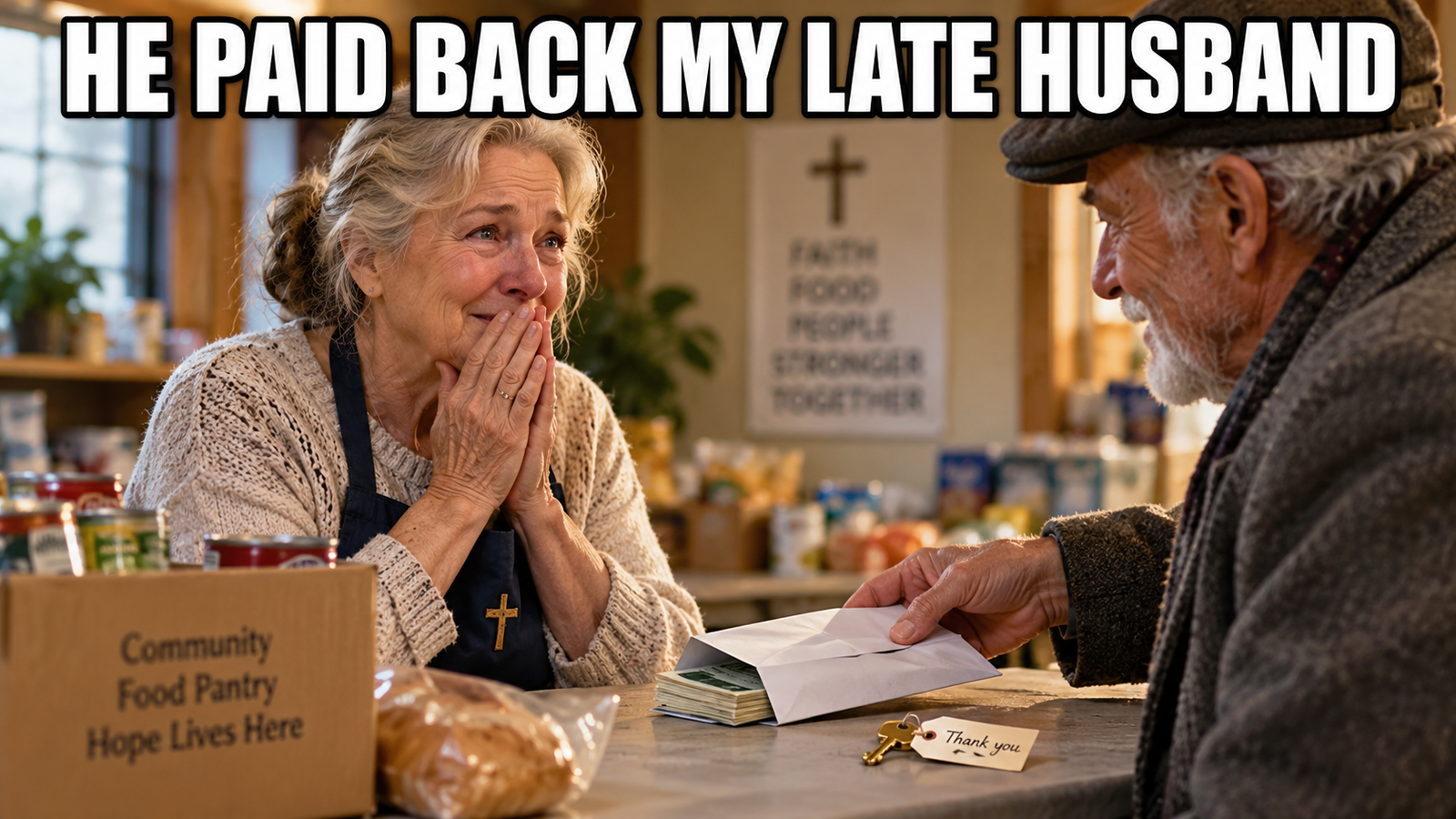
Every Tuesday for the past six years, I’ve handed out canned goods at the food pantry behind Grace Methodist. I’m 63, I know most of the regulars by name, and I’d never seen the man in the gray wool coat before. He didn’t take a bag. He waited until the line was gone, then set a thick envelope on the folding table in front of me.
Inside was $4,200 in cash, bundled with rubber bands. He said it was for my husband, Leonard. I told him, as gently as I could, that Leonard passed away two winters ago. He nodded like he already knew. He said that in 1994, when he was 26 and sleeping in his car with a newborn, Leonard paid his rent for seven months. Leonard never said one word to me about it. We were barely making our own mortgage back then.
I tried to give the money back. He wouldn’t take it. Instead he asked if he could sit down for a minute, because there was something else Leonard had made him promise, and he’d waited a long time to keep it.
He told me Leonard didn’t just pay his rent. He asked him for one favor in return, a favor that had to stay secret until after Leonard was gone. Then he reached into his coat again and pulled out a small brass key with a paper tag tied to it.
The tag had my name on it, in Leonard’s handwriting.
PART 1 — THE MAN WHO DIDN’T TAKE A BAG
I didn’t move for a while after he set the key on the table. The fellowship hall smelled like burnt coffee and cardboard, the way it always does on Tuesdays, and somewhere behind me Marjorie was stacking the leftover green beans back on the shelf. Ordinary sounds. I remember thinking how strange it was that the world kept making ordinary sounds.
The man in the gray coat sat down across from me on one of the metal folding chairs. Up close he was older than I’d first thought, maybe fifty-five, with careful hands and a face that had spent a lot of time outdoors. He kept his eyes on the key, not on me.
“My name is Calvin Ashby,” he said. “I should have come sooner. I want you to know that I tried to come sooner.”
I asked him how he knew Leonard. I asked it the way you’d ask a question at a funeral, polite and a little guarded, because over the past two years I had learned that grief brings strangers to your door. Some of them mean well. Some of them want something.
He told me again about 1994. He had been twenty-six, laid off from a lumber mill, living in a 1987 Chevy Cavalier with his wife Renee and their six-week-old daughter. They parked behind the hardware store on Fulton Street because the night manager didn’t call the police. One morning in November, a tall man in a mechanic’s jacket knocked on the fogged-up window and asked if they were all right.
That man was my husband. I knew it before he said the name. Leonard could never walk past a fogged-up window.
“He came back that afternoon with a sack of groceries and a phone number for a landlord on Cherry Street,” Calvin said. “And then he paid our rent. Seven months. Three hundred and ten dollars a month. He wouldn’t let me thank him. He said the only thing he wanted was a favor, someday, when he asked for it.”
He said the only thing he wanted was a favor, someday, when he asked for it.
I looked down at the envelope of cash still sitting by my elbow. Forty-two hundred dollars. I did the arithmetic without meaning to. Seven months at three-ten was twenty-one seventy. He had paid it back almost twice.
“Mrs. Pruett,” Calvin said softly, “Leonard didn’t want the money back. He told me to give it to you. That was part of the favor.”
PART 2 — THE YEAR WE COULDN’T AFFORD ANYTHING
I need to tell you about 1994, because it matters.
Leonard and I had been married nine years. We had a two-bedroom house on Linden Avenue with a mortgage that ate half of everything he brought home from the garage. I worked mornings at the school cafeteria. We had a 1981 Buick that needed a new transmission, and that fall Leonard rebuilt it himself in our driveway, at night, under a work light, because we couldn’t pay anyone else to do it.
I remember that winter mostly as a list of things we said no to. No to a Christmas tree that year; we decorated the ficus. No to my sister’s wedding in Tampa. No to the honeymoon we’d promised ourselves on our tenth anniversary, the one we’d been talking about since the day we got married. We had wanted to go back to Lake Hollis, where Leonard proposed, and rent the little cabin with the green door for a whole week.
“Next year,” he said. He said it so gently that I believed him.
We never went. Next year became the year his father got sick, and the year after that we replaced the roof, and then our son Michael started college, and then it simply became one of those plans that couples carry around for so long it turns into a joke. “When we go to Lake Hollis,” we’d say, about anything we’d never do.
So when Calvin told me that in November of 1994 my husband had been quietly paying a stranger’s rent, I didn’t feel proud right away. I felt something closer to dizzy. I thought about the ficus with the paper ornaments. I thought about the night I cried because we couldn’t fly to my sister’s wedding, and Leonard held me and said nothing at all.
“Where did he get it?” I asked. “We didn’t have three hundred dollars a month. We didn’t have thirty.”
Calvin hesitated. “He worked Saturdays. At a body shop over in Millbrook. Cash jobs. He told me you thought he was helping his brother.”
I had thought exactly that. For seven months, every Saturday, Leonard had left at six in the morning with a thermos and told me he was helping Ray rebuild a boat. I had packed his lunch. I had asked how the boat was coming along.
“I’m not telling you this to make you upset,” Calvin said. “He said you’d be upset. He said you’d have every right.”
PART 3 — THE FAVOR
I took Calvin into the pantry office because Marjorie had started to notice, and because I didn’t trust myself to stay sitting in the open. The office was really just a storage closet with a desk in it. We sat among boxes of peanut butter and a calendar from 2019 that nobody had taken down.
“Tell me the favor,” I said.
Calvin rubbed his thumb along the edge of the key’s paper tag. “It took him a long time to ask,” he said. “I’d been trying to pay him back for years. I got on at a cabinet shop in 1996 and started my own business in 2003. Every Christmas I sent him a check, and every Christmas he mailed it back torn in half. Then in 2011, he called me and asked if I still did carpentry.”
2011. I counted backward in my head. That was the year Leonard turned fifty-five. The year he started talking about retiring early, and then stopped talking about it.
“He wanted me to fix up a place,” Calvin said. “A cabin. It was in bad shape, the roof was half gone, the porch was rotten through. He’d bought it for nineteen thousand dollars from an old man who couldn’t keep it up anymore. He didn’t have the money to pay me, so he said he’d work alongside me. Weekends. Whenever he could get away.”
My mouth had gone dry. “Where?”
He didn’t answer right away. He reached into his coat and set a photograph on the desk between us, a snapshot printed at a drugstore, slightly faded. A small cabin with cedar shingles, a long porch, and a door painted a deep, glossy green.
It was a small cabin with cedar shingles, a long porch, and a door painted a deep, glossy green.
Lake Hollis.
I put my hand over my mouth. I couldn’t help it. It was the cabin. Not one like it. The same one, the one we’d stayed in for two nights in 1985, when Leonard had knelt down on that porch in the rain and asked me to marry him while a family of ducks complained under the steps.
“He said it was going to be for your fortieth anniversary,” Calvin said quietly. “He said he’d promised you a week there, a long time ago, and he was going to give you the rest of your life instead.”
Our fortieth anniversary would have been June of 2025. Leonard died in February of 2024.
PART 4 — WHAT I DIDN’T KNOW ABOUT MY HUSBAND
I drove home that afternoon with the key in my coat pocket and the envelope of cash on the passenger seat, and I didn’t turn on the radio. I kept thinking about all the Saturdays.
Because there had been Saturdays in our later years too, and I had a story for every one of them. Leonard was fishing with Ray. Leonard was at a car show. Leonard was helping the church men’s group fix the youth center. I had never once questioned any of it. Why would I? He came home tired and happy, with sawdust in his hair, and I thought it was sweet that a man in his sixties still liked building things for other people.
He had been building something for me. The thought kept arriving and departing, like a radio station going in and out.
At home I did something I hadn’t done since the funeral. I went into the garage and opened his tall red tool chest. I had avoided it for two years. It still smelled like WD-40 and the spearmint gum he chewed instead of smoking. In the bottom drawer, under a folded shop rag, I found a spiral notebook I’d never seen before.
It was a log. Dates, hours, materials, receipts stapled to the pages. *Roof decking, $1,140. Porch joists, $486. Windows (3), $912. Paint, green, Calvin’s mix, $64.* Fourteen years of entries in his square block printing. Near the back, he had kept a running total. The last number on the last page was $61,380, including the purchase price.
There was a note in the margin of the final page, dated three weeks before he died. *Almost there. Calvin says by spring. Don’t tell D. Want to see her face.*
I sat down on his rolling stool. I’ll be honest with you: part of me was angry. Not the loud kind of anger. The quiet, hurt kind. For fourteen years, the man I shared a bed with had kept a whole second life inside a red tool chest, and I’d been washing his sawdust-covered jeans and never once asked.
And then I turned the page, and there was one more line, written in a shakier hand.
*If I don’t make it, Calvin knows what to do.*
PART 5 — THE ROAD TO LAKE HOLLIS
I called my son Michael that evening. He’s thirty-eight now, an accountant in Columbus, and he is very much his father’s son: calm, practical, slow to react. I told him everything. He was quiet for so long that I thought the call had dropped.
“Mom,” he finally said, “did you know Dad took out a home equity line in 2016?”
I hadn’t. Michael had handled the estate paperwork. He’d seen a small line of credit, twelve thousand dollars, paid off in full eighteen months before Leonard died. He had assumed it was for the furnace. We had replaced the furnace in 2016. It had cost four thousand dollars.
“So he wasn’t hiding a debt,” Michael said slowly. “He was hiding a cabin.”
“He was hiding a cabin,” I repeated, and somehow that made us both laugh, the helpless kind of laughter that comes right before you cry.
That Saturday, Michael drove down and we went to Lake Hollis together. It’s two hours north, past three small towns and a long stretch of cornfields. I hadn’t been there since 1985. I’d half expected it to be gone, sold off to developers, covered in vacation condos. But the gravel road was still there, and the hand-painted sign for the bait shop, and the wide gray water spreading out under a cold October sky.
Calvin was waiting in the little parking area. He had brought his wife, Renee, and a young woman in her early thirties with his same careful hands.
“This is Hope,” Calvin said. “She was the baby in the car.”
Hope hugged me before I could say anything. She said her parents had told her about Leonard her whole life. She said she became a social worker because of him.
We walked down the path together, through the trees, and there it was. The cedar shingles were new and honey-colored. The porch was wide and solid. And the door was green, deep and glossy, exactly the shade I remembered from a rainy night when I was twenty-four years old and absolutely certain about my whole life.
Calvin held out his hand toward the door. “It’s yours,” he said. “It was always yours.”
PART 6 — THE GREEN DOOR
The key turned easily. Leonard always kept locks oiled.
Inside, the cabin smelled like cedar and fresh paint and something else I couldn’t name at first. Then I realized it was lavender. There was a bundle of dried lavender on the kitchen windowsill, tied with twine. I used to grow lavender along our back fence on Linden Avenue. I’d given up on it years ago when my knees got bad.
The main room was small and bright. A woodstove. Two armchairs facing the window and the lake. A bookshelf, built into the wall, half full of paperbacks. I walked over to it, and my throat closed up, because I recognized them. Mysteries. My mysteries. The old ones I’d read in my twenties and given away at yard sales when we needed the shelf space. Agatha Christie, Dorothy Sayers, all the ones with the cracked spines. He must have hunted them down one by one at thrift stores, for years.
Michael was standing in the doorway to the bedroom, and he didn’t come out.
“Mom,” he said. “You should see this.”
The bedroom had a quilt on the bed that I knew. It was my grandmother’s wedding-ring quilt, the one that had disappeared from our cedar chest sometime around 2018. I had turned the house upside down looking for it. I’d blamed the movers from when Michael’s things came back from college.
On the quilt, there was a shoebox, and on the shoebox, there was a single word in Leonard’s printing: *ANNIVERSARIES.*
Inside were thirty-nine envelopes.
One for every year of our marriage. Each one had a year written on the front, starting with 1986 and ending with 2024. They were sealed. Some of them were yellowed with age. The early ones were written on cheap drugstore cards; the later ones on heavy cream stationery.
Calvin had stayed out on the porch with his family. Michael sat on the edge of the bed. I held the box on my lap for a long time.
“He wrote you one every year,” Michael said. “And he never gave you any of them.”
“He gave me cards every year,” I said. “Funny ones. With dogs on them.”
“Then what are these?”
I didn’t know. I didn’t know if I was ready to know. My fingers found the envelope marked 1994, the year of the ficus and the paper ornaments, and I opened it.
PART 7 — THE LETTER FROM 1994
The card was plain, the kind you buy in a pack of ten. Inside, Leonard had written in pencil, pressing hard.
*Dee,*
*Today I told you no again. No tree, no trip to see your sister, no Lake Hollis. I watched you be brave about it, and I felt about two inches tall.*
*There’s something I haven’t told you. There’s a young family living in their car behind Hobart’s. A baby, Dee. A baby in a car in November. I can’t explain why, but I could not drive past them. I’m paying their rent with Saturday work at Millbrook. I know we need that money. I know you’d say yes if I asked you, and that’s exactly why I’m not asking, because you’d give up even more, and you’ve given up enough.*
*I’m going to make this up to you. I don’t know how yet. But I’m writing it down so I can’t forget: I owe you a week at Lake Hollis, and a Christmas tree, and probably a lot more than that.*
*All my love, every day. L.*
I owe you a week at Lake Hollis, and a Christmas tree, and probably a lot more than that.
I read it twice. Then I handed it to Michael, because I didn’t have any words left, and he read it with his jaw tight, the way his father used to look when he was trying not to show anything at all.
I understood something then that I hadn’t understood in thirty-nine years of marriage. I had always thought Leonard was a simple man. Kind, steady, a little stubborn, not much of a talker. I had loved him the way you love the weather in a place you’ve always lived. I’d never thought of him as someone with secrets.
But he hadn’t been hiding anything from me, not really. He had been carrying something for me, a long, slow promise, and he’d been too proud and too stubborn to set it down until it was finished.
I opened 2003 next, the year Calvin started his business. *Calvin called to say thank you again. I told him the only thanks I want is for him to do the same for somebody else. He says he already has. Two families this year, Dee. Two.*
I opened 2011. *Bought the Hollis cabin today. Don’t laugh.*
I laughed. I laughed so hard I had to put the card down, and Michael laughed too, and out on the porch I heard Calvin’s family go quiet, listening.
PART 8 — WHAT CALVIN KNEW
That evening Calvin built a fire in the woodstove, and Renee made coffee in the little kitchen as if she’d done it a hundred times, which, it turned out, she had. The Ashby family had been coming to the cabin on weekends to work on it for years. Hope had painted the bedroom. Renee had sewn the curtains.
“He didn’t want strangers working on it,” Calvin explained. “He wanted people who cared.”
I asked the question I’d been holding all day. “Why didn’t you come to me right away? After the funeral. Why wait two years?”
Calvin looked at the fire for a long time before he answered.
“Because the cabin wasn’t finished,” he said. “When Leonard got sick, we still had the kitchen to do, and the dock, and the wiring needed inspecting. He made me promise. He said, ‘Don’t you dare hand her a half-done job. She’s had enough half-done things from me.’ So I finished it. I did it nights and weekends. It took me nineteen months.”
“You paid for it,” I said. It wasn’t a question. I’d seen the notebook. Leonard’s log stopped in January of 2024.
Calvin didn’t deny it. “About eleven thousand. Materials only.” He held up a hand before I could argue. “Mrs. Pruett, your husband kept my daughter warm for seven months. I’ll never be finished paying that back. I don’t want to be.”
I’ll never be finished paying that back. I don’t want to be.
Hope was sitting cross-legged on the rug by the bookshelf. She spoke up quietly. “There’s one more thing in the favor,” she said. “Dad, tell her.”
Calvin nodded. He reached into his coat once more, and this time he pulled out a folded document. It was the deed. The cabin was in my name, transferred in 2019. But there was a second page clipped to it, a handwritten note signed by both Leonard and Calvin.
*When Dee has had her week, if she wants to, the cabin should do what that landlord on Cherry Street did for the Ashbys. Give somebody a place to land.*
My husband had planned a second life for this little cabin, too.
PART 9 — A WEEK AT LAKE HOLLIS
I stayed a week.
Michael went back to Columbus on Sunday night, and Calvin’s family left me with a full refrigerator and their phone numbers written on a sticky note on the fridge. For the first time in almost forty years, I was at Lake Hollis, and I was alone, and I wasn’t sure what to do with myself.
So I did what Leonard had planned for me. I read a mystery every day in the armchair by the window. I walked down to the bait shop and bought a terrible cup of coffee from a teenager who called me ma’am. I sat on the porch steps where he’d proposed and listened to the ducks complain. And every evening, I opened one more envelope.
I read our whole marriage that way, one year at a time.
Some of the letters were funny. In 1999 he wrote three pages about a raccoon that had gotten into our garage and the elaborate trap he’d built to catch it, which the raccoon had promptly turned into a bed. Some were hard. In 2008, the year we lost my mother, he wrote only four lines, and I held that card for an hour. Some of them made me realize how much he’d noticed when I thought he wasn’t paying attention at all. *You hummed while you made dinner tonight. You haven’t done that since your mother passed. I almost cried into the meatloaf.*
You hummed while you made dinner tonight. I almost cried into the meatloaf.
On the last night, I opened 2024. It was dated January 9th, a month before he died. The handwriting wavered, but it was still his.
*Dee, if you’re reading this at the cabin, then Calvin kept his word, and I’m sorry I wasn’t there to see your face. I hope you laughed when you saw the green door. I hope you’re not too mad about the quilt.*
*I spent our whole marriage owing you things. I hope this squares it a little. And if there’s anything left over, give it away. That’s the only way I ever figured out how to keep anything.*
I sat by the window until the lake went dark, and I didn’t feel like a widow that night. I felt like a wife who’d finally gotten her week.
PART 10 — A PLACE TO LAND
It’s been a year now since Calvin Ashby walked into the Grace Methodist food pantry in his gray wool coat.
I still volunteer every Tuesday. Marjorie still stacks the green beans too high. But some things are different. The $4,200 Calvin gave me went into a fund at the pantry, and we’ve used it for emergency rent for six families so far. Every time I write a check from it, I write the memo the same way: *From L.P., with thanks to C.A.*
And the cabin has a calendar now.
Hope helped me set it up. She works with the county family services office, and she knows the families who need a quiet place for a few days: a mother just out of the hospital, a father who lost his job right before Christmas, a grandmother raising three grandkids who hasn’t had a night off in two years. They stay for a week at no cost. Calvin keeps the woodstove in good repair. Renee stocks the kitchen. I leave a mystery novel on the nightstand and a card on the table, and the card always says the same thing.
*Somebody once gave my family a place to land. Now it’s your turn. Rest well.*
I keep one week every June for myself. Our anniversary week. Michael comes up for a day or two with his wife, and we grill on the porch and argue about whether the ducks under the steps are descendants of the original ducks. Michael insists they are. I’ve decided to believe him.
People ask me sometimes whether I’m still angry that Leonard kept so much from me. It’s a fair question. I was angry, for about a day. But I’ve had a year to read his letters, and I’ve come to understand that he wasn’t really keeping secrets. He was keeping promises, the slow way, the only way he knew how.
The last time I closed up the cabin for the season, I stood on the porch with the green door at my back and looked out at the water. The light was going gold over Lake Hollis. I thought about a fogged-up car window in November of 1994, and a tall man in a mechanic’s jacket who couldn’t walk past it.
He wasn’t really keeping secrets. He was keeping promises, the slow way.
I locked the door with his key and put it in my coat pocket, where it lives now.
“Next year,” I said out loud, to nobody, to the ducks, to him.
And this time, I knew it was true.