I’ve been working in payroll at a regional furniture company for eight months. I’m 24, and it’s my first real job out of college. Last month, while cleaning up some old records for an audit, I noticed something strange.
There’s an employee named Thomas Reyes who has been paid $3,100 every two weeks for 19 years. No department. No manager. No timesheets. No performance reviews. His address is a P.O. box. And every single one of his payments is approved personally by our CEO, Mr. Whitfield, who doesn’t approve anyone else’s pay directly.
I asked around carefully. Nobody had heard of him. Not the longest-serving warehouse manager, not HR, not the receptionist who’s been here since 1996. I did the math one night and stopped when the total went past $1.5 million.
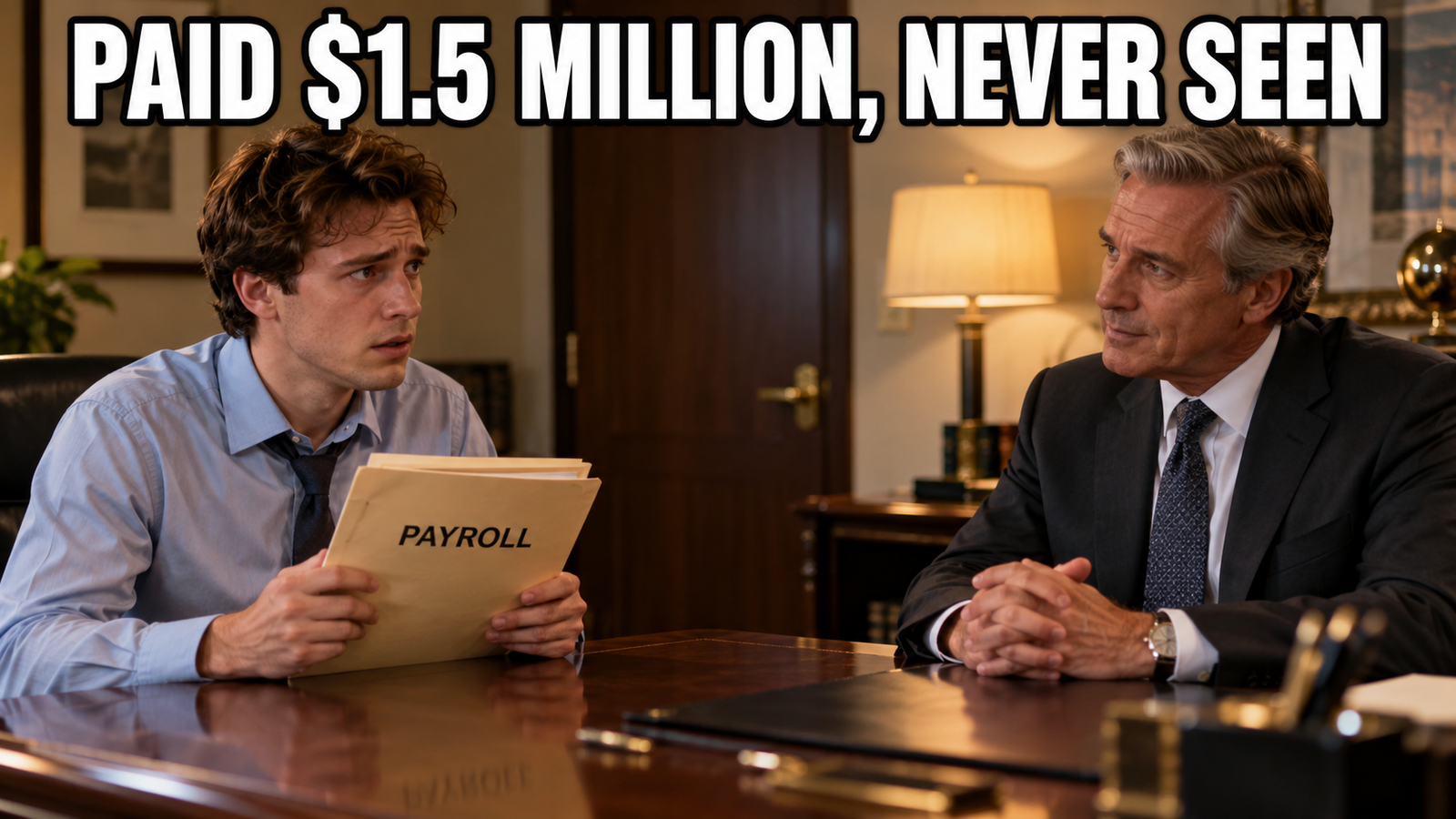
I knew I had two options. I could pretend I never saw it, or I could report it. If it was fraud, staying quiet would make me part of it. So I printed the records, put them in a folder, and asked for ten minutes on Mr. Whitfield’s calendar.
He let me speak without interrupting. When I finished, he didn’t look angry or nervous. He got up and closed his office door, which I’d never seen him do. Then he sat back down and looked at the folder for a long time. “You’re the first person in nineteen years to notice,” he said. “Before you decide what to do, I’d like you to meet him.”
PART 1 — THE FOLDER ON THE DESK
Mr. Whitfield didn’t say anything for almost a full minute after he closed the door.
He sat back down behind his desk, which was enormous and old and made of dark walnut, built in our own factory in 1979, the year the company was founded. He picked up the folder I’d brought, the one with nineteen years of payroll records for a man named Thomas Reyes, and he turned the pages slowly, one at a time, as if he were reading a letter from an old friend.
I sat in the chair across from him with my hands clamped between my knees so he wouldn’t see them shake. I’m twenty-four. I’d been at Lakeshore Furniture for eight months. I was fairly sure I was about to be fired.
“You did the math,” he said finally. Not a question.
“Yes, sir. One million, five hundred and sixty-two thousand dollars. Plus benefits. Plus the health insurance premiums, which are paid at the family rate.”
“You’re the first person in nineteen years to notice,” he said.
“You’re the first person in nineteen years to notice,” he said. He set the folder down and looked at me over his reading glasses. Clifford Whitfield was sixty-eight, silver-haired, with a face that always looked slightly tired. He’d taken over the company from his father in 1998. Everyone said he was a decent boss. He knew the warehouse guys by name. He came to the company picnic every summer and worked the grill.
“Before you decide what to do,” he said, “I’d like you to meet him.”
“Meet who?”
“Thomas.” He stood up and took his coat off the hook by the door. “He’s expecting us at two. He gets nervous when people are late.”
PART 2 — THE AUDIT
Let me back up and explain how I got there.
I got the job at Lakeshore Furniture right out of Grand Valley State with a degree in accounting. It wasn’t glamorous. Lakeshore is a family-owned company in Grand Rapids, Michigan, that makes solid wood dining tables and bedroom sets. We have about three hundred and forty employees, most of them in the factory and the warehouse. I’m one of two people in the payroll department. The other is Linda, who’s sixty-two and has been there since 1996 and runs the whole thing with a coffee mug that says *Don’t Talk To Me Until Friday*.
In February, the company hired an outside firm for its first full financial audit in a decade. Linda asked me to clean up old payroll records in preparation. Archive the inactive files. Make sure every active employee had a complete record: a job title, a department, a manager, a hire date, a performance review on file.
Every active employee had a complete record. Except one.
Three hundred and thirty-nine of them did.
One didn’t.
His name was Thomas Reyes. His hire date was August 14, 2005. He was listed as active. He’d been paid every two weeks since September 2007, by direct deposit, $3,100 per paycheck before taxes. But there was no department. No job title, just a code I’d never seen: *SPL-1*. No manager. No timesheets, ever. No performance reviews. His mailing address was a P.O. box in Wyoming, Michigan, a suburb south of the city.
And every single one of his paychecks, for nineteen years, had been approved by a single signature. Not Linda’s. Not the HR director’s. *C. Whitfield.*
PART 3 — ASKING AROUND
I didn’t go to Linda first. I don’t know why. Maybe because she’d been there so long that I was afraid she’d know, and that knowing would make her part of it.
Instead, I asked around. Carefully. I asked Gus, the warehouse manager, who’s worked at Lakeshore for thirty-one years, if he’d ever worked with a guy named Thomas Reyes. Gus squinted at the ceiling and shook his head. I asked the HR director, a brisk woman named Pam, if she knew what the code *SPL-1* meant. She frowned and said she’d never seen it. I asked the receptionist, Doreen, who’s been at the front desk since 1996 and knows everybody’s birthday. She said the name sounded familiar, but she couldn’t place it.
Nobody had ever met Thomas Reyes.
Nobody had ever met Thomas Reyes.
That night, I sat at my kitchen table and added it all up. Nineteen years of paychecks. Benefits. Health insurance. I stopped when the total passed a million and a half dollars and sat there staring at the calculator on my phone.
I knew what it looked like. A ghost employee. It’s one of the oldest frauds in the book. We studied it in my auditing class junior year. Someone creates a fake employee on the payroll, routes the paychecks to an account they control, and nobody notices because nobody ever looks.
And the only person who’d ever approved Thomas Reyes’s pay was the CEO.
I drove past the post office in Wyoming the next morning on my way to work. I don’t know what I expected to see. A man in sunglasses collecting envelopes? It was just a post office, beige brick, with a flag out front and a line of people mailing packages. I sat in the parking lot for ten minutes feeling ridiculous and then drove to work and spent the whole day pretending everything was normal. Linda asked me twice if I was coming down with something. I told her it was allergies.
PART 4 — THE CHOICE
I didn’t sleep much that week.
I had two options, and I hated both of them. I could pretend I’d never seen it. Archive the file, move on, keep my head down. I was twenty-four, eight months into my first real job, with forty-one thousand dollars in student loans. Mr. Whitfield owned the company. If I made trouble, nobody would blame him. They’d blame me.
Or I could report it. To the auditors, or the board, or both. And if it really was fraud, and I stayed quiet, then I was part of it.
I called my father on Wednesday night. My dad, Hector Morales, is fifty-three. He worked in a meatpacking plant in Holland, Michigan, for twenty-two years until a conveyor belt accident in 2012 crushed his left hand. The company fought his compensation claim for three years. They said he’d been careless. He wasn’t. A safety guard had been removed to speed up the line. Everybody knew it. Nobody would say it.
They said he’d been careless. He wasn’t. Everybody knew it. Nobody would say it.
“Mijo,” my father said, after I explained. “You already know what you’re going to do. You’re calling me so I’ll tell you it’s okay.”
“Is it okay?”
“Somebody should have said something at my plant,” he said. “Somebody always knows. It’s just that nobody wants to be the one.”
So on Friday, I printed the records, put them in a folder, and asked Mr. Whitfield’s assistant for ten minutes on his calendar.
PART 5 — THE DRIVE
Mr. Whitfield drove us himself, in an old Buick with a cracked dashboard. I’d always assumed CEOs drove something nicer.
He didn’t say much on the way. We drove south on 131, past the outlet mall and the stadium, into a neighborhood of small brick ranch houses with chain-link fences. He parked in front of a yellow house with a wheelchair ramp leading up to the front door and a wooden sign hanging on the porch that said *Reyes* in hand-carved letters.
Before he got out, he sat with his hands on the steering wheel for a moment.
“In August of 2007,” he said, “Thomas Reyes was twenty years old. He’d worked in our warehouse for two years. Good kid. Fast, careful, always early. He wanted to be a furniture designer. He’d sit in the break room and sketch chairs on napkins.” He paused. “He showed me some once. They were good. Really good.”
He’d sit in the break room and sketch chairs on napkins. They were good. Really good.
“On August twenty-ninth, a storage rack in Bay Four failed. It was overloaded. Forty-two hundred pounds of oak tabletops came down. Thomas was underneath it.”
I didn’t say anything.
“He survived,” Mr. Whitfield said. “He had a severe brain injury. He spent four months in the hospital and two years in rehabilitation. He can’t work. He can’t drive. He needs help with a lot of things most of us don’t think about.” He stared out the windshield. “And it was my fault.“
PART 6 — WHAT WHITFIELD DID
“The rack had been flagged as overloaded in a safety inspection in June,” Mr. Whitfield said. “Two months before. The inspector recommended we reinforce it or redistribute the weight. The repair would have cost eleven thousand dollars. I signed off on delaying it until the next fiscal year.” He closed his eyes. “We were behind on orders. I thought we had time.”
He’d found that out the day after the accident, reading through the inspection files at two in the morning in his office. He told me he threw up in the wastebasket.
“My father built this company on one rule,” he said. “He had it painted on the wall of the original shop, over the door. *We make things that last.* He meant the furniture. But he also meant the people. He used to say a company is only as good as the way it treats the guy at the bottom of the ladder on his worst day.” Mr. Whitfield shook his head. “And I had just let that guy get crushed under a rack I knew was dangerous, to save eleven thousand dollars and hit a quarterly number. I’ve never been so ashamed of anything in my life.“
“Our insurance company wanted to fight it,” he said. “They wanted to say Thomas had been careless. That he’d ignored warning signs, stood where he shouldn’t have. Our lawyer said we could probably win. Thomas’s family didn’t have money for a lawyer of their own.”
“Our lawyer said we could probably win. Thomas’s family didn’t have money for a lawyer of their own.”
I thought of my father’s hand.
“I refused,” Mr. Whitfield said. “I went to the hospital and I sat down with Thomas’s mother, and I told her the truth. All of it. I told her the rack was my responsibility. And I told her that Thomas would be taken care of for the rest of his life. His full salary. His health insurance. Whatever he needed. She didn’t have to sue anybody. She didn’t have to prove anything. She just had to let me keep my word.”
“That’s the SPL-1 code,” I said slowly. “Special leave.”
“Permanent special leave,” he said. “I made the code up myself. The only people who knew were me, our old CFO, who retired in 2014, and the board of directors at the time. It’s in the minutes from September 2007. Sealed, at Mrs. Reyes’s request. She didn’t want Thomas to be a story people told at the water cooler.”
PART 7 — WHERE THE MONEY CAME FROM
“But it’s company money,” I said. I had to say it. My father would have wanted me to. “A million and a half dollars of company money, for nineteen years, with no disclosure to the current board. Even if the reason is good, that’s still…”
Mr. Whitfield nodded. He actually looked pleased, which confused me.
“You’re right,” he said. “That’s exactly what it would be. If it were company money.” He reached into his coat and handed me a sheet of paper, folded in thirds. It was a page from his own personal tax return, from 2008. And a letter from the company’s board, dated October 2007.
The letter was short. *The board acknowledges Mr. Whitfield’s request to reduce his executive compensation by the amount of the Reyes obligation, effective immediately and continuing indefinitely.*
The board acknowledges Mr. Whitfield’s request to reduce his executive compensation by the amount of the Reyes obligation.
He’d cut his own salary. By exactly the amount of Thomas’s pay and benefits, every year for nineteen years. The money went through the company’s payroll so Thomas would have real employee benefits, real health insurance, and a real job title for his records. But every dollar of it came out of Clifford Whitfield’s own pocket.
“Linda knows,” he said. “She’s processed my reduced salary since 2007. She just doesn’t know why. She never asked.” He smiled faintly. “Linda doesn’t ask questions she doesn’t need the answers to.”
“Why didn’t you just pay him directly?” I asked. “Out of your own bank account?”
“Because Thomas wanted to be an employee,” Mr. Whitfield said. “When he could understand things again, about a year after the accident, the first thing he asked his mother was whether he’d lost his job. He was so worried about it. I wanted him to be able to say he still worked at Lakeshore. I wanted it to be true.”
PART 8 — THOMAS
Thomas Reyes opened the door himself.
He was thirty-nine now, a big man with a gentle face and a scar along his hairline that his dark hair didn’t quite cover. He walked with a cane. He spoke slowly, carefully, like each word was something he’d had to build. But his eyes were bright and alert, and when he saw Mr. Whitfield, his whole face lit up.
“Cliff,” he said. “You’re late.”
“Two minutes,” Mr. Whitfield said. “Traffic.”
“Two minutes is late.” Thomas looked at me. “Who’s this?”
“This is Kevin. He works in payroll.” Mr. Whitfield hesitated. “He found your file.”
Thomas studied me for a moment. Then he grinned. “Took them long enough,” he said. “Come in. I want to show you something.”
“Took them long enough,” he said. “Come in. I want to show you something.”
He led us through the small, tidy house to a converted garage in the back. It was a workshop. Sawdust on the floor, tools on the walls, a big window letting in afternoon light. And everywhere, on every surface, there were chairs. Small ones, about a foot tall. Models. Dozens of them, maybe a hundred, carved from oak and maple and walnut and cherry. Rocking chairs, ladder-back chairs, a tiny Windsor chair with every spindle perfect.
“It’s my therapy,” Thomas said. “My occupational therapist said I should do something with my hands. Fine motor skills. So I make chairs.” He picked up a little walnut armchair and handed it to me. “This one’s my best. It took four months.”
It was beautiful. Every joint was flush. The curve of the arms looked like water.
Thomas’s mother came out from the kitchen while we were standing there. Mrs. Graciela Reyes was in her late sixties, small and brisk, with an apron over her church clothes. She hugged Mr. Whitfield like a son and then looked me up and down. When he explained who I was, she took both of my hands in hers and held them for a long moment. “You came to check on him,” she said. “Good. Somebody should always check.” Then she went back to the kitchen and returned with a plate of tamales, because, Mr. Whitfield told me quietly, she always did, every single visit, for nineteen years.
Mr. Whitfield picked up a small rocking chair from the windowsill. “This was the first one,” he said quietly. “2009. He gave it to me.” He turned it over. On the bottom, in shaky pencil, it said: *For Cliff. Thanks for not lying.*
PART 9 — WHAT I DECIDED
I didn’t report Mr. Whitfield to anyone.
I went back to the office that afternoon and told Linda everything. She listened without interrupting. When I finished, she set down her coffee mug and looked out the window for a long time.
“I always wondered,” she said. “Nineteen years of that man cutting his own salary. I figured he had a gambling problem.” She laughed a little and wiped her eyes. “I should have known it was something like this.”
Then I went to the outside auditors with Mr. Whitfield and the sealed board minutes and his tax returns. They reviewed everything. It took two weeks. In the end, they classified Thomas’s file as a properly authorized and fully funded executive compensation arrangement, with a recommendation that the current board be formally informed. Mr. Whitfield told them in April. The vote to continue the arrangement was unanimous.
The vote to continue the arrangement was unanimous.
But I did one more thing, and I didn’t ask anyone’s permission.
I called my father and asked him to drive up to Grand Rapids on a Saturday. I took him to the yellow house with the wheelchair ramp and introduced him to Thomas. They sat in the workshop for three hours. Thomas showed my dad how he holds a carving knife with a special grip his therapist designed. My dad showed Thomas how he still uses his left hand for some things, the three fingers that work. They didn’t talk about accidents. They talked about wood, and the Tigers, and their mothers’ cooking.
On the drive home, my father didn’t say anything for a long time. Then he said, “That man Whitfield. He told the truth.”
“Yeah,” I said.
“Nobody ever told the truth for me,” my father said. He looked out the window. “I’m glad somebody did for him.”
PART 10 — SPL-1
Mr. Whitfield is retiring at the end of this year. He’s handing the company to his daughter, Rachel, who’s been running operations for five years. He asked me to come to his office in September, and I thought it was to say goodbye.
Instead, he handed me a file. *SPL-1.*
“When I’m gone,” he said, “somebody has to make sure this keeps happening. Rachel knows. The board knows. But I want somebody in payroll who understands why. Somebody who’ll check.” He paused. “Somebody who’ll notice if it ever stops.”
“I want somebody in payroll who understands why. Somebody who’ll notice if it ever stops.”
He’s set up a trust, funded with his own money, to pay Thomas’s salary and benefits for the rest of Thomas’s life, no matter what happens to the company. But the payments still go through Lakeshore’s payroll. Thomas still has an employee ID. Thomas still works there. Mr. Whitfield made sure of that.
And Thomas has a job title now. It took him and Mr. Whitfield two months to agree on it. It says *Master Model Maker, Design Department*.
Because here’s the last thing. Rachel Whitfield saw Thomas’s chairs in May. She stood in that converted garage for an hour, picking them up one at a time. Then she asked Thomas if Lakeshore could produce one of his designs, the little walnut armchair, full size.
It’s in our catalog now. The Reyes Chair. It’s the best-selling dining chair we’ve introduced in ten years. Thomas gets a royalty on every one, separate from his salary. He’s using it to build a ramp and a wider workshop door so he can make bigger pieces.
I go to see him every other Saturday. Sometimes Mr. Whitfield comes. Sometimes my dad does. We sit in the workshop with the sawdust and the afternoon light, and Thomas carves, and we talk about nothing much.
I still have the little walnut armchair Thomas handed me that first day. He made me keep it. It sits on my desk in the payroll office, next to Linda’s coffee mug.
Last week, Linda picked it up and turned it over. On the bottom, in careful pencil, Thomas had written something I hadn’t noticed before.
*For Kevin. Thanks for checking.*