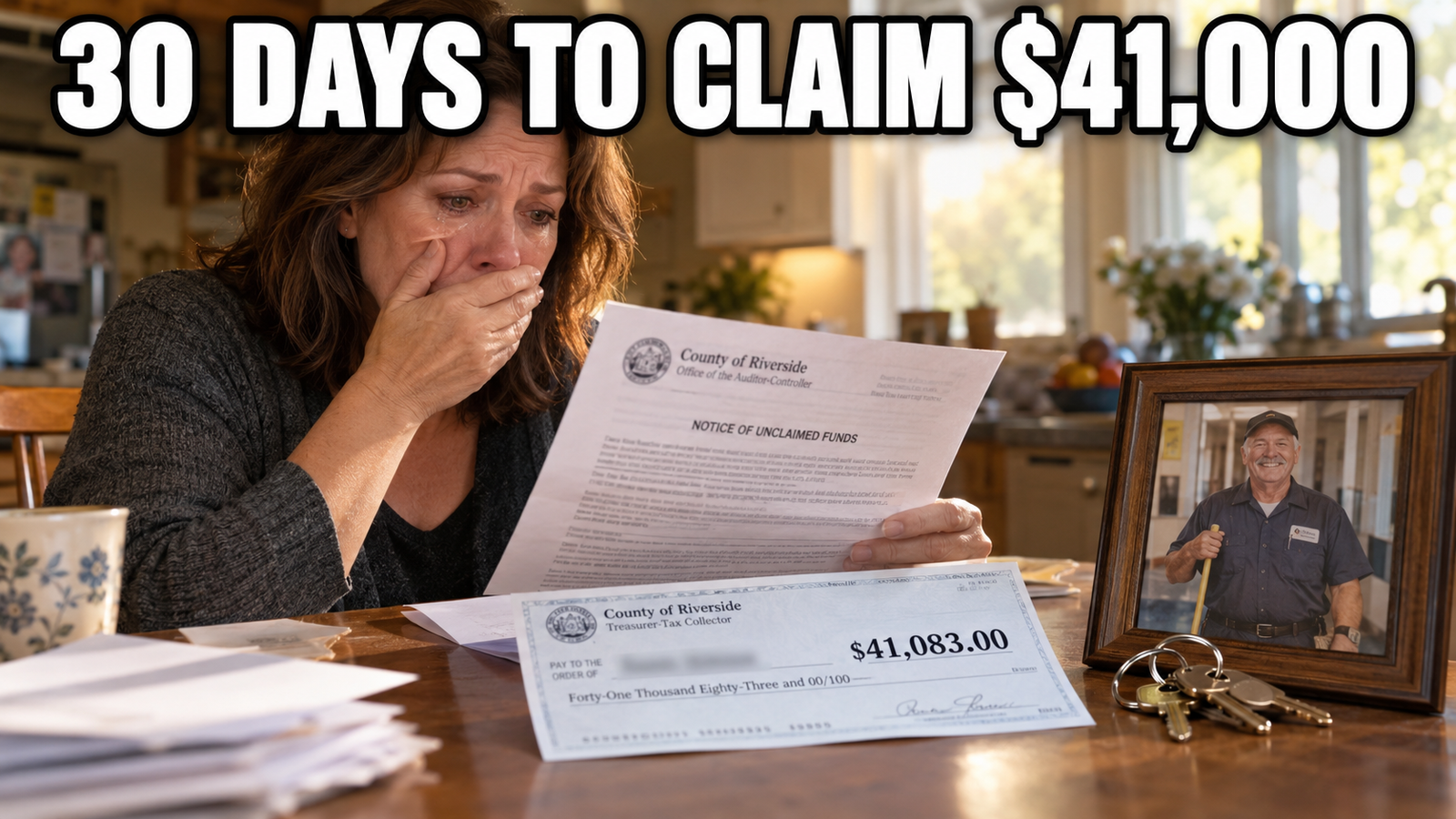
The letter came in a plain envelope from the Wayne County Treasurer’s Office. I almost threw it out with the grocery flyers. It said an account opened in 1986 had been inactive for over 20 years, and that I, Beverly Ann Pruitt, was listed as the sole beneficiary. The balance was $41,083. I had 30 days to file a claim, or the money would go to the state.
I’m 48. I work at a dental office. I don’t have a rich relative, and I’d never heard of the man whose name was on the account: Clarence Moody.
I called the office, sure that it was a mistake. A clerk named Diane pulled up the file. She confirmed my maiden name, my birthday, and my childhood address on Sycamore Street. She said Mr. Moody had made a deposit every month for 13 years and listed me as beneficiary when I was eight years old.
I asked her if the file said anything else about him. She said there was a short form with his occupation and employer on it, filled out by hand. She read it aloud.
“Custodian. Lincoln Elementary School.” That was my school, from kindergarten through sixth grade. And as she said the name of the school, a memory I hadn’t thought about in forty years came back all at once. The winter of 1986, when my father lost his job at the plant, and the quiet man with the ring of keys who found me crying by the lunchroom door. I remembered what he asked me that day. I had just never understood why.
PART 1 — THE LUNCHROOM DOOR
The memory came back the way old songs do. All at once, every word.
It was January of 1986. I was eight years old, in third grade at Lincoln Elementary in Wooster, Ohio. My father had just lost his job at the Rubbermaid plant, after fourteen years on the line. My mother was working nights at a nursing home. Nobody at home said anything to me about money, but I knew. I knew because the refrigerator was emptier, and because my mother cried in the bathroom with the water running, and because my lunch account at school had run out.
That day, the cashier in the lunch line, a tired woman with a hairnet, told me my account was negative and I’d have to take the cheese sandwich. The cheese sandwich was what they gave kids who couldn’t pay. Everybody knew it. Everybody knew what it meant.
The cheese sandwich was what they gave kids who couldn’t pay. Everybody knew what it meant.
I didn’t take it. I walked out of the lunchroom and stood in the hallway by the door with my face against the cinderblock wall and cried so hard I couldn’t breathe.
And a man with a ring of keys found me there.
He was the custodian. Tall, thin, older, with gray hair and a gray work shirt with his name stitched over the pocket in red thread. *Clarence.* He crouched down beside me, so he was at my eye level, and he didn’t ask me what was wrong. He just waited until I could breathe again.
Then he asked me a question.
“Beverly,” he said. “What do you want to be when you grow up?”
I’ve thought about that question my whole life. I just never understood why he asked it.
PART 2 — THIRTY DAYS
The letter came in a plain white envelope from the Wayne County Treasurer’s Office. I almost threw it away with the grocery flyers. I thought it was about my property taxes.
Instead, it said that an account opened in 1986 at a local savings bank had been inactive for over twenty years. The bank had been sold twice since then and the account had finally been turned over to the county’s unclaimed funds program. I, Beverly Ann Pruitt, was listed as the sole beneficiary. The balance was $41,083. I had thirty days to file a claim, or the money would go to the state.
I’m forty-eight. I’ve worked at the same dental office in Wooster for twenty-six years, at the front desk, scheduling appointments and fighting with insurance companies. I’m divorced, with a grown son in the Navy. I don’t have a rich relative. My parents both passed in the 2010s, and they never had more than a few thousand dollars in their lives.
I don’t have a rich relative. My parents never had more than a few thousand dollars in their lives.
The name on the account was Clarence Moody. I had no idea who that was.
I read the letter four times standing at my kitchen counter. Then I did what any sensible person would do: I assumed it was a scam. I looked up the phone number for the Wayne County Treasurer’s Office myself, on the county’s website, instead of calling the one printed on the letter. I checked the return address against the courthouse address. I even called my son, Ethan, on his ship in San Diego, and asked him if this was one of those internet tricks. He laughed and said, “Mom, scammers don’t usually mail you an actual letter on county letterhead with a case number.” Then he told me to call them first thing in the morning and call him right back.
I called the treasurer’s office the next morning, sure it was a mistake. A clerk named Diane pulled up the file. She confirmed my maiden name, my date of birth, and my childhood address on Sycamore Street. She said Mr. Moody had made a deposit every month for thirteen years, from February 1986 to March 1999, and had listed me as beneficiary when I was eight years old.
I asked her if the file said anything else about him. She said there was a short form, handwritten, with his occupation and employer. She read it aloud.
*”Custodian. Lincoln Elementary School.”*
PART 3 — WHAT I TOLD HIM
“A dentist,” I’d said.
I remember it now. Standing in that hallway with snot running down my face, and this tall, quiet man crouched in front of me, waiting. I said I wanted to be a dentist. I’d just been to one for the first time that fall, a free clinic at the church, and the dentist had been a woman with a kind voice who gave me a purple toothbrush and told me I had the strongest teeth she’d seen all week. I’d decided right then that’s what I would be.
Clarence nodded seriously, as if I’d told him something very important.
“That’s a good thing to be,” he said. “Dentists help people. And they make good money, so their kids never have to eat the cheese sandwich.” He stood up, slowly, with a hand on his knee. “You go on back in there and get yourself a hot lunch, Beverly. It’s taken care of.”
“Dentists make good money, so their kids never have to eat the cheese sandwich.”
I went back in. The cashier with the hairnet looked at me strangely and said my account had been fixed. I got sloppy joes and tater tots and chocolate milk.
I remember sitting at the long cafeteria table with my tray, eating so fast I gave myself the hiccups, and looking back through the little window in the lunchroom door. The custodian was out in the hallway, mopping the same spot on the floor where I’d been standing, slow and steady, back and forth. He didn’t look up. He never once looked up. After a while he picked up his bucket and walked away down the hall, his keys jingling, and I went back to my tater tots and forgot all about him for forty years.
And my lunch account never ran out again. Not that whole winter. Not the next year, after my father found a new job at a warehouse for less money. Not in fourth grade or fifth grade or sixth. I never once thought about why. I was eight. I thought that’s just how it worked.
I never became a dentist. The money for college wasn’t there. I went to work at nineteen as a receptionist at Dr. Hartman’s office, and twenty-six years later, I’m still there. Every day, I watch other people do the job I wanted. I’m good at the front desk. But every once in a while, a little kid comes in for their first cleaning, scared to death, and I think about the woman with the purple toothbrush.
PART 4 — MRS. DALEY
I had thirty days. I spent the first week trying to find out who Clarence Moody was.
There wasn’t much. No obituary that I could find online. No family that showed up in records. Lincoln Elementary had closed in 2012 and merged with another school. I called the school district office, and a nice woman there said personnel records from the 1980s were in storage somewhere and she’d see what she could do.
Then I thought of the lunch lady.
Not the cashier with the hairnet. The other one. Mrs. Daley, who’d run the Lincoln Elementary kitchen for thirty years, a round, cheerful woman who called every kid “sugar” and slipped extra tater tots to the ones who looked hungry. I found her through the Wooster Senior Center. She was eighty-five years old and sharp as a tack.
Mrs. Daley called every kid “sugar” and slipped extra tater tots to the ones who looked hungry.
She remembered me. Of course she did. “Beverly Pruitt,” she said, holding my hand in the senior center lobby. “Little blond braids. Always had a book.” Then her face changed. “Oh, sugar. Is this about Clarence?”
“You knew him?”
“Everybody knew Clarence,” Mrs. Daley said. “Best custodian that school ever had.” She was quiet for a moment. “And he paid for your lunches. Did you know that? Every month, for four years, he came into my kitchen with an envelope of cash and paid your account in full. And three other kids’, too. He made me swear I’d never tell a soul.”
PART 5 — CLARENCE
Mrs. Daley told me the rest over coffee in the senior center cafeteria.
Clarence Moody was born in 1929 in Alabama. He came to Ohio in the 1950s for work, and he’d been the custodian at Lincoln Elementary since 1962. He was quiet, private, and very particular about his floors. He lived alone in a little rented house on Bowman Street and walked to work every morning, rain or snow.
“He had a little girl once,” Mrs. Daley said quietly. “Ruby. She died in 1971 of a kidney illness. She was eight. His wife left him not long after. Couldn’t bear to be in the same house. He never remarried. Never talked about it much.”
“He had a little girl once. Ruby. She was eight.”
Eight years old. The same age I was in that hallway.
“He told me once, years later,” Mrs. Daley said, “that he’d been mopping the hallway that day and heard a little girl crying by the lunchroom door. He said he almost walked past. He said he’d walked past a lot of crying kids in that building, because it wasn’t his place. But he said you had blond braids, and you were holding your lunch tray card so tight your knuckles were white, and he just couldn’t walk by.”
She looked at me over her coffee cup.
“Ruby had blond hair, too,” she said. “Her mama was white. Clarence was Black. That was a hard thing in 1962, sugar. Real hard. They married in Ohio because they couldn’t in Alabama. He used to say Ruby was the best thing that ever happened to him, and the reason he could stand anything else.”
PART 6 — THE ACCOUNT
The school district finally found Clarence’s personnel file in a storage unit. It was thin. A hire date in 1962, a retirement date in 1994. An emergency contact: none. And a copy of a change-of-beneficiary form for his small school pension, dated 1986, listing me.
The savings bank account was in the treasurer’s file. Diane, the clerk, let me see it. She’d taken an interest in the case. “We get a lot of these,” she said. “Not many like this one.“
The deposits started on February 3, 1986, a week after the day in the hallway. Twenty dollars. Then twenty dollars every two weeks, on payday, for years. Sometimes there’d be a little extra. Fifty dollars in December. A hundred dollars once, in 1991. After he retired in 1994, the deposits got smaller. Fifteen dollars. Ten. But they never stopped.
The deposits started a week after the day in the hallway. Twenty dollars, every two weeks, on payday.
Clipped to the original account application was a handwritten note in pencil, on lined paper. It was in Clarence’s handwriting. Diane had found it in the bank’s old file when the county took it over.
*For Beverly Pruitt’s dental school. She said she wants to be a dentist. I believe she will. To be given to her at age 21. C. Moody.*
I was twenty-one in 1999.
“The deposits stopped in March of 1999,” Diane said gently. “I looked it up. Mr. Moody passed away that April. He was seventy. Heart failure, at home. There was no will, no family to notify. Nobody knew about the account.”
He died six months before my twenty-first birthday. He’d been saving for thirteen years, and he died six months short.
I sat in Diane’s little office in the county building and did the math in my head, the way I do insurance math all day long. In 1999, I was twenty-one and working at Dr. Hartman’s front desk for six dollars and fifty cents an hour. I’d just been told by the financial aid office at the University of Akron that even with loans, I couldn’t afford their pre-dental program. I’d cried in my car in their parking lot. If that money had come to me that October, I might have gone. I might have been a dentist for twenty-five years by now. I made myself stop thinking about it. It wasn’t what Clarence would have wanted me to take from his gift. But I thought it anyway.
PART 7 — WHERE HE IS
I found Clarence Moody’s grave in the old section of the Wooster Cemetery, near the back fence, under a maple tree. It was a small flat stone, the kind the county provides when nobody else does. It just said his name and his dates. *Clarence J. Moody, 1929–1999.*
Next to it, a much older stone. Granite, gray, with a little lamb carved on top.
*Ruby Grace Moody. 1963–1971. Daddy’s girl.*
Ruby Grace Moody. 1963–1971. Daddy’s girl.
I sat down on the grass between them. I didn’t care that it was wet. I sat there for a long time, with my hand flat on his stone, and I told him about my life. About Dr. Hartman’s office, and my son in the Navy, and my divorce, and the little scared kids I check in for their first cleanings. I told him I never became a dentist, and I was sorry. I told him I’d thought about the woman with the purple toothbrush every week for forty years.
And then I told him the truth, which I’d never said out loud to anybody.
“I always wondered why my lunch account never ran out,” I said. “I thought maybe it was God. I guess it sort of was.“
There was a mud-stained plastic vase stuck in the ground at the head of Ruby’s grave. Empty. I walked back to my car, drove to the Kroger on Burbank Road, bought two bunches of yellow tulips, and came back and put one on each of them.
PART 8 — THE OTHER THREE
Mrs. Daley had said three other kids. I wanted to find them.
It took two weeks, and a lot of help from Mrs. Daley, who still remembered every child she’d ever fed. There had been four of us, in the end, whose lunches Clarence paid for in the late 1980s. Two of them I found.
One was Marcus Fields. He was fifty now, an electrician in Akron. When I called him and told him, he was quiet for a long time. Then he said, “I always thought my grandmother paid for it.” His grandmother had raised him on Social Security. “She couldn’t have,” he said. “I don’t know why I never wondered.”
“I always thought my grandmother paid for it. I don’t know why I never wondered.”
The other was Teresa Alvarado, forty-seven, a nurse in Cleveland. She cried on the phone. She said she’d been hungry most of her childhood, and the only hot meal she could count on was lunch at Lincoln. “I used to think the lunch ladies were angels,” she said. “I didn’t know there was a janitor.”
The fourth, a boy named David, Mrs. Daley said, had died in a car accident in 2004. She cried a little when she told me.
The three of us met in March at the cemetery. Marcus brought his two teenage sons. Teresa drove down from Cleveland with her husband. We stood around Clarence’s little county stone and told each other what we remembered. A tall man with a ring of keys. A gray shirt with his name in red thread. A quiet voice in a hallway.
“He asked me what I wanted to be when I grew up,” Marcus said. “I told him an astronaut.” He laughed and wiped his eyes. “I’m an electrician. Close enough, right? I work with stars, sort of.”
PART 9 — WHAT I DID WITH IT
I filed the claim on day twenty-six.
The money came in May. Forty-one thousand and eighty-three dollars, the result of thirteen years of twenty-dollar deposits and twenty-seven years of quiet interest, sitting in a forgotten account while I scheduled other people’s cleanings.
I thought about it for a long time. I’m forty-eight. Too old for dental school. That would take eight years, and a lot more than forty-one thousand dollars.
But not too old for dental hygiene.
I’m forty-eight. Too old for dental school. But not too old for dental hygiene.
Wayne County’s community college has a two-year dental hygiene program. I’d looked at it a dozen times over the years and talked myself out of it every time. Too expensive. Too late. Too hard to do while working full time. Too much like wanting something.
I enrolled in August. Dr. Hartman, bless him, let me cut back to part-time at the front desk and promised me a job as a hygienist when I graduate. My classmates are mostly twenty-two-year-olds who call me Miss Bev and ask me for advice about their boyfriends. My chemistry grades are better than theirs. I don’t tell them that.
The first thing I spent Clarence’s money on was a set of dental instruments in a black zippered case. Scalers, curettes, mirrors, probes. They cost six hundred dollars. When the box came in the mail, I sat at my kitchen table and opened it and cried, because the handle of every instrument was a bright, unmistakable purple.
PART 10 — THE QUESTION
I took the rest of Clarence’s money, what I didn’t need for tuition, and I did one more thing.
There’s a fund now at the Wooster City Schools. It pays off negative lunch balances. Every year, at every elementary school in the district, quietly, so no kid ever has to take the cheese sandwich again. It’s called the Clarence and Ruby Moody Lunch Fund. Marcus and Teresa chipped in too. So did Mrs. Daley, out of her Social Security check, fifty dollars, which I tried to refuse and couldn’t.
It pays off negative lunch balances, quietly, so no kid ever has to take the cheese sandwich again.
The district asked if we wanted a plaque at the new elementary school. I said yes, but only a small one, and only by the lunchroom door. It’s there now. A little brass rectangle on the cinderblock wall, about the height of a third grader’s eyes.
*Somebody believes you will. — C.M.*
I graduate next May. I’ll be fifty. I already have my first patient lined up. Dr. Hartman says I can do a cleaning on a scared little kid from the free clinic at church, her very first one, and I’m going to give her a purple toothbrush and tell her she has the strongest teeth I’ve seen all week.
And then I’m going to ask her a question.
“What do you want to be when you grow up?”
I finally understand why Clarence asked me that, crouched in a school hallway in 1986 with his ring of keys. He didn’t ask because he wanted an answer. He asked because I’d just been told, in front of everyone, what I couldn’t have. He wanted me to say out loud what I could.
And then he spent thirteen years believing it for me, twenty dollars at a time, until the day he couldn’t anymore.
Forty years late, I’m finally keeping my end of the deal.