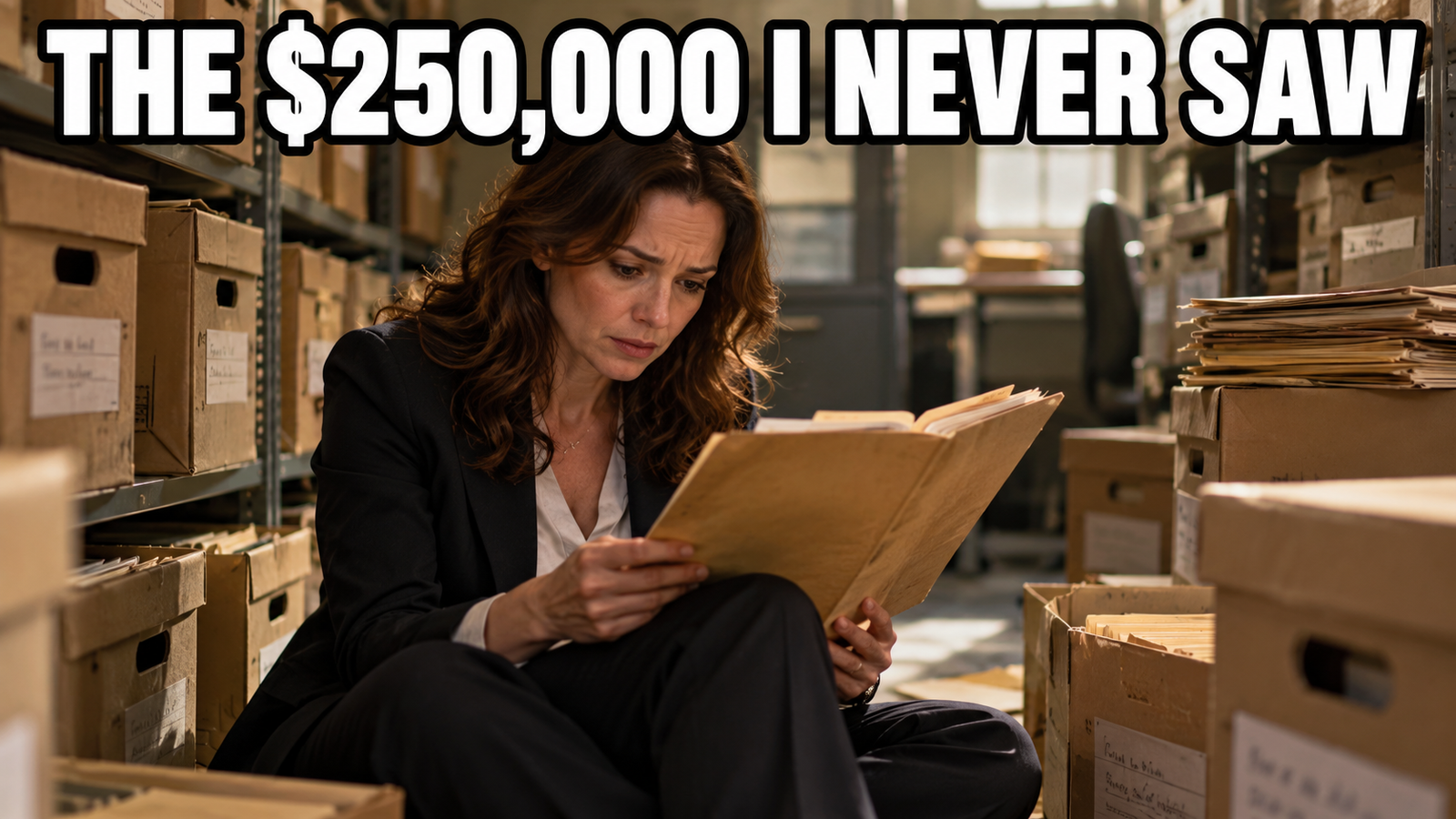
I got my first job out of law school at a firm in Pittsburgh last fall. I’m 38, because I went back to school late, after fifteen years as a paralegal. In my third week, I was sent to the basement archive to pull closed files from the early 1990s for an old client’s estate.
The fourth box I opened had my father’s name on it. Raymond Duca. My father. A steelworker who died in 1992, when I was four, in an accident at the mill in Homestead. My mother raised three kids alone on a cafeteria salary. We lived in a duplex with a leaking roof. I wore my brother’s old shoes until high school. When I was nine, our electricity was shut off for two weeks in February.
According to the file, the steel company settled a claim for my father’s death in November of 1993. The amount was $250,000. A quarter of a million dollars. There was a signed receipt in the folder. The signature on the line marked “Received by” was my mother’s.
I read it four times. Then I sat on the floor of that archive room until the motion-sensor lights turned off around me. I never heard a word about any settlement. My mother never mentioned it. We never had more than a few hundred dollars in the bank in my entire childhood.
The next morning, the senior partner, a man in his seventies who’d worked at the firm since 1979, called me into his office. He’d seen the box on my desk. He closed the door. “Your mother signed for it,” he said. “Ask her where it went.”
PART 1 — ASK HER
“Your mother signed for it,” Mr. Feldman said. “Ask her where it went.”
He was seventy-three, with thick white eyebrows and half-moon reading glasses and a voice that had made opposing counsel nervous for fifty years. He’d closed the door to his corner office behind me. Through the window behind his desk, I could see the Monongahela River, gray and slow, and beyond it, the empty lot where the Homestead steel mill used to stand.
My father died in that mill. In 1992. I was four.
The archive box sat on the corner of Mr. Feldman’s desk where he’d set it, with *DUCA, R. – HOMESTEAD WORKS – CLOSED 11/93* written on the side in faded marker. He rested one hand on top of it, the way you’d rest your hand on a sleeping dog.
“You know where it went,” I said. “Don’t you.”
“You know where it went,” I said. “Don’t you.”
He looked at me over his glasses for a long moment.
“I know where it went,” he said. “I handled the settlement myself. I was forty years old. It’s one of maybe three cases in my whole career I still think about.” He took off his glasses and set them on the desk. “But it’s not my story to tell, Gina. It’s your mother’s. And she’s waited a long time for you to ask her.”
“She’s never said one word about it.”
“No,” Mr. Feldman said gently. “I don’t imagine she has. She’s not that kind of woman.” He paused. “Ask her about Danny Szabo. Then come back and tell me what she said.”
PART 2 — THE DUPLEX ON 13TH AVENUE
I’m thirty-eight. I went to law school late, after fifteen years as a paralegal. I passed the Pennsylvania bar last summer on my first try and got hired by Feldman, Brice & Kowalski, a mid-sized firm downtown that does mostly estate and personal injury work. I was the oldest first-year associate they’d ever hired. I didn’t care. I’d been waiting my whole life for this.
My father, Raymond Duca, was a crane operator at the Homestead Works. He was thirty-four when he died. My mother, Theresa, was thirty-one, with three kids: my brother Joe, who was nine, my sister Annie, who was six, and me.
My father was thirty-four when he died. My mother was thirty-one, with three kids.
I don’t remember him. I have photographs. A big man with a black mustache and a laugh you can see even in a picture. I have his hard hat, which hangs on a hook in my hallway. I have one memory that might be real or might be something I made up from a photo: sitting on his shoulders at Kennywood amusement park, holding on to his ears.
After he died, my mother got a job in the cafeteria at Homestead Elementary. She worked there for twenty-six years. We lived in half of a duplex on 13th Avenue in Munhall, with a roof that leaked in the back bedroom every spring. I wore my brother’s old sneakers until high school. We got free lunch at school. One February when I was nine, the electric company shut off our power for two weeks, and we did our homework by flashlight and slept in our coats.
My mother never complained. Not once that I can remember. When I asked her once, at about twelve, why we didn’t have money like other families, she said, “We have exactly what we need, and we have each other. That’s more than most.”
I believed her. Why wouldn’t I?
PART 3 — THE BOX
In my third week at the firm, a senior associate sent me down to the basement archive to pull closed files from the early 1990s for an old client’s estate case. The archive is a long, windowless room with metal shelves and motion-sensor lights and boxes going back to the 1960s.
The fourth box I pulled had my father’s name on it.
I sat down on the concrete floor right there and opened it. Inside were three thick folders. Accident reports from the Homestead Works, dated June 18, 1992. Witness statements. Medical records. Correspondence between the firm and the steel company’s lawyers. And a settlement agreement, dated November 9, 1993.
The amount was $250,000.
The amount was $250,000. A quarter of a million dollars.
A quarter of a million dollars. In 1993. Paid by USX Corporation to the estate of Raymond J. Duca for wrongful death resulting from an equipment failure. There was a signed receipt in the folder, with the firm’s letterhead. The signature on the line marked *Received by* was in my mother’s small, careful handwriting.
*Theresa M. Duca.*
I read it four times. Then I sat on the floor of that archive room until the motion-sensor lights clicked off around me and left me sitting in the dark.
Two hundred and fifty thousand dollars. We’d slept in our coats for two weeks in February.
PART 4 — WHAT I DIDN'T DO
I didn’t call my mother that night. I didn’t know how.
I sat in my apartment in Squirrel Hill with the photocopy of the receipt on my kitchen table and went through every possibility I could think of. I’m a lawyer now, after all. I’m supposed to be good at this.
Maybe there were debts. Maybe my father had borrowed money nobody knew about. Maybe there were medical bills, funeral costs, a second mortgage. But I’d been through the file. The settlement was clean. The firm took its fee, a third, and the rest went to my mother. Over a hundred and sixty thousand dollars, in one check, in November of 1993.
Maybe she was robbed. Maybe someone took advantage of her, a grieving widow with three kids. That happened. I’d seen cases like that as a paralegal.
Or maybe, said a small, ugly voice in the back of my head, she spent it. On something. On herself. Maybe she let us grow up poor while the money went somewhere else.
Maybe, said a small, ugly voice in the back of my head, she let us grow up poor while the money went somewhere else.
I hated that voice. My mother is the most selfless person I’ve ever known. She’s sixty-five now. She still lives in the same half of the same duplex on 13th Avenue. She still cuts coupons and drives a 2009 Corolla. She still sends me twenty dollars in a birthday card every year with a note that says *Treat yourself.*
But I couldn’t make the voice stop.
I called my brother Joe that night, in Cleveland, and asked him if he’d ever heard anything about a settlement. He was quiet for a second. Then he said, “I remember Mom going downtown in her church dress a couple times, the year after Dad died. She’d come home and go straight to her room.” He paused. “I always figured it was the cemetery.” My sister Annie, in Erie, didn’t remember anything at all. She asked me why I wanted to know. I told her it was nothing. A work thing. I didn’t know yet how to say it out loud.
So the next morning, I went to work with the box on my desk, and before I could figure out what to do with it, Mr. Feldman walked past my office, saw the name on the side, stopped, and asked me to come see him.
PART 5 — DANNY SZABO
I drove to Munhall that Saturday. My mother was in her kitchen, making pierogies for church, her hands white with flour. She looked up and smiled when I came in. Then she saw what I was holding, and her smile went still.
I set the photocopy of the receipt on her kitchen table.
She wiped her hands slowly on a dish towel. She looked at the receipt for a long time. Then she sat down across from me, in the same chair she’d sat in to help me with my homework by flashlight in 1997.
“Mr. Feldman,” she said. “I always wondered if you’d end up at that firm. I wondered if you’d find it.”
“Mom. Who is Danny Szabo?”
“Mom. Who is Danny Szabo?”
My mother closed her eyes.
“Danny Szabo was nineteen years old,” she said. “He’d been working at the mill for three months. It was his first real job. He was on the ground crew under your father’s crane on June 18, 1992.” She opened her eyes and looked at me. “When the cable started to fail, your father saw it before anybody else. He had about four seconds. He could have jumped clear of the cab. Instead, he swung the load away from the ground crew. Away from Danny.”
I stared at her.
“The load came down on the cab instead,” my mother said quietly. “Your father saved that boy’s life. And three other men’s. And it cost him his.”
PART 6 — WHAT DANNY LOST
I’d never heard that story. In the thirty-four years since that day, nobody had ever told me how my father died. Just that it was an accident at the mill. That it was quick.
“Danny was hurt anyway,” my mother went on. “Not as bad as your father. But a piece of the cable whipped back and hit him. He broke his back. He was paralyzed from the waist down.” She folded the dish towel very carefully in her lap. “He was nineteen.”
“Did he get a settlement too?”
My mother laughed, a short, bitter sound I’d never heard her make.
“The company fought him,” she said. “For two years. They said he was standing where he shouldn’t have been. They said he was untrained. They said a dozen things that weren’t true. His family didn’t have a lawyer like Mr. Feldman. They had a man who advertised on bus benches. He lost.” She shook her head. “Danny got nothing. Not one dime. And his mother was a widow too, Gina. She cleaned houses. They lived in a third-floor walk-up in Braddock. Danny couldn’t even get up the stairs.”
“Danny got nothing. Not one dime. They lived in a third-floor walk-up. Danny couldn’t even get up the stairs.”
I put my hand over my mouth.
I thought about all the times I’d been angry at my mother as a teenager. Angry that I couldn’t go on the class trip to Washington, D.C., because it cost four hundred dollars. Angry about the sneakers, and the free lunch tickets, and the Christmas I got a used bike with a new bow on it. I’d told her once, at fifteen, that she didn’t understand what it was like to have nothing. She’d looked at me for a long moment and said, “You’re right, honey. I’m sorry.” And then she’d gone and made dinner.
“I went to see him in the rehabilitation hospital,” my mother said. “In August of 1992. Two months after your father died. I didn’t know why I was going. I just felt like I had to.” She looked out the kitchen window at the little backyard where my father’s old swing set still stood, rusted. “He was lying in that bed, this skinny kid with a broken back, and when I told him who I was, he started crying. He said, ‘Mrs. Duca, I’m so sorry. It should have been me. He should have let it be me.’“
PART 7 — WHERE IT WENT
“So you gave it to him,” I said. “The settlement.”
My mother nodded.
“Not all of it,” she said. “I kept twenty thousand. I paid off the funeral and put a little aside for emergencies.” She almost smiled. “Which turned out to be the roof, mostly. And that furnace in 1999.”
The rest, almost a hundred and forty thousand dollars, she gave to Danny Szabo and his mother. In November of 1993, the week the check cleared. She drove to their apartment in Braddock with a cashier’s check and Mr. Feldman, who’d insisted on coming, and she set it on their kitchen table.
“Danny’s mother wouldn’t take it at first,” my mother said. “She said it was blood money. Your father’s blood.” My mother’s voice shook for the first time. “And I said, ‘No. It’s his gift. He gave his life so your son could live. This is just the rest of it.‘”
“He gave his life so your son could live. This is just the rest of it.”
The money bought a one-story house in West Mifflin with ramps and wide doorways. It paid for a wheelchair, a hand-controlled car, and two years of physical therapy that Danny’s insurance wouldn’t cover. It paid for Danny to go to community college.
“Mom,” I said. My voice cracked. “We slept in our coats. The electricity was off for two weeks.”
“I know.” She reached across the table and took my hand. Her fingers were still dusty with flour. “I know, honey. And every night that February, I asked myself if I’d done the wrong thing. Whether I’d taken something from my own children to give to somebody else’s.” She held on tight. “But then I’d think about your father in that crane. He had four seconds. And he chose.” She looked at me. “I wanted to choose the same way he did. I wanted you kids to grow up with a father you could be proud of. Even if he wasn’t here.”
PART 8 — THE SCHOLARSHIP
I didn’t say anything for a long time. Then something occurred to me. Something that made the back of my neck go cold.
“Mom,” I said slowly. “My law school scholarship.”
When I applied to Duquesne Law at thirty-four, I couldn’t afford it. Not even close. I’d been a paralegal for fifteen years, saving what I could, but tuition was over forty thousand a year. I’d almost given up. And then, two weeks after I was accepted, a letter came. I’d been awarded something called the Raymond J. Duca Memorial Scholarship. Full tuition, all three years.
I’d been awarded something called the Raymond J. Duca Memorial Scholarship. Full tuition, all three years.
I’d never applied for it. I’d never heard of it. The letter said it was administered by a private foundation in honor of a steelworker who’d died at Homestead. I assumed it was the union. Or the Steelworkers’ Historical Society. I wrote a thank-you note to the foundation address and never got a reply.
My mother was smiling now. Crying and smiling at the same time.
“Danny Szabo got his degree from Pitt in 2001,” she said. “Accounting. He opened his own firm in 2006. Szabo Financial, in West Mifflin. He has thirty employees now.” She wiped her eyes with the back of her floury hand. “He called me the day you got into law school. He’d been waiting thirty years for a way to pay it back.”
PART 9 — WEST MIFFLIN
I drove to West Mifflin that same afternoon. I didn’t call first. I didn’t want to give myself time to lose my nerve.
Szabo Financial is in a one-story brick building on Lebanon Road, with a ramp to the front door and a little garden out front. The receptionist asked if I had an appointment. Before I could answer, a door opened at the end of the hall, and a man in a wheelchair rolled out.
He was fifty-three. Broad shoulders, graying hair, a short beard. He stopped in the middle of the hallway when he saw me.
“You look like him,” he said. “Your father. Around the eyes.” His voice was rough. “I’d know you anywhere.”
“You look like him,” he said. “Your father. Around the eyes. I’d know you anywhere.”
He took me back to his office. On the wall behind his desk, in a frame, there was a photograph I’d never seen. My father, in a hard hat, standing in front of a crane at the Homestead Works, grinning at the camera with his arm around a skinny kid in coveralls. On the bottom, in faded ink: *Ray and Danny, first week. 5/92.*
“He trained me,” Danny said. “My first three weeks. He bought me lunch every day because he knew I didn’t have money. He told me I was going to be a crane operator someday, just like him.” He looked at the photograph for a long time. “I never got to be.”
“You became something else,” I said.
“Your mother made sure of that,” Danny said. “And your father. Every day of my life, I’ve known I’m alive because of Ray Duca. Everything I have, everything I’ve built, it’s his.” He turned and looked at me. “When your mother told me you were applying to law school, I knew exactly what I wanted to do. I set up the foundation that same week. I told her not to tell you. I wanted you to feel like you’d earned it.” He smiled. “You did, by the way. I read your application essay. It was about your father.”
PART 10 — FOUR SECONDS
I went back to Mr. Feldman’s office the next Monday. I told him everything my mother had said, and everything Danny had said. He listened without interrupting, with his half-moon glasses on the end of his nose.
When I finished, he was quiet for a long time.
“Forty-four years of practice,” he said finally. “Thousands of cases. Settlements bigger than that one by a factor of a hundred. And the one I still think about is a cafeteria worker from Munhall setting a cashier’s check down on a kitchen table in Braddock and saying it was the rest of her husband’s gift.” He took off his glasses. “I’ve never seen anything braver in a courtroom or out of it.”
“I’ve never seen anything braver in a courtroom or out of it.”
There’s a new case on my desk now. A young warehouse worker in Homestead, twenty years old, injured on the job. The company is fighting his claim. They say he was standing where he shouldn’t have been. His family can’t afford a lawyer. They found our firm through a bus bench ad.
I asked Mr. Feldman if I could take it pro bono. He said yes before I’d finished the sentence.
Then he did something I didn’t expect. He took the old Duca archive box off the corner of his desk, the one he’d kept there since that first week, and handed it to me. “Keep this,” he said. “It belongs to your family. Not to the firm.”
My mother still lives on 13th Avenue. I tried to buy her a new house with my first real paycheck. She refused. She says the duplex has everything she needs. But she let me fix the roof. And she let me take her to dinner with Danny Szabo, his wife, and their two daughters, at a restaurant in Homestead built on the old mill site, overlooking the river.
At the end of dinner, Danny raised his glass.
“To Ray Duca,” he said. “Four seconds. Fifty-three years.”
My mother laughed and cried and raised her glass of iced tea.
And for the first time in my life, I understood exactly who my father was. Not a photograph. Not a hard hat on a hook. A man who had four seconds and chose. And a woman who had a hundred and forty thousand dollars and chose the same way.
I keep a copy of that settlement receipt in my desk at work now, in the top drawer, where I can see it every day. Right next to my bar card.
*Received by Theresa M. Duca.*
Received, and given away.