My mother’s peach pie won the blue ribbon at the Chilton County Fair eleven years in a row. People drove from Birmingham for it. When she died in May, at 84, the only thing my brothers and I fought over was who would get the recipe box.
I got it. I’m 44, and I run a small bakery in Clanton, Alabama, so it made sense. The box was green tin, dented, held shut with a rubber band. I’d seen my mother reach into it a thousand times. I’d never once been allowed to look inside.
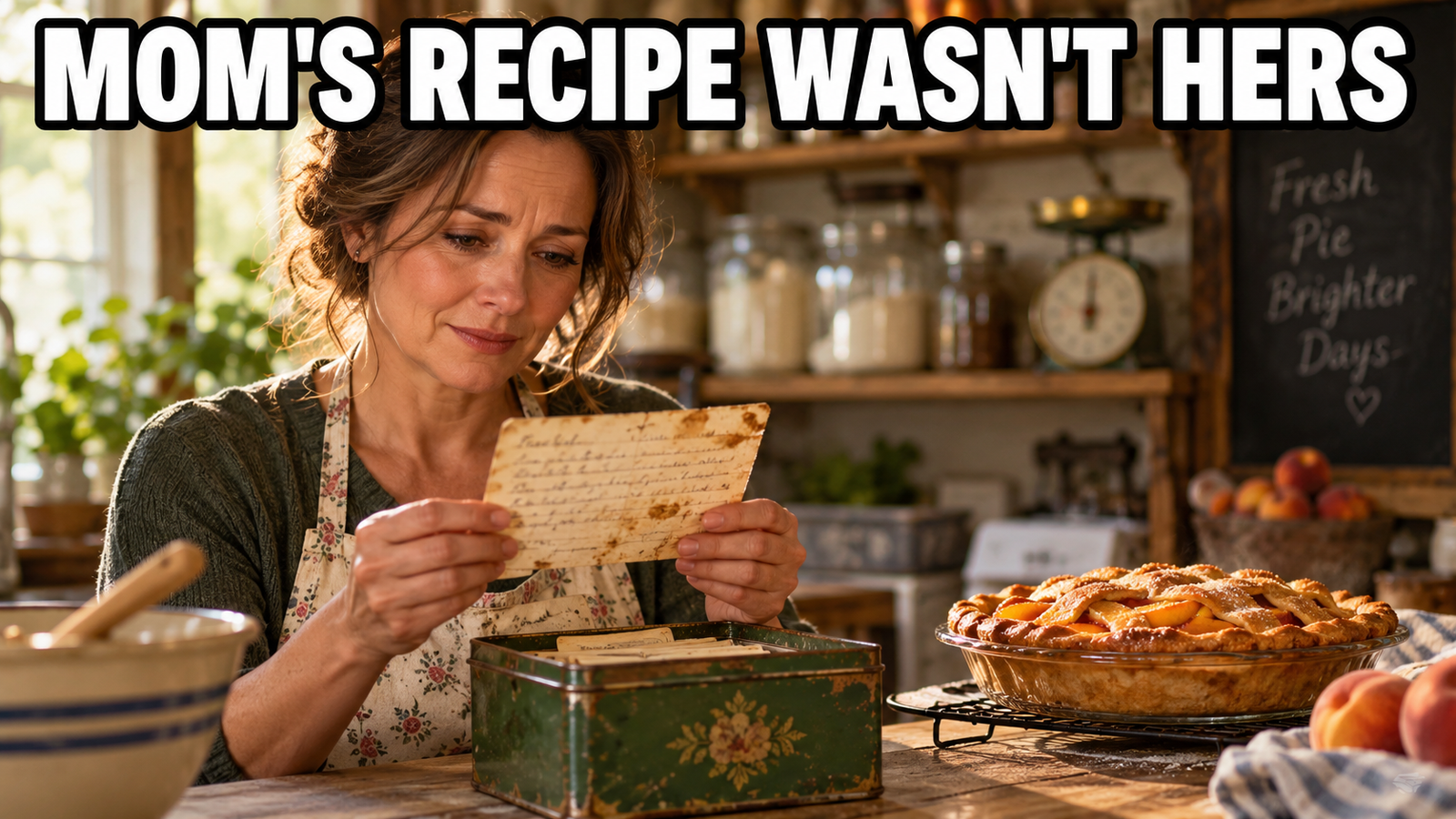
The peach pie card was in the front. Yellowed, stained with butter, the corners soft. I started reading it in my kitchen that night, and by the second line I knew something was wrong. It wasn’t my mother’s handwriting. My mother wrote in tight, slanted cursive. This was round and loopy, in purple ink, with little circles over the i’s.
At the bottom, someone had written a note in the same purple ink: “Bea, bake this every summer so they never forget me. Love always, Junie. 1962.” My mother’s name was Beatrice. I had never heard her mention anyone named Junie.
I called my aunt Carol, my mother’s older sister, who is 86 and lives in Montgomery. I read her the note. There was a long silence on the line. Then Aunt Carol asked me, very quietly, whether there was anything else in the box. Something tucked behind the last card, under the cake recipes. I looked. There was. A small white envelope with a hospital bracelet inside.
PART 1 — THE GREEN TIN BOX
My mother’s peach pie won the blue ribbon at the Chilton County Fair eleven years in a row, from 1979 to 1989. After the eleventh, the fair board quietly asked her to stop entering so somebody else could win. She laughed about that for the rest of her life. People drove from Birmingham and Montgomery for that pie. Every Fourth of July, our church sold forty of them in an hour.
My mother, Beatrice Tate, died in May at eighty-four, in her own bed, in the little white house on County Road 24 outside Clanton, Alabama, where she’d lived for fifty-nine years. Peach country. The orchards start right at the end of her gravel driveway and run for miles.
The only thing my brothers and I fought over was the recipe box.
I’m forty-four. My name is Lorraine, but everybody calls me Rainey. I’m the youngest of three, and the only girl. I run a small bakery on Second Avenue in Clanton called Rainey’s, and for eleven years I’ve been trying, and failing, to make my mother’s peach pie as well as she did.
After the funeral, my two older brothers and I sat at Mama’s kitchen table and divided her things. It went easily. Wayne, who’s sixty-four, took Daddy’s old truck. Bobby, who’s sixty, took the shotguns and the fishing gear. Neither of us wanted to fight. We’d buried our father in 2014, and we’d learned then that the things that matter don’t fit in a truck bed anyway. The only thing we argued over at all was who would get the recipe box.
It was a green tin box, dented on one corner, held shut with a rubber band. It had sat on the shelf over Mama’s stove my whole life. I’d watched her reach into it a thousand times. I had never once been allowed to look inside. “That box is mine,” she’d say, and slap my hand away. “When I’m gone, you can snoop all you want.”
In the end, Wayne said, “Rainey runs a bakery. She should have it.” Bobby agreed. So I took it home.
PART 2 — THE PURPLE INK
I didn’t open it for a week. I couldn’t. It sat on my kitchen counter next to the toaster, and every time I walked past it, I felt like Mama was watching me from the shelf over her stove.
On a Sunday night in early June, after I closed the bakery, I finally sat down at my kitchen table with a glass of sweet tea and slid the rubber band off.
The peach pie card was right in the front. Of course it was. Yellowed and soft, stained with butter in one corner, the edges worn round from fifty years of fingers. I picked it up and started to read, and by the second line, I knew something was wrong.
It wasn’t my mother’s handwriting.
My mother wrote in a tight, slanted, no-nonsense cursive. She’d learned it from the nuns at a Catholic school in Birmingham in the 1950s, and every letter leaned to the right like it was in a hurry to get somewhere. I’d know her handwriting on a grocery list from across a room. She wrote every birthday card I ever got in that hand. Every permission slip. Every note in my lunch box until I was twelve, folded into a square, that said things like Eat the apple, not just the cookie and Proud of you, Rainey girl. I still have some of them in a shoebox in my closet.
This was different. Round and loopy, in faded purple ink. Little circles instead of dots over every i. The kind of handwriting a teenage girl would have in 1962.
And there were things in the recipe I had never known. A pinch of nutmeg. A tablespoon of bourbon in the filling. Brown butter in the crust instead of lard. I’d been making my mother’s pie for eleven years without the bourbon or the brown butter. No wonder it never tasted right.
At the bottom of the card, in the same purple ink, someone had written a note.
Bea, bake this every summer so they never forget me. Love always, Junie. 1962.
PART 3 — WHO WAS JUNIE
My mother’s name was Beatrice. Bea, to her friends and her sisters. And I had never once, in forty-four years, heard her mention anyone named Junie.
I read the note four or five times. Then I went through the rest of the box, card by card. Most of them were in my mother’s slanted handwriting. Chess pie. Pound cake. Chicken and dumplings. Squash casserole. But six of them, scattered through the box, were in that same round, loopy purple script. Peach cobbler. Fried apple hand pies. Caramel cake. Fig preserves. All the best things my mother ever made.
All the best things my mother ever made were written in someone else’s hand.
It was almost ten o’clock. I called my Aunt Carol anyway.
Aunt Carol is my mother’s older sister. She’s eighty-six and lives alone in Montgomery, sharp as a tack, still driving herself to the beauty parlor every Friday. My mother was the middle of three Moss girls, born and raised on a peach farm near Thorsby. Carol was the oldest. And the third, the baby of the family, was named Dorothy. She died young. That was all I’d ever been told. Mama wouldn’t talk about it.
Aunt Carol answered on the second ring. I apologized for calling so late. Then I read her the note on the back of the peach pie card. Bea, bake this every summer so they never forget me. Love always, Junie.
There was a long silence on the line. So long I thought we’d been cut off.
“Junie,” Aunt Carol said finally, in a voice I’d never heard from her. Small and old. “Lord have mercy. I haven’t heard anybody say that name out loud in sixty years.”
PART 4 — THE ENVELOPE
“Aunt Carol,” I said. “Who was she?”
She didn’t answer the question. Instead she said, very quietly, “Rainey, honey. Is there anything else in that box? Something tucked in the back, behind the last card? Under the cake recipes?”
I set the phone down on the table and pulled out the last section of cards. Cakes. Behind the very last card, a recipe for Lane cake in my mother’s handwriting, there was something stiff and flat, pressed against the back of the tin.
A small white envelope. Unsealed, the flap tucked in.
Inside was a tiny plastic hospital bracelet, yellowed with age.
Inside was a tiny plastic hospital bracelet, the old-fashioned kind with little white beads strung on it and a slip of paper inside a clear sleeve. The beads spelled out MOSS. The paper slip, in faded typewriter letters, said:
Baby Boy Moss. Mother: June D. Moss. Born 6/14/62, 3:40 a.m. Lloyd Noland Hospital, Fairfield, Ala.
I picked up the phone again. My hand was shaking.
“It’s a hospital bracelet,” I said. “A baby boy. June 14, 1962. Mother, June D. Moss.”
Aunt Carol made a sound like something tearing. Then she said, “Oh, Bea. Oh, Bea, you kept it.”
“Aunt Carol,” I said, “who is June Moss?”
There was another long silence. When she spoke again, her voice was steadier. “Rainey, I’m going to drive up there tomorrow. This isn’t a telephone story. And honey, you need to have your brother Wayne there too.”
“Wayne?” I said. “Why Wayne?”
“June fourteenth,” Aunt Carol said gently. “Rainey, when is Wayne’s birthday?”
PART 5 — AUNT CAROL
My brother Wayne was born on June 14, 1962.
I knew that. Of course I knew that. We’d had his birthday cookout every June for my entire life. I just hadn’t put the date together with the bracelet, because why would I? Wayne was my big brother. Mama’s first baby. Everybody always said he looked just like her.
Aunt Carol drove up from Montgomery the next afternoon in her old Buick. Wayne came over from his house in Verbena after work, still in his power company uniform, confused and a little annoyed. Bobby came too. I hadn’t told them anything except that it was about Mama and that it was important.
We sat at my kitchen table. I set the recipe card and the bracelet in the middle. Aunt Carol looked at them for a long time without touching them.
“Junie wasn’t a nickname for Dorothy,” she said finally. “Dorothy was Junie. June Dorothy Moss. She went by Junie from the day she was born. She was the baby of the family, three years younger than your mama.” She smiled a little. “And she was the best cook in Chilton County. Better than Mama. Better than Bea. Better than anybody.”
“She was the best cook in Chilton County. Better than Mama. Better than Bea. Better than anybody.”
Aunt Carol told us about Junie. Funny and wild and full of music. She sang in the choir at the Baptist church and in the kitchen and in the peach orchard, all day long. She taught herself to bake when she was nine, standing on a chair at the stove. By the time she was fifteen, half the church ladies in Thorsby were asking her for recipes.
“And in the fall of 1961,” Aunt Carol said, “when she was sixteen, Junie fell in love with a boy named Leon Eddings. He worked in the packing shed on our daddy’s farm. He was eighteen. He was going into the Army.”
PART 6 — 1962
Wayne had gone very still.
“Leon shipped out in January of 1962,” Aunt Carol said. “To Germany. And in February, Junie found out she was expecting.” She looked down at her hands. “You have to understand what that meant, in 1962, in a Baptist family in Thorsby, Alabama. Our daddy was a deacon. Our mama could hardly leave the house for shame.”
They sent Junie away. To an aunt in Fairfield, outside Birmingham, where nobody knew her. The plan was for the baby to be adopted by strangers through the Baptist children’s home. Nobody would ever have to know.
“But Bea wouldn’t have it,” Aunt Carol said. Her eyes filled. “Your mama was twenty years old. She was engaged to your daddy, Earl. And she told our parents, flat out, standing in the kitchen, that if they gave that baby to strangers, she would never speak to them again as long as she lived.”
“She told our parents that if they gave that baby to strangers, she would never speak to them again as long as she lived.”
Junie had the baby on June 14, 1962, at Lloyd Noland Hospital in Fairfield. A big, healthy boy with a full head of dark hair. Bea was there in the waiting room. She was the only one from the family who came.
And then something went wrong.
“An infection,” Aunt Carol said quietly. “They call it sepsis now. Back then, they just called it childbed fever. It came on two days after. The doctors did everything they could. She was seventeen years old.” She wiped her eyes with a folded handkerchief. “Junie died on June nineteenth. Your mama was holding her hand.”
Nobody said anything for a long time. Bobby put his hand on Wayne’s shoulder. Outside my kitchen window, the evening light was going gold over the peach trees across the road. A mockingbird was singing somewhere. It seemed wrong, somehow, that the world could go on being so ordinary while we sat there learning something that had been true all our lives.
“Before she passed,” Aunt Carol said, “she asked Bea for two things. She asked Bea to raise her boy as her own. And she asked her to keep making the peach pie every summer. So people would remember her.”
PART 7 — WADE
My mother married my father, Earl Tate, in August of 1962, two months after Junie died. They moved into the little white house on County Road 24 with a two-month-old baby boy. They told everyone at the new church that he was theirs. Most people in Clanton never knew any different. People in Thorsby, who did know, never said a word. That’s how small towns were, back then. Some secrets got kept by everybody at once.
Earl and Bea adopted him legally in 1963, through a lawyer in Birmingham. They named him Wayne Earl Tate. Bobby came along in 1966. I came along much later, a surprise, in 1982.
“I’m not hers,” Wayne said slowly. “Mama wasn’t my mama.”
Wayne sat at my kitchen table and looked at the bracelet for a long time. He’s a big, quiet man. A lineman for the power company for forty years. I’d seen him climb a pole in an ice storm. I’d never once seen him cry.
“I’m not hers,” he said slowly. “Mama wasn’t my mama.”
“Yes, she was,” Aunt Carol said, very firmly. “Wayne, you listen to me. Bea Tate was your mama in every way that ever mattered. She walked the floor with you every night of your first year with colic. She sat up with you through measles and a broken arm and that time you rolled the tractor. She loved you so fierce it scared people.” Aunt Carol reached across the table and took his big hand in both of hers. “But Junie was your mama too. And she loved you for five days with everything she had.”
Wayne put his head down on my kitchen table, on his folded arms, and cried like a little boy. Bobby and I sat on either side of him with our hands on his back, the way Mama used to sit with us when we were small and sick.
PART 8 — WHY SHE NEVER TOLD
“Why didn’t she tell me?” Wayne asked, much later, when the sweet tea was gone and the sun was going down outside my kitchen window. “Sixty-four years. Why didn’t Mama ever tell me?”
Aunt Carol was quiet for a while.
“She meant to,” she said. “She told me so. She was going to tell you when you turned eighteen. Then when you got married. Then when your first baby was born.” She shook her head. “But every time, she’d look at you, and she’d think about how it would feel to hear it. That the woman who raised you wasn’t the one who bore you. And she couldn’t. She was afraid you’d think she’d lied to you your whole life.”
“She was afraid you’d think she’d lied to you your whole life.”
“She did lie to me,” Wayne said. But there wasn’t any anger in it.
“She did,” Aunt Carol agreed. “But she kept the most important promise she ever made. She made that pie every summer for sixty-three years, Wayne. Every single one. Even the summer your daddy died. Even the summer she had her hip done and couldn’t stand at the stove, she sat on a kitchen stool and rolled out that crust.”
I thought about my mother at the county fair. Eleven blue ribbons. How she’d never once looked happy when the judges announced her name. She’d always looked a little sad. She’d smile and accept the ribbon and then go sit in the truck for a while by herself. I used to think she just didn’t like crowds.
It was never her pie. It was Junie’s. Every ribbon belonged to a seventeen-year-old girl who’d died before she ever got to enter it.
PART 9 — THE HEADSTONE
Aunt Carol told us one more thing before she drove home to Montgomery that night.
Junie was buried in the cemetery behind Thorsby First Baptist, in the Moss family plot. But because of the shame, because of how she died, our grandparents had only put a small, flat marker on her grave. It said J.D.M. and 1945–1962. Nothing else. No name. No epitaph.
“Bea went out there every June nineteenth,” Aunt Carol said. “For sixty-three years. She’d take a slice of peach pie wrapped in wax paper and leave it on the stone.” She smiled sadly. “The groundskeeper used to complain about the ants.”
“Bea went out there every June nineteenth, for sixty-three years. She’d take a slice of peach pie wrapped in wax paper.”
On June nineteenth this year, the first one without our mother, Wayne and Bobby and I drove out to Thorsby together. Aunt Carol came too. We found the little flat marker in the corner of the Moss plot, half sunk into the grass. Wayne knelt down and brushed the dirt off with his big hands. Then he set down a slice of peach pie in wax paper, the first one I’d ever made from Junie’s real recipe. Bourbon. Brown butter. Nutmeg.
He stayed there on his knees for a long time. Then he stood up and said, “She needs a real stone. With her name on it.”
We ordered it that same week. Wayne insisted on paying for the whole thing himself. Bobby and I argued, and then we let him. It seemed like it ought to be his. Gray granite, with a peach blossom carved in the corner. It went up in August.
June Dorothy Moss. 1945–1962. Beloved daughter, sister, and mother. Bake this every summer so they never forget me.
PART 10 — JUNIE'S PEACH PIE
I changed the name of the pie at my bakery.
It used to be called Bea’s Peach Pie. It was on the chalkboard menu by the register for eleven years, and it was never quite right, and I never understood why. Now it’s called Junie’s Peach Pie. It’s made from the real recipe, the one in purple ink. And it sells out by ten o’clock every morning from June through September.
Now it’s called Junie’s Peach Pie. And it sells out by ten o’clock every morning.
Next to the register, in a small frame, is the original recipe card, with its butter stain and its loopy purple handwriting and the little circles over the i’s. And next to that is the only photograph of Junie that Aunt Carol could find. A girl of sixteen in a choir robe, laughing at something outside the frame, with dark curly hair and Wayne’s exact smile.
Customers ask about her all the time. I tell them the truth. That she was the best cook in Chilton County. That she wrote this recipe when she was sixteen. That my mother kept it alive for sixty-three years so nobody would forget her.
In August, Wayne entered Junie’s Peach Pie in the Chilton County Fair. Wayne. Who’s never baked anything more complicated than a frozen pizza in his life. He spent three Saturdays in my bakery kitchen learning to make the crust, with flour up to his elbows and his reading glasses on the end of his nose, cussing at the rolling pin.
It won the blue ribbon.
When the judge called out the name, Wayne walked up to accept it in his power company uniform, and he leaned into the microphone, and he said, in front of the whole fairground, “This isn’t my ribbon. It’s my mother’s. Her name was Junie Moss, and she was seventeen, and she should’ve won this sixty-four years ago.”
Then he walked back to the truck and sat there by himself for a while. Just like Mama used to.
I didn’t go after him. I knew exactly where he was. He was with both of them.