I’ve been a hospice nurse in Spokane for nineteen years. I’m 52. I’ve learned not to bring my work home with me. But last Tuesday, I met a new patient, an 88-year-old man named Leonard Voss, and I haven’t slept right since.
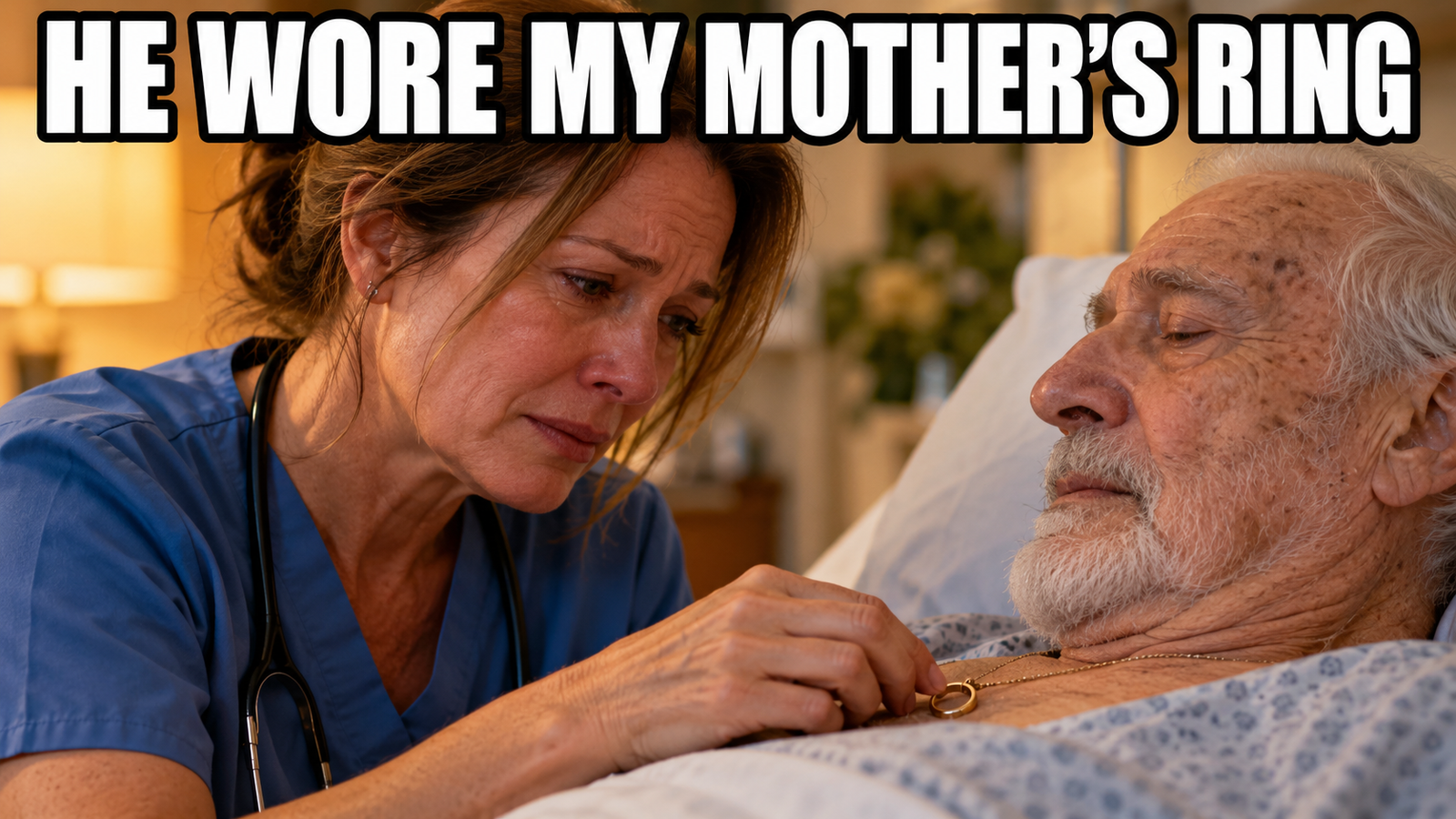
He was admitted with heart failure. He was quiet and polite and very thin, with no family listed in his chart. When I took his blood pressure, I noticed he was wearing a ring on a gold chain around his neck. A woman’s wedding band. Thin, yellow gold, with a tiny chip out of the edge.
I knew that ring. I’d know it anywhere. My mother wore it every day of my childhood. The chip came from the day she caught her hand in our car door in 1979. My mother died in 2011, and we buried her wearing her wedding ring. I watched the funeral director put it on her finger myself.
I asked Mr. Voss, as casually as I could, where the ring came from. He looked at me for a long time. Then he asked me my mother’s name. I told him. Eleanor Brandt.
He closed his eyes. He said, “Then you must be Katie.” Nobody has called me Katie since I was nine. He reached for my hand and said there was a box in the closet of his apartment, and he’d been waiting thirty years for someone to come and get it. He asked me to bring it to him before Friday.
PART 1 — ROOM 6
I’ve been a hospice nurse in Spokane for nineteen years. I’m fifty-two. I’ve sat with more than two thousand people in the last weeks of their lives. I’ve learned how to listen without flinching, how to hold a hand without crying, and how to leave work at work. That last one took me ten years to learn. I thought I had it down.
Then last Tuesday, I walked into room 6 at the Hospice House on the South Hill and met a new patient named Leonard Voss. And I haven’t slept right since.
He was eighty-eight. Congestive heart failure, end stage. He’d come to us from a small apartment downtown, brought in by ambulance after a neighbor found him short of breath on the stairs. The chart listed no family. No children. No spouse. Emergency contact: his building manager.
The chart listed no family. No children. No spouse.
He was a small, thin, very neat man with a white mustache, pale blue eyes, and beautiful hands. Long, slender, steady fingers, even at eighty-eight. The kind of hands that do fine work. He was polite and quiet, and he apologized for being a bother every time I adjusted his oxygen.
When I bent to take his blood pressure, his hospital gown shifted, and I saw that he was wearing something on a thin gold chain around his neck.
A woman’s wedding band. Thin, yellow gold, a little worn. With a tiny chip out of the outer edge, near the top, like someone had caught it on something hard.
I knew that ring. I’d have known it anywhere.
PART 2 — THE CHIP
My mother, Eleanor Brandt, wore that ring every single day of my childhood. Through dishes and gardening and bread dough and diapers. She never took it off. I can still see it on her hand on the steering wheel of our green Pontiac, driving me to ballet.
The chip came from the day she caught her hand in that same Pontiac’s door, in the parking lot of the Rosauers grocery store, in the summer of 1979. I was five. I remember because she said a word I’d never heard her say before, and then she sat in the driver’s seat holding her hand and laughing and crying at the same time. Her finger was purple for a week. The ring was never quite round again. And there was that little chip, right at the top, shiny gold underneath where the worn surface had broken.
I remember because she said a word I’d never heard her say before.
My mother died in October of 2011, of pancreatic cancer, at sixty-one. We buried her at Greenwood Memorial Terrace, wearing her favorite blue dress and her wedding ring. I watched the funeral director slip that ring on her finger myself. I’d asked to be there. I’d wanted to be the last person to touch her hand.
So it was impossible. It was impossible that the ring on the chain around Leonard Voss’s neck was my mother’s ring.
I finished taking his blood pressure. 98 over 60. I wrote it down. My hand was shaking.
“That’s a lovely ring,” I said, as casually as I could manage. “Was it your wife’s?”
PART 3 — YOU MUST BE KATIE
Leonard Voss looked at me for a long moment with those pale blue eyes. He didn’t answer my question. Instead he asked one of his own.
“What was your mother’s name?”
I hadn’t told him anything about my mother. I hadn’t said a word.
“Eleanor,” I said. “Eleanor Brandt.”
He closed his eyes. “Then you must be Katie.”
He closed his eyes. For a moment I thought he’d drifted off. Then he opened them again, and they were wet.
“Then you must be Katie,” he said.
Nobody has called me Katie since I was nine years old.
I was Katie until the fall of fourth grade, when I decided I was far too grown up for it and announced at dinner that from now on I was Kate. My father laughed and said, “Yes, ma’am.” My mother looked at me with an expression I didn’t understand at the time, a sad sort of smile, and then she said, “All right, Kate.” She never called me Katie again. Nobody did.
“How do you know that name?” I said. My voice came out sharper than I meant it to.
Leonard Voss reached up with his long, careful fingers and held the ring on its chain. “There’s a box,” he said. “In the hall closet of my apartment. A wooden box, on the top shelf, behind the winter blankets. I’ve been waiting thirty years for someone to come and get it.” He looked at me. “Would you bring it to me, please? Before Friday?”
“Why Friday?” I said.
He smiled, very gently. “Because I’m a jeweler, Katie. I’ve spent my whole life measuring things. And I don’t think I have much longer than that.”
PART 4 — THE BOX
I’m not supposed to do things like that. Hospice nurses don’t go into patients’ apartments to fetch things from closets. There are rules. I knew all of them. I’d written some of them.
But I got the key from his building manager that evening, after my shift. I told her the truth: Mr. Voss had asked me to bring him something important. She knew him well. She said he’d lived in that apartment for forty years and never once been late on his rent. She handed me the key without hesitating.
She said he’d lived in that apartment for forty years and never once been late on his rent.
His apartment was small and spotless. Two rooms over a closed-down shoe store on Riverside Avenue. A small workbench by the window with a jeweler’s loupe, tiny files and pliers laid out in a perfect row, as if he might come back and sit down at any moment. A sign leaning against the wall, painted on wood: Voss Fine Jewelry & Repair. Est. 1964. No photographs anywhere. Not one. On the kitchen table, there was a single coffee cup, washed and turned upside down on a folded dish towel, and a library book on Paris with a bookmark two-thirds of the way through. I stood in the middle of that tidy little room for a long time. It felt like the apartment of a man who had been waiting very patiently for something, and had made sure everything was in order in case it came.
The box was right where he said. On the top shelf of the hall closet, behind two folded wool blankets. It was walnut, hand-made, with brass corners and a small brass lock. The key was taped to the bottom.
I didn’t open it there. It wasn’t mine to open. I drove it straight back to the Hospice House and carried it into room 6, where Leonard Voss was lying awake in the dark, waiting.
“You brought it,” he said. And he smiled like a man who’d been holding his breath for thirty years and could finally let it go.
PART 5 — 1972
He asked me to sit down. He asked me to turn on the small lamp by the bed. Then he asked me to open the box.
On top was a photograph. A young woman of about twenty-two, with long dark hair parted in the middle, leaning on the glass counter of a jewelry store, laughing. It was my mother. I’d never seen the picture, but I’d have known that laugh anywhere.
“May of 1972,” Leonard said. “She came into my shop with your father to pick out wedding bands. Richard was a good man. A steady man. A little impatient with jewelry stores.” He almost smiled. “While he went to feed the parking meter, your mother and I talked for twenty minutes about Spokane Falls and poetry and whether it was silly to want to see Paris. I made their rings by hand. Hers was the best work I ever did.”
“Hers was the best work I ever did.”
I looked down at the ring on the chain.
“That’s not a copy,” I said.
“No,” he said. “That’s the ring I made her in 1972.”
He told me the rest slowly, stopping to catch his breath.
My parents married in June of 1972. The first year was hard. My father worked long hours at the Kaiser aluminum plant. They fought about money and about his mother and about having children. In the spring of 1973, they separated for four months. My mother moved into a small apartment on the South Hill. And she started stopping by the jewelry store on Riverside Avenue to have her ring cleaned. Then to talk. Then to walk along the river after he closed up.
“I loved her,” Leonard said simply. “From the first day. I never pretended otherwise. Not to her. Not to myself.”
PART 6 — KATIE
In August of 1973, my mother went back to my father. They’d been in counseling with their pastor. They’d decided to try again. And in October of that year, she found out she was pregnant.
I was born on April 2, 1974.
“You don’t have to say it,” I said. “I can count.”
I sat in the chair beside Leonard Voss’s bed, in the soft light of the lamp, and I did the math. Then I did it again.
“You don’t have to say it,” I said. “I can count.”
Leonard nodded slowly. He didn’t look away from me.
“She told Richard,” he said. “Before you were born. She told him everything. She said she wouldn’t build a marriage on a lie. And he said he’d raise you as his own, and love you as his own, as long as I stayed away. And he did. He kept his word, Katie. Every day of his life. I want you to know that.”
My father, Richard Brandt, died in 2001 of a heart attack, at fifty-four. He coached my softball team. He taught me to drive a stick shift and change my own oil. He walked me down the aisle in 1998 and cried so hard he couldn’t say “her mother and I.” He never once, by a word or a look, gave me any reason to think he was anything but my father.
“I stayed away,” Leonard said. “That was the bargain. And Eleanor did one thing for me. Once a year, on your birthday, she sent me a letter and a photograph. That was all. One letter, one picture, once a year.” He nodded at the box. “Until you were nine.”
PART 7 — NINE LETTERS
Under the photograph of my mother at the jewelry counter, there were nine envelopes. Tied together with a thin blue ribbon.
I opened them in order, sitting there beside his bed. Leonard watched me read each one. He didn’t say anything. He didn’t need to. Every now and then he closed his eyes, and I knew he was reading them along with me, from memory.
The first one had a photo of me at one day old, red-faced and furious in a hospital blanket. Leonard. She’s here. Katherine Eleanor. Seven pounds, two ounces. She has your hands. I’m sorry and I’m not sorry. E.
“She has your hands.”
I looked down at my own hands, holding the letter. Long, slender fingers. My father always teased me that I had piano hands and no ear for music. I looked at Leonard’s hands on the blanket. The same.
The others came one a year. Katie at two, in a sandbox. Katie at four, missing a tooth, holding a kitten. Katie at five, with a bandaged knee, standing next to a green Pontiac. She saw me catch my ring in the car door this summer, my mother wrote that year. I chipped it. I almost brought it to you to fix. Then I thought, no. Let it stay chipped. Let something show that it’s been through something.
The ninth letter was from April 1983. My ninth birthday. There was a photo of me blowing out candles on a cake shaped like a horse.
Leonard. This will be the last one. Richard has asked me to stop, and he’s right to. She’s old enough now to start asking questions, and she deserves one father she never has to wonder about. Please understand. I will always be grateful. She will always be partly yours. E.
“That fall, you told everyone you were Kate,” Leonard said softly. “Eleanor wrote to me one more time, years later, and told me. She said it felt like the universe drawing a line.”
PART 8 — THE RING
“But the ring,” I said. “Leonard, I watched her buried in that ring. I put it on her hand myself. I was there.”
Leonard Voss closed his eyes. A small smile moved under his white mustache.
“You put a ring on her hand,” he said. “Not that ring.”
“You put a ring on her hand,” he said. “Not that ring.”
In the summer of 2011, when my mother was dying, she came to see him. The first time in thirty-eight years. She walked into his apartment over the shoe store, so thin he barely recognized her, and sat down at his workbench, and slid her wedding ring off her finger and put it on the bench in front of him.
“She asked me to make a copy,” Leonard said. “An exact copy. Down to the chip. She wanted to be buried wearing it, so you and your brother would never wonder. And she wanted me to keep the real one.” He opened his eyes and looked at me. “She said, ‘You made it, Leonard. And you gave me the only other thing I ever loved as much as my children. I want part of me to stay with the one other person who knew the whole truth.'”
He’d made it in three weeks. He said it was the hardest piece of work he’d ever done. He’d matched the gold and the wear and the slight oval shape where her finger had been crushed in the car door. He’d even chipped it, carefully, with a tiny file, in exactly the right place.
“It was perfect,” he said quietly. “I made sure of that. I didn’t want you to ever notice.”
I hadn’t. Not once.
PART 9 — FRIDAY
I didn’t go home that night. I sat in the parking lot of the Hospice House at midnight with the engine off and the walnut box on the passenger seat, watching the lights of the city spread out below the South Hill. I thought about every Father’s Day card I’d ever signed. I thought about my mother’s face in the summer of 2011, so thin and so calm, telling me she’d made all her arrangements and I wasn’t to worry about a thing. I’d thought she meant the funeral. I called my husband, Dan, and told him I’d explain later. Then I called my older brother, Michael, in Seattle, and told him what I could. He was quiet for a long time. Then he said, “Do you want me to come?” I said no. Not yet. This part was mine.
I sat with Leonard Voss through Wednesday and Thursday. I wasn’t his nurse anymore. I asked my supervisor to reassign him, and I explained why, and she put her hand on my shoulder and said, “Take all the time you need, Kate.” I sat with him as his daughter.
I sat with him as his daughter.
We talked when he had the breath for it. He told me about his shop, and Paris, which he finally saw in 1990, alone, and loved. He told me he’d never married because he’d never stopped loving my mother, and he’d decided long ago that it wouldn’t be fair to any other woman. He asked about my children. I showed him pictures on my phone. My daughter, who’s twenty-two and studying art in Portland. My son, who’s nineteen and an apprentice electrician.
“Your daughter has the hands,” Leonard said, looking at a photo of her at her pottery wheel. He laughed softly. “Poor thing.”
On Thursday night, he asked me to take the ring off its chain. He couldn’t manage the clasp anymore. I unhooked it and held it out to him. He took my left hand in his long, careful fingers and slipped the ring onto my ring finger, beside my own wedding band.
It fit perfectly.
“Of course it does,” he said. “I sized it for her.”
Leonard Voss died at 4:40 on Friday morning, with the lamp on, and me holding his hand. Just like he said.
PART 10 — VOSS FINE JEWELRY
Leonard left a simple will. He left his savings, about forty thousand dollars, to the Hospice House where he died. He left his tools and his workbench to a jewelry-making program at the community college. And he left the walnut box and everything in it to “Katherine Eleanor Brandt Hollis, my daughter.”
It was the first time anybody had ever put it in writing.
It was the first time anybody had ever put it in writing.
I told my children. My daughter cried and then asked if she could have one of his files for her pottery tools. My son was quiet for a long time, and then he asked if I was okay, and then he hugged me the way his grandfather Richard used to, hard enough to lift me off the ground.
My brother Michael came over from Seattle for Leonard’s funeral. Small, at a Lutheran church downtown. Maybe twenty people. Customers, mostly, from fifty years at the shop. Women who’d had their wedding rings made by him. Men who’d brought in their fathers’ pocket watches. One woman stood up and said that Leonard Voss had repaired her late husband’s wedding band for free, in 1987, because she couldn’t afford it and he said rings like that shouldn’t wait.
Michael held my hand through the whole service. Afterward, in the parking lot, he said, “Dad knew. The whole time. And he never let it make one bit of difference.” He shook his head. “I think that might be the best thing I ever heard about him.”
He’s right. I’ve thought about it every day since. Richard Brandt knew from before I was born, and he loved me anyway. Every softball game. Every oil change. Every tear-blurred walk down that aisle. He chose me every single day.
And Leonard Voss loved me from forty years and four miles away, with nine letters and a walnut box and a promise he kept until the end.
I wear the ring now, on my right hand. The real one, with the chip at the top. People notice it sometimes, at work. A patient asked me about it just last week, an old woman in room 4 with very sharp eyes.
“That’s a lovely ring,” she said. “Was it your mother’s?”
“Yes,” I said. “And my father made it.”
She smiled. She didn’t ask which one. I didn’t explain. Some stories you only tell once, in a quiet room with a lamp on, to the person who needs to hear it most.