The parking permit renewed itself on a car I sold. City lot, $640 a year. I sold the Honda in 2024. The city drafted my card anyway and mailed a replacement permit to my brother’s address. Their lot camera showed my old Honda in the space with a different plate. That plate traces to my mother, who doesn’t drive. The added driver on its insurance is 29 and lives at my brother’s.
PART 1 — SIX HUNDRED AND FORTY DOLLARS
The parking permit renewed itself on a car I sold.
I found out on a Tuesday morning in October, sitting at my kitchen table in Dayton, Ohio, with a cup of coffee and my banking app open, the way I do the first week of every month. I’m forty-six. I’m an insurance claims adjuster. Looking at numbers that don’t add up is literally my job. And there, between the electric bill and my gym membership, was a charge I hadn’t seen in two years.
City of Dayton Parking Services. $640.00.
The parking permit renewed itself on a car I sold.
For eleven years, I’d paid for an annual permit in the city lot on East Third Street, a block from my old office downtown. Six hundred and forty dollars a year for a numbered space, B-17, under a concrete overhang, so my car wouldn’t sit in the snow. Then, in the spring of 2024, my company went hybrid, and I started working from home four days a week. I didn’t need a downtown space anymore. I didn’t need a second car either. So I sold my old silver Honda Accord to my neighbor across the street, Mr. Alvarez, for four thousand dollars, and I canceled the permit.
At least, I thought I had.
I called Parking Services. A tired woman named Denise pulled up my account. She said the permit had been set to automatic renewal back in 2013, and the renewal was tied to the vehicle and the space, not just to me.
“The plate on file is still showing active in that space,” she said. “The lot camera reads it every morning. So the system renewed it. And it looks like a replacement permit sticker was mailed out last month, because the old one was reported damaged.”
“Reported by who?” I asked. “I sold that car two years ago.”
There was a pause while she typed.
“The replacement went to a different address than the one on your account,” she said slowly. “Do you want me to read it to you?”
PART 2 — THE ADDRESS
She read it to me.
It was my brother’s address.
My older brother, Wes, lives on the west side of Dayton, in the same brick ranch house on Rosedale Drive where we grew up. Our father died in 2016. Our mother, Jean, is seventy-eight. She lived there with Wes until last year, when her memory started slipping and we moved her into an assisted living apartment ten minutes away. Wes kept the house. He’s fifty-two, a maintenance supervisor at a hospital, divorced, and the most stubborn man I know.
The replacement permit went to my brother’s address.
Wes and I aren’t close. We weren’t close as kids, and we got less close after Dad died and we argued about everything from the funeral to the house to Mom’s care. We talk on her birthday and at Christmas. That’s about it.
So I sat there at my kitchen table, with Denise on the phone, trying to think of any reason on earth my brother would have requested a replacement parking permit for a car I sold to the neighbor two years ago.
“Ma’am,” I said. “Is there any way you can see what car is actually parked in that space?”
“I can do better than that,” Denise said. “I can email you this morning’s camera image. Would that help?”
It arrived in my inbox four minutes later.
PART 3 — THE PHOTOGRAPH
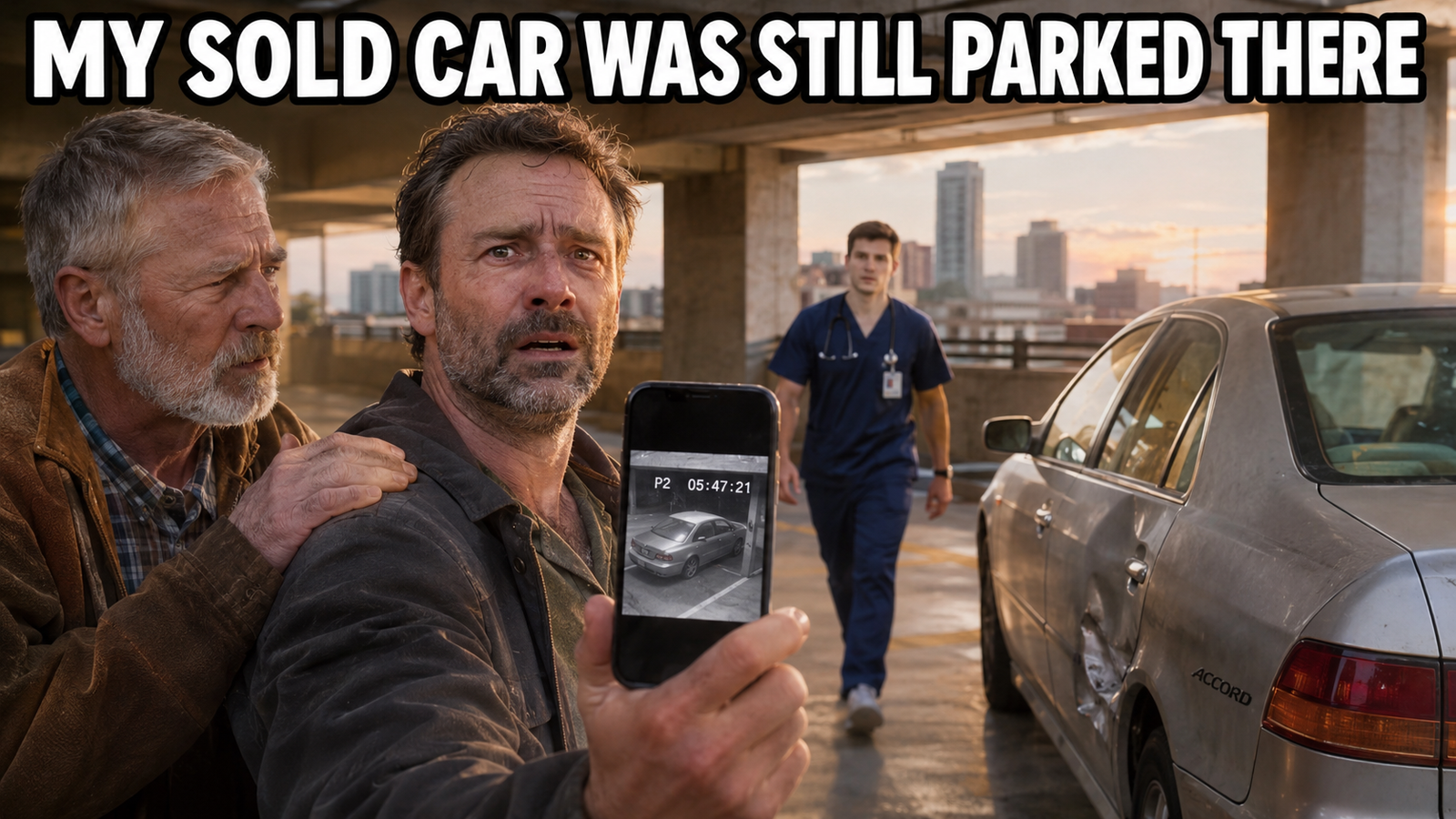
It was a grainy, black-and-white image, taken from a camera mounted on a concrete pillar, time-stamped 6:47 a.m. that morning. Space B-17. My old space.
And sitting in it was my old silver Honda Accord.
I knew it instantly. The dent in the rear passenger door from a shopping cart at Kroger in 2019. The faded university sticker on the back window that I’d never managed to scrape off. The little crack in the corner of the windshield.
The Honda was in the space. But a different plate was on it.
But the plate was wrong.
When I sold the car to Mr. Alvarez, I’d taken my plates off, the way you’re supposed to in Ohio. He’d gotten his own. I’d seen them. I’d watched him screw them on in his driveway with a borrowed screwdriver.
This plate wasn’t his. And it wasn’t mine.
I’m a claims adjuster. I have access to the same vehicle lookup databases every insurance company uses. I sat down at my desk and ran it. It took about thirty seconds.
The plate was registered to a 2016 Toyota Corolla. And the registered owner was Jean M. Pryce.
My mother.
PART 4 — A WOMAN WHO DOES NOT DRIVE
My mother has not driven a car since 2019.
She gave up her license herself, after she got confused one afternoon on the way home from church and ended up forty minutes away in Springfield, crying in a gas station parking lot. Wes and I both remember that day. She handed him her keys the next morning and said, “I’m done. I don’t trust myself anymore.” She was very calm about it. She was always very practical.
She’d never owned a Corolla. She drove a maroon Buick LeSabre for twenty years. When she stopped driving, Wes sold it.
She handed him her keys the next morning and said, “I’m done.”
So I kept digging. That’s what I do for a living. I pulled the insurance record on the plate.
The Corolla was insured. But not through a normal policy. It was a force-placed policy. If you don’t work in insurance, here’s what that means. When someone takes out a car loan, the lender requires them to carry insurance. If they don’t, or if it lapses, the lender buys a policy for them, usually an expensive one, and charges it right to the borrower’s loan account.
The premium was being drafted every month from a loan account in my mother’s name. A car loan, opened in March 2025, at a credit union on the west side. For fourteen thousand dollars.
And on the policy, under additional drivers, there was one name. A man, twenty-nine years old.
Living at my brother’s address.
PART 5 — ETHAN
I knew who it was before I even read the name.
Ethan. My nephew. Wes’s only son.
I hadn’t seen Ethan in almost four years. The last time was Thanksgiving of 2022, at Mom’s house, when he showed up late and hollow-eyed, and left early, and Wes followed him out to the driveway and the two of them shouted at each other in the cold where we could all hear. Ethan had been struggling with addiction since he was nineteen. Pills first, after a back injury from a warehouse job. Then worse. He’d been in and out of treatment four times. He’d lost two jobs and a driver’s license.
I hadn’t seen Ethan in almost four years.
After that Thanksgiving, Wes told us all that Ethan was “on his own now.” That he’d done everything he could. That he wasn’t going to watch his son destroy himself anymore. We didn’t talk about Ethan after that. It was too painful for everybody.
And now his name was on an insurance policy for a car registered to my seventy-eight-year-old mother, who didn’t drive, paid for out of a loan in her name that none of us knew about.
I sat at my desk and felt sick.
There’s a word for this in my business. We see it all the time. Elder financial exploitation. A family member, usually a grandchild or a son, quietly opening accounts in an aging parent’s name. I’ve worked dozens of those claims. They never end well.
I sat with that thought for a long time. I thought about every one of those files I’d worked. The grandson who emptied a savings account one forty-dollar withdrawal at a time. The son who refinanced his mother’s house without her understanding what she’d signed. The calm, polite voices on the phone, always explaining that it was a family matter and none of my business. I’d learned to recognize the pattern. And this looked exactly like the pattern.
But I also remembered Ethan at six years old, sitting on our father’s lap on the back porch at Rosedale Drive, learning to whistle. I remembered him at twelve, crying at Dad’s hospital bed. I didn’t know the man he’d become. I only knew the boy.
I called Wes.
PART 6 — WES
He answered on the fourth ring. “Nate. What’s wrong? Is it Mom?”
“Mom’s fine,” I said. “Wes, I need to ask you something, and I need you to not hang up on me.”
I told him everything. The permit. The photograph. The plate. The loan. The force-placed insurance. Ethan’s name.
There was a long silence on the line. When Wes finally spoke, his voice was very quiet and very hard.
“He’s living in my basement, Nate. Since August.”
“He’s living in my basement,” Wes said. “Since August. He showed up at my door and said he’d been clean for two years and he needed a place to stay while he saved for an apartment. I said one month. One.” He took a breath. “I’ve been watching him like a hawk. He leaves at ten every night and comes home at eight in the morning. He says he’s working. I didn’t believe him. I thought he was using again.”
“And the permit?” I said. “The replacement sticker. It went to your address.”
“I never saw it,” Wes said. “He gets the mail before I wake up.” He went quiet again. Then he said, in a voice I hadn’t heard since we were boys, “Nate, if he’s been stealing from Mom, I don’t know what I’m going to do.”
“Don’t do anything,” I said. “Not yet. Let me go see Mom first.”
“Nate,” Wes said, before I could hang up. “Whatever she tells you. Call me right after. Promise.”
I promised. It was the first thing either of us had promised the other in ten years.
PART 7 — JEAN
My mother’s apartment at Sycamore Glen is small and bright, with a window looking out at a courtyard full of bird feeders. She was sitting in her recliner with a crossword puzzle book and a cup of tea when I came in. She has good days and bad days now. This was a good one. She knew me right away.
“Nathan,” she said, pleased. “You didn’t call.”
I sat down across from her. I didn’t know how to start, so I just took out my phone and showed her the photograph from the lot camera. The Honda. The plate.
She looked at it for a long time. Then she looked up at me over her reading glasses. And she smiled.
“Oh,” she said. “You found us out.”
“Oh,” my mother said. “You found us out.”
“Mom,” I said carefully. “Did Ethan take out a loan in your name?”
My mother set down her crossword. She folded her hands in her lap. Her eyes were perfectly clear.
“No, honey,” she said. “I did.”
PART 8 — WHAT MY MOTHER DID
In March of 2025, Ethan called his grandmother.
He’d been clean for nineteen months by then. He’d been living in a recovery house in Springfield, going to meetings every day, working part-time at a car wash. He’d just finished a nurse’s aide certification course at the community college, paid for with every dollar he’d saved. And he’d been offered a job. Night shift, on the cardiac floor at Miami Valley Hospital, downtown Dayton. Starting at nineteen dollars an hour.
“He said, ‘Grandma, I finally got a real job. And I can’t get there.'”
“He said, ‘Grandma, I finally got a real job. And I can’t get there,'” my mother told me. “The buses don’t run at night. He’d gotten his license back, but he didn’t have a car. And nobody would give him a loan, with his history. Not a bank. Not a credit union. Nobody.” She lifted her chin. “So I went with him to my credit union, the one I’ve banked at for forty years, and I took out the loan myself. In my name. For a little used Toyota.”
“And the insurance?” I asked.
My mother’s face fell a little. “That’s where it got complicated,” she said. “Nobody would insure him either. Not with his record. The credit union said if he couldn’t get insurance, they’d buy it for him and charge it to the loan. It costs a fortune. Two hundred and twelve dollars a month.” She shrugged. “So I let them. He pays me back every two weeks. Cash. He brings it here on Sunday afternoons. I keep it in an envelope in my sock drawer.”
“Mom,” I said. “Why didn’t you tell Wes? Or me?”
My mother looked out at the bird feeders for a long moment.
“Because your brother had given up on him,” she said quietly. “And you had stopped asking about him. And I hadn’t. I’m his grandmother. I was not going to give up on that boy. Not as long as I was breathing.”
She reached over and patted my hand, the way she used to when I was little and had a fever.
“I know it wasn’t exactly by the book,” she said. “I know you’d have a word for it at your job. But I’m seventy-eight, Nathan. I don’t have time to wait for everybody to come around. So I decided to just help him, and let the rest of you catch up.”
I didn’t know whether to laugh or cry. So I did a little of both. Then I went out into the hallway and called my brother, like I’d promised.
PART 9 — THE HONDA
That left one question. My old Honda.
I asked my mother. She laughed and said she didn’t know anything about that. So that night, I went across the street and knocked on Mr. Alvarez’s door.
Mr. Alvarez is seventy-four, a retired machinist, a widower with a big garden. When I showed him the photograph, he sighed and invited me in for coffee.
“The Toyota’s transmission died in September,” Mr. Alvarez said.
“The Toyota’s transmission died in September,” he said. “The boy came over in the middle of the night, panicking. He’d been at your brother’s two weeks. He said if he missed one shift in his first year, they’d let him go. He said he couldn’t lose this job.” Mr. Alvarez shrugged. “I don’t drive much anymore. Your old Honda just sat in my driveway. So I told him to take it. Use it until the Toyota’s fixed.”
Ethan had moved the plates from the broken Toyota to my old Honda. He shouldn’t have. It was wrong, and it was illegal, and he knew it. But the Toyota was sitting in a repair shop waiting on a twelve-hundred-dollar transmission he was saving up for. The insurance on the Toyota’s plate was in force. And he didn’t know what else to do.
And when he pulled into the city lot on his first night shift in my old Honda, the camera read the car, matched it to my space, and sent him a notice that the permit sticker was damaged. So he called Parking Services and asked them to mail a replacement to the only address he had.
He thought the space came with the car. He didn’t know it was being charged to me.
“He’s a good boy,” Mr. Alvarez said, refilling my coffee. “He mows my lawn without me asking. He brought me soup in March when I had the flu. Whatever he did before, that’s not who he is now. I see him every morning, coming home tired in those blue scrubs. A man doesn’t work that hard for something he doesn’t believe in.”
I walked back across the street in the dark and stood in my driveway for a long time, looking at the empty spot where my old Honda used to sit.
PART 10 — EIGHT IN THE MORNING
I waited for Ethan in the parking lot of Miami Valley Hospital the next morning at eight. Wes came too. He insisted.
We stood next to my old silver Honda in space B-17 in the cold and watched the night shift come out through the sliding doors. Nurses. Respiratory therapists. Janitors. And then a tall, thin young man in navy blue scrubs, with a backpack over one shoulder and a lanyard around his neck, laughing at something an older nurse beside him had said.
He saw us. He stopped dead in the middle of the crosswalk.
He saw us. He stopped dead in the middle of the crosswalk.
The older nurse looked at him, then at us. She put a hand on his arm. “You okay, Ethan?” she asked. “You want me to stay?”
“No,” Ethan said. “It’s okay. That’s my dad. And my uncle.”
He walked over to us slowly, like a man walking to his own sentencing. He stopped in front of his father. He didn’t say anything. Neither did Wes.
Then the older nurse, who’d lingered by the doors, called out across the parking lot. “Mr. Pryce? Are you Ethan’s dad? I’m his charge nurse. I just want you to know, he’s the best aide on my floor. Patients ask for him by name. You should be very proud.” And she went back inside.
My brother looked at his son. Wes’s face crumpled. And for the first time in four years, he put his arms around his boy, right there in space B-17, and held on.
We fixed everything. Properly. I paid for the Toyota’s transmission, and Ethan insisted on signing an IOU, which I’ve put in a drawer and will never cash. The plates went back on the Toyota. Mr. Alvarez sold Ethan my old Honda for one dollar, on the condition that he come over every Saturday and help with the garden. I canceled the permit for real this time and asked Denise to put it in Ethan’s name, if he wanted it. He does. He pays for it himself now.
And the loan in my mother’s name? Ethan paid it off in full last month. He brought the final payment to Sycamore Glen on a Sunday afternoon, in cash, in an envelope.
My mother didn’t put it in her sock drawer. She put it in his hand and told him to buy himself a decent winter coat, and to come to Thanksgiving.
He came. All of us did. Wes carved the turkey. Ethan sat between his father and his grandmother, in clean clothes, with three years of sobriety and a hospital badge clipped to his shirt pocket. And my mother, who has bad days now, had one of her very best. She looked around the table at all of us and said, very clearly, “There. I told you he’d come home.”
I still check my bank statements on the first of every month. But I don’t mind the charges from that city lot anymore. They’re not mine now. They’re Ethan’s.
And every time I drive past Miami Valley Hospital, I look for a silver Honda with a dented back door, parked in space B-17. It’s always there. Right where it belongs.