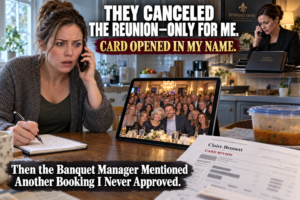
His mother canceled our reunion because she was “sick.” I sent soup—then received a photo of forty relatives at dinner, my husband among them. The next morning, a manager called about a card in my name that I’d never opened. Then she mentioned another booking.
Part 1
I left the soup on Rose’s porch in a container she had returned to me three times without its lid.
That morning, she had sounded weak on the phone. The reunion would have to be canceled, she said. Forty people, all those arrangements, and now she could barely get out of bed.
“I’m sorry,” I told her. “Do you need anything?”
“No, sweetheart. Just rest.”
I made chicken soup anyway. For nine years, I had been married to her son, Mark, and I still believed small kindnesses could make our relationship easier. Rose liked things done her way. I liked knowing what the plan was. Somehow that difference usually ended with me being told I worried too much.
My husband kissed my forehead before leaving for work.
“I’ll be late,” he said. “We’re finishing a proposal.”
“Do you want dinner saved?”
“Don’t wait up.”
I worked from home that afternoon, answering client questions and checking invoice details. At thirty-six, I ran a small payroll service. Numbers were not a hobby; they paid our bills. Mark sometimes introduced my work as “Claire fussing over spreadsheets,” then asked me to handle every household payment.
At six, I ate leftovers and put the soup pot in the sink.
At seven twelve, my cousin Jenna sent a message.
Wish you were here.
Below it was a photograph.
The banquet hall had warm lights, white tablecloths, and a long row of relatives raising their glasses. Rose sat near the center, looking perfectly healthy. Mark stood behind her chair, smiling with one hand on her shoulder.
I enlarged his face first.
Then I looked at the room. There were roughly forty people, the same group Rose had supposedly canceled. Jenna had married Mark’s cousin Dean, which was how she became part of both our families. She had traveled in from another state for the weekend.
She believed she was sharing a happy picture, not handing me evidence.
I wrote: I thought it was canceled.
Three dots appeared, disappeared, then returned.
What? Rose said you couldn’t come.
I put the phone on the table.
I did not drive over. I knew how easily my arrival could become the evening’s main offense. Rose would look wounded. Mark would ask why I could not wait until morning. Everyone would remember me walking in angry rather than remember the lie that brought me there.
I waited.
He came home shortly after eleven, carrying a mint from the banquet hall in his pocket. I knew the wrapper because we had held Rose’s birthday there two years earlier.
“How was work?” I asked.
He loosened his tie.
“Long.”
I turned my phone toward him.
His hand stopped at his collar.
“Claire.”
“Why was I told the reunion was canceled?”
He sat down, though I had not asked him to.
“Mom wanted one peaceful night.”
I looked at him for several seconds.
“One peaceful night.”
“It wasn’t supposed to hurt you.”
“What had I supposedly done?”
He rubbed his forehead.
“You ask questions. About costs, plans, who’s doing what. Sometimes people just want to enjoy themselves.”
“So you lied.”
“I avoided an argument.”
“And your mother pretended to be sick.”
He said nothing.
I thought about the soup cooling on her porch and all the small ways I had tried to be useful without being difficult.
Then he reached for my phone.
“Who sent you that?”
I moved it away.
He was not asking whether I was hurt. He was trying to find the person who had let me know.
Part 2
Jenna called the next morning while I was making coffee.
“I’m so sorry,” she said.
“You didn’t do anything wrong.”
“I know, but I kept thinking about what happened after I sent it.”
“What happened?”
“Mark asked Dean whether I’d been texting you.”
I looked toward the stairs. My husband had already left, earlier than usual, saying he had a meeting.
“What did Dean say?”
“That I text you all the time.”
She hesitated.
“Rose looked upset. She kept saying people needed to respect private family decisions.”
“I’m married to her son.”
“I know.”
I thanked Jenna for telling me. I did not ask her to question relatives on my behalf or turn the group photograph into a public accusation. I needed to understand what had happened before deciding what to do with it.
After we hung up, I took my mug to the desk.
There was an email from Rose.
Claire, I’m sorry your feelings were hurt. You know I haven’t been myself. Please don’t turn a simple dinner into something ugly.
I read the message twice. The illness had not disappeared; it had changed into a reason she should not be held responsible for what she did while apparently well enough to host forty guests.
I did not answer.
At nine thirty, the phone rang again.
The caller introduced herself as Paula, the banquet manager at Hartwell Hall.
“Is this Claire Bennett?”
“Yes.”
“I’m calling about a payment review concerning last night’s family dinner. Our processor asked us for supporting records, and I wanted to verify the contact information we have.”
“I wasn’t at that dinner.”
There was a pause.
“I have you listed as the cardholder.”
“What card?”
She described the card ending and the amount charged. The dinner, service charges, drinks, and additional room time had come to several thousand dollars.
“I don’t own that card,” I said.
Paula’s voice changed from routine courtesy to careful attention.
“Then I shouldn’t discuss any more payment details until this is clarified. Do you have a moment to speak about the event records?”
“Yes.”
She explained that she had my number from the birthday event I had personally organized two years earlier. The new booking used my name with a different email address, and a payment issue had led her to compare the records rather than rely only on the recent contact information.
“What email?”
She read it.
Mark’s work address.
I opened a blank page on my desk and began writing down the time, the number, and exactly what she had said.
“I did not book this dinner,” I told her. “I did not authorize payment.”
“Understood. Please contact the issuer directly through a verified channel. We can preserve the event records and provide them through the appropriate process.”
I asked whether Mark had signed anything.
“Yes. He signed the final event acknowledgment. Your mother-in-law handled several arrangements.”
I felt my coffee turn sour in my stomach.
Then Paula said, “There’s another reason I wanted to reach you.”
I gripped the pen.
“They also left a deposit for a wedding,” she said. “Your husband is listed as the groom.”
Part 3
For a moment, I could hear the room around me more clearly than the voice on the phone.
The refrigerator clicked off. A truck passed outside. Somewhere upstairs, the washing machine reached the end of its cycle.
“My husband,” I repeated.
“Mr. Mark Bennett.”
“I’m his wife.”
Paula was silent long enough for me to understand she had not known that.
“I’m sorry,” she said. “I understood you were the person managing payment for a family booking. I didn’t realize—”
“Who is the bride?”
She hesitated.
“There are privacy limits on what I can discuss. I can tell you that your name appears in the billing records. The future event should be included when you clarify the unauthorized charges.”
I appreciated the boundary even while hating it. She was not a friend with gossip. She was a manager realizing her records might be part of something serious.
“Please preserve everything,” I said. “Messages, forms, payment information. I’ll contact the card issuer.”
“I will.”
After the call, I sat very still.
There were two possible worlds. In one, there was a mistake large enough to sound impossible. In the other, the reunion was not the deepest thing my husband had hidden.
I began with the facts I could verify.
I found the issuer’s public contact information independently rather than using a number from an unfamiliar message. I explained that a merchant had contacted me about a card in my name that I did not recognize. The representative took me through a careful verification process and referred the matter for review.
I did not have the card. I did not know the login. I did not know when the application had been made.
By the end of the conversation, I had a reference number and instructions for providing a written statement. I was told the disputed application used personal information matching mine, with Mark’s work email as the contact address. Further records would take time to obtain through the review process.
My Social Security number had not appeared in a banquet-hall file Paula could casually read aloud. It was part of a credit application I now had to dispute.
I wrote that distinction in my notes. I needed to be accurate, especially when anger made every detail seem connected.
Before moving to the next task, I made myself eat a piece of toast. I had been sitting for hours, and my hands were beginning to shake. There was nobody else home to notice. Taking care of myself felt awkwardly deliberate, but I needed to remain able to think. I drank water, opened the curtains, and returned to the desk.
Then I checked our ordinary accounts.
There were transactions I recognized and others I had not questioned because Mark described them as work expenses awaiting reimbursement. I downloaded statements I could access legitimately and saved copies of messages he had sent me about money.
I did not guess passwords or enter his workplace systems.
I could investigate my own life without becoming careless about somebody else’s records.
At noon, he texted.
Are we okay? Mom says you haven’t answered her.
I looked at the words until they seemed almost absurd.
We were not okay because he lied about a dinner. We were not okay because a credit application apparently used my identity. And someone had booked a wedding with my husband’s name where the groom belonged.
I replied: I need a conversation tonight. Please don’t involve your mother.
He answered quickly.
You’re making this bigger than it is.
A few minutes later, Rose called.
I let it go to voicemail.
Her message began warmly and ended with a sentence I had never heard from her before.
“Whatever Paula told you, you need to hear our explanation first.”
Part 4
I played the message once more, then saved it.
Rose knew which manager had called. She knew there was something to explain. That did not tell me everything she had done, but it removed the comfortable possibility that the whole situation was an isolated typo.
I called my sister, Anna.
She listened without interrupting, then asked where I was.
“At home.”
“Are you safe?”
“I think so.”
“Do you want company?”
“Yes.”
She arrived an hour later carrying a bag of groceries and no opinions about how long I should wait before being angry. She put food away, sat beside me, and read the notes I chose to show her. When I began apologizing for interrupting her day, she pointed at the groceries and said she had already needed to shop. It was a small kindness, letting me accept help without first defending the need for it. I had spent so long trying to appear easy to live with that even asking my sister to sit in the kitchen felt like a failure. She stayed until that feeling eased. I was grateful she had not set a time limit. Then she asked whether I had eaten anything besides toast, and I realized I could answer honestly without being scolded.
“Start with what you know,” she said.
So we made a short list. The dinner happened. Mark lied about being at work. He admitted I was excluded. A card in my name paid for the event. I did not apply for it. A future wedding booking listed him as groom. Rose’s voicemail named Paula before I had told her about the call.
“What don’t you know?” Anna asked.
“Who the bride is. Whether Mark knows the card is being reviewed. What he’s told everybody.”
“And what do you need tonight?”
I thought about it.
“Answers. But not an argument that goes until three in the morning.”
We arranged that Anna would wait nearby while I spoke with him, and that I could go to her house afterward. I packed a bag with clothes, medication, documents, and my work laptop. We had no children, which removed one set of immediate worries without making the marriage easier to leave.
When Mark came home, he saw the bag by the stairs.
“What is that?”
“Some things I may need.”
“For what?”
“I haven’t decided where I’m sleeping tonight.”
He looked frightened for the first time.
“Claire, this is ridiculous.”
I remained seated at the kitchen table.
“Did you open a credit card in my name?”
He did not answer immediately.
“Mom handled the application.”
“Did you know?”
“She said it was easier because your credit was better.”
I stared at him.
“You’re describing a reason. I asked whether you knew.”
“Yes.”
“Did I agree?”
“We were going to tell you.”
“When?”
“When everything settled.”
I wrote down his answer.
He reached toward the paper.
“Don’t do that.”
I moved it out of reach.
“I need to remember what you say.”
“You make me sound like a criminal.”
“I’m asking about something you did without my permission.”
He looked away.
“How long has it been open?”
“A few months.”
“How many charges?”
“I don’t have everything in front of me.”
“Then get the records.”
He opened his mouth, closed it, and tried another approach.
“I’m sorry about the dinner. Mom knew you’d be upset about the cost.”
“Because you were making me pay for being excluded?”
“It wasn’t like that.”
I waited until he looked at me again.
“What wedding did you book at Hartwell Hall?”
The color left his face.
Then he said, “I was going to tell you after the reunion.”
Part 5
“Tell me what?”
Mark stood behind a chair, holding its back with both hands.
“I met someone.”
The sentence was small enough to fit anywhere. He said it as though reducing its size could reduce the life around it.
“How long?”
“About a year.”
I looked at the kitchen clock.
A year included our anniversary, the weekend I cared for him after he hurt his back, the month we discussed whether to move closer to his work. It included ordinary affection I had accepted as evidence that we were building the same future.
I remembered a Sunday the previous autumn when he had insisted I rest while he went out to buy groceries. He came home with flowers. I had kept them alive for nearly two weeks, changing the water every morning. There was no way to know whether that afternoon belonged to the affair, and I refused to turn every memory into an accusation. Still, I understood that memories would be difficult for a while.
“Her name?”
“Leah.”
“Does she know you’re married?”
He hesitated.
“Does she?”
“She knows things have been difficult.”
“That is not the same answer.”
“I told her we were separating.”
“We weren’t.”
“I know.”
“And your mother knows her?”
He nodded.
“Was she at the reunion?”
“Yes.”
I thought about the photograph. A woman stood near the end of the row, partly obscured by another guest. I had enlarged my husband’s face without studying everyone around him.
The dinner had not merely excluded a difficult daughter-in-law. It had created a setting in which he could show another woman a version of the family without me in it.
“Was that why Rose wanted one peaceful night?”
Mark sat down.
“Mom thought it would be easier if there wasn’t a scene.”
I let out a short, disbelieving breath.
“You weren’t afraid of a scene. You were afraid I’d be there.”
He covered his face.
“I didn’t know how to tell you.”
“You knew how to apply for credit.”
He lowered his hands.
“Mom said she’d sort it out.”
“Why is your work email on the application?”
“Because she needed somewhere to send it.”
“And you received the messages.”
“Yes.”
There was no useful place left for him to put the responsibility. Rose could have suggested it. She could have filled in information. He had known, received the emails, and used the result.
“What did you tell Leah about the wedding money?”
“That my family was helping.”
I stared at him.
“Your wife was helping. Without knowing.”
He looked toward the bag.
“Are you leaving?”
“Yes. Tonight.”
“Can we talk first?”
“We have been talking.”
He stood as I picked up my coat, then stopped when Anna appeared at the doorway. I had told him she was nearby; he had apparently chosen not to believe she would remain.
She did not argue with him. She took one bag and waited while I collected the other.
At the door, he said, “Please don’t destroy my life over this.”
I looked back.
“I’m trying to find out what happened to mine.”
That night, at Anna’s house, I cried for the first time. She sat beside me, neither urging forgiveness nor telling me I ought to feel relieved.
I slept badly and woke to messages from Mark and Rose. Some apologized. Others warned that card disputes could cause trouble for everyone.
Jenna also wrote.
I asked Dean what he’d been told. He says Mark told people you and he had already agreed to divorce.
Then she sent another photograph from the dinner.
This time, Leah stood beside my husband, holding a small bouquet.
Part 6
The bouquet was pale pink.
I kept looking at it because it was easier than looking at my husband’s expression. He wore the attentive smile I recognized from photographs of our own engagement.
Jenna called when I asked.
“Did they announce anything?”
“Not a formal engagement,” she said. “Rose introduced Leah as someone important to Mark. Dean thought you’d already separated. We didn’t know what was appropriate to ask.”
“Did anyone mention me?”
“Rose said you wanted distance and didn’t want people contacting you about it.”
I closed my eyes.
My absence had been explained differently to different people. Sick mother. Canceled dinner. Busy wife. Difficult wife. Separated wife who wanted no questions. Each version removed the need to check with me.
“I’m sorry,” Jenna said. “I should have called before sending the photo.”
“The photo helped.”
“I hate that I congratulated him on looking happy.”
“You believed what they told you.”
I did not need another person punished for being deceived. I needed her to tell the truth now that she knew it.
“Please keep the messages you have,” I said. “And don’t tell people I agreed to any of this.”
“I won’t.”
I spent the morning trying to work. One client needed a corrected report, and another asked about a deadline. I answered carefully, grateful for questions with clear solutions. Between messages, I looked at the photograph again and wished I had never seen it. Then I remembered that not seeing it would have left the facts unchanged. The knowledge hurt, but it gave me a chance to make decisions. I finished the urgent tasks, told the clients who needed to know that I would be unavailable that afternoon, and closed the laptop.
That afternoon, I met with a lawyer, Naomi Ellis, to discuss the marriage and the financial concerns. I brought my notes, statements, the issuer reference number, and messages I could lawfully access.
She did not promise that every charge would disappear by Friday or that my husband would be arrested because I was angry. She explained the work in front of us: document what happened, respond to the issuer’s requests, understand the accounts, and address separation through the appropriate process.
“What do you want immediately?” she asked.
“To stop new debt appearing in my name. To keep working. To sleep somewhere I can think.”
We made a plan around those things.
I contacted the relevant financial institutions and completed the identity-theft reporting and credit-protection steps appropriate to my situation. The details were tedious, and some conversations had to be repeated. I kept records rather than treating one phone call as a complete repair.
Paula responded to a written request through the proper channels. The venue preserved its booking records. It would not proceed with additional disputed billing simply because Mark wanted the dates held.
I did not ask her to cancel an event on someone else’s behalf. I asked that no use of my identity or purported authorization be accepted without verification.
At the end of the day, Naomi looked at one of Rose’s messages.
We were going to pay it off before you ever noticed. There was no harm intended.
“Save that,” she said.
“I have.”
For years, I had been told my habit of asking questions spoiled family occasions. Now dates, names, amounts, and exact wording were the tools keeping me from drowning in explanations.
When I returned to Anna’s house, an unfamiliar number called.
I let it go to voicemail.
A woman spoke slowly, as if choosing each word with care.
“My name is Leah Morgan. I think your husband has been telling us very different things.”
Part 7
I listened to the message twice before responding.
I did not owe Leah a meeting. I did not know what she had understood, and I was too tired to become somebody else’s judge. But she might have information about commitments made using my name.
I asked her to communicate in writing first.
She replied with a clear account. Mark had told her he and I had separated months earlier and were completing the paperwork. He said we maintained a civil relationship and that I was helping coordinate some financial matters as part of an agreed arrangement.
That explanation made me feel physically ill.
It turned my ordinary competence into a cover story. The wife who handled bills could also be the imaginary former wife who cheerfully financed his next wedding.
Leah sent copies of messages relevant to the booking. She offered to provide them through my lawyer if needed. I told Naomi before making any decisions about meeting.
Before deciding to meet, I asked myself what I wanted from the conversation. I did not need details about their dates, gifts, or private jokes. Those would stay in my head without helping me understand the money. I wrote down three questions about what Mark had said, what Rose had arranged, and which documents Leah had seen. Having those questions gave the meeting an ending I could choose.
We eventually spoke in a public café, with Anna sitting at another table nearby. I wanted the conversation limited and calm. Leah agreed.
She looked younger than I expected, though not young enough for age to explain what happened. She kept both hands around a cup she did not drink from.
“I asked whether you knew,” she said. “He said you did.”
“Did you ever speak to me?”
“No.”
“Then you had his answer.”
She nodded.
“I should have checked.”
I let that sentence stand without deciding whether it was enough.
“What did Rose say?”
“That she was relieved Mark had found someone who understood him. That you preferred not to attend family things while the separation was being finalized.”
“And the dinner?”
“She said it would be a chance to meet people before the wedding.”
My throat tightened.
“They called it a family reunion when they spoke to me.”
Leah looked down.
“I didn’t know.”
She took an envelope from her bag. It held printed copies of the event estimate Mark had shown her. The billing contact was my name. The email was his. Rose was listed as the person coordinating arrangements.
“Why did you think my name was there?”
“He said you had a business discount and had offered to handle it.”
I almost laughed. Not because anything was funny, but because there seemed to be no limit to the useful wife he could invent once I was not in the room.
“I didn’t offer.”
“I understand.”
Leah said she had not signed a payment guarantee or authorized any use of my information. She had paid for a dress consultation herself, and she was now trying to unwind arrangements she could control.
“I’m not asking you to feel sorry for me,” she said.
“I don’t have much room for anyone else right now.”
“That’s fair.”
We finished the conversation without becoming friends. Two people could recognize the same deception without being required to comfort each other through it.
As I stood to leave, Leah added one last thing.
“Rose told me you’d agreed to give Mark the house.”
I turned back.
Our house had been mine before the marriage. We had never agreed on a transfer.
“Did she show you anything?”
Leah nodded.
“A document. With your name at the bottom.”
Part 8
I called Naomi from the parking lot.
Leah did not claim she had watched me sign anything. She had seen a document Rose displayed during a discussion of future housing. It might have been a draft. It might have been assembled to look convincing. The important thing was that my family had represented another agreement I had never made.
Naomi asked me to describe exactly what Leah said and avoid adding conclusions before we saw the document.
“Can she provide a copy?”
“She doesn’t have one.”
“Then we’ll treat it as an account to examine, not a completed transfer.”
I appreciated the distinction. Every new discovery made me want to shout the worst possible interpretation. Accuracy gave me somewhere firmer to stand.
We reviewed the house records and the documents I possessed. There was no mysterious overnight change I could confirm. The practical concern was what Mark and Rose had promised, submitted, or misrepresented, and how to stop them continuing to speak for me.
After the call, Anna suggested a walk. We went only as far as the corner shop, where she bought milk and I chose apples. The ordinary transaction steadied me: a price, a payment, a receipt, nothing hidden behind a family explanation. We carried the bags home slowly. For a few minutes, I could feel my feet on the pavement instead of living entirely inside the next possible discovery. Anna talked about her garden, and I listened with more gratitude than the subject would usually deserve.
That evening, Rose came to Anna’s door.
Anna called me from the kitchen.
“You don’t have to see her.”
“I’ll speak through the door. For a minute.”
Rose stood on the porch with a bakery box.
“I brought something,” she said.
I thought about the soup on her porch.
“I don’t want it.”
“Claire, please. We’ve all said things badly.”
“This isn’t about wording.”
“Mark was unhappy.”
“He could have told me.”
“He didn’t want to hurt you.”
“He used my identity and planned a wedding.”
She glanced toward the street.
“Keep your voice down.”
I lowered it because I wanted control of my words, not because her neighbors’ opinions mattered.
“What document did you show Leah about my house?”
Rose’s face changed.
“It was only a possible arrangement.”
“Did I agree?”
“We assumed you’d want things settled peacefully.”
“You assumed my permission again.”
She shifted the bakery box to her other hand.
“You have to understand how much pressure Mark was under.”
“I understand that he made decisions. So did you.”
“He’s still your husband.”
“And I’m still the person whose name you used.”
For a moment, she looked almost angry enough to abandon the soft voice.
“We would have paid it back,” she said.
“That would not make me the applicant.”
She stared at me.
For nine years, I had filled every difficult silence between us. I explained my intentions, reassured her, found something to apologize for, and made it possible for the visit to end pleasantly.
I did not do that now.
“Any questions about money or property go through the people handling them,” I said. “Don’t come here again without asking.”
I closed the door.
Anna stood a few feet away.
“How do you feel?”
“Awful.”
She nodded.
“Do you want tea?”
“Yes.”
Setting a boundary did not make me instantly calm. It left me shaking in a kitchen that was not mine, grieving people I had trusted to be ordinary family.
Then my phone lit up with a message from Mark.
Mom says you won’t be reasonable. If you report this, don’t expect me to protect you when everyone hears what you’ve done.
Part 9
I saved the message and sent it to Naomi.
I did not answer with a threat of my own. I did not write a public post while angry. I had enough evidence to preserve and enough real decisions to make without creating a second argument he could point to.
The following weeks were slow. I marked appointments on Anna’s kitchen calendar and crossed them out only after they were finished.
The issuer asked for information. I supplied it. Some records arrived promptly; others took longer. The venue confirmed details through the channels established for the dispute. Mark and Rose obtained their own advice after discovering that “we meant to pay it back” did not end the questions.
I did not control every consequence. I controlled the accuracy of my account and the boundaries around my cooperation.
Our separation moved forward separately from the credit review. The future wedding booking was not proof of a second legal marriage, and I did not pretend it was. It was evidence of a future Mark had planned while allowing me to believe we still shared one.
That was enough to change what I wanted.
I went back to the house with Anna at an arranged time to collect more things. Mark stayed away as agreed. The rooms looked painfully normal. My slippers waited beside the couch. A photograph from our anniversary stood on the shelf.
I put it facedown before deciding whether to pack it.
Anna did not comment.
In the kitchen, there was a container beside the sink.
The soup container. Rose had apparently returned it to Mark, finally with its lid.
I stood looking at it longer than I intended.
It represented something almost ridiculous: hours I had spent trying to care for a woman who was, at that same moment, preparing a dinner from which I had been deliberately excluded.
I washed it and packed it with my other things.
I was not going to leave behind useful belongings just because they had become attached to an ugly memory.
Jenna visited after returning for another family weekend. She told me that several relatives had learned the truth and wanted to call.
“They can ask,” I said. “But I don’t want forty versions of why I should forgive him.”
“I told Dean that.”
“How did he respond?”
“He said he should have checked with you.”
That was more helpful than telling me everyone had been shocked. Shock could become another way to do nothing.
Some relatives apologized. Others said marriages were complicated, which was true but irrelevant to whether I applied for a card. I learned to end those conversations before spending an hour defending facts already documented.
Mark requested a private meeting.
I declined and offered written communication about practical matters.
He sent a long apology. There were sentences that sounded sincere and others that described his loneliness as though it were an invoice I had neglected to pay. I read it once, then set it aside until I could decide what needed a response.
Leah wrote only to confirm she had ended her involvement with Mark and would cooperate with requests for relevant records. I thanked her for that, not for solving anything between us.
By early winter, the financial review had resolved the disputed card liability in my favor on the evidence submitted. Other issues continued through their own processes. I kept the final correspondence rather than assuming every system would update itself immediately.
Naomi called to discuss the next steps in the separation.
“What do you want your life to look like after this?” she asked.
For the first time, I had an answer that did not begin with Mark.
Part 10
“I want my home to feel like mine,” I said.
Not because every room needed new furniture. Because I wanted to open a letter without wondering whether someone had already decided what it meant for me.
I wanted to work without hiding the fact that details mattered. I wanted friendships where a question was an invitation to clarity rather than evidence that I was difficult.
And I wanted quiet that did not require my absence.
The separation took time. There were decisions about property, belongings, and shared expenses. Some were straightforward. Others required patient work through our advisers. I did not get every outcome simply because I had been wronged, and I did not need the story to end with my husband losing everything in order to know I could leave.
What I needed was a fair, documented ending to arrangements I could no longer trust.
When the practical situation allowed it, I returned to my house. Anna helped me carry boxes inside. We put the kettle on before unpacking, and she sat on the floor while I decided which drawer would hold my work files.
“Do you want to repaint?” she asked.
“Eventually.”
“Do you want to throw anything dramatically into the garden?”
I laughed for the first time in days.
“No. The neighbors have suffered enough.”
We ate sandwiches among the boxes. Nobody told me the room ought to look happier. It could be unfinished and still be safe to sit in.
I moved my desk closer to the window. I changed account access and contact details through proper channels. I checked that the credit records reflected the outcome of the dispute and kept copies of the corrections.
Those were ordinary tasks. They made the house feel steadier than a symbolic bonfire ever could.
Rose sent one more message asking whether we might have lunch someday.
She wrote that she missed the family as it had been.
I did too. But the family she missed had depended on me not knowing what was happening inside it.
I replied that I was not ready for contact and would reach out if that changed. I did not explain until she agreed with me. Agreement was no longer the condition for having a boundary.
Mark’s final personal letter arrived after the main separation arrangements were settled.
He said he regretted lying. He said his mother’s involvement had made everything worse. He said he hoped I remembered the good years as well as the ending.
I did remember them.
That was part of the grief. We had shared ordinary happiness, and some of it had been real. The ending did not erase every morning of coffee or every trip we had enjoyed. It changed what I could safely build from those memories now.
I wrote a short reply acknowledging the practical matters he had raised. I did not offer a conversation about the marriage. There was nothing he needed to explain that would turn his choices into my consent.
As spring approached, Jenna suggested a small family dinner.
“Only if you want one,” she said. “And nobody will invite people behind your back.”
I thought about it for a week.
Then I said yes.
We did not book a banquet hall. Eight people came to my house, bringing food and asking where they could put it. Anna arrived early to help. Jenna and Dean brought bread. Two relatives I trusted came with dessert, and a friend from work brought a salad she admitted she had bought on the way.
There were no speeches about fresh starts.
Someone asked about my business, and I described the new client I had taken on. Nobody called it fussing over spreadsheets. Dean asked a practical question about payroll and listened to the answer.
Halfway through dinner, Jenna raised her glass.
“I’m glad you’re here,” she said.
I looked around my own table.
“So am I.”
After everyone left, Anna stayed to wash dishes. I dried them, putting plates away in the cupboard I had rearranged that morning.
“Was it too much?” she asked.
“No.”
“You can say if it was.”
“I know.”
That was the difference I had spent years missing. People who cared about me could ask a question and allow the answer to be inconvenient.
Later, I opened the refrigerator and found leftovers labeled in Jenna’s handwriting. Soup, bread, and a container of roasted vegetables. There was enough food for several days, all given without a story I needed to believe first.
I heated a small bowl of soup even though I was not hungry. I wanted to sit at my kitchen table for a few more minutes, with the house quiet around me and nobody waiting for me to apologize for noticing something wrong.
Months earlier, my husband had said his mother wanted one peaceful night.
I finally had one.
It included me.