The Night Our Name Changed Forever
A powerful emotional story about fear, moral conflict, generational truth, and the courage to confront a past that refuses to stay buried.
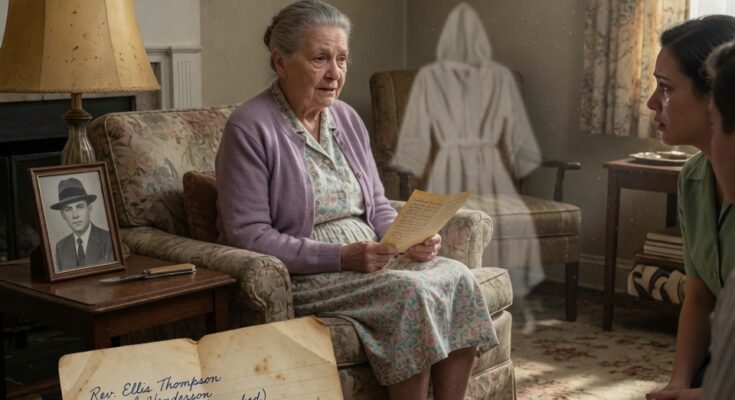
My grandmother did not raise her voice when she told us the truth. That is what made it harder to hear. She spoke slowly, carefully, as if every word had been waiting years to be released.
“It happened in 1958,” she said. “And once it happened, nothing about our name was ever the same.”
We were sitting in her living room, the curtains half open, sunlight stretching across the worn carpet. The house was quiet, but the silence felt heavy, like it was holding something back.
Then she looked at me and said,
“Your grandfather wasn’t the man you think he was.”
That sentence stayed in the air long after she said it.
All my life, I had known my grandfather as a quiet man. He worked hard. He kept to himself. He avoided attention. He never talked about the past. When people mentioned certain names or places, he would simply leave the room.
As a child, I thought he was just private.
As an adult, I began to wonder if he was hiding something.
Now I was about to find out.
My grandmother told us that during that time, the town was divided. There were people who believed in change, in equality, in justice—and there were people who fought against it with anger and fear.
Fear was the strongest force in that town.
One night, a group of men came to my grandfather. They did not ask politely. They did not give him space to think. They told him what they expected. They reminded him of his family. They reminded him of what could be taken away.
“He didn’t have a real choice,” my grandmother said quietly.
But then she paused.
“He had a moral choice. And that’s different.”
That night, my grandfather went with them.
He wore the white hood.
The room felt colder when she said it.
I didn’t want to imagine it. I didn’t want to see him that way. The man who taught me how to fix things, who gave me my first pocketknife, who sat quietly at the dinner table—how could that man have stood among hate?
But my grandmother did not stop.
“He came home that night and didn’t speak,” she said. “Not to me. Not to anyone. He just sat there… like something inside him had broken.”
From that moment on, everything changed.
He stopped laughing.
He stopped going to town events.
He stopped looking people in the eye.
The shame never left him.
Years passed, but the guilt stayed. My grandmother said he would wake up in the middle of the night, sweating, breathing heavily, as if he were reliving something he could never undo.
Then one day, many years later, he finally spoke.
Not to the town.
Not to his friends.
But to her.
“He told me everything,” she said.
He told her about the people who were targeted. He told her about the fear that kept him silent. He told her about the moment he realized he had crossed a line he could never uncross.
Then he handed her a folded piece of paper.
On it was a list of names.
“These are the people who stood for what was right,” he said. “The ones who marched… the ones who refused to be silent.”
My grandmother looked at the list and realized something.
Some of those people were still alive.
Some had left town suddenly.
Some had avoided harm.
And beside a few names, my grandfather had written small notes.
“Warned.”
“Told to leave.”
“Helped.”
“He tried to fix it,” my grandmother said. “In secret. Quietly. Without anyone knowing.”
But fixing something does not erase what came before.
“He said something to me I never forgot,” she continued.
“I protected you all… but I sold my soul.”
That was the truth he lived with.
He had chosen fear once.
And spent the rest of his life trying to choose courage.
When he died, the town did not speak kindly of him. Some remembered only the hood. Others whispered rumors without knowing the full story. No one knew about the list. No one knew about the warnings.
Until now.
My grandmother handed me the paper that day. It was fragile, like the letter before it. But the names were still clear.
“Don’t hide it,” she said. “That’s how these things keep happening.”
I didn’t know what to do at first. Part of me wanted to protect our family name. Part of me wanted to forget everything I had just learned.
But another part of me knew something important.
Silence is what allowed the past to survive.
So I chose to tell the truth.
I brought the list to the local archive. I shared the story—not just the part about the hood, but the part about the warnings, the guilt, the attempt to make things right.
Some people were angry.
Some were surprised.
Some cried.
But something changed.
The story became complete.
Not clean.
Not easy.
But honest.
Today, our family name still carries weight in that town. Some remember the worst. Some remember the effort to repair. Both are true.
And that is the lesson I carry forward.
A name is not protected by hiding its past.
A name is protected by facing it.
By telling the full story.
By teaching the next generation what fear can do—and what courage must do after.
Because history does not disappear when we ignore it.
It waits.
Until someone is brave enough to speak.
Moral of the Story
Fear can lead people to make terrible choices, but silence allows those choices to live on. Truth may be painful, but it is the only way to break the cycle, restore dignity, and build a future that is stronger than the past.