The Neighborhood They Erased
A cinematic emotional story about local history, eminent domain, lost communities, and the truth hidden beneath an empty downtown lot.
I used to think the stories about the “disappeared” neighborhood were just stories.
The kind older people tell when they want the past to feel bigger than it really was. The kind of stories that grow over time, shaped by memory, softened by nostalgia, and dismissed by younger people who believe everything important must already be written down somewhere.
Everyone called it an urban legend.
No clear records. No public memorial. No street signs. Just whispers about a downtown neighborhood that supposedly used to exist where now there was only an empty, overgrown lot.
I never questioned it.
Until the reunion.
My family had gathered at my aunt’s house on a hot summer afternoon. Three generations sat under the trees, eating barbecue from paper plates and telling old stories that moved from laughter to silence without warning.
That was when Mr. Arthur spoke.
He was my grandpa’s oldest friend, a quiet man with tired eyes and a voice that carried more years than his face showed. Someone had joked that our town never had any real history.
Mr. Arthur leaned forward and said, “That’s not true. There used to be a whole neighborhood downtown.”
My cousin laughed and said, “You mean the one that disappeared?”
Mr. Arthur did not laugh.
“It didn’t disappear,” he said. “It was erased.”
The backyard went quiet.
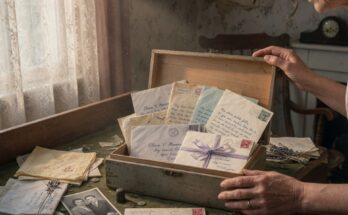
He reached into his jacket pocket and pulled out an old envelope. Inside was a faded photograph. He handed it to me first.
At first, I did not understand what I was seeing.
It was a street, alive with people. Storefronts lined both sides. A barber pole stood outside one shop. A grocery sign hung crookedly above another. Children stood near a corner, smiling at the camera. Men in work shirts leaned beside parked cars. Women walked with shopping bags in their hands.
It was not empty.
It was not forgotten.
It was a living place.
“Where is this?” I asked.
Mr. Arthur looked at me and said, “Downtown. Same block where the empty lot is now.”
I stared at the picture again, trying to match it with the cracked pavement and weeds I had passed a hundred times without thinking.
“How?” I whispered.
Mr. Arthur’s expression hardened.
“Eminent domain,” he said.
He explained that in the early 1960s, city officials declared the neighborhood “blighted.” They used clean words like redevelopment, progress, renewal, and modernization. Men in suits came with maps, notices, promises, and deadlines.
Families were given weeks to pack.
Weeks.
Some had lived there for generations. Some owned small businesses that fed their children. Some were elderly and had nowhere else to go. Some believed the city would help them relocate. Some believed they would be treated fairly.
Most were wrong.
“They bulldozed everything,” Mr. Arthur said. “Homes, shops, churches, memories. Everything.”
My aunt asked, “What did they build?”
Mr. Arthur gave a bitter smile.
“Nothing that lasted.”
That sentence stayed with me.
An entire neighborhood destroyed for progress, and progress never truly came.
That night, I could not stop thinking about the photograph. I kept seeing the children on the corner, the shop signs, the faces. I kept thinking about how many times I had walked past that empty lot without knowing I was walking past buried history.
The next morning, I went downtown.
I stood beside the lot and looked across the weeds, broken asphalt, and chain-link fence. Cars passed behind me. People hurried along the sidewalk. No one stopped. No one looked. To them, it was just unused land.
To me, it felt like a grave without a marker.
So I started digging.
First, I went to the city archives. I searched old maps, planning documents, property records, newspaper clippings, and council meeting notes. At first, I found almost nothing. Then I noticed the gaps.
Missing pages.
Changed street names.
Maps where entire blocks became blank between one year and the next.
Then I found the phrase repeated again and again: urban renewal.
It sounded harmless on paper.
But behind those words were real people.
I found a list of properties taken under eminent domain. Dozens of addresses. Hundreds of names. Families reduced to case numbers. Businesses reduced to parcels. Lives reduced to lines in a government file.
The more I read, the angrier I became.
This had not been a mistake.
It had been systematically destroyed.
People were told their homes were in the way of progress. They were offered payments too small to rebuild what they lost. Some moved to the edges of town. Some left completely. Some never recovered financially. Some never recovered emotionally.
I found an interview with an elderly woman who had lived there as a girl. She said her mother cried for weeks after they left. Not because the house was grand, but because it was theirs.
Another man said his father owned a small diner on that street. After the city took it, he tried to open somewhere else, but customers were scattered, money was gone, and his spirit broke before the business did.
One sentence from the archive stayed with me:
“We were not moved. We were removed.”
That was the truth.
Not redevelopment.
Removal.
A week later, I visited Mr. Arthur again. I brought copies of what I had found. He sat at his kitchen table, looking through the papers slowly.
“Now you see it,” he said.
“Why didn’t anyone fight?” I asked.
He looked up at me.
“They did. But they didn’t have the power.”
Then he told me what the documents did not say.
He told me about neighbors gathering in church basements, trying to understand the legal language. He told me about mothers begging for more time. He told me about old men standing in front of their shops until police told them to move.
He told me about my grandfather.
My grandfather had been young then. He worked at a hardware store on the edge of that neighborhood. He helped families load furniture onto trucks. He kept addresses in a notebook, hoping people would find each other again.
“He never got over it,” Mr. Arthur said. “He said a town can lose its soul one block at a time.”
I felt that sentence deep in my chest.
After that, I kept researching. I found more photographs. A church picnic. A ribbon cutting for a grocery store. A classroom of children from a school that no longer existed. A beauty shop with flowers painted on the window. A family standing proudly in front of a brick house they would later be forced to leave.
Each image made the empty lot feel less empty.
It became crowded with memory.
I began posting what I found online. At first, only a few people noticed. Then former residents and their children began commenting.
“My grandmother lived there.”
“My uncle owned that store.”
“I never knew why my family moved.”
“Please keep sharing.”
The story spread.
People started sending photographs from shoeboxes and attics. Receipts. Church programs. School pictures. Old business cards. A restaurant menu. A wedding invitation with an address from a street that no longer existed.
Piece by piece, the neighborhood returned.
Not physically.
But in memory.
And memory matters.
Because a place is not truly gone while someone still speaks its name.
Months later, I stood before the city council with copies of the photographs and a list of names. My voice shook, but I kept reading.
I asked for a historical marker at the empty lot. I asked for the records to be digitized. I asked for the story to be taught as part of local history.
Some officials looked uncomfortable.
Good.
Truth should make people uncomfortable when silence has been too comfortable for too long.
Mr. Arthur sat in the front row. When I finished, he did not clap. He only nodded once, slowly, as if something he had carried for sixty years had finally been placed on the table.
The council did not approve everything immediately. These things move slowly when the past embarrasses the present.
But they could no longer pretend they did not know.
And that mattered.
Today, when I pass the empty lot, I no longer see nothing.
I see the barber shop. I see the diner. I see the grocery store. I see children on the corner and families on porches. I see a neighborhood that was never allowed to grow old.
I see what was lost.
And I see what must be remembered.
Mr. Arthur told me something before he died.
He said, “They erased the buildings, but they couldn’t erase the people unless we let them.”
So I won’t let them.
I will keep the photograph.
I will keep the names.
I will keep telling the story.
Because history does not only belong in textbooks. Sometimes it lives under weeds, behind fences, inside old envelopes, and in the memory of one person brave enough to say:
“This happened here.”
Moral of the Story
History does not disappear simply because buildings are gone. Communities can be erased from maps, but they can be restored through memory, truth, and the courage to ask what happened. When we remember the people who were pushed aside, we give dignity back to lives that were never meant to be forgotten.