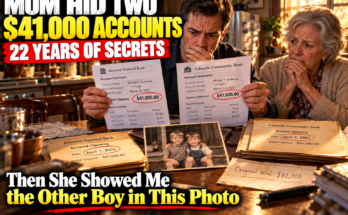
At Sunday dinner, my 72-year-old mother slipped me a $41,000 cashier’s check and whispered, “Your brother can’t know yet.” Hours later, I found an old photograph inside the envelope—dated three years before he was born.
Part 1
My mother had always been terrible at keeping surprises.
When we were children, she could barely hide Christmas presents without accidentally asking whether we preferred the blue bicycle or the red one. At birthdays, she smiled too much whenever she knew something we didn’t.
But that Sunday evening, when she placed a brown envelope beside my dinner plate, there was no smile on her face.
Mom was seventy-two then. Her silver hair was cut just below her ears, and she still wore the thin gold wedding band Dad had given her almost fifty years earlier.
My younger brother, Matthew, sat across from me.
“What’s that?” he asked.
Mom’s fingers remained on the envelope.
“Nothing important.”
Matthew laughed. “Then why are you giving it to Daniel?”
Mom looked at me.
That look made me stop smiling.
“Put it away,” she said.
I slid the envelope toward me.
Matthew returned to his dinner, talking about a contractor who had given him an absurd estimate for repairing his roof.
I barely listened.
The envelope felt unusually heavy in my lap.
When Matthew went into the kitchen for coffee, Mom leaned toward me.
“Don’t open it here.”
“Why?”
Her eyes moved toward the kitchen doorway.
“Your brother can’t know yet.”
I stared at her.
“Can’t know what?”
“Please, Daniel.”
Matthew returned before she could say anything else.
I left twenty minutes later.
At home, I put the envelope on my kitchen counter and stared at it.
My wife, Laura, was upstairs helping our daughter with homework. I could hear their voices through the ceiling.
Finally, I tore open the flap.
The first thing I pulled out was a cashier’s check.
I actually thought I had misread the number.
**$41,000.**
Payable to me.
I sat down.
Mom wasn’t wealthy. Dad had worked as a maintenance supervisor for a manufacturing company. Mom had spent most of her adult life working part-time in a school office.
They lived carefully.
Forty-one thousand dollars wasn’t an amount Mom casually handed anyone.
Beneath the check was a photograph.
It was faded around the edges, the colors washed into the warm orange tint old photographs sometimes develop.
Mom looked much younger.
She was standing outside the house where Matthew and I had grown up.
Beside her were two little boys.
One was unmistakably me.
The other looked like Matthew.
Not vaguely.
Not in the way relatives sometimes resemble one another.
He had Matthew’s dark hair, narrow chin, and slightly uneven smile.
I turned the photograph over.
A date was written there.
**May 1986.**
I checked it again.
Matthew was born in 1989.
Three years later.
My phone was already in my hand.
Mom answered after two rings.
“You opened it.”
“Who is the other boy?”
Silence.
“Mom?”
“You saw the date?”
“Yes.”
Another silence.
Then she said quietly, “Now you understand why the money had to go to you first.”
“No. I don’t understand anything.”
“Turn the photograph over again.”
“I did.”
“Look beneath the date.”
I carried the picture beneath the kitchen light.
There was another line of writing so faded I had missed it.
Four words.
And when I finally made them out, I stopped breathing for a moment.
**Daniel and Matthew — brothers.**
Part 2
I called Mom back immediately.
“You wrote Matthew’s name on this picture.”
“I know.”
“But Matthew wasn’t born.”
“I know.”
“Then who is that boy?”
Mom didn’t answer.
I could hear her breathing.
“Mom, who is he?”
“Come tomorrow.”
“No. Tell me now.”
“Daniel—”
“You handed me forty-one thousand dollars and a photograph of a child who looks exactly like my brother, with my brother’s name written on the back three years before he was born.”
Laura had come downstairs.
She stood in the doorway, watching me.
I lowered my voice.
“Tell me what this is.”
Mom finally said, “His name was Matthew.”
Was.
That single word changed the temperature of the room.
I sat down again.
“What do you mean?”
“Come tomorrow morning. Alone.”
She hung up.
Laura sat beside me.
I showed her the photograph.
She examined it for nearly a minute.
“That looks like your brother.”
“I know.”
“Could the date be wrong?”
“My mother just told me his name was Matthew.”
Laura looked at me.
“What?”
I showed her the check next.
She didn’t say anything for a while.
Then she asked the obvious question.
“What does forty-one thousand dollars have to do with this?”
I didn’t know.
The next morning, I arrived at Mom’s house before eight.
She had already made coffee.
On the dining table was a cardboard document box.
I recognized Dad’s handwriting on the side.
**FAMILY — PRIVATE**
Mom sat across from me.
“I should have told you years ago.”
“Then tell me now.”
She folded her hands.
“You were five when that photograph was taken.”
I looked at the boy again.
“He was six.”
“Who was he?”
Mom’s eyes filled.
“Your brother.”
I stared at her.
“You mean my half brother?”
“No.”
“My cousin?”
“No.”
“Then what?”
She touched the photograph.
“He was our son.”
For several seconds, I couldn’t understand the sentence.
“You had another child?”
“Yes.”
“And his name was Matthew?”
“Yes.”
“What happened to him?”
Mom looked toward the window.
“He didn’t stay with us.”
That answer made me angrier.
“What does that mean?”
She opened the box.
Inside were school records, letters, photographs and several old financial statements.
Mom pulled out a photograph of Dad holding the same boy beside a fishing pond.
Then another of me and the boy building something from wooden blocks.
“You knew him,” Mom said.
I laughed once, but there was no humor in it.
“I would remember having a brother.”
“You were five.”
“I remember kindergarten. I remember Dad’s old truck. I remember breaking my arm.”
“I know.”
“Why don’t I remember him?”
Mom’s face changed.
“Because after he left, your father removed almost everything connected to him.”
She handed me another photograph.
A birthday cake.
Two boys.
Six candles.
The boy named Matthew was blowing them out while I stood beside him.
“What happened?”
Mom looked down.
“His biological mother came back.”
I stared at her.
“Biological mother?”
And that was when Mom told me the boy in the photograph had never legally been theirs.
But Dad had spent years trying to make him so.
Then she pulled a yellowed court document from the box.
At the bottom was a surname I had never seen before.
Part 3
The boy’s full name had been **Matthew Ellis**.
Mom explained that his mother, Caroline Ellis, had been her younger cousin.
Caroline was twenty-one when Matthew was born and struggling to care for him.
For what was originally supposed to be several weeks, Matthew came to live with my parents.
Several weeks became months.
Then years.
By the time I was old enough to form memories, Matthew was simply my brother.
“He called us Mom and Dad,” Mom said. “He shared your room.”
“Why didn’t you adopt him?”
“We tried.”
She pushed the court papers toward me.
Caroline had initially agreed.
Then, shortly before the adoption was finalized, she changed her mind.
“She came back for him?”
“Yes.”
“After years?”
Mom nodded.
“What did Dad do?”
“Everything he legally could.”
The dispute lasted months.
Dad hired an attorney. Mom gathered school records, medical records and statements from teachers.
But Caroline was Matthew’s legal mother.
Eventually, she regained custody.
“How old was I?”
“Almost six.”
“And Matthew?”
“Seven.”
I looked again at the photograph.
“Did I understand?”
“You cried for weeks.”
That hurt in a way I couldn’t explain.
There was grief buried somewhere inside me that I didn’t remember experiencing.
Mom said Dad couldn’t bear hearing me ask when Matthew was coming home.
So photographs disappeared.
His toys disappeared.
His name disappeared.
Eventually, I stopped asking.
“That’s horrible.”
“I know.”
“You both lied to me.”
“Yes.”
“For almost forty years.”
“Yes.”
Mom didn’t defend herself.
That somehow made me less angry and more unsettled.
Then I remembered something.
“My brother.”
Mom knew immediately which brother I meant.
The Matthew I had grown up with.
The Matthew born in 1989.
“Why did you give him the same name?”
Mom’s fingers tightened around her coffee cup.
“Your father chose it.”
“Why?”
“He said he wasn’t ready to lose the name too.”
I stood and walked toward the window.
Suddenly, ordinary pieces of childhood felt different.
Why Dad sometimes became unusually emotional on Matthew’s birthday.
Why there were almost no family photographs from 1986 through 1988.
Why Grandma once called my brother “Matty” and then corrected herself even though everyone called him Matt.
I turned back.
“Does Matthew know?”
“No.”
“Why?”
“Your father refused.”
“Why?”
Mom reached into the box again.
This time she pulled out a bank statement.
The account had been opened in 1987.
The balance on the final statement was almost exactly **$82,000**.
I looked at the cashier’s check Mom had given me.
Forty-one thousand.
Half.
“What’s this?”
“Your father started saving for the first Matthew after he left.”
“Why?”
“He hoped one day Matthew would find us.”
“And did he?”
Mom didn’t answer immediately.
Then she reached deeper into the box and removed a stack of unopened envelopes held together by a rubber band.
Every envelope had been addressed to Dad.
The oldest was nearly twenty years old.
The newest had arrived eleven months before Dad died.
The sender was:
**Matthew Ellis.**
Part 4
I picked up the newest letter.
“Dad knew where he was?”
“For years.”
My anger returned instantly.
“You just said Dad hoped he’d find us.”
“He did.”
“And when Matthew finally found him?”
“Your father wouldn’t let him back into our lives.”
I stared at her.
“Why?”
“Read the first letter.”
The envelope had already been opened.
Inside was a handwritten note.
Matthew said he had found Dad through an old business directory.
He remembered us.
He remembered me.
He remembered the bedroom we had shared.
He even remembered the wooden train set Dad built.
The final paragraph was short.
He wanted to see us.
Especially me.
I looked at Mom.
“What did Dad say?”
“He met him.”
“Without telling you?”
“I knew.”
“Without telling me?”
“Yes.”
I dropped the letter onto the table.
“Why?”
“Because by then your brother Matthew was twelve.”
I understood the distinction she was making.
Dad had one Matthew from his past and another growing up in his house.
“He thought telling us would hurt Matt?”
“He was afraid it would change everything.”
“That wasn’t his decision to make.”
“No.”
Mom’s answer came immediately.
“He was wrong.”
That stopped me.
Mom rarely criticized Dad.
“Then why didn’t you tell us?”
“Because I was afraid too.”
She explained that Dad met Matthew Ellis several times over the years.
He had grown up mostly in another state.
His relationship with Caroline had been complicated.
He had married, had children and built a stable life.
But he never stopped thinking of my parents as family.
“Did he ask about me?”
“Every time.”
I closed my eyes.
Mom pushed another envelope toward me.
This one had my name written across the front.
Not Dad’s.
Mine.
“He gave this to your father sixteen years ago.”
I opened it.
Inside was a photograph of a man in his late twenties holding a baby.
On the back:
**For Daniel. This is my daughter, Emma. I wish you knew she existed. — Matt**
I couldn’t speak.
Then another thought occurred to me.
“The forty-one thousand.”
Mom nodded.
“The account eventually reached a little over eighty-two thousand. Your father left instructions that half belonged to you.”
“And the other half?”
“To Matthew Ellis.”
“Why me?”
“Because Dad believed the two of you had lost something together.”
I shook my head.
“No. If the money was for him, give him all of it.”
“That’s not what your father wanted.”
“I don’t care.”
Mom looked at me carefully.
“The money isn’t why I finally told you.”
“Then why now?”
She took her phone from the table.
There was a message open.
It had arrived four days earlier.
I read it.
**Mrs. Carter, this is Emma Ellis. My father has asked me to contact you. He doesn’t know how much time he has, and there is something he wants Daniel to know.**
I looked up.
“What does she mean, how much time?”
Mom’s eyes filled again.
“Matthew is very sick.”
Part 5
For the next hour, I barely spoke.
I read every letter Dad had kept.
Some were short.
Some were angry.
Some were forgiving.
Matthew wrote about getting married.
About becoming a father.
About buying his first house.
About losing his mother.
About wondering whether I remembered him.
One letter was written after Dad told him I had gotten married.
Matthew congratulated me.
Then he wrote:
**I won’t come. I understand why you don’t want me there. But please tell Daniel someday that I never forgot him.**
Dad never told me.
I remembered my wedding clearly.
Dad had been unusually quiet that morning.
At the time, I thought he was emotional because his oldest son was getting married.
Now I wondered whether there had been another reason.
“Did Dad invite him?”
“No.”
“Did Matthew ask?”
“Yes.”
I pushed the letters away.
Laura called twice.
I didn’t answer.
Mom sat quietly.
Finally, I asked, “Where is he?”
“About four hours away.”
“Can I speak to him?”
“I think that’s what Emma wants.”
I called the number.
A woman answered.
“Hello?”
“Is this Emma?”
“Yes.”
“My name is Daniel Carter.”
Silence.
Then she exhaled.
“Oh.”
That one sound told me she knew exactly who I was.
“You know about me?”
“My whole life.”
I closed my eyes.
“How is your father?”
“He’s home.”
“Can he talk?”
“Yes.”
“Can I speak to him?”
Emma hesitated.
“I think he’d rather see you.”
I looked at Mom.
“Today?”
“If you can.”
Four hours later, I was standing outside a modest brick house in a town I had never visited.
Mom had offered to come.
I told her I needed to do it alone.
Emma opened the door.
She was in her early thirties.
The moment I saw her, something about her eyes felt familiar.
“Daniel?”
“Yes.”
She hugged me.
I wasn’t expecting it.
“Dad has talked about you forever.”
She led me through the house.
Family photographs covered the hallway.
Then I saw one that made me stop.
It was a copy of the same photograph Mom had given me.
Two boys.
Me and Matthew.
May 1986.
“He kept that?”
Emma smiled sadly.
“It’s probably his favorite picture.”
She led me into a quiet room.
A man sat near the window.
He was thinner than I expected.
His hair was gray.
But the face was unmistakable.
Not because he looked like my younger brother.
He didn’t, not really.
He looked like the little boy in the photograph grown older.
He looked at me for a long time.
Then he smiled.
“You got old.”
I laughed before I could stop myself.
“So did you.”
His eyes filled.
“Do you remember me?”
I wanted to say yes.
I wanted that more than anything.
But I couldn’t lie.
“No.”
Matthew nodded.
“I figured.”
Then he reached toward the small table beside him.
There was an old wooden toy train sitting there.
“I thought this might help.”
The instant I saw it, something moved inside my memory.
Not a complete scene.
A voice.
A bedroom.
Two boys whispering after bedtime.
And one sentence I hadn’t heard in nearly forty years.
**Don’t tell Mom we’re still awake.**
Part 6
I picked up the train.
One wheel had been repaired with a tiny brass pin.
“I remember this.”
Matthew’s expression changed.
“You do?”
“Not everything.”
I turned it over.
Dad had carved our initials underneath.
**D + M**
I sat beside him.
For the next two hours, Matthew filled in pieces of my childhood.
We used to build forts behind the couch.
He hated peas.
I was afraid of thunderstorms.
He once convinced me that the attic contained buried treasure.
I broke his favorite toy truck and blamed the dog.
Some memories returned as feelings before images.
Others didn’t return at all.
But I believed him.
Then I asked the question that had been waiting since morning.
“Why did Dad keep you away?”
Matthew looked toward the window.
“He thought he was protecting everyone.”
“That doesn’t make it right.”
“No.”
“Were you angry?”
“For a long time.”
“At him?”
“At everybody.”
He told me that after Caroline regained custody, she moved repeatedly.
For years, contact with my parents was inconsistent.
By adulthood, Matthew understood more about the legal fight.
He found Dad.
Dad apologized.
They began meeting occasionally.
“But he wouldn’t tell Daniel,” Matthew said.
“Because of my younger brother?”
“That was part of it.”
“What was the other part?”
Matthew hesitated.
“Your dad blamed himself for what happened.”
“For losing you?”
“For something before that.”
I waited.
Matthew looked toward Emma.
She quietly left the room.
“When my mother first asked your parents to take me, she wasn’t just struggling financially.”
I said nothing.
“She had borrowed money from people she shouldn’t have.”
This was the first detail Mom hadn’t mentioned.
“Your dad paid it.”
“How much?”
“Forty-one thousand dollars.”
I stared at him.
The same amount as my check.
“In 1986?”
Matthew nodded.
“That was a fortune then.”
“Yes.”
“Why?”
“To give my mother a chance to start over.”
Dad had drained savings, borrowed against the house and taken extra shifts.
He believed Caroline would stabilize.
Instead, once she recovered, she wanted Matthew back.
Dad felt as though the money had helped make it possible for her to leave and reclaim him.
“So the account?”
“He started rebuilding the forty-one thousand.”
“For you?”
“For both of us, apparently.”
Matthew smiled faintly.
“Your father had complicated ideas about guilt.”
I thought of the check in my kitchen.
Forty-one thousand for me.
Forty-one thousand for Matthew.
A financial monument to the amount Dad had once spent trying to save a family.
“Why didn’t Mom tell me this?”
“Maybe because there’s another part.”
Of course there was.
Matthew reached into a drawer.
He pulled out a sealed envelope.
Dad’s handwriting was on it.
**FOR DANIEL AND MATTHEW — TOGETHER**
“My father gave you this?”
“Six months before he died.”
“Why didn’t you open it?”
“He told me not to.”
“Until?”
Matthew looked at me.
“Until you came looking for me.”
Part 7
The envelope contained three pages.
Dad began with an apology.
Not the polished kind people write when they want forgiveness.
It was messy.
Specific.
Painful.
He admitted that removing Matthew from our family history had been cowardly.
He said he had convinced himself children forgot easily.
Then, when I actually did stop asking about Matthew, Dad realized what he had done.
By then, he was afraid reopening the past would hurt me again.
When my younger brother was born, Dad suggested the name Matthew.
Mom initially refused.
Dad wrote:
**I told myself I was honoring the boy we lost. Looking back, I understand how unfair that was to both Matthews. One deserved to be remembered as himself. The other deserved a name untouched by my guilt.**
I had to stop reading.
Matthew looked away.
The second page explained the money.
Dad had tracked every dollar he spent resolving Caroline’s debts.
The total had been just over $41,000.
After Matthew left, Dad opened a savings account.
Over decades, it grew.
He eventually decided the money should be divided equally between us.
Not as compensation.
Not as inheritance.
As a choice.
**Use it together. Give it away. Burn the statements and never discuss me again if that’s what you need. But make the decision together. I made too many decisions for both of you.**
I read that sentence twice.
The final page was addressed directly to me.
Dad wrote that Matthew had asked about me for years.
He admitted he had intercepted letters.
He admitted he had refused Matthew permission to attend my wedding.
My chest tightened.
Then came the line that changed what I thought I knew.
**He came anyway.**
I looked up.
Matthew’s eyes were wet.
“You were at my wedding?”
He nodded.
“Dad said you weren’t invited.”
“I wasn’t.”
“But you came?”
“I stood at the back of the church.”
Suddenly, I remembered something.
A man standing near the doorway.
Someone I assumed was connected to Laura’s family.
He left before the reception.
“You saw me?”
“I saw you.”
“Why didn’t you talk to me?”
“Because your dad found me first.”
I looked down at the letter.
Dad had written about it.
He saw Matthew before the ceremony and asked him to leave.
Matthew agreed on one condition.
He wanted to see me get married.
Dad allowed him to stand at the back.
Afterward, Matthew left without introducing himself.
I felt angry at Dad.
Then angry at Matthew.
Then guilty for being angry at either of them.
“You should have told me.”
“I know.”
“You were an adult.”
“I know.”
“You didn’t need his permission.”
“No.”
“Then why?”
Matthew looked at the old train.
“Because some part of me was still seven years old, waiting for your father to tell me I could come home.”
That answer destroyed whatever argument I had prepared.
Then Matthew told me there was one person who still didn’t know any of this.
My younger brother.
The other Matthew.
And before we decided what to do with Dad’s money, he wanted to meet him.
Part 8
I drove home that evening with Dad’s letter on the passenger seat.
Mom was waiting.
I didn’t yell.
That surprised both of us.
“You left out the forty-one thousand.”
She nodded.
“And the wedding.”
Another nod.
“And Dad’s letter.”
“I didn’t know Matthew still had it.”
“You knew it existed.”
“Yes.”
I sat opposite her.
“Why did you give me the check before telling me?”
“Because I was afraid you’d refuse to hear the story.”
“So you used forty-one thousand dollars to get my attention?”
A tiny, exhausted smile appeared.
“It worked.”
I almost laughed.
Almost.
Then I told her Matthew wanted to meet my younger brother.
Mom’s face changed.
“No.”
“Why?”
“He doesn’t know.”
“That’s exactly the problem.”
“You don’t understand what this could do to him.”
“He’s thirty-seven, Mom.”
“He grew up believing that name was chosen for him.”
“It was.”
“Not entirely.”
There it was.
The real fear.
My younger brother had spent his life carrying the name of a child our parents had erased.
I called him anyway.
“Can you come over?”
“Why?”
“Mom and I need to tell you something.”
“Is this about that envelope?”
“Yes.”
He arrived thirty minutes later.
Mom tried to begin.
She couldn’t.
So I placed the photograph in front of him.
He stared at it.
“That’s creepy.”
“What?”
“That kid looks like me.”
I told him the date.
His smile disappeared.
Then I told him everything.
Not all at once.
Slowly.
The first Matthew.
Caroline.
The custody dispute.
Dad removing the photographs.
The second pregnancy.
His name.
When I finished, my brother sat completely still.
Finally, he asked Mom:
“You named me after him?”
Mom began crying.
“Your father did.”
“And you agreed.”
“Yes.”
“Did Dad wish I was him?”
“No.”
“Mom.”
“No.” She reached toward him. “Never. You were our son. You were never a replacement.”
He stood.
“Then why didn’t you tell me?”
Mom had no answer that could fix it.
My brother walked outside.
I followed.
He stood beside his car.
“There’s more,” I said.
He laughed bitterly.
“Of course there is.”
“He wants to meet you.”
“Who?”
“The first Matthew.”
My brother looked at me.
“He’s alive?”
“Yes.”
I hadn’t realized until that moment that I had avoided mentioning Matthew’s illness.
“He’s not well.”
My brother’s anger softened.
“How bad?”
“Bad enough that we shouldn’t wait.”
He looked through the window at Mom.
Then back at me.
“When?”
“Whenever you’re ready.”
He opened his car door.
“Tomorrow.”
Part 9
The drive took four hours.
My brother barely spoke during the first two.
Then he asked:
“What do I call him?”
“Matthew.”
“That’s going to be confusing.”
Despite everything, we both laughed.
It helped.
Emma opened the door when we arrived.
The first Matthew was in the same chair by the window.
My brother stopped when he saw him.
For a strange moment, nobody spoke.
Then the older Matthew smiled.
“I’ve heard you’ve been borrowing my name.”
My brother blinked.
Then laughed.
“Apparently.”
That broke the tension.
They talked for nearly an hour.
The older Matthew wanted to know about our childhood.
My brother wanted to know about his.
Eventually, the conversation turned to Dad.
My brother asked the question I’d expected.
“Did he love you?”
Matthew answered without hesitation.
“Yes.”
“Did he love me?”
“Yes.”
“How can you know?”
“Because every time he talked about you, his face changed.”
My brother looked down.
Matthew continued.
“He made mistakes because he was afraid of losing people. That doesn’t excuse them. But don’t turn yourself into one of his mistakes. Your name belongs to you.”
My brother’s eyes filled.
Then Matthew handed him something.
A photograph.
Dad and Matthew fishing together years after Matthew had become an adult.
On the back Dad had written:
**My first Matthew.**
My brother stared at it.
“That hurts more than I expected.”
“I know.”
Matthew reached for another photograph.
This one showed Dad holding my younger brother as a baby.
On the back:
**My Matthew, home at last.**
My brother covered his mouth.
Dad had preserved both photographs.
Two boys.
One name.
Two different kinds of love tangled inside one man’s guilt.
Before we left, I asked Matthew about the money.
“What do you want to do with your forty-one thousand?”
He smiled.
“Emma doesn’t need it.”
“That wasn’t my question.”
“I know.”
He looked toward my brother.
“Maybe neither of us should keep it.”
I understood.
Dad’s original forty-one thousand had been spent trying to hold a family together.
The eighty-two thousand he later saved had become another attempt to repair the past with money.
Maybe the best way to end that pattern was not to divide it.
“What are you thinking?”
Matthew told us.
My younger brother immediately agreed.
So did I.
There was only one person left to tell.
Mom.
And when we returned home and explained what we planned to do with Dad’s $82,000, she opened the old document box one last time.
“I think,” she said, “you need to see what your father was saving this for.”
Then she pulled out a folder none of us had seen.
Part 10
The folder contained plans.
Dad had researched a small scholarship program for children being raised by relatives who were not their biological parents.
Grandparents raising grandchildren.
Aunts raising nieces.
Older siblings raising younger siblings.
Families formed by circumstance rather than paperwork.
He had never created it.
Perhaps he was too embarrassed by the story behind it.
Perhaps he ran out of time.
At the top of the first page, he’d written a possible name:
**The Two Brothers Fund.**
My younger brother stared at it.
“You’ve got to be kidding.”
Mom smiled through tears.
“He was never good at names.”
That made all three of us laugh.
Even in death, Dad somehow managed to be painfully sentimental.
We used the $82,000 to establish a small educational fund.
Not because it erased what Dad had done.
It didn’t.
Money couldn’t return the years Matthew and I lost.
It couldn’t undo Mom’s silence.
It couldn’t give my younger brother a childhood untouched by a secret he never knew he was carrying.
But it could become something better than guilt.
Matthew lived long enough to see the first award made.
A seventeen-year-old girl being raised by her aunt received help toward community college.
Emma sent us a photograph of Matthew holding the acceptance letter.
He looked thinner.
But he was smiling.
He died several months later.
At his memorial, I stood beside my younger brother.
Two Matthews had shaped my life.
Only one had grown up beside me.
But both were my brothers.
Emma gave me the wooden train after the service.
It sits on a shelf in my house now.
Underneath are Dad’s carved initials:
**D + M.**
Sometimes people ask what they mean.
For years, my family believed secrets protected people.
Dad protected me from grief.
Mom protected my brother from comparison.
Matthew protected Dad from confrontation.
Everyone was protecting someone.
And all that protection cost us decades.
Now, when someone asks about the train, I tell them.
I tell them I had a brother before the brother I remembered.
I tell them my parents loved a child they couldn’t keep.
I tell them fear made good people make painful choices.
And I tell them about a Sunday dinner when my seventy-two-year-old mother handed me a $41,000 cashier’s check and whispered that my brother couldn’t know.
She was wrong about that too.
He needed to know.
We all did.
Because the most valuable thing inside that envelope wasn’t the check.
It was the photograph.
For almost forty years, it had preserved something our family had tried to erase:
Two little boys standing beside their mother.
One was me.
The other was my brother.
And this time, nobody was going to remove him from the picture.