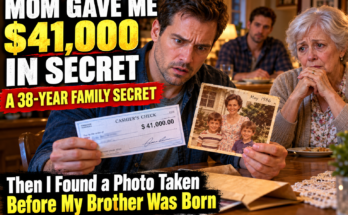
I found two secret accounts in Mom’s name at different banks, each holding exactly $41,000 and opened 22 years earlier. Mom admitted someone had given her $82,000 to divide equally—then showed me a childhood photograph containing a second little boy I didn’t recognize.
Part 1
I found the first $41,000 account on a Tuesday afternoon.
I found the second one less than an hour later.
That was when I stopped believing it was a coincidence.
Mom was seventy-four and preparing to move from the house where she’d lived for thirty-seven years into a smaller condominium.
Nothing was wrong with her health.
She was simply tired of stairs, gutters, lawn care, and paying to heat rooms she no longer used.
My name is Daniel Parker.
I’m forty-one.
As the oldest of Mom’s two children, I volunteered to help organize her finances before the move.
My younger sister, Emily, handled furniture.
I got paperwork.
At first, everything was ordinary.
Checking account.
Savings.
Pension.
Insurance.
Then I found a statement from **Commonwealth Savings Bank**.
Mom had never mentioned having an account there.
Balance:
**$41,000.00**
Not $41,013.
Not $40,982.
Exactly:
**$41,000.00**
The account had been opened twenty-two years earlier.
I assumed it was an old certificate of deposit or emergency savings.
Then, buried inside another folder, I found a statement from **North County Bank**.
Different institution.
Different account number.
Same opening year.
Same balance.
**$41,000.00**
I walked into the kitchen carrying both statements.
Mom was wrapping coffee cups in newspaper.
“What’s this?”
She glanced at the papers.
Her hands stopped moving.
That was enough.
“You know about them.”
“Of course I know about them.”
“Why do you have two separate accounts with exactly forty-one thousand dollars?”
She returned to the cup.
“They’re savings.”
“Mom.”
“What?”
“Exactly the same amount?”
“Yes.”
“At different banks?”
“Yes.”
“Opened the same year?”
She didn’t answer.
I sat down.
“Twenty-two years ago someone gave you eighty-two thousand dollars, didn’t they?”
Her eyes lifted.
That had been a guess.
Her expression confirmed it.
“Who?”
Mom placed the cup down.
“Daniel, there are some things I intended to explain eventually.”
I almost laughed.
“I’m forty-one. How eventual were you planning?”
She didn’t appreciate that.
For several seconds, she stared through the kitchen window.
Finally:
“Yes. Someone gave me eighty-two thousand dollars.”
“Who?”
“A man you knew.”
“Why did he give it to you?”
“He told me to divide it equally.”
“Between what?”
Mom corrected me.
“Between whom.”
That single word changed the conversation.
I looked again at the two statements.
“Who are the accounts for?”
“One was for you.”
My stomach tightened.
“And the other?”
Mom stood.
Without another word, she walked upstairs.
She returned carrying an old photograph.
The colors had faded.
Two little boys sat on a wooden porch.
One was unmistakably me.
Maybe six years old.
Skinny legs.
Striped shirt.
Missing front tooth.
Beside me sat another boy.
About my age.
Maybe slightly older.
He had one arm around my shoulder.
We looked happy.
Comfortable.
Like children who knew each other well.
I turned the photograph over.
On the back:
**Daniel & Matthew — Summer 1991**
“Who’s Matthew?”
Mom sat across from me.
Her eyes filled.
“You really don’t remember him?”
“No.”
She looked at the photograph for a long time.
Then she said:
“Matthew was your brother.”
Part 2
I thought I’d misunderstood.
“My what?”
“Your brother.”
“I don’t have a brother.”
“You did.”
The room became very quiet.
Mom immediately clarified something important.
Matthew wasn’t another child she had secretly given birth to.
He wasn’t Dad’s son from an affair.
He wasn’t my biological brother.
“Then why are you calling him my brother?”
“Because that’s what you called each other.”
Matthew was the son of Mom’s older sister, Rebecca.
Aunt Rebecca.
That name I knew.
But only barely.
She died when I was seven.
I remembered adults talking about her.
I remembered Mom crying.
I remembered a funeral dress that scratched my neck.
I did not remember Matthew.
“Rebecca had a son?”
“Yes.”
“Why has nobody ever told me?”
Mom closed her eyes.
“Because after she died, everything became complicated.”
Matthew was eighteen months older than me.
Aunt Rebecca raised him alone.
His father had left when Matthew was a baby.
Because Mom and Rebecca lived only fifteen minutes apart, Matthew and I grew up together.
Weekends.
Birthdays.
Summer afternoons.
Sleepovers.
Mom had photographs.
Dozens.
She’d packed most away after Rebecca died.
“Why don’t I remember him?”
“You do. You just don’t know those memories are Matthew.”
She reminded me of a boy I used to call Matt.
Suddenly fragments appeared.
A red bicycle.
Plastic dinosaurs.
Someone sleeping on the floor beside my bed.
Two children building a fort behind Dad’s garage.
I had always assumed those memories belonged to neighborhood friends.
Mom placed more photographs on the table.
There we were.
Again and again.
Daniel and Matthew.
Not brothers by blood.
But close enough that six-year-old me apparently introduced him that way.
“What happened to him?”
After Rebecca died, Matthew’s biological father returned.
His name was **Paul Mercer**.
He had legal parental rights.
Within three months, he took Matthew and moved out of state.
Mom tried to remain in contact.
At first, letters came.
Then fewer.
Eventually none.
Paul remarried.
Addresses changed.
Phone numbers changed.
Matthew disappeared from our lives.
“How does this connect to eighty-two thousand dollars?”
Mom looked at the photograph.
“Because the money came from your grandfather.”
Grandpa Walter.
Mom and Rebecca’s father.
He died twenty years ago.
Two years before his death, he gave Mom $82,000.
His instruction was simple.
**$41,000 for Daniel.**
**$41,000 for Matthew.**
“Why you and Matthew?”
“Because you were the two oldest grandchildren.”
“What about Emily?”
“She wasn’t left out.”
Grandpa later created a separate education account for her.
The $82,000 had a different purpose.
“What purpose?”
Mom hesitated.
“Grandpa believed he owed Matthew something.”
“Why?”
Her eyes dropped.
“Because Grandpa was the reason Matthew’s father came back.”
Part 3
After Aunt Rebecca died, Grandpa Walter contacted Paul Mercer.
Mom had begged him not to.
Rebecca hadn’t spoken to Paul for years.
According to Mom, Paul had provided almost no support.
But Grandpa believed a child belonged with his surviving biological parent.
“He thought he was doing the right thing.”
“Did you?”
“No.”
Mom and Dad had offered to take Matthew.
They were prepared to raise him with me.
Matthew already spent half his time at our house.
But Grandpa insisted Paul had a right to know.
So he called him.
Paul arrived.
Then he took Matthew.
“Grandpa regretted it?”
“For the rest of his life.”
Paul didn’t allow much contact.
Grandpa sent birthday cards.
Most were returned.
He hired someone once to locate them after they moved.
Mom became angry with him.
“Why?”
“Because I thought he was making everything worse.”
The family fractured.
Grandpa blamed himself.
Mom blamed Grandpa.
Dad tried to keep everyone calm.
And Matthew, the person at the center, was a child with no control over any of it.
Years passed.
Then, twenty-two years ago, Grandpa came to Mom’s house carrying a cashier’s check.
**$82,000.**
“Where did he get it?”
“He sold some land.”
The land had belonged to Mom’s grandparents.
Grandpa could have kept the proceeds.
Instead, he divided part of it between me and Matthew.
“He said half was yours because you were his grandson.”
“And Matthew’s?”
Mom looked at me.
“He said Matthew’s half was because he had failed him.”
Mom tried to refuse.
Grandpa insisted.
But he imposed one rule.
The money had to remain separate.
One account for me.
One for Matthew.
Mom couldn’t combine them.
Couldn’t use Matthew’s money for me.
Couldn’t give it to Emily.
Couldn’t treat it as hers.
“What if you never found Matthew?”
“That was the problem.”
Grandpa told her to keep looking.
For twenty-two years, Mom had done exactly that.
At first she searched through relatives.
Then public directories.
Later social media.
She found several Matthew Mercers.
None matched.
Paul Mercer appeared to have disappeared too.
“So you kept forty-one thousand dollars untouched for someone you haven’t seen since he was a child?”
“Yes.”
“What about my account?”
“Same.”
“Why?”
“Because I couldn’t give you yours without explaining his.”
That stunned me.
“You could have.”
“I know.”
“Then why didn’t you?”
Mom gave the same answer parents seem to give when they know their reasoning no longer makes sense.
“I thought I was protecting you.”
“From what?”
“From losing him twice.”
I didn’t understand.
She explained.
After Matthew left, I asked about him constantly.
When was Matt coming home?
Why couldn’t we visit?
Could he come to my birthday?
Mom kept promising we’d see him again.
Then I stopped asking.
Apparently I became anxious whenever adults mentioned him.
A counselor told my parents not to force conversations I wasn’t ready for.
Over time, Matthew became something the family stopped mentioning.
Not intentionally at first.
Then silence became habit.
I stared at the photograph.
“I forgot my own cousin.”
Mom corrected me softly.
“You forgot his name. I don’t think you forgot him.”
Then she pulled out another document.
A letter.
It was addressed to me.
The handwriting wasn’t Grandpa’s.
It wasn’t Mom’s.
The return address was twenty-one years old.
The sender:
**Matthew Mercer.**
“You had a letter from him?”
Mom nodded.
“Why didn’t you give it to me?”
“Because it never arrived while the address was valid.”
“What does that mean?”
“Your grandfather found it after Matthew had already disappeared again.”
I opened it.
Matthew had been seventeen when he wrote it.
The first line said:
**Daniel, I don’t know if you remember me, but I remember everything.**
Part 4
Matthew remembered the fort behind our garage.
The red bicycle.
The dinosaurs.
The porch in the photograph.
He remembered me calling him my brother.
He remembered leaving.
He wrote:
**Dad said Aunt Linda didn’t want me anymore. I never believed him.**
Mom covered her mouth.
“Paul told him that?”
“Apparently.”
Matthew wrote that his father had repeatedly claimed Mom and Dad were relieved not to have another child to support.
It wasn’t true.
Mom and Dad had fought to maintain contact.
Paul blocked it.
Matthew didn’t know.
At seventeen, he found an old birthday card from Grandpa.
The address led him to our town.
He wrote the letter.
But before Grandpa could respond, Matthew and Paul moved again.
“How did Grandpa get the letter?”
“It was mailed to his old business address. It was forwarded months later.”
Grandpa tried to find Matthew.
Failed.
Then he gave Mom the $82,000.
The timing suddenly made sense.
Matthew’s letter revived Grandpa’s guilt.
He wanted money waiting if Matthew ever returned.
The letter ended:
**If Daniel remembers me, tell him I never stopped calling him my brother.**
I couldn’t finish reading aloud.
For the first time, the $41,000 account felt irrelevant.
I wanted to find Matthew.
Twenty-two years had passed.
He would be forty-two or forty-three.
Mom had searched unsuccessfully.
Technology had changed.
Records had changed.
We started again.
Emily helped.
We found dozens of people.
Wrong ages.
Wrong parents.
Wrong states.
Then Emily discovered something.
A legal name-change record from fifteen years earlier.
**Matthew Paul Mercer** had changed his surname.
New name:
**Matthew Paul Reynolds.**
Reynolds was his stepmother’s maiden name.
We searched again.
This time we found him.
He lived in Colorado.
Married.
Two children.
Worked as a high-school science teacher.
There was a staff photograph.
I stared at it.
Older.
Beard.
Glasses.
But the eyes were the same as the little boy beside me on the porch.
Mom began crying.
“That’s him.”
We found a public school email address.
I wrote the message five times before sending it.
Finally:
**My name is Daniel Parker. My mother is Linda Parker. Rebecca was her sister. I think you and I knew each other when we were children.**
I attached the photograph.
His response arrived forty-seven minutes later.
Only one sentence.
**Danny, I’ve been waiting thirty-five years for someone from your family to find me.**
Part 5
Matthew called that evening.
The first few minutes were awkward.
What do you say to someone who was once close enough to be your brother but is now essentially a stranger?
He solved it.
“Do you still hate tomatoes?”
I laughed.
Apparently I had refused to eat them as a child.
“You remember that?”
“You used to hide them under your mashed potatoes.”
Something inside me shifted.
Memory returned through tiny details.
Matthew hated thunderstorms.
He broke his arm falling from our backyard tree.
He called my dad Uncle James.
He stole the blue dinosaur because he insisted it was his.
“It was mine,” he said.
“Absolutely not.”
We laughed.
Mom cried silently beside me.
Then Matthew asked about her.
“Is Aunt Linda there?”
Mom took the phone.
“Hi, sweetheart.”
Matthew stopped speaking.
Then we heard him crying.
“Aunt Linda?”
“Yes.”
“I thought you didn’t want me.”
Mom broke.
For more than thirty years, Matthew had believed a lie.
She told him everything.
The calls.
The letters.
The searches.
Grandpa.
The $82,000.
Matthew became quiet.
“Money?”
Mom explained the two accounts.
“One is yours.”
“No.”
“Yes.”
“I don’t want it.”
I almost laughed.
Apparently refusing unexpected family money was universal.
“Matthew, Grandpa left it for you.”
“He already spent enough years feeling guilty.”
“The money has been waiting twenty-two years.”
“Then give it to your kids.”
“No.”
“Daniel—”
“I’m not taking your forty-one thousand dollars.”
There was silence.
Then Matthew laughed.
“You still argue exactly the same way.”
“I don’t remember arguing with you.”
“I do.”
The reunion happened six weeks later.
Matthew flew in with his wife, Karen.
His children were in college and couldn’t come.
Mom waited at the airport.
The moment Matthew appeared, she recognized him.
No hesitation.
She walked toward him.
He dropped his bag.
They embraced.
I stayed back.
Then Matthew looked at me.
For a second, neither of us knew what to do.
Finally he smiled.
“My dinosaur.”
I laughed.
“You stole it.”
We hugged.
That evening, Mom brought out the box of photographs.
Matthew knew almost every one.
He remembered Dad.
Grandpa.
Rebecca.
He had only a few photographs of his mother.
Mom gave him dozens.
That mattered more than the bank account.
Then Matthew saw the original porch photograph.
He turned it over.
**Daniel & Matthew — Summer 1991.**
“I remember this day.”
“What happened?”
“Grandpa took the picture.”
Mom looked surprised.
“No, James did.”
Matthew shook his head.
“Grandpa.”
He was certain.
Then he said something stranger.
“There’s another version.”
“What?”
“Grandpa took two pictures.”
Nobody knew what he meant.
Matthew remembered one photograph of us sitting on the porch.
Then another with Grandpa sitting between us.
Mom had never seen it.
Matthew thought his father had taken it when he left.
If that second photograph still existed, it might be among Paul’s belongings.
“Is your father alive?” I asked.
Matthew looked down.
“Yes.”
That surprised everyone.
“Do you talk to him?”
“Not for twelve years.”
“Does he know you’re here?”
“No.”
Then Matthew told us why they’d stopped speaking.
It wasn’t because of childhood.
It was because Matthew had discovered that Paul possessed something Grandpa had sent decades earlier.
Not photographs.
Money.
A check.
Amount:
**$41,000.**
Part 6
Grandpa had tried to give Matthew $41,000 long before Mom opened the second account.
The check was dated twenty-three years earlier.
One year before the $82,000 gift.
Grandpa mailed it to Paul with a letter saying the money belonged to Matthew and should be held for him.
Paul never gave it to Matthew.
“Did he cash it?”
“No.”
That was the strange part.
Matthew found the uncashed cashier’s check in Paul’s safe twelve years earlier.
By then it was long stale.
He confronted his father.
Paul claimed he hadn’t trusted Grandpa.
He thought the money was an attempt to interfere in their family.
“So he kept it?”
“Yes.”
“Why not return it?”
Matthew didn’t know.
Paul kept the check and letter hidden.
When Matthew found them, the argument reopened everything.
Paul admitted he’d blocked many of Mom’s letters.
He admitted telling Matthew we didn’t want him.
“Why?”
“He was afraid I’d choose you.”
Mom looked devastated.
Paul had returned after Rebecca’s death wanting to become Matthew’s father.
But instead of trusting the relationship, he tried to erase the competing family.
He moved.
Blocked contact.
Changed addresses.
Eventually encouraged Matthew to take the Reynolds surname.
Matthew said:
“He wanted a clean beginning.”
Mom whispered:
“He gave you one by cutting off half your life.”
Matthew nodded.
After their confrontation, he stopped speaking to Paul.
But he kept Grandpa’s old letter.
He’d brought a copy.
Grandpa had written:
**This money is not payment for Rebecca. Nothing could be. It is not payment for Matthew either. I want him to know there is still a place for him here.**
The $41,000 wasn’t guilt money.
It was a bridge.
Paul never delivered it.
When the check went uncashed, Grandpa eventually realized something was wrong.
That was likely why he changed his strategy.
He sold land.
Gave Mom $82,000.
Half for me.
Half for Matthew.
This time, he placed the money with someone he trusted.
Mom.
Two accounts.
Two banks.
Exactly $41,000 each.
Grandpa wanted symmetry.
If Matthew ever returned, nobody could claim he’d been treated as less than the grandson who remained.
“But why give Daniel forty-one thousand too?” Emily asked.
Mom finally understood.
“Because Grandpa didn’t want Matthew’s money to look like compensation.”
If he gave only Matthew $41,000, it could be interpreted as guilt.
Giving both boys equal amounts transformed it into inheritance.
Grandpa wasn’t buying forgiveness.
He was treating both grandsons the same.
I looked at Matthew.
“So you are taking it.”
“No.”
“Matthew.”
He smiled.
“You’ve known me again for six weeks and you’re already annoying.”
“Apparently that’s what brothers do.”
Mom cried at that.
The question became more complicated when we visited the banks.
The accounts had not actually remained at $41,000 for twenty-two years.
Mom had simplified.
Both original accounts had earned interest.
But every year, Mom removed the interest and placed it in a separate holding account.
“Why?”
“Because your grandfather said forty-one thousand each.”
She was determined to preserve exact equality.
The accumulated interest from both accounts totaled nearly **$63,000**.
Neither Matthew nor I knew it existed.
“What were you planning to do with that?”
Mom looked embarrassed.
“I hadn’t decided.”
Matthew laughed.
“Your family is very good at creating bank accounts and not deciding what to do with them.”
“Our family,” Mom corrected.
Matthew stopped smiling.
Then his eyes filled.
“Our family,” he repeated.
Part 7
Matthew eventually agreed to accept the $41,000.
But only after I accepted mine.
That was his condition.
I had originally planned to leave my account untouched.
It didn’t feel like mine.
I hadn’t known about it.
Didn’t need it.
But Matthew said:
“If you refuse yours, mine becomes charity.”
That convinced me.
Grandpa wanted equality.
So we honored equality.
$41,000 to Matthew.
$41,000 to me.
Then we had to decide what to do with the $63,000 in accumulated interest.
Mom said it belonged equally to both of us.
We disagreed.
Emily had been excluded from the original arrangement only because Grandpa later created something else for her.
But the interest wasn’t part of Grandpa’s explicit instruction.
We could choose.
Matthew suggested dividing it among all three of us.
Emily refused.
Then Matthew proposed something better.
A scholarship in Aunt Rebecca’s name.
Mom became emotional immediately.
Rebecca had wanted to become a teacher before becoming a mother.
She never finished her degree.
Matthew became a teacher.
It felt appropriate.
We used part of the accumulated interest to create a small annual scholarship for students from single-parent households pursuing education or vocational training.
Not enormous.
But meaningful.
Matthew contributed part of his own $41,000 too.
So did I.
The rest of our shares remained ours.
No guilt attached.
That was important.
Then Matthew asked to visit Grandpa’s grave.
Mom took us.
He stood there for a long time.
“I was angry with him.”
“Why?”
“I thought he stopped looking.”
Mom shook her head.
“He never did.”
Matthew placed a copy of the old $41,000 check near the headstone for a moment.
Then picked it back up.
“What are you going to do with it?”
“Frame it.”
I laughed.
“Why?”
“Because apparently this family communicates through bank documents.”
Fair.
Before returning home, Matthew asked whether we could find the porch where the childhood photograph had been taken.
The house belonged to someone else now.
But the porch remained.
We stood on the sidewalk.
Matthew pointed.
“That’s where we sat.”
I could suddenly see pieces of it.
Grandpa holding a camera.
Matthew shoving me.
Me complaining.
Dad telling us to sit still.
Were those genuine memories or details my mind built from stories?
I didn’t know.
Maybe it didn’t matter.
Matthew stood beside me.
Mom took a new photograph.
Two men in their forties.
Same porch.
Same positions.
Afterward Matthew looked at the image.
“We need one with Aunt Linda.”
Mom joined us.
Then Emily.
Then our spouses.
The new photograph contained the family that remained.
But Matthew still wanted the missing second photograph from 1991.
The one with Grandpa between us.
There was only one person who might have it.
Paul.
Matthew hadn’t spoken to his father in twelve years.
He didn’t want to.
Mom told him he didn’t have to.
I agreed.
A photograph wasn’t worth reopening a relationship he didn’t want.
Then, two months later, a package arrived at Matthew’s house.
No return address.
Inside was the missing photograph.
Grandpa sat between us on the porch.
One arm around Matthew.
One around me.
On the back, in Paul’s handwriting:
**I should have given this to you years ago.**
There was also a letter.
Part 8
Paul’s letter didn’t ask for forgiveness.
That mattered to Matthew.
He simply admitted what he’d done.
After Rebecca died, Paul returned terrified.
He’d been absent for years.
He knew Mom and Dad had effectively become Matthew’s second parents.
He believed that if Matthew were allowed to choose, he’d stay with them.
So Paul never allowed the choice.
He used his legal rights.
Then he controlled the information Matthew received.
Paul wrote:
**I told myself I was protecting my relationship with my son. What I actually did was make sure the relationship began with a lie.**
Matthew read the sentence twice.
Paul admitted hiding Grandpa’s check.
Hiding letters.
Moving without forwarding addresses.
He also admitted something we didn’t know.
Grandpa came to see them once.
Matthew had been at school.
Paul refused to let Grandpa wait.
He told him to leave.
Grandpa did.
But before leaving, he gave Paul the photograph.
The one with Grandpa and both boys.
“Why did Paul keep it?”
Matthew shrugged.
“Maybe even he couldn’t throw everything away.”
Paul’s letter ended:
**I cannot return the years. I can return this.**
No demand.
No request to call.
Just the photograph.
Matthew didn’t call him immediately.
Months passed.
Then one evening, he did.
The conversation lasted seventeen minutes.
I know because Matthew called me afterward.
“How was it?”
“Hard.”
“Are you seeing him?”
“I don’t know.”
“Did he apologize?”
“Yes.”
“Did you forgive him?”
Matthew paused.
“I told him forgiveness isn’t the first thing we need.”
“What is?”
“Truth.”
That sounded right.
They began talking occasionally.
Slowly.
Matthew set boundaries.
Paul respected them.
No instant reconciliation.
No pretending.
Just conversation.
Mom struggled with it more than Matthew.
Part of her still hated Paul for taking him away.
One evening she admitted:
“I don’t know how you can talk to him.”
Matthew replied:
“Because I don’t want another twenty years of silence.”
Mom understood.
Our family had already lost enough time.
The two $41,000 accounts eventually closed.
For the first time in twenty-two years, Mom no longer had to maintain them.
She said she felt strange.
“Like I’ve stopped waiting.”
“Were you waiting for Matthew?”
“Every day.”
Even when she wasn’t actively searching, part of her was waiting.
The accounts were proof.
Every statement arrived.
Every year she updated the paperwork.
Every time she saw **$41,000**, she thought:
**One for Daniel.**
**One for Matthew.**
One grandson present.
One missing.
Now both had received the money.
The purpose was complete.
Except for one thing.
Mom had never told us who originally suggested the amount.
We assumed Grandpa chose $41,000 randomly based on the land sale.
He hadn’t.
The number came from Aunt Rebecca.
Years before she died, she’d written a will.
Her estate was tiny.
But one clause mentioned Matthew.
If anything happened to her, she hoped someday to leave him:
**$41,000 toward education and a first home.**
She never accumulated it.
Grandpa remembered.
When he sold the land, he chose her number.
Then he matched it for me.
The accounts weren’t only Grandpa’s promise.
One of them completed Rebecca’s.
Part 9
Matthew didn’t know about his mother’s old will.
Mom had a copy.
When she showed him, he sat at the kitchen table for nearly an hour.
He traced Rebecca’s signature with his finger.
“I don’t remember her voice.”
Mom did.
So she told stories.
Rebecca laughed loudly.
Burned toast constantly.
Loved old mystery novels.
Hated driving at night.
Sang badly.
Matthew wanted ordinary details.
Not dramatic ones.
“What toothpaste did she use?”
Mom laughed.
“I don’t know.”
“What did she drink?”
“Tea. Too much sugar.”
“Did she like winter?”
“No. She complained from November until March.”
Matthew smiled.
Those details mattered more than the $41,000.
Money can preserve intention.
It can’t preserve a person.
Stories do that.
So we began recording Mom.
Not because she was ill.
Because she knew things nobody else knew.
Family stories.
Names.
Places.
Who was standing outside the frame of old photographs.
Why certain people stopped speaking.
Which stories we’d misunderstood.
Mom initially hated the camera.
Then she became good at it.
Emily labeled every recording.
One was called:
**REBECCA — FOR MATTHEW.**
It lasted three hours.
Matthew watched it with his children.
His daughter later told Mom:
“Now I feel like I know Grandma Rebecca a little.”
Mom cried.
That might have been the greatest return on Grandpa’s $82,000.
Not interest.
Connection.
The scholarship began the following spring.
We named it:
**The Rebecca Parker Second Beginning Scholarship.**
Matthew chose “Second Beginning.”
He said too many people talk about second chances as though the first life must be erased.
He didn’t want to erase anything.
Not Paul.
Not Grandpa’s mistake.
Not Mom’s silence.
Not the lost years.
He wanted to build from them.
The first scholarship recipient received $4,100.
One tenth of the number that had followed our family for decades.
Matthew insisted.
“Of course you did,” I said.
He smiled.
The recipient was a young man entering a vocational electrical program.
His mother had raised him alone.
Matthew presented the award.
He didn’t tell the entire family story.
He simply said:
“This scholarship exists because someone once set aside money for a child and refused to stop believing that child still belonged somewhere.”
Mom cried in the front row.
So did I.
Afterward, Matthew handed me an envelope.
Inside were two photographs.
1991:
Two little boys on the porch.
Recent:
Two middle-aged men in almost the same place.
“Keep them together,” he said.
I did.
I framed them side by side.
Under the first:
**BEFORE WE LOST EACH OTHER.**
Under the second:
**AFTER WE FOUND EACH OTHER.**
Mom objected.
“You didn’t lose each other.”
“What would you call it?”
She thought.
“Interrupted.”
I liked that better.
So I changed it.
**BEFORE THE INTERRUPTION.**
**AFTER.**
Because the relationship hadn’t ended.
It had simply gone silent.
Part 10
When I first found the two bank statements, I thought the mystery was mathematical.
Two banks.
Two accounts.
Same opening year.
Same exact balance.
**$41,000.**
It looked deliberate because it was.
But I assumed the secret would be about money.
It wasn’t.
The money was only a marker.
One account represented the grandson who stayed.
The other represented the grandson who disappeared.
Grandpa gave Mom $82,000 and told her to divide it equally because he refused to let distance change Matthew’s place in the family.
Mom preserved that equality for twenty-two years.
Perhaps too literally.
She could have invested the money differently.
She could have told me earlier.
She could have explained Matthew.
She knows that.
I don’t pretend every decision was right.
Mom’s silence cost us something.
So did Grandpa’s decision to contact Paul without considering what Matthew’s existing family relationship meant.
Paul’s fear cost us even more.
There is plenty of blame available if we want it.
We don’t.
Not because the mistakes didn’t matter.
Because blame can’t return thirty-five years.
What we can do is stop adding more.
Matthew is part of my life now.
We aren’t magically the six-year-olds in the photograph.
We don’t share every holiday.
We don’t call every day.
Sometimes weeks pass.
Then one of us sends the other something stupid.
Usually a dinosaur joke.
Last Christmas, Matthew mailed me a small blue plastic dinosaur.
Underneath he’d written:
**Mine. Still mine.**
I sent it back.
**Absolutely not.**
Mom thinks we’re ridiculous.
She’s probably right.
Matthew’s children know us.
My children know him.
They call him Uncle Matt.
The first time my son said it naturally, I saw Matthew turn away for a second.
He didn’t want anyone to see his face.
Mom saw.
She always sees.
The $41,000 Matthew received helped him finish paying the mortgage on his home.
He resisted using it at first.
Then Mom showed him Aunt Rebecca’s old will again.
Education and a first home.
Matthew had already educated himself.
So he used the money on the home.
“Mom would approve,” he said.
I used part of my $41,000 to help my daughter with graduate-school expenses.
The rest remains invested.
Emily jokes that she deserves a secret $41,000 account too.
Mom reminds her that Grandpa paid a substantial part of her college costs.
Emily says that isn’t as mysterious.
She’s right.
But after everything we’ve learned, we prefer less mystery.
The old accounts are gone.
Mom kept the final statements.
Each says:
**Closing balance: $0.00.**
She placed them in the same box as the photographs.
At first I thought zero looked sad.
Twenty-two years of waiting reduced to nothing.
Then Mom corrected me.
“The accounts didn’t become empty.”
“What do you mean?”
“They did what they were supposed to do.”
She’s right.
The money moved.
The promise didn’t disappear.
One $41,000 account reached Daniel.
One reached Matthew.
The accumulated growth helped create a scholarship bearing Rebecca’s name.
The old photographs returned to the family.
Paul told the truth.
Matthew learned that Mom and Dad had wanted him.
I learned that the little boy beside me in photographs wasn’t a forgotten neighbor.
He was someone I once loved enough to call my brother.
Maybe that’s why seeing the photograph for the first time felt strange.
My conscious memory didn’t recognize him.
Something else did.
Familiar posture.
Familiar smile.
His arm around my shoulder.
The ease between us.
Mom once asked whether I was angry that she hadn’t told me earlier.
“Yes.”
She nodded.
No defense.
No explanation.
Just:
“I should have.”
That helped more than excuses would have.
Then she asked:
“Would knowing at eighteen have changed anything?”
“I don’t know.”
“At twenty-five?”
“Maybe.”
“At thirty?”
“Probably.”
She looked down.
“That’s what I regret.”
Not the money.
Not keeping the accounts.
The years when we might have searched together.
We can’t know whether we would have found Matthew sooner.
But we could have tried.
That’s why our family no longer treats difficult history like something children must never hear.
We tell age-appropriate truth.
We answer questions.
We label photographs.
Especially photographs.
Mom has written names, dates and places on the back of hundreds of them.
She says nobody in this family is ever again going to stare at a picture and ask:
**Who is that?**
The original porch photograph is the most important.
Two boys.
Daniel and Matthew.
Summer 1991.
On the back, beneath Grandpa’s old handwriting, Mom added one more sentence:
**They called each other brothers.**
She didn’t write:
**They were separated.**
She didn’t write:
**They forgot.**
She didn’t write anything about $82,000.
Because money was never the most important thing in the photograph.
The two $41,000 accounts only preserved the evidence long enough for us to understand it.
Grandpa couldn’t bring Matthew home.
Mom couldn’t recover the missing years.
I couldn’t become six years old again and remember everything I’d forgotten.
But twenty-two years after Grandpa divided $82,000 exactly in half, both accounts finally reached the people whose names he carried in his mind when he created them.
One grandson had been there all along.
The other had simply been harder to find.
And when we finally found him, I discovered something more valuable than the money waiting at the bank.
I discovered why the boy in the photograph had his arm around me.
He wasn’t a stranger.
He was Matt.
And once, before the adults made everything complicated, we already knew exactly what we were to each other.
Brothers.