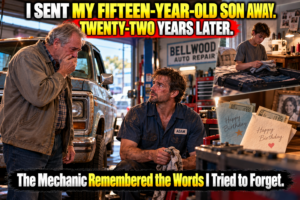
In 2004, I sent my fifteen-year-old son away so my new wife could have his room. He mailed two birthday cards. I answered neither. Twenty-two years later, my truck broke down outside Bellwood—and the mechanic who crawled from beneath it had his mother’s eyes.
Part 1
“You said, ‘Your mother isn’t here to take your side anymore.’”
Adam held the rag in both hands.
He did not shout.
He looked at me the way a mechanic looks at something damaged before deciding whether it can be repaired.
I stood beside my truck, unable to speak.
His hair was darker than I remembered. There were gray threads near his temples, though he was only thirty-seven. A faint scar crossed one knuckle. His work shirt bore a stitched name.
ADAM.
I did not need to read it.
His eyes were his mother’s.
“You remember now?” he asked.
I looked toward the open workshop.
A radio played quietly. Someone was sorting tools at the far bench. Outside, a delivery truck rolled past on the road.
Ordinary life continued while a sentence I had buried for twenty-two years returned intact.
“Yes,” I said.
It was not completely true.
I remembered the argument.
I remembered the hallway.
I remembered Reba standing behind me with her arms folded.
But I had spent years remembering the version in which I tried to help Adam.
The farm would be good for him.
My brother had space.
A boy needed work, fresh air, something useful to do.
That was the story I told myself.
Now Adam gave me the sentence that belonged to him.
Your mother isn’t here to take your side anymore.
I closed my eyes.
“I’m sorry.”
He folded the rag.
“My service manager will explain the repair.”
He walked toward the office.
“Adam.”
He stopped but did not turn.
“I didn’t know you were here.”
“I know.”
“I looked for you.”
He faced me then.
“When?”
I opened my mouth.
Nothing came out.
After Reba left in 2011, I asked my brother, Paul, how Adam was doing.
Paul said he was working and wanted to be left alone.
I accepted that answer.
I called it respecting his wishes.
I did not drive to the farm.
I did not write.
I did not ask Paul to give him a letter.
I asked one question and treated the answer as permission to stop.
Adam waited.
Finally, I said, “Not the way I should have.”
He nodded once.
Then he went inside.
A younger man came over a few minutes later. He explained what was wrong with the truck and when the repair could be completed.
I listened badly.
The truck needed a part. It would not be ready until the following afternoon.
There was a motel nearby.
He gave me directions.
Before leaving, I looked toward the workshop.
Adam stood beneath another vehicle, speaking with an employee.
He appeared calm.
Capable.
At home in a place where I was only a customer.
I wanted to tell him I recognized him immediately.
I wanted to tell him I thought about him every birthday.
Neither sentence would answer the question he asked.
When?
As I reached the office door, I noticed a photograph behind the counter.
Adam stood beside a woman and two children.
His arm rested around a boy’s shoulders.
I looked at the picture too long.
The service manager followed my gaze.
“That’s the owner and his family.”
I turned toward the workshop again.
My son owned the place.
He had built a life.
And I knew nothing about it.
Part 2
That night, I sat on the edge of a motel bed and tried to remember 2004 honestly.
My wife, Ellen, died in the spring of 2003.
Adam was fourteen.
She had been the person who made our house feel organized without making anyone notice the effort.
She remembered school events.
She knew when Adam was pretending not to worry.
She could tell me I was wrong without turning it into a battle.
When she died, I discovered how much of fatherhood I had performed beside her rather than learned for myself.
Adam became quiet.
I became impatient with the quiet.
He stayed in his room.
I told him he needed to get outside.
He forgot homework.
I told him he needed discipline.
He cried at night.
I stood in the hallway and did not knock because I did not know what to say.
Then I met Reba.
She laughed easily. She wanted dinner out, weekend drives, plans that did not involve grief.
With her, I could imagine I was becoming a man again instead of remaining a widower.
I married her a year after Ellen died.
Adam attended the wedding in a shirt that no longer fit properly at the collar.
I remember telling him to smile for the photographs.
I did not ask why he found that difficult.
Reba wanted a sewing room.
She worked on quilts and alterations, and our smaller spare bedroom did not suit her equipment.
Adam’s room had the best light.
At first, she asked whether he could move into the spare room.
Then she said he would probably enjoy living with Paul.
My brother ran a farm forty miles away.
He had helped with Adam during Ellen’s illness. Adam liked him.
That made the plan easy to present as something generous.
When I spoke to Paul, I said Adam needed a change.
Paul asked whether the boy wanted to come.
I said he would understand.
I never asked him.
The night I told Adam, he stood in his bedroom holding a book Ellen gave him.
“Where am I supposed to put my things?”
“At Paul’s.”
“All of them?”
I became irritated.
He was asking simple questions because he was trying to understand whether I meant a visit or an exile.
I treated those questions as resistance.
“Your uncle has plenty of room.”
“This is my room.”
Reba waited behind me.
I could feel her expecting me to be firm.
Adam looked past my shoulder at her.
Then he said, “Mum wouldn’t do this.”
That was when I said it.
Your mother isn’t here to take your side anymore.
I remembered now.
Clearly.
Not as a vague argument or a regrettable tone.
As words I chose to make a grieving child stop objecting.
Adam looked at me for several seconds.
Then he put the book down.
He folded his shirts.
He packed.
He did not slam the door.
He did not beg.
I took his silence as acceptance.
At the motel, I pressed my hands over my face.
For years, I had wondered why he left so quietly.
Now I understood.
I had told him who would no longer protect him.
Then I proved who would not take her place.
Part 3
The next morning, I called Paul.
He answered on the fourth ring.
“Frank?”
My name sounded strange in his voice.
We spoke occasionally, mostly about health, weather, and practical family matters. Over the years, we learned how to avoid the subject that sat beneath every conversation.
“I saw Adam.”
Paul went quiet.
“Where?”
“Bellwood. At his shop.”
“You all right?”
The question startled me.
“I don’t know.”
Paul waited.
I told him about the truck.
I told him what Adam said.
My brother exhaled slowly.
“He remembers.”
“Yes.”
“I told you that.”
I looked at the motel curtains.
“When?”
“More than once.”
I wanted to argue.
Then I remembered conversations in which Paul said Adam was hurt and I answered that the arrangement was temporary.
Conversations in which he asked me to visit and I said work was difficult.
Conversations in which he mentioned a school event and I said the boy probably did not want me there.
I had not forgotten every warning.
I had filed them under reasons other people did not understand my situation.
“What happened after he came to you?” I asked.
Paul’s voice changed.
“You want to know now?”
“Yes.”
He paused.
Then he told me.
Adam arrived with two bags and a box of books.
For the first week, he asked before taking food from the refrigerator.
He washed his clothes immediately, as though leaving a basket somewhere might be considered taking up too much space.
He woke early and worked hard.
Too hard.
Paul told him he was there to attend school and be part of the household, not to earn every meal.
Adam nodded.
Then he continued finding things to do.
One evening, Paul found him repairing a loose gate in the rain.
When he told him to come inside, Adam asked whether he had done something wrong.
I stared at the wall.
“No,” Paul said. “I told him. But he needed to hear it a lot.”
My brother had two daughters.
They treated Adam like a cousin who stayed, then like a brother.
His wife, June, made room for his books in the living room.
Nobody touched his room without asking.
Nobody suggested he should be grateful enough to stop grieving.
He finished school.
He trained as a mechanic.
He worked at a shop, saved money, and eventually started his own business.
Paul attended his graduation.
Paul stood beside him at his wedding.
Paul helped carry a cot into his first child’s room.
I listened while my brother described the life that continued after I decided not to participate.
“Why didn’t you tell me all that?”
“I tried.”
The answer came without anger.
That made it worse.
“What about the cards?”
Paul was silent.
Then he said, “He worked for that money.”
“The twenty dollars?”
“He said fathers got presents too.”
I leaned forward.
Adam mailed two birthday cards.
One in 2005.
Another in 2006.
A twenty-dollar bill inside each.
Reba said answering would confuse him.
She said Paul’s home was settled now.
She said contact would stir things up.
I let her explanation protect me from the discomfort of writing.
“Did he ask whether I replied?” I said.
“Yes.”
“What did you tell him?”
“The truth.”
Paul paused.
“He stopped asking after the second year.”
Part 4
I returned to the shop before noon.
The truck was not ready.
I did not mind.
The service manager offered coffee.
I accepted and sat near the window.
Adam passed through the reception area twice.
The first time, he carried paperwork.
The second, he spoke with a woman about a noise her car made when turning.
He asked questions.
He listened to her answers.
He did not make her feel foolish for struggling to describe the problem.
Ellen had that patience.
I saw it in him.
Near lunchtime, a boy came through the side door carrying a backpack.
He was about twelve.
“Dad?”
Adam looked up.
“Hey. How was it?”
“Fine.”
“That sounds suspiciously short.”
The boy smiled.
“Mr. Carson said the project was good.”
“I want the full report over lunch.”
Adam put his hand briefly on the boy’s shoulder.
It was an ordinary gesture.
I watched as though it were something extraordinary.
The boy noticed me.
“Is that the truck guy?”
“Yes.”
Adam’s voice remained steady.
I looked down at my hands.
Truck guy.
That was accurate.
I had arrived with a problem to be repaired.
I had no right to arrive with a family title and expect it to be accepted.
When the boy went into the office, I stood.
“Can I speak with you?”
Adam glanced at the clock.
“Ten minutes.”
We went to a small bench outside.
I began badly.
“After your mother died, I wasn’t myself.”
He looked at me.
“Who were you when you didn’t answer the cards?”
I stopped.
He continued.
“You had years to become yourself again.”
“Yes.”
“I wasn’t asking you to understand everything. I was asking whether you still wanted me.”
I could not speak.
“I sent money because I didn’t know what else a birthday card was supposed to have,” he said. “I thought if it looked proper, you might answer.”
I looked at the ground.
“I kept them.”
His expression tightened.
“That doesn’t help.”
“I know.”
“You kept them. I kept checking the post.”
The workshop door opened, then closed behind someone carrying equipment.
Adam waited.
I forced myself to say the words without placing an excuse after them.
“I chose Reba’s comfort over your home.”
He looked at me.
“I sent you away while you were grieving. I let you believe you had to make yourself useful somewhere else. Then I ignored the ways you tried to reach me.”
His jaw moved.
For the first time, I saw effort beneath his calm.
“I’m sorry,” I said. “You deserved a father who stayed.”
He stared across the road.
Finally, he said, “Yes.”
Just that.
Yes.
I had wanted an opening.
He gave me an answer.
Then he stood.
“My ten minutes are up.”
Part 5
The truck was repaired by midafternoon.
The bill was fair.
Adam did not reduce it because I was his father.
I did not ask him to.
I paid.
Before leaving, I asked whether I could write to him.
He looked at me for a long time.
“You can send a letter to the shop.”
“Will you read it?”
“I don’t know.”
I nodded.
That was more than I deserved to demand.
On the drive home, I passed the turn for Paul’s farm.
I stopped.
My brother came out of the house carrying a mug.
When he saw me, he set it down.
I had not visited for years.
He waited beside the porch.
“I called first,” I said, though it sounded foolish. “June said I could come.”
He nodded.
We sat at the kitchen table.
The room looked familiar and changed.
New curtains.
Different chairs.
A photograph of Adam’s family near the dresser.
I had seen the same people at the shop.
Now they belonged to a larger collection of memories.
Adam at graduation.
Adam beside a battered first car.
Adam with a baby asleep against his chest.
I stood to look.
Paul did not narrate them.
He let me see what I missed.
June brought tea.
She was polite.
That hurt too.
I remembered how easily I used to enter their home and assume family meant welcome without questions.
Now welcome was something they chose to offer carefully.
“I need to apologize to both of you,” I said.
Paul sat back.
“For putting you in the position of raising my son while I pretended I’d made a sensible arrangement.”
June looked at me directly.
“We loved having him.”
“I know.”
“Don’t make him sound like a burden we accepted.”
“I’m sorry. That’s not what I mean.”
I started again.
“You gave him what I withheld.”
She nodded.
That was closer.
Paul told me Adam knew he was loved.
“He had to work at believing it,” he said. “But he knew.”
I asked whether Adam ever talked about me.
“Sometimes.”
“What did he say?”
Paul studied me.
“I’m not going to give you every private thing he said as a boy.”
I nodded.
“You’re right.”
There were limits now.
I needed to learn them without treating them as cruelty.
Before I left, June handed me a small photograph.
Adam at fifteen, standing beside Ellen in a picture taken before she became ill.
He had brought it to the farm.
June made a copy years earlier.
“You should remember how young he was,” she said.
I held it carefully.
At home that evening, I opened the drawer containing the birthday cards.
The first was blue.
The second had a badly drawn fishing boat on the front.
Inside, Adam wrote:
*Hope you have a good day, Dad.*
No accusation.
No demand.
The innocence of it was almost unbearable.
Part 6
I wrote several letters before sending one.
The first explained too much.
The second asked too much.
The third mentioned my lonely holidays, and I tore it up.
My loneliness was not Adam’s debt.
He had spent birthdays waiting for an answer.
I could not present my empty Christmas table as though it balanced the account.
The letter I finally sent was short enough to read without becoming responsible for my feelings.
I named what I did.
I named the sentence I said.
I acknowledged the cards.
I said I would respect his decisions about contact.
I did not ask him to forgive me.
I did not write that Ellen would want us together.
I had already used her absence against him once.
I would not use her memory to push him now.
After sending it, I began seeing a counselor.
At first, I expected to discuss grief.
We did.
We also discussed the choices I made after grief stopped being new.
The counselor asked what I gained by sending Adam to Paul.
I said I thought it would help him.
She waited.
Eventually, I said it made my house easier.
It made Reba happier.
It let me stop feeling inadequate around a grieving boy I did not know how to comfort.
Saying that aloud felt ugly.
It was also accurate.
I had chosen relief.
Then I called the choice necessary.
Reba left in 2011.
For years, I treated that as the moment my life went wrong.
Now I saw that it was simply the moment I lost the person I used to justify something already wrong.
I stopped telling people my son was estranged as though distance arrived without an author.
When someone asked, I said I sent him away when he was young and failed to keep contact.
The reactions were uncomfortable.
They should have been.
A month passed.
Then six weeks.
Adam did not reply.
I resisted asking Paul to intervene.
I resisted sending another letter to find out whether the first reached him.
He had given me an address.
I had used it.
The next decision was his.
One afternoon, an envelope arrived.
No shop logo.
Just my name in handwriting I almost recognized.
Inside was a single sheet.
*I read it.*
Beneath that:
*I’m not ready to discuss forgiveness. But you can meet me for coffee next Thursday.*
I sat down.
I read it three times.
Then I called the number he included and left a brief message.
“I’ll be there. Thank you.”
I did not add anything else.
For once, I let a small opening remain small.
Part 7
Adam chose a café halfway between Bellwood and my town.
I arrived twenty minutes early.
He arrived on time.
We shook hands awkwardly.
Then we sat.
For the first few minutes, we discussed the truck.
It was running well.
He nodded.
I asked about the shop.
He told me how he bought it from the previous owner after working there for several years.
He talked about staff, customers, and the difficulty of finding reliable parts.
I listened.
I did not turn his achievements into proof that the farm had been good for him.
I understood how insulting that would be.
He built his life despite my absence.
Paul and June helped him.
That did not make my abandonment a contribution.
Eventually, Adam asked about the old house.
“I still live there.”
“My room?”
I swallowed.
“It’s a spare room now.”
He looked toward the window.
“I used to imagine you changed it back after she left.”
I felt the words land.
“I didn’t.”
He nodded.
“Thanks for answering.”
He took a sip of coffee.
Then he said, “I don’t need you to change it now.”
“I understand.”
“You can’t put the furniture back and make it 2004.”
“No.”
We sat quietly.
Then he asked whether I remembered his fifteenth birthday.
I tried.
It came a few months after he moved to Paul’s.
I remembered sending a message through my brother.
No gift.
No visit.
No card.
“I didn’t do enough.”
“You didn’t do anything.”
I looked at him.
“Yes.”
He seemed tired afterward.
So was I, but my tiredness mattered less in that moment.
He had lived the memory.
I was only beginning to hear it without editing.
Before leaving, he told me about his wife.
Her name was Beth.
They had a son, Owen, and a daughter, Lucy.
He showed me a photograph on his phone.
I did not reach for it.
I looked where he held it.
Owen was twelve.
Lucy was nine.
I counted backward automatically, measuring years against things I was doing while their lives began.
Adam saw my expression.
“I’m telling you because I want to,” he said. “Not because you’re entitled to meet them yet.”
“I know.”
He nodded.
At the door, I asked whether we could meet again.
“Maybe.”
I thanked him for coming.
On the drive home, I realized I had learned more about him in an hour than I had allowed myself to know in twenty-two years.
I also realized knowledge was not the same as closeness.
Closeness would have to be offered.
And kept safe.
Part 8
We met three more times over the following months.
Sometimes the conversation was easy.
Sometimes Adam asked a question that made me wish I could return to talking about engines.
I answered anyway.
He wanted to know whether Reba asked me to send him away.
“Yes.”
“Did you argue?”
“Not enough to change anything.”
“So you agreed.”
“Yes.”
He wanted to know whether I saw his cards when they arrived.
“Yes.”
“Did she hide them?”
“No.”
He looked at me for several seconds.
I understood why the distinction mattered.
Reba influenced me.
I acted.
He needed me to stop placing her between him and the father who ignored him.
I did.
At our fourth meeting, he said he had told Beth we were talking.
“She’s cautious.”
“She should be.”
He smiled faintly.
“Most people say that and then complain when she is.”
“I’m trying not to.”
“She won’t let the children become part of an experiment.”
“Neither should you.”
He looked at me.
For the first time, I thought he might believe I understood at least one boundary without being forced to defend it.
Later that month, Paul invited me to a family lunch.
He said Adam would be there.
I asked whether Adam knew I was invited.
“Yes. We spoke.”
I went.
Beth greeted me politely.
Owen and Lucy knew me as their father’s father.
Nobody called me Grandpa.
I did not ask them to.
We ate outside.
Lucy told a long story about a school play.
Owen interrupted to correct something.
Adam stopped him gently.
“Let her finish.”
I watched the exchange.
Then I stopped watching it like a lesson and listened to Lucy.
After lunch, Owen showed me a small model engine he was building.
I knew enough to ask useful questions.
I did not take it from his hands to show him how it should be done.
When he wanted advice, he asked.
It was a good afternoon.
That frightened me afterward.
I wanted to make too much of it.
To decide the family had opened and I could step in.
Instead, I sent Paul and June a thank-you message.
I sent Adam one sentence.
*Thank you for allowing me to be there.*
He replied the following morning.
*The children had a good time.*
I held the phone.
Then I put it down.
I had spent years refusing to answer simple kindness.
Now I was learning how to receive it without demanding more.
Part 9
On my next birthday, Adam sent a card.
There was no money inside.
I was glad.
On the front was a photograph of an old pickup truck.
Inside, he wrote:
*Hope the truck is behaving.*
Then:
*Happy birthday.*
I sat at the kitchen table with it open.
The house was quiet.
For once, the quiet did not feel like something I could blame on the people who were not there.
I took paper from the drawer.
I wrote back that afternoon.
I thanked him.
I told him the truck was running well.
I said I enjoyed meeting the children.
I did not make the response a confession he had to survive.
I answered the card.
Twenty-one years after I should have answered the last one.
A week later, Adam called.
It was a short conversation.
He asked about a tool Ellen’s father had given me years earlier.
He remembered it in the garage and wondered whether I still had it.
I did.
He asked whether he could borrow it for a restoration project.
I said yes.
When he came to collect it, he stood in the doorway before entering.
I stepped aside.
He walked through the house slowly.
There were rooms he remembered and details he did not.
At the bottom of the stairs, he paused.
I waited.
“Can I see it?”
“Your room?”
He nodded.
We went upstairs.
The room contained a bed, a chest of drawers, and boxes I needed to sort.
Nothing dramatic.
No sewing machine.
No attempt to rebuild his childhood.
Adam stood near the window.
“The light’s the same.”
“Yes.”
He looked at the wall where a bookshelf once stood.
“Mum measured that for me.”
“I remember.”
He turned.
“Do you?”
I nodded.
“She wanted to make sure the shelf would hold the encyclopedia set.”
He looked back at the wall.
For a moment, I saw something soften.
Then it was gone.
He did not cry.
He did not announce that he forgave me.
He asked for a minute alone.
I went downstairs.
When he returned, he carried nothing from the room.
He collected the tool.
At the door, he said, “I used to think you stopped loving me.”
My throat tightened.
“I didn’t.”
He looked at me.
Then I added what the first answer left out.
“But I stopped behaving like someone whose love you could trust.”
He nodded slowly.
“That’s closer.”
After he left, I sat in the kitchen.
I did not tell myself the visit fixed anything.
I told myself I had finally given him a true answer.
Part 10
I still spend some holidays alone.
That may sound like a sad ending.
It is simply the truth.
Adam has a family, obligations, traditions, and people who remained beside him while I stayed away.
I cannot return late and expect the calendar to make room immediately.
Sometimes I am invited.
Sometimes I am not.
When I am invited, I arrive on time.
I bring what I am asked to bring.
I do not stay until someone has to ask me to leave.
I answer messages.
I keep promises small enough to make and important enough to honor.
Adam and I are building something cautious.
It does not resemble what we lost.
He will never be fifteen again.
Ellen will never stand in the kitchen and ask me whether I have thought about what he needs.
I have to ask that question myself now.
One afternoon, I went to the shop for an oil change.
Adam was working on another vehicle.
Owen sat at a bench doing homework.
He looked up when I entered.
“Hi, Frank.”
“Hello.”
He showed me a drawing for a school project.
I asked about it.
He explained.
Then Adam came over, wiping his hands.
“The truck still behaving?”
“Thanks to your work.”
He smiled slightly.
We discussed the service.
Nothing urgent.
Nothing dramatic.
As I prepared to leave, Lucy arrived with Beth.
She waved.
Then she asked whether I would be at Sunday lunch.
I looked at Adam before answering.
He nodded.
“Yes,” I said.
She smiled and went inside.
I stood beside the truck for a moment.
Twenty-two years earlier, I told a boy his mother was no longer there to take his side.
I made grief sound like the end of his protection.
Paul and June proved me wrong.
They gave him a home.
He grew up and made one of his own.
Now he was deciding, carefully, whether I could stand near it.
I did not deserve that decision simply because I was old or lonely.
He offered it because he was willing.
That generosity frightened me more than his anger.
Anger was something I could explain away if I remained the man I had been.
Generosity required me to become someone who would not waste it.
Before driving home, I took the latest birthday card from the passenger seat.
I had brought it because I wanted to thank him again.
Then I thought better of making an ordinary card carry too much.
I placed it carefully in the glove compartment.
At Sunday lunch, I would ask him about his week.
I would listen to the answer.
And when he called, I would call back.