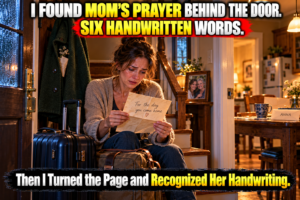
Eight months after burying my mother, I returned to her empty house with two suitcases and a marriage I could no longer save. A folded prayer slipped from behind her coat. On the outside, she had written six words: “For the day you come home.” Then I turned it over.
Part 1
The key caught halfway into the lock.
For a moment, I stood on my mother’s front porch, jiggling it the way she had taught me, with my left shoulder pressed against the door.
“Lift a little,” I heard her say in my memory. “That old frame swells whenever it rains.”
It had rained all afternoon.
Water dripped from the porch roof onto the hydrangeas she used to trim every spring. The hedge along the walkway had grown uneven, and the light above the door flickered when I stepped beneath it.
I had meant to replace that bulb.
I had meant to do a lot of things.
The lock finally turned.
Inside, the hallway smelled faintly of furniture polish and the lavender sachets Mom tucked into drawers. I dragged my suitcases over the threshold and stopped beneath the framed photograph of my sister and me in our school uniforms.
I was forty-three now.
In the photograph, I was missing a front tooth.
My mother had written our names and ages on the back because she believed someday someone would need to remember.
That morning, my husband had stood beside our kitchen counter and told me he wanted a divorce.
He had said it with the same careful voice he used when explaining why we should refinance the car.
“I think we both know this hasn’t been working.”
I remembered looking at the toaster.
There were crumbs beneath it. I had been meaning to clean them.
“Is there someone else?” I asked.
He rubbed his forehead.
“I don’t want this to turn into an interrogation, Anna.”
After sixteen years, even my first question seemed to be too much.
An hour later, while I was folding clothes into a suitcase, my manager called.
The dress shop was closing. The owner had tried to keep it going, but there would be no shifts after Saturday.
“I’m so sorry,” she said.
I told her I understood.
I had become very good at understanding things that hurt me.
By late afternoon, I had packed two suitcases, collected my medication, and left my wedding ring beside the little ceramic dish near the sink.
My husband asked where I was going.
“Mom’s.”
He nodded.
He did not offer to carry my bags.
Now I stood inside the house she had left to my sister, Beth, and me, listening to the refrigerator humming in the next room.
We had agreed to wait before deciding whether to sell. Beth lived two hours away and said neither of us should make permanent decisions while grief was still making ordinary ones difficult.
I had been grateful.
I had also stayed away.
Being here without Mom seemed harder than being somewhere else and pretending I was merely too busy to visit.
Her coat still hung behind the front door.
A dark green wool coat with one loose button.
I reached to touch the sleeve.
Then I shut the door, and something slipped from beneath the coat and fluttered onto the floor.
A folded sheet of paper.
I bent to pick it up.
Across the outside, in blue ink, were six words in the slanting handwriting I had known all my life.
For the day you come home.
I sat on the bottom stair.
My suitcase stood beside me, its handle still extended.
I unfolded the paper.
“Heavenly Father, in the mighty name of Jesus…”
My mother’s prayer.
I could hear her saying it softly at the sink, while rinsing plates, while checking the back door before bed.
I read it once.
Then again.
At the bottom, beneath “Amen,” she had added a sentence that made my hands begin to shake.
Sweetheart, turn the page.
Part 2
I turned the paper over slowly.
There was a letter on the back, written in smaller handwriting to make everything fit.
My mother had never liked wasting good paper.
*Anna,*
*I don’t know what has brought you through this door. Perhaps you only came for the Christmas decorations. If so, put this back and forgive your mother for being sentimental.*
A laugh escaped me.
It sounded strange in the empty hallway.
*But if you came because life has hurt you, please listen.*
*You never have to earn a place here.*
I held my breath.
For years, I had tried to be the daughter who didn’t need anything.
Beth had three children, a demanding job, and a husband whose work required travel. Mom helped her whenever she could, and I told myself it made sense.
I was nearby. I had no children. I had a husband and a regular paycheck.
Whenever Mom asked whether I needed help, I answered before she finished.
“No, we’re fine.”
Sometimes I even brought groceries I couldn’t comfortably afford so she would have proof.
The letter continued.
*I have heard you crying in the bathroom. I have watched you turn your phone facedown when his name appeared. I didn’t know how to ask without making you retreat.*
*I’m sorry I sometimes let your answer end the conversation.*
I pressed the paper against my knees.
I remembered the bathroom.
Christmas, two years earlier.
My husband had called while I was helping Mom peel potatoes. He was angry that I had spent too much on presents for Beth’s children.
I had bought books.
Three books.
I went into the bathroom because I didn’t want Mom to hear.
When I came out, she had put the potatoes aside and asked whether I wanted tea.
I thought she hadn’t noticed.
*You don’t have to explain everything tonight,* she had written. *You don’t even have to know what happens next.*
*There is an envelope in the kitchen drawer beneath the tea towels. It holds the house papers, a little money, and Mrs. Bennett’s telephone number.*
*She has promised to answer if you call.*
I looked toward the kitchen.
Mrs. Bennett lived next door. Her first name was Ruth, but I had called her Mrs. Bennett since I was six and never managed to stop.
She had brought casseroles after Dad died.
She had sat with Mom during the afternoons of her final illness when Beth and I couldn’t be there.
After the funeral, she hugged me so tightly that I smelled flour on her cardigan.
“Don’t disappear,” she said.
I had disappeared anyway.
I stood and walked into the kitchen.
Mom’s blue mug remained beside the sink. Beth had washed it after the funeral and left it there because neither of us knew where else it belonged.
I opened the drawer near the stove.
Two folded tea towels. A packet of birthday candles. The little notebook where Mom recorded telephone messages.
Underneath was a cream envelope with my name on it.
Inside were copies of the house documents, a savings statement, Ruth’s telephone number, and a photograph.
My eighteenth birthday.
Mom and I stood beside the kitchen table, laughing over a cake that had collapsed in the center.
On the back, she had written:
*We ate it anyway.*
Beneath the photograph was another note.
*The money won’t solve everything. Use it to give yourself a little breathing room.*
*Then tell someone the truth.*
I took out my phone.
Ruth’s number was already in it.
I had ignored two calls from her that summer, telling myself I would return them when I had something cheerful to say.
Now my thumb hovered above her name.
I nearly put the phone away.
Instead, I pressed call.
She answered on the third ring.
“Anna?”
“I’m at Mom’s house.”
There was a pause.
Then, very gently, she said, “Did you find what she left behind the door?”
Part 3
“You knew about it?”
“Yes.”
I lowered myself into Mom’s kitchen chair.
“When did she put it there?”
“Last winter. Before she became too tired to manage the stairs.”
I stared at the letter.
Last winter, I had still been telling everyone that my marriage was fine.
“I don’t understand.”
“Tell me what happened today.”
There was no urgency in her voice, no demand for a tidy explanation.
I tried to give her one anyway.
“My husband and I are separating. And the shop is closing, so I need to look for another job. It’s a lot at once, but I’ll manage.”
“Have you eaten?”
I looked at the clock above the stove.
Almost eight.
“I had coffee.”
“That wasn’t my question.”
“No.”
“Unlock the back door. I’m bringing soup.”
Before I could protest, she ended the call.
Ten minutes later, I heard her shoes on the steps.
She came in carrying a saucepan wrapped in a towel and a bag containing bread, butter, and two apples.
Her gray hair was pinned crookedly at the back, as though she had been resting and got up too quickly.
“You didn’t need to do all this,” I said.
“I was going to eat it myself. Now I’ll have company.”
She put the saucepan on the stove, found bowls in the correct cupboard, and turned the burner low.
I watched her move through the kitchen.
For a moment, the house felt occupied again.
Not the way it had before, but enough that I could unclench my hands.
Ruth sat opposite me.
“Start wherever you can.”
So I told her.
About my husband saying he wanted a divorce. About losing the job. About the credit card balance I had been paying in small installments without mentioning it to anyone.
I told her how careful I had become at home.
Careful about purchases. Careful about questions. Careful about having an opinion before I knew his.
“He never hit me,” I said.
Ruth looked at me steadily.
“I didn’t ask whether he did.”
I stared down at the table.
That was the sentence I always used when I felt foolish for being unhappy.
He never hit me.
We had a nice apartment.
He remembered anniversaries, sometimes.
There were photographs of vacations where we both looked content.
But there were also evenings when he wouldn’t speak to me because I had embarrassed him by disagreeing in front of someone else. There were conversations that ended with me apologizing for remembering them incorrectly.
“I kept thinking if I could stop upsetting him, things would get easier.”
Ruth folded her hands.
“Did they?”
“No.”
The word came out so quietly I barely heard it.
She stood to stir the soup.
I took out the savings statement.
The account held four thousand eight hundred dollars.
It wasn’t a fortune. It was enough to keep a frightened person from making every decision in one night.
“Was this meant for me?”
“Yes. Your mother spoke to the attorney when she arranged her papers. Beth knows there was a separate gift.”
“Beth knows?”
“She knows the money exists. She doesn’t know why you might need it.”
I felt a familiar rush of shame.
My younger sister had a busy, difficult life. I pictured telling her mine had collapsed and hearing concern turn into exhaustion.
“I can’t call her tonight.”
“All right,” Ruth said. “Tomorrow, perhaps.”
She poured the soup.
We ate without speaking for a while.
Afterward, she helped me make a list: call Beth, contact the electricity company, ask my manager for a reference.
Three things.
She pushed the paper toward me.
“You can do those in the morning.”
Before leaving, she picked up Mom’s letter.
Her eyes moved over it, and her mouth tightened.
“There’s something else she wanted you to know,” she said.
Then she looked toward the hallway.
“It’s upstairs, in the sewing basket.”
Part 4
The stairs creaked beneath us.
Ruth insisted on coming up with me.
“I know where she put it,” she said. “And I don’t want you emptying every drawer at midnight.”
Mom’s bedroom was exactly as Beth and I had left it.
The quilt lay smooth across the bed. Her slippers were tucked beneath the chair by the window. On the dresser stood a photograph of Dad with one hand raised to shield his eyes from the sun.
I had not been inside this room since the week after the funeral.
For months, I had imagined it would hurt too much.
It did hurt.
But it was also a bedroom. Curtains. A bedside lamp. A chair where my mother had mended things while listening to the weather forecast.
Ruth lifted the sewing basket from beneath that chair.
Inside were spools of thread, a tomato-shaped pincushion, and the little silver scissors Mom never let anyone borrow.
At the bottom lay a notebook.
“She started this after your father died,” Ruth said.
I opened it.
The first pages contained prayers, recipes, and scraps of advice Mom seemed to have written for herself.
*Eat something before deciding the world is ending.*
*Call Ruth back.*
*Replace the porch bulb.*
I smiled through tears.
Then I found my name.
*Anna visited today. She stayed only forty minutes. She kept looking at the clock, though she said she had nowhere to be.*
The entry was dated three years earlier.
Another page:
*She apologized because the cake she brought was dry. I wish she knew she could come empty-handed.*
I sat on the edge of the bed.
Ruth stood beside the dresser.
“I shouldn’t read her private thoughts.”
“She asked me to give it to you.”
I turned another page.
*I asked whether everything was all right at home. She said yes so quickly that I didn’t ask again. I’m afraid of pushing. I’m also afraid of what silence might cost us.*
I closed the notebook.
“She should have told me.”
“Perhaps.”
Ruth’s voice was gentle, but she didn’t rush to protect my mother from criticism.
“Your mother didn’t always know the right thing to say.”
I looked at her.
“She always seemed so sure.”
“That came with age. And even then, she wasn’t sure as often as you thought.”
We sat together on the bed.
Ruth told me about the first year after Dad died, when Mom would call her before breakfast because she couldn’t stand the quiet.
“She prayed every morning,” Ruth said. “Then some mornings she came next door and told me she was angry with God.”
“Mom?”
“Oh, yes.”
I thought of all the prayers I had heard her say, firm and certain, as though faith came easily.
“She never told me.”
“She worried you’d feel responsible for making her happy.”
That sounded painfully familiar.
I opened the notebook again.
Near the back was an entry written during her illness.
*I cannot make Anna speak. I can leave a door open. I can make sure she has something practical if she needs to step through it.*
Below that:
*Beth came today. I told her not to confuse Anna’s independence with having no needs.*
My eyes filled.
“What did Beth say?”
Ruth shook her head.
“You’ll have to ask her.”
After Ruth went home, I carried the notebook downstairs.
I washed the bowls, checked the locks, and placed Mom’s prayer beside the bed in my old room.
For the first time in months, I prayed aloud.
I didn’t use polished words.
“Lord, I’m frightened. Help me tell the truth tomorrow.”
Then my phone lit up.
A message from my husband.
*We need to discuss what you’re planning to tell people.*
Part 5
I read the message three times.
A second one arrived.
*I hope you’re not going to make this uglier than it needs to be.*
My first instinct was to reassure him.
Of course not.
I would never.
I could already hear myself explaining that Ruth knew only a little, that I hadn’t exaggerated, that I understood he was under pressure too.
I put the phone facedown.
Then I picked it up again.
For sixteen years, silence from him had meant danger to the peace of our home. I had learned to answer quickly, smooth things over, and guess which words would keep the next day bearable.
My hands moved before I had decided what I wanted.
I typed half a response.
Deleted it.
Finally, I wrote:
*I’m safe at Mom’s house. We can discuss practical matters tomorrow.*
I sent it.
The phone rang immediately.
I watched his name until the call stopped.
A message followed.
*Why are you acting like this?*
I turned the phone to silent.
Then I sat on the bed, expecting guilt to overwhelm me.
It came, but so did something else.
Relief.
In the morning, pale light fell across the wallpaper Mom had never replaced. There were tiny yellow flowers beside the window, faded from years of sun.
I found my list in the kitchen.
Call Beth.
I dialed before I could invent a reason to wait.
She answered breathlessly.
“I’ve got about ten minutes before a meeting. What’s up?”
“I’m at Mom’s house.”
Her voice changed.
“Did something happen?”
I told her.
Not everything. Enough.
She stayed quiet until I finished.
Then she said, “How long has it been bad?”
“I don’t know.”
“Anna.”
“Years, maybe.”
I heard a door close at her end.
“I’m stepping out.”
“You said you have a meeting.”
“They can start without me.”
That nearly undid me.
I told her about the prayer, the letter, the envelope.
“She left money for me.”
“I know.”
“You never said anything.”
“Mom asked me to let you find it when you needed it. I worried that was too complicated, but she felt strongly about it.”
“Are you upset?”
“About the money?”
“Yes.”
“No. I’m upset that you thought you couldn’t tell me you were hurting.”
I stared at the window.
Outside, Ruth was shaking crumbs from a tablecloth.
“You already have so much to handle.”
“That doesn’t mean you don’t get to have problems.”
“I didn’t want to be another thing on your list.”
Beth exhaled.
“You’re my sister.”
I began crying then, with none of the control I had managed the night before.
Beth waited.
When I could speak, I asked whether she thought I should move back home.
“I think you should stay where you can breathe while you work out what happens next.”
After we hung up, I called the electricity company.
Then my manager.
She promised a reference and said she knew of a small homeware store looking for someone reliable.
By noon, I had done all three things on the list.
I was exhausted.
I was also hungry.
I made toast and ate it standing beside the counter.
When I opened the drawer for a knife, I saw Mom’s envelope again.
There was one folded page I had missed, tucked behind the house papers.
It was addressed to both Beth and me.
Part 6
I called Beth again.
“I found another letter.”
“What does it say?”
“I haven’t opened it.”
“Well, open it.”
“I thought we should read it together.”
She went quiet for a moment.
“All right. I’m listening.”
I unfolded the page.
*My girls,*
*Please do not let this house become something you use to measure how much I loved either of you.*
Beth made a small sound.
Mom knew us.
She knew how quickly ordinary decisions could become tangled with everything we had never said.
*I have left it to you equally. That does not mean every need will arrive equally or at the same time.*
*Talk to each other. Ask questions before making assumptions. If one of you needs shelter, I hope the other will remember how often we have all needed help.*
There was a paragraph about where she kept the attorney’s details, followed by a reminder that the kitchen tap still leaked unless turned firmly.
At the bottom, she had written:
*No argument over this house is worth losing your sister.*
Beth was quiet.
“Are you still there?” I asked.
“Yes.”
“I won’t stay forever.”
“You don’t have to promise that today.”
“I can pay something once I find work.”
“We’ll work it out.”
“I don’t want you to think—”
“Anna, stop.”
I closed my eyes.
She softened her voice.
“Let me offer something without you explaining why you don’t deserve it.”
That afternoon, Beth called again with a proposal.
For three months, I would stay in the house. I would cover ordinary utilities as I became able, and we would share necessary property expenses from the small estate fund Mom had left for maintenance.
At the end of that time, we would review everything.
No vague promises.
No keeping score.
We wrote it down so neither of us would have to worry about remembering a conversation differently.
The simplicity of it surprised me.
Money had become so tense in my marriage that I had forgotten people could discuss it without someone being punished.
Later, my husband called.
This time, I answered.
“I’m not coming back tonight,” I said before he could begin.
“I wasn’t asking you to.”
“All right.”
“I just think we should keep this private.”
“I’m allowed to talk to my sister.”
“I didn’t say you weren’t.”
He sounded irritated now, as though I had introduced an unreasonable idea.
I steadied the phone against my ear.
“I’ll be getting advice about the practical arrangements.”
“So that’s where we are?”
“You told me you wanted a divorce.”
“I said I thought we should separate.”
“No. You said divorce.”
A long silence followed.
Normally, I would have filled it.
This time, I waited.
Finally, he said, “I can see this isn’t going to be a useful conversation.”
“We can speak when we’re ready to discuss the bills and belongings.”
I ended the call.
My whole body shook afterward.
Ruth found me sitting on the back step.
She didn’t ask why I was trembling. She sat beside me, shoulder to shoulder, until it eased.
“I thought prayer was supposed to make me stronger,” I said.
“Perhaps this was strength.”
“It didn’t feel like it.”
“Most difficult things don’t, while you’re doing them.”
That evening, Beth sent a message.
*Coming Saturday. No cleaning. I mean it.*
I smiled.
Then another message arrived from my old manager.
*The homeware store wants to meet you tomorrow. Can you be there at ten?*
I looked toward the two suitcases in the hallway.
Every piece of clothing I owned seemed to belong to the woman I had been trying to convince everyone I was.
Part 7
I unpacked after dinner.
Until then, leaving the suitcases closed had allowed me to imagine I was only visiting.
Opening them made the move real.
I hung three blouses in the wardrobe and placed my folded trousers in the dresser. My old bedroom had become Mom’s guest room years earlier, but she had never removed the little shelf Dad made for my books.
There was a mark on the wall where I used to measure myself.
I touched it.
Then I chose a navy blouse for the interview.
It had a missing button at the cuff.
My husband once pointed it out while we were having dinner with friends.
“Anna’s too busy rescuing everyone else’s clothes at the shop to look at her own.”
People laughed.
I laughed too.
Now I carried the blouse downstairs and opened Mom’s sewing basket.
I found a button close enough to match and threaded a needle beneath the kitchen light.
My stitches were uneven.
I pulled them out and started again.
The work steadied me.
By morning, the cuff was repaired.
The homeware store occupied a narrow building on the main street, with baskets stacked beside the entrance and lamps glowing in the window.
The owner, a woman named Denise, offered me coffee.
I refused automatically, then remembered I hadn’t had breakfast.
“Actually, yes. Thank you.”
She asked about my experience.
I told her about stock deliveries, difficult customers, displays, scheduling, and the regular shoppers who came to the dress shop because I remembered what suited them.
For half an hour, I spoke without checking whether someone approved of how I sounded.
Denise took notes.
“The job is part-time to start,” she said. “I don’t want to promise hours I can’t provide.”
“I appreciate that.”
“We need someone who can be patient with people.”
“I can do that.”
She smiled.
“I believe you.”
I didn’t receive an offer that morning.
She said she would call after meeting another applicant.
Still, on the walk back to my car, I felt different.
There was a version of me other people had known for years: competent, kind, useful.
She had not vanished because my husband no longer wanted the marriage.
On Saturday, Beth arrived with a bag of groceries and a stern expression.
“You cleaned.”
“Only the kitchen.”
“And the bathroom?”
“A little.”
She put the groceries down.
“Next time I’m checking for dust before I leave.”
We hugged awkwardly at first.
Then she held on.
I buried my face against her shoulder.
“I’m sorry I didn’t tell you.”
“I wish you had. But I’m here now.”
We spent the afternoon going through the practical papers.
Then Beth picked up Mom’s notebook.
“Can I read it?”
“Yes.”
She turned pages slowly.
When she reached her own name, she stopped.
“What?”
She handed it to me.
*Beth thinks Anna wants distance. Anna thinks Beth has no room for her. I wish they could hear each other without guessing first.*
I looked at my sister.
She looked back.
All those months of short calls and cheerful answers had meant something different to each of us.
“Did you really think I didn’t want you around?” I asked.
Beth swallowed.
“After Mom died, you stopped answering.”
Before I could respond, she turned another page.
A loose photograph fell from the notebook onto the table.
On the back, Mom had written a date neither of us expected.
Part 8
It was the date of the last birthday I had spent at Mom’s house.
Two years earlier.
I remembered that day because I had nearly canceled.
My husband was annoyed that Mom wanted me for lunch when we already had dinner reservations. He said I was letting her turn one birthday into a full weekend.
So I told Mom I could only stay briefly.
In the photograph, Beth and I stood beside her in the garden.
Beth was laughing. Mom had one arm around each of us.
I looked tense.
I remembered worrying about the time.
On the back, beneath the date, was another sentence.
*Both my girls here. I wanted another hour.*
Beth ran her finger over it.
“I thought you left because of me.”
“What?”
“You were quiet all through lunch. I’d been talking about the children, and I thought maybe I made you feel left out.”
“No.”
“You wouldn’t stay for coffee.”
“He kept calling.”
Beth lowered the photograph.
I hadn’t seen how much of my life I had been explaining to everyone without telling them anything true.
They filled the silence with their own fears.
“I thought you were tired of hearing about my problems,” I said.
“You never told me your problems.”
“I know.”
We sat with that.
Neither of us could recover the afternoon in the garden.
We could only stop wasting the next one.
Beth made coffee.
I told her more about the marriage: how an ordinary disagreement could last for days, how I had begun rehearsing conversations in the car before going home.
She listened.
Then she said, “I need to ask you something, and you don’t have to give me an answer you think I want.”
“All right.”
“If he calls tomorrow and says he’s changed his mind, what will you do?”
My stomach tightened.
I had asked myself the same question at night.
There was still a part of me that wanted him to choose me, even after everything. A part that confused being wanted with being safe.
“I don’t know.”
Beth nodded.
“Then you don’t have to decide tomorrow.”
“What if he says I’m giving up?”
“You can take time to understand what you want.”
After she left, I reread Mom’s prayer.
The words about hidden plans sounded different now.
I didn’t know how to identify every source of harm in the world. I knew I had spent years hiding my own hurt beneath politeness.
I prayed for the courage to look at things plainly.
Then I booked an appointment with a counselor.
I left a message with a legal advice office.
I wrote down the household accounts I remembered and the documents I would need.
The actions were small, but they occupied my hands and gave my worry somewhere useful to go.
On Monday, Denise called.
She offered me the job.
Four days a week to begin.
I thanked her so many times that she laughed.
“Save some enthusiasm for the stockroom. It’s a mess.”
I started Thursday.
That evening, my husband’s car pulled up outside Mom’s house.
I saw him through the kitchen window, standing beside the gate.
In his hand was a bouquet of flowers.
Part 9
I waited before opening the door.
That was new.
Usually, his arrival decided what I did next.
Now I took a breath, put down my mug, and stepped into the hallway.
He held the flowers awkwardly.
“Can we talk?”
“Here.”
He looked past me into the house.
“On the doorstep?”
“I’m comfortable here.”
He sighed.
“I don’t want to fight.”
“Neither do I.”
He said the apartment felt strange without me. He said he had been under pressure. He said we had both let things drift.
For a few minutes, I heard what I had wanted to hear for years.
He missed me.
Then he added, “I think involving your sister has made this harder.”
I looked at the flowers.
White roses.
He used to send them after arguments and expect the delivery to finish the conversation.
“Beth isn’t responsible for our marriage.”
“I’m just saying she’s only hearing your side.”
“She’s hearing how I feel.”
“And I never get to have feelings?”
“You do.”
He shifted his weight.
“Then why does everything I say sound wrong to you now?”
I could feel the old panic beginning.
The urge to soften my voice further. To find the sentence that would turn him back into the person I wanted him to be.
I glanced at Mom’s coat behind the door.
“I’m not going to resolve sixteen years on the porch,” I said.
“So what are you going to do?”
“Keep my appointments. Start my job. Think.”
“I brought flowers, Anna.”
“I see them.”
He looked hurt.
Perhaps he was hurt.
That did not mean I had to change my answer.
“I can’t come home because this conversation is uncomfortable.”
For a moment, neither of us spoke.
Then he placed the bouquet on the porch chair.
“Call me when you’re ready to be reasonable.”
He walked away.
I closed the door and leaned against it.
My legs shook.
I cried for the marriage I had wanted, for the years I had spent waiting for it to become that marriage, and for the part of me that still wished the flowers had meant something different.
Then I called Ruth.
She listened.
“Do you want company?”
“Yes.”
She came over in her slippers.
We sat in the kitchen, and she made tea.
“I feel cruel.”
“Because you didn’t give him the answer he wanted?”
I wiped my face.
“Yes.”
“You were clear. That can feel unfamiliar when you’ve spent a long time being careful.”
The next morning, I went to the counseling appointment.
I expected someone to tell me whether I should stay or leave.
Instead, the counselor asked what happened when I disagreed with my husband, what I feared, and what I wanted my ordinary days to feel like.
I had trouble answering the last question.
No one had asked it in a long time.
Thursday arrived.
At the homeware store, Denise showed me the till, the stockroom, and the shelf where she kept spare pens.
By noon, I had helped a man choose a lamp for his wife’s reading chair and found replacement cups for a woman who broke two while washing up.
Ordinary work.
At lunch, I ate a sandwich in the little staff room.
My phone buzzed.
Beth.
*How’s the first day?*
I sent a photograph of my sandwich.
*So far, nobody has complained about my repaired cuff.*
She replied with three laughing faces.
That evening, I returned to Mom’s house and found an envelope waiting beside the prayer.
Ruth had left it there.
Across the front were Mom’s words again.
*For when you begin to feel like yourself.*
Part 10
I carried the envelope to the kitchen table.
Inside was a small photograph of me standing behind a stall at a school fundraiser.
I was eleven, wearing an apron too large for me.
There were homemade biscuits arranged in paper bags, and I was holding a tin for the money.
On the back, Mom had written:
*Anna can talk to anyone when she forgets to be afraid.*
I remembered that day.
I remembered being proud because I sold everything before the other stalls had packed up.
I remembered Mom pretending to be a difficult customer.
“What if I only want half a biscuit?”
“Then you’ll have to find someone to buy the other half,” I told her.
She laughed for the rest of the afternoon.
There was a note in the envelope.
*Sweetheart, I hope you are beginning to notice yourself again.*
*You have always been more than the person who keeps everyone comfortable.*
*You are funny. You are patient. You notice when people need something, often before they ask. Please remember to notice yourself too.*
I read that line several times.
Below it, she had written:
*I cannot tell you what to do about your marriage, your work, or this house. Those choices belong to you.*
*I can tell you that being loved should leave room for you to speak.*
I laid the letter beside her prayer.
For a while, I simply sat there.
Then I called Ruth.
“How many envelopes are there?”
She laughed.
“That’s the last one.”
“Are you sure?”
“I helped her put them together. I’m sure.”
“Thank you.”
“You’re welcome.”
“No. For all of it.”
Her voice softened.
“Your mother asked me to answer. You did the difficult part. You called.”
The months that followed were not easy.
My husband and I moved ahead with the separation. Some conversations went calmly; others left me needing an hour to settle afterward.
I kept seeing the counselor.
I worked.
I learned the names of regular customers at the homeware store and discovered Denise had a habit of leaving her glasses on shelves she had just dusted.
When she lost them, I usually knew where to look.
My wages were modest, but they were mine to plan with. I made a budget at Mom’s kitchen table and stopped treating every number as evidence of a personal failure.
Beth and I reviewed the house arrangement after three months.
We decided I would stay longer while we considered what made sense for both of us. We spoke openly about expenses, plans, and the memories that made some rooms difficult.
Once, we disagreed.
I wanted to keep Mom’s armchair. Beth wanted it for her youngest child’s reading corner.
For a few minutes, grief made us sharp.
Then Beth said, “We’re doing the thing.”
“What thing?”
“The argument Mom specifically told us not to have.”
We laughed reluctantly.
The chair went to Beth.
I kept the blue mug.
By spring, I replaced the porch bulb.
I trimmed the hydrangeas badly enough that Ruth came over to supervise.
“You’ve cut that one too low.”
“I’m learning.”
“Yes,” she said. “I can see that.”
I began having people over on Sundays.
Nothing elaborate.
Soup. Bread. Sometimes a cake that sank in the middle.
Beth brought the children when she could. Ruth came with biscuits. A friend from the shop joined us one afternoon and stayed to help wash up.
There were still nights when I missed Mom so fiercely that I opened her notebook just to see her handwriting.
There were nights when I missed my husband too.
Healing did not mean every memory became simple.
But I no longer had to turn those feelings into instructions. Missing someone did not require me to return. Being lonely did not mean I had failed.
One evening, I took a clean sheet of paper from the drawer and copied Mom’s prayer.
I corrected the broken lines carefully, keeping the words that had meant so much to her.
Then I wrote a note beneath it.
*For anyone having a difficult day: you don’t have to face it without telling someone.*
I sent a photograph to Beth.
A few minutes later, she called.
“Are you all right?”
“Yes.”
“Really?”
I looked around the kitchen.
There were dishes drying beside the sink, my work schedule pinned to the refrigerator, and a small vase of flowers I had bought for myself.
“Yes,” I said. “Really. And when I’m not, I’ll tell you.”
After we hung up, I returned the original prayer to its place behind Mom’s coat.
The coat still had a loose button.
I took it down, carried it to the table, and opened the sewing basket.
This time, I found matching thread immediately.
I stitched the button firmly, put everything away, and hung the coat back on its hook.
Then I checked the doors before bed.
At the front door, I rested my hand on the worn wood and said the words Mom had said so often.
“Lord, watch over this home.”
I thought of Beth and her children. Of Ruth next door. Of the people who had answered when I finally let them hear me.
“Help me care for them,” I whispered. “And help me accept their care.”
I switched off the hallway light.
“Amen.”

One Comment on “I Returned to My Late Mother’s House After My Marriage Fell Apart and Found a Prayer Behind the Door—Then Six Words in Her Handwriting Made Me Turn the Page”