My father shut his door on me when I was eighteen and pregnant. I never went back. On my son’s eighteenth birthday, he asked me to drive him there. Then he opened his backpack on the porch—and I realized he had brought something I had never thought to show my father.
Part 1
On the morning my son turned eighteen, I burned the first batch of pancakes.
I was standing over the stove remembering the first time I held him, how his fingers closed around my thumb and how frightened I was that someone might notice I didn’t know what I was doing.
Then the smoke alarm chirped.
“Good to know adulthood comes with the usual breakfast,” Noah said from the kitchen doorway.
He was wearing an old gray sweatshirt and the crooked smile he used whenever he wanted to keep me from worrying.
I waved a dish towel beneath the alarm.
“Your birthday privileges are being reviewed.”
He kissed my cheek and took the pan from me.
That was my boy. Eighteen years old, taller than the refrigerator, and still unable to pass through the kitchen without checking whether I needed help.
We ate the second batch at our small table beside the window.
There were strawberries, a candle stuck into a stack of pancakes, and an envelope containing money I had been saving for his first semester of college.
He read the card twice.
Then he put it down carefully.
“Mom, there’s something I want to do today.”
“As long as it doesn’t involve getting another tattoo suggestion from Mason.”
He didn’t laugh.
“I want to visit Grandpa.”
The room changed around me.
The refrigerator hummed. A bus passed outside. Downstairs, our neighbor was sweeping the pavement in the same steady rhythm she used every Saturday.
I looked at the untouched strawberry on my fork.
“My father?”
Noah nodded.
He had never called him Grandpa without hesitation before.
“Why today?”
“Because I’m eighteen.”
I set the fork down.
At eighteen, I had packed my clothes into two plastic bags while my father stood in the hallway telling me that actions had consequences.
At eighteen, I had waited outside a bus station for a boyfriend who promised to come and didn’t.
At eighteen, I had learned how long a night could become when there was no door in the world you felt entitled to knock on.
Noah watched my face.
“You can say no,” he said.
“Have you spoken to him?”
“No. I haven’t called or written. Aunt June gave me the address, but I told her I wouldn’t go without asking you.”
My father’s younger sister had stayed in our lives, even when doing so made hers more difficult.
“What do you want from him?”
Noah looked toward the backpack beside his chair.
“I’ve been preparing for this.”
Something inside me tightened.
“Preparing what?”
“Something I’d like you to see when he does. If that’s okay.”
I studied him.
There was no excitement in his expression. No fantasy of an instant family waiting behind a familiar door.
He looked serious, and a little scared.
“I don’t need you to defend me,” I said.
“I know.”
“And meeting him won’t make our life more complete.”
“I know that too.”
I folded my napkin.
He was the same age I had been when my father decided I was old enough to lose my home.
I wanted to protect him from the man who had done that.
I also knew he was asking me to trust the person I had raised.
“We go together,” I said. “We leave whenever either of us wants.”
Noah nodded immediately.
Then he reached down and zipped his backpack closed.
Part 2
My father lived forty-three minutes away.
For eighteen years, I had carried that distance around as though it were an ocean.
There were other roads, other grocery stores, other towns where I could buy shoes or have my car inspected. I had become skilled at arranging my life around places I didn’t want to pass.
That morning, the navigation app offered the route I had avoided.
I turned it off.
I remembered the way.
Noah sat quietly beside me, holding his backpack against his knees.
“You don’t have to tell me anything more,” he said after a while.
“About that night?”
He nodded.
He knew the outline.
I had never told him he was the reason my father threw me out. That distinction mattered to me, even when he was too young to understand it.
My father had made a choice about a frightened daughter.
My son hadn’t made anyone do anything.
“I was going to tell him after dinner,” I said.
The words surprised me.
Outside, fields gave way to low brick houses.
“Your grandmother’s birthday had been the week before. I made the chicken she used to make because I thought it might put him in a better mood.”
My mother had died when I was fifteen.
For three years, my father and I had lived around the shape of her absence.
He worked. I went to school. We ate in front of the television because sitting across from each other made the empty chair too obvious.
“When I told him, he asked who the father was.”
“Kyle.”
I nodded.
Noah knew his biological father’s name. There had never been much else to give him.
“Dad already disliked him. Said he talked too much and finished nothing. He wasn’t wrong about Kyle.”
I tightened my hands on the wheel.
“But being right about him didn’t make everything else right.”
Noah looked out the window.
“What did Grandpa say?”
“That I’d made a bad choice. That if I wanted to act grown, I could find out what being grown meant.”
My voice sounded calmer than I felt.
“I thought he meant he was angry. I thought if I went upstairs and gave him time, he’d knock on my door later.”
Instead, he had followed me into the hallway and told me to pack.
I remembered pulling a sweater from the wardrobe and putting it back because it belonged to my mother.
I remembered thinking he might say I couldn’t take it.
That was the detail I had never told anyone.
How quickly a home could turn into a place where you were afraid to touch your own things.
“Aunt June came for you?” Noah asked.
“The next morning. I called her from the bus station.”
“Why not that night?”
I swallowed.
“Because I was ashamed.”
He turned toward me.
“You were the one who needed help,” he said. “You weren’t the one who should have been ashamed.”
I blinked hard and kept driving.
We stopped at a red light near my old school.
The bakery on the corner had become a pharmacy. The playground fence was higher. The town had continued changing without asking whether I was ready.
“We can still go home,” Noah said.
I looked at him.
“Do you want to?”
He shook his head.
“Neither do I.”
I turned onto Hawthorn Street.
At the end of the block stood the house where I had learned to ride a bicycle.
My father’s truck was in the driveway.
And the porch light was still the one my mother chose.
Part 3
I parked across the street.
For a moment, neither of us moved.
The house looked smaller than it did in my memories. The white paint had faded around the window frames, and the rosebush beneath the porch had grown thick and untidy.
My father used to trim it every Sunday.
Noah reached for his backpack.
“Would you wait here for a minute?”
I turned toward him.
“You said together.”
“We are together. I just want to introduce myself before he starts explaining anything to you.”
I looked at the porch.
“If he speaks badly to you, you leave.”
“I will.”
“You don’t have to stay polite if someone is cruel.”
He gave me a small smile.
“You taught me how to leave a room, Mom.”
He got out.
I watched him cross the street, shoulders straight beneath the straps of the backpack I bought him two summers earlier.
At the gate, he paused.
Then he walked up the path and knocked.
I gripped the car keys until the metal pressed into my palm.
The door opened.
My father stood there wearing a checked shirt with the sleeves rolled to his elbows.
His hair was white.
That was what struck me first.
In my memory, he was still the broad-shouldered man who could lift a washing machine with one neighbor helping, the man whose dark hair always smelled faintly of sawdust.
The person in the doorway had a lined face and a slight bend in one shoulder.
He looked at Noah.
Then past him.
His eyes found my car.
Even from across the street, I saw recognition change his face.
Noah said something.
My father’s hand tightened on the door.
Then my son reached into his backpack and pulled out a large, clothbound album.
It was blue.
I recognized the fabric.
Months earlier, he had asked if he could use an old dress I no longer wore for an art project.
I had told him to take it.
He held the album in both hands and spoke again.
My father didn’t reach for it.
Noah turned and looked toward me.
Then he lifted one hand, asking whether I wanted to come.
I opened the car door.
The street seemed very quiet as I crossed it.
Halfway up the path, I smelled cut wood from the open workshop beside the garage.
My chest tightened so sharply I had to slow down.
My father watched me approach.
“Emily,” he said.
No one had said my name in that voice for eighteen years.
I stopped beside Noah.
“Dad.”
He looked between us.
“I didn’t know you were coming.”
“Neither did I until this morning.”
Noah held out the album again.
“My name is Noah,” he said. “I’m eighteen today.”
My father’s eyes moved over his face.
I could see him looking for family resemblance.
“Happy birthday,” he said uncertainly.
“Thank you.”
Then Noah opened the cover.
On the first page was a photograph of me at eighteen, sitting on Aunt June’s sofa with a newborn wrapped against my chest.
I looked exhausted.
I also looked happy.
“Before you tell us why you stayed away,” my son said, “I’d like you to see who you stayed away from.”
My father stepped back from the doorway.
And for the first time since the night he threw me out, he asked me to come inside.
Part 4
I didn’t move immediately.
Noah looked at me.
“Only if you want to.”
The choice steadied me.
I stepped over the threshold.
The hallway smelled of furniture polish and coffee. My mother’s little mirror still hung beside the stairs, though someone had replaced the telephone table beneath it.
My father closed the door gently.
“Would you like something?” he asked. “Tea? Water?”
“Water,” I said.
He went to the kitchen.
I stood beside the sitting room doorway and looked at the chair where I used to do homework.
Its upholstery had changed.
The small dent in the wooden arm had not.
I made that dent when I dropped a school trophy at twelve and cried because I thought he would be angry.
Back then, he had laughed.
“It’s a chair, Em,” he told me. “We keep people. We repair furniture.”
I wondered whether he remembered saying it.
Noah set the album on the coffee table.
My father returned with three glasses on a tray.
His hands shook slightly.
He sat opposite us.
“June gave you the photograph?” he asked.
Noah nodded.
“Some of them. Mom had most of the others.”
“You made this?”
“Over the last year.”
I turned toward him.
A year.
He had asked me for baby photographs for a school portfolio. He had spent evenings scanning pictures, borrowing boxes from June, and asking questions that made me laugh about things I hadn’t remembered in years.
I thought he was making something for graduation.
“I didn’t lie about the project,” he said quietly. “It started that way. Then I wanted to finish it for today.”
He opened to the second page.
There was a photograph of my first apartment: a narrow kitchen, a folding table, a baby seat on the floor.
Beside it, Noah had placed a picture of my hands sewing a costume.
“That was for my first school play,” he said. “She worked a double shift, came home, and made me a tree.”
I covered my face.
“You wanted to be a dragon.”
“I was an excellent tree.”
My father looked at the picture.
“Where was his father?”
Noah’s expression changed.
“Not there.”
My father looked toward me.
“I told you about that boy.”
The words fell into the room with sickening familiarity.
My fingers went cold.
Noah closed the album.
“We can leave,” he told me.
My father sat forward.
“That isn’t what I meant.”
“It’s what you said,” Noah replied.
He didn’t raise his voice.
“You were right that Kyle wasn’t ready to be a father. Mom knows that. She lived with it. But you didn’t have to stop being hers.”
My father stared at him.
I heard a clock ticking in the dining room.
Noah waited, one hand resting on the closed cover.
He wasn’t going to perform the rest of the album while I sat there being hurt.
My son had come prepared to speak, but he had also come prepared to walk away with me.
My father lowered his head.
“You’re right,” he said.
I looked at him sharply.
He rubbed his palms against his knees.
“That was the wrong thing to say.”
Noah glanced at me before opening the album again.
I nodded.
And my father began to look at the years he had missed.
Part 5
The album didn’t contain awards.
That surprised me.
Noah had earned a scholarship to study visual communications at the community college. There were certificates in the desk drawer at home, photographs from school ceremonies, a newspaper clipping from a volunteer project.
None of those appeared in the first pages.
Instead, there was a photograph of him asleep against my shoulder on a bus.
A picture of our old kitchen calendar covered in work shifts.
A birthday cake leaning badly to one side.
“That one was six,” Noah said.
“Seven,” I corrected.
“Six was the supermarket cake with the dinosaur.”
“Right.”
I smiled despite myself.
My father studied the crooked cake.
“You made that?”
“The oven tilted,” I said.
“And she told me mountains were more interesting than flat land,” Noah added.
My father’s mouth moved as if he might smile.
Then he looked at the next page.
It showed me wearing my nursing assistant uniform, standing outside Aunt June’s building with a toddler clinging to my leg.
I had changed careers twice since then. Every job had been chosen partly for wages and partly for whether I could arrange childcare around it.
“June helped,” I said.
“I know,” my father replied.
I looked up.
“You knew?”
He nodded slowly.
“She told me when you moved into your own place.”
“Did she tell you where?”
He looked at his hands.
“Yes.”
The water in my glass caught the afternoon light.
I set it down because I no longer trusted myself to hold it.
For years, there had been a small, foolish shelter in my mind.
Perhaps he hadn’t known how to find me.
Perhaps June had respected my silence so completely that he imagined I had gone farther away.
I had never believed that explanation entirely.
I had still used it when the truth felt too heavy.
“Did you know when Noah started school?”
“Yes.”
“When I was in hospital with pneumonia?”
He closed his eyes.
“June told me.”
Noah looked between us.
I could see him realizing that his album was opening doors he hadn’t expected.
“You don’t have to keep going,” he said.
I touched his hand.
“I want to know.”
My father drew a breath.
“At first, I thought you’d come back.”
“You told me not to.”
“I know.”
“You said I couldn’t expect to make foolish decisions and have you clean them up.”
His face changed.
I had remembered the words accurately.
“I thought you’d understand I was angry.”
“I understood you were my father.”
He looked at me.
“When you told me to leave, I believed you. I was eighteen. You were the person who taught me what home meant.”
My father began to cry.
Quietly, without covering his face.
For years, I had imagined his remorse as something that would satisfy me.
Seeing it made me feel no victory.
I felt the old ache of wanting him to have been different when it could still have changed my life.
Noah turned another page.
This one held a photograph I had never seen.
I was standing outside his primary school, bent over a broken bicycle chain, still wearing my work shoes.
Underneath, in my son’s handwriting, were the words:
She came when I called.
Part 6
“Who took that?” I asked.
“Mason’s mother. She sent it when I asked whether anyone had photographs of you.”
I leaned closer.
In the picture, my hair was falling out of its clip. There was grease on one wrist and a shopping bag hanging from the handlebars.
I remembered the afternoon.
Noah’s chain had slipped on the way home. He called me from a friend’s phone, embarrassed because the other children were riding ahead.
I had been halfway through buying groceries.
I left the trolley with the cashier and walked to the school.
To me, it had been a frustrating Tuesday.
To him, it was something he had kept.
“You remember this?” I asked.
He looked surprised.
“Of course.”
My father wiped his face with a handkerchief.
Noah turned the album toward him.
“That’s what I wanted you to see.”
He pointed to the photographs.
“Not that I got good grades. Not that Mom proved anybody wrong. Just this.”
He touched the picture of the bicycle.
“She came.”
The room went quiet again.
My father looked at the photograph for a long time.
Then he said, “I don’t know how to answer that.”
“You don’t have to answer the picture,” Noah said. “You have to answer her.”
He sat back beside me.
For the first time since we arrived, he stopped guiding the conversation.
My father looked at me.
“I was afraid,” he said.
I waited.
“Your mother was gone. I didn’t know how to talk to you anymore. Every conversation felt like I was already failing.”
He swallowed.
“When you told me, I thought about the town. What people would say. What kind of life you’d have. I was angry that you hadn’t listened about Kyle.”
“I was afraid too.”
“I know.”
“No. You know now that I was afraid. That night, you didn’t ask.”
He nodded.
“You’re right.”
I looked toward the hallway.
I could see eighteen-year-old me standing there with a bag cutting into each hand.
“I waited outside for almost an hour,” I said.
My father’s face went still.
“What?”
“After you shut the door. I sat on the wall by the gate. I thought you might come out.”
His mouth opened.
No words came.
“It started raining,” I continued. “I moved under the tree. Then I thought maybe you’d see me and be angrier that I hadn’t gone.”
I hadn’t planned to tell him that.
The memory had simply risen, whole and cold.
Noah’s hand found mine.
“I didn’t need you to approve of my life,” I told my father. “I needed you to let me come inside.”
He bent forward with both hands pressed against his face.
I let him cry.
For once, I didn’t rush to make a man’s regret easier to carry.
Eventually, he looked up.
“I should have opened the door.”
I nodded.
“Yes.”
“That night. The next morning. Every day after.”
My throat tightened.
He looked at Noah, then back at me.
“I kept waiting until I knew what to say. After a while, saying anything meant admitting how long I’d waited.”
He rubbed the edge of the handkerchief between his fingers.
“Then waiting became the only thing I knew how to do.”
Noah reached for the album again.
“There’s one more page,” he said.
Part 7
I expected an empty photograph frame.
Some invitation to begin again.
Instead, the final page held a photograph of our kitchen table.
Two mismatched chairs. A chipped bowl of oranges. My reading glasses beside an electricity bill.
Noah had taken it early one morning, when sunlight reached across the floor and made our ordinary little room look almost beautiful.
Below it, he had written a short paragraph.
I read it silently.
This is where I grew up. There was enough food, even when Mom pretended she preferred toast. There was someone to ask about homework. There was a place to come back to when I was embarrassed, wrong, frightened, or tired. I didn’t grow up without a family. I grew up with her.
I covered my mouth.
“Noah.”
He looked suddenly younger than eighteen.
“I didn’t want you to think the whole thing was about him.”
My father sat perfectly still.
“I wanted you to see it too,” Noah said.
His voice shook now.
“You keep saying you wish you’d given me more. A bigger place. A car sooner. Someone else at the school meetings.”
I tried to smile.
“Those are normal things to want for your child.”
“I know. But I remember what you gave me.”
He touched the edge of the page.
“I wanted it written down.”
I had spent eighteen years measuring what I couldn’t afford, while my son had been keeping a record of what I gave him.
I pulled him toward me.
He hugged me awkwardly across the album, one arm trapped between us.
For a moment, I forgot where we were.
He smelled of laundry soap and the same cheap shampoo he had used since he was twelve.
When we separated, my father was looking at the kitchen photograph.
“You built a good home,” he said.
I wiped my face.
“I had help.”
“June.”
“June. Friends. Neighbors. Teachers. People who didn’t owe us anything and still showed up.”
He accepted the words without defending himself.
Then he stood.
I tensed automatically.
He noticed.
“I’m only getting something,” he said.
He went to the cabinet beside the fireplace and returned with a photograph.
My mother held me on her hip. I was perhaps three, wearing yellow overalls. My father stood beside us looking absurdly proud.
He placed it on the table.
“I’ve looked at this for years,” he said.
I stared at the little girl in the picture.
“Did looking at it ever make you call?”
He lowered his eyes.
“No.”
I was glad he didn’t say he had almost done it.
Almost would have asked me to be grateful for something that never reached me.
“Would you like to take it?” he asked.
I shook my head.
“Not today.”
He nodded and left it where it was.
Outside, a dog barked.
The sound brought the afternoon back into focus.
We had arrived less than an hour earlier.
It felt as though we had been sitting there for years.
“We should go,” I said.
Noah closed the album immediately.
My father stood too quickly.
“Already?”
I looked at him.
He caught himself.
“Of course. It’s his birthday.”
We moved toward the hallway.
At the door, he looked at Noah’s backpack.
“May I keep the album?” he asked.
My son shook his head gently.
“It’s Mom’s.”
Part 8
My father stepped aside.
The open doorway framed the garden, the gate, and our car across the street.
I could leave.
The realization came with such force that I nearly cried again.
Eighteen years earlier, I had stood in that hallway waiting to be told whether I could stay.
Now my son held the album against his chest, and we had somewhere to go together.
“Emily,” my father said.
I stopped.
He looked as if he was choosing every word separately.
“I’m sorry I put you out. I’m sorry I knew where you were and stayed away. I’m sorry you were ill and I left June to do what I should have helped with.”
His eyes filled.
“I don’t expect you to know what to do with that.”
I looked down at the floorboards.
There was a pale mark where the old telephone table had stood.
“I don’t,” I said.
He nodded.
Noah remained beside me, quiet.
My father turned toward him.
“Thank you for bringing her.”
“She brought me,” Noah replied.
My father looked at the car.
Then he nodded again.
“Yes. She did.”
On the porch, he asked whether he could contact me.
I thought about the years when I had wanted that question more than anything.
Now wanting an answer wasn’t the same as being ready to receive one.
“You can write to June,” I said. “She can ask whether I want the letter. Please don’t come to our apartment or Noah’s school.”
“I won’t.”
“And don’t ask him to persuade me.”
He glanced at Noah.
“All right.”
They didn’t hug.
My father held out his hand.
Noah shook it.
Then we walked down the path.
I expected my father to call after us.
He didn’t.
He stood on the porch until we drove away.
At the first corner, I pulled over.
Noah turned toward me.
“Was that wrong?” he asked.
I switched off the engine.
He was pale now, all the composure he carried into the house suddenly gone.
“I thought I was ready. I thought if he saw—”
“Come here.”
He leaned across the center console, and I held him as well as I could.
“You didn’t do anything wrong.”
“I didn’t know about the rain.”
“I know.”
“Or the hospital.”
“You couldn’t.”
His breath shook.
“I’m sorry I brought you back there.”
I pulled away enough to look at him.
“You asked. I chose. You are not responsible for fixing what happened before you were born.”
He wiped his eyes with his sleeve.
“I wanted him to know you.”
“I think he saw more today than he has allowed himself to see in eighteen years.”
“Does that help?”
I considered the question.
“Some parts. It hurts too.”
He nodded.
I started the car.
“Now we have a birthday to finish.”
“Are we still getting the terrible pizza?”
“The very worst.”
He laughed weakly.
At home, June was waiting with a cake and eighteen candles arranged in uneven rows.
She looked at my face and asked no questions.
Later, after we sang and Noah blew out the candles, I carried the album into my bedroom.
Inside the back cover was a small envelope.
On it, Noah had written:
For you. This part was never for him.
Part 9
I opened the envelope after everyone had gone to bed.
Inside was a letter written on ordinary lined paper.
There were crossed-out words and a coffee stain near the corner.
Mom,
I know you sometimes think I missed out because there were only two of us. Sometimes I did wonder about Grandpa. I wondered about Kyle too. I wanted to know where I came from.
But I never wondered who wanted me.
I stopped reading.
Through the wall, I heard Noah moving around his room, probably looking for the phone charger he misplaced every night.
I pressed the page against my chest.
Then I continued.
I remember you saying sorry when the washing machine broke and we had to carry clothes to the laundromat. I liked those nights. We got vending-machine hot chocolate and you let me stay up while the dryers turned.
I remember you saying sorry when you couldn’t come to every football practice. I could still see you when you arrived late. You always looked for me first.
I don’t want you to think I was happy because I didn’t notice it was hard. I noticed. I was happy because I knew we belonged to each other.
“I never wondered who wanted me.”
I read that sentence again.
For eighteen years, I had feared that the beginning of his life would leave a question I could never answer well enough.
He had carried an answer of his own.
The next morning, I knocked on his bedroom door.
“You awake?”
“Unfortunately.”
I sat on the edge of his bed.
“I read the letter.”
He pulled the blanket over his face.
“You’re going to cry again.”
“Probably.”
He lowered the blanket.
I thanked him.
Then I told him something I needed him to understand.
“Being your mother was hard sometimes. You were never the mistake in it.”
His eyes filled.
“I know.”
I kissed his forehead, though he complained that he was legally too old for that now.
A week later, June called.
My father had sent a letter.
“You don’t have to read it,” she said.
“Have you?”
“No. It’s addressed to you.”
I asked her to bring it.
The envelope sat on my kitchen table for two days.
When I finally opened it, there were no explanations about the town, no reminders that he had lost my mother too.
He described what he remembered from the night he put me out.
He admitted that he had heard me moving outside and assumed I was waiting for Kyle.
He had not opened the curtain.
I put the letter down.
Some truths didn’t bring relief.
I took it to the counselor I had started seeing after our visit.
She helped me sit with the fact that an apology could be sincere and still arrive too late to prevent the harm.
Months passed.
Noah started college.
We argued about laundry, money, and whether instant noodles counted as dinner.
My father wrote twice more, always through June, never asking Noah to intervene.
Eventually, I sent a short reply.
I could meet him for coffee.
One hour.
Somewhere that belonged to neither of us.
On the morning of the meeting, Noah offered to come.
I shook my head.
“Thank you. This conversation is mine.”
Part 10
My father was already at the café when I arrived.
He stood as I approached, then seemed uncertain whether to hug me.
I sat down.
He sat too.
For a while, we talked about the weather.
It was painfully ordinary.
Then he asked about Noah’s classes.
I told him about the photography course, the early bus, the way Noah had discovered that being good at school didn’t mean every assignment would be easy.
My father listened.
He didn’t call Noah talented as though that explained why he deserved a family.
He asked whether he was enjoying himself.
That mattered to me.
Halfway through the hour, I told him I was still angry.
“I understand,” he said.
“I don’t think you understand all of it.”
He looked at me.
“Then I’ll listen.”
So I told him about signing hospital forms alone.
About the first fever.
About standing in the supermarket comparing the price of nappies while a woman beside me complained that her mother bought the wrong brand.
I told him how often I had wanted to call.
He stayed.
He didn’t argue with my memories.
When the hour ended, he asked whether we could meet again.
“Maybe,” I said.
He accepted that.
We met once the following month, then again six weeks later.
There were good conversations and difficult ones. Once, he began offering advice about Noah before I had asked for it, and I told him that grandfather was not a position he could step into fully formed.
He apologized.
We kept talking.
Noah met him separately when he wanted to.
I didn’t supervise their relationship, but I made one thing clear: my son would never carry messages between us.
My father respected it.
A year after the birthday visit, Noah turned nineteen.
This time, he asked for dinner at home.
June brought a cake. Two of his friends crowded around the table. Someone spilled lemonade before the food was served.
My father came by invitation.
He knocked.
He brought a book Noah had mentioned wanting, with a gift receipt tucked inside.
There was no grand speech.
He helped June carry dishes, asked where the glasses belonged, and sat where I showed him.
At one point, I watched him listening while Noah described a photograph he wanted to take.
His face held the same attention I remembered from childhood, before grief and pride had narrowed him into the man at the door.
I was glad to see it.
I was sad that we had lost so much time.
Both feelings stayed.
After the candles, my father approached me in the kitchen.
“Thank you for inviting me.”
I nodded.
“I’m glad you came.”
He looked toward the dining room.
“Your mother would have loved him.”
I swallowed.
“Yes. She would.”
For once, remembering her didn’t become a way to avoid talking about us.
We stood quietly until June called for someone to help with the cake.
Later, after the guests left, Noah and I washed the dishes.
“You okay?” he asked.
“Yes.”
He looked at me carefully.
“Really?”
I thought about it.
“Really.”
The blue album stood on the shelf beside the window. Sometimes I opened it to a random page and found a version of our life I had been too busy living to appreciate.
Noah handed me a plate.
I dried it and put it away.
Outside, the last bus moved down the street. Upstairs, our neighbor laughed at something on television.
Our kitchen was small. The chairs still didn’t match.
My son nudged my shoulder with his.
Whatever my father and I managed to build from here, this had already been a home for nineteen years.
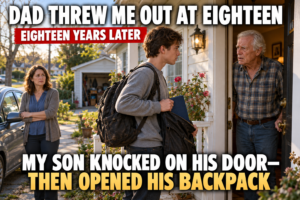
The boy he called “a bad choice” abandoned me soon afterward. I raised my son alone and never returned to my childhood home.
Eighteen years later, on his birthday, my son put his backpack beside the kitchen table.
“Mom, I want to visit Grandpa. I’ve been preparing for this.”
At the house, he asked me to wait in the car.
I watched my father open the door.
Then my son reached into his backpack—and brought out something I hadn’t known he was making.
Continue Read More…