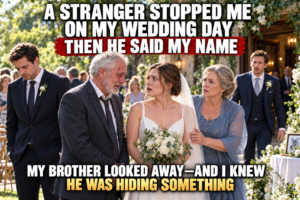
For twelve years, my mother never asked whether I was safe or happy. On my wedding day, a stranger rushed toward me, shouting for me to stop. Then he hugged me, whispered a childhood nickname, and shattered the one story about my family I had never questioned.
Part 1
My mother cried when my brother left for college.
She stood in the driveway holding a handkerchief she had ironed that morning, waving until his car disappeared around the corner. That evening, she left his bedroom door open and made his favorite dinner even though he wasn’t there to eat it.
Two years later, when I moved out, she asked whether I was taking the good suitcase.
“The zipper sticks,” I said.
“It still belongs here.”
I unpacked my clothes into a laundry bag.
She watched from the kitchen doorway, then returned to a television program before I finished.
I was eighteen. I had three hundred and eighty dollars, a place in a training program, and a room waiting above a florist’s shop where the radiators knocked all night.
My brother Daniel had left with a car, a laptop, and envelopes of emergency money tucked into his luggage.
I left with a bag of clothes and my school certificates wrapped in a towel so they wouldn’t bend.
For years, I had tried to make my mother notice me.
I learned to cook the meals she liked. I kept my grades high. I cleaned the bathroom before she asked and listened when she complained that Daniel didn’t call often enough.
Whenever he came home, the house changed.
She bought better coffee. She put fresh sheets on his bed. She laughed at stories that weren’t particularly funny and touched his shoulder whenever she passed him.
If I spoke too long, her eyes moved toward the clock.
“You always make everything so complicated, Hannah.”
Eventually, I learned to finish my stories before anyone could interrupt.
My father wasn’t there to notice.
According to my mother, he died when I was six.
I remembered him in fragments: a deep laugh, a blue work jacket, the smell of oranges on his hands because he peeled them for me in one long strip.
Sometimes I dreamed of sitting on his shoulders beneath a row of trees.
When I asked about him, Mom said talking only made the sadness worse.
So I stopped asking.
After I moved out, I waited for her to call.
I kept the phone beside my pillow the first night. The second night too.
A week later, I sent a message telling her I had arrived safely.
She replied with a question about a missing serving spoon.
Months passed.
Then years.
I stopped sending updates she didn’t answer.
There were people who helped me build a life anyway.
Ruth, the florist downstairs, taught me which flowers survived being forgotten in a hot delivery van. My supervisor helped me apply for a better job. Friends invited me to ordinary dinners and noticed when I went quiet.
Then I met Owen.
He worked as an electrician, owned too many nearly identical jackets, and asked questions as if he genuinely expected the answers to matter.
The first time I became ill at his apartment, he brought water without sighing about the inconvenience.
I cried after he went into the kitchen.
He found me and thought the fever had worsened.
I couldn’t explain that being cared for still startled me.
Twelve years after leaving my childhood home, I stood in a wedding dress inside a small garden venue, watching Ruth arrange the ribbon on my bouquet.
My mother had received an invitation.
She had not replied.
I told everyone I wasn’t waiting.
Then a car pulled into the courtyard, and I looked toward it before I could stop myself.
Part 2
The car belonged to Daniel.
He stepped out wearing a dark suit and the uncertain expression he had carried through most of our recent conversations.
For years, we had exchanged birthday messages and little else.
He wasn’t cruel in the open way our mother could be. He simply grew up accustomed to being the person whose needs interrupted everyone else’s.
If she forgot my birthday, he assumed I didn’t care about birthdays.
If I missed a family dinner, he assumed I was busy.
When I finally told him why I stopped coming home, he said, “You know how Mom is.”
As if knowing the weather prevented you from getting wet.
But over the previous year, something in him had changed.
He began calling without a favor to ask. He listened when I corrected his memories. Once, he admitted that the bicycle he remembered as a joint birthday present had never been mine to ride.
I invited him because he was trying.
Now he stood beside his car, speaking to someone still seated inside.
I turned away before seeing who it was.
“You don’t have to check every arrival,” Ruth said gently.
“I’m not.”
She raised one eyebrow.
I smiled despite myself.
Ruth had known me since the day I arrived above her shop carrying a laundry bag. She had watched me learn to budget, mend clothes, negotiate wages, and accept invitations without assuming I needed to earn them.
When Owen proposed, she cried harder than I did.
She was walking me down the aisle.
That decision had taken less than a minute.
There were sixty guests, wooden chairs beneath the trees, and a cake made by a friend who had warned me not to expect perfectly straight icing.
It was exactly the wedding I wanted.
Near the entrance, on a small table, stood a framed photograph of my father.
I had found it in a box before leaving home: him standing beside a lake, dark hair pushed back from his forehead, smiling at someone outside the frame.
I couldn’t remember who took it.
Beneath it, the venue coordinator had placed a card:
Dad, I wish you could have been here.
I had written the words the night before.
Now I straightened the frame.
Ruth touched my elbow.
“How are you feeling?”
I thought about giving the easy answer.
Then I said, “Happy. And sad that happy still feels like something I need to explain.”
She squeezed my arm.
From the garden, I heard chairs moving and the musicians checking the opening notes.
Owen was waiting beneath the trees.
I took a breath.
Then someone shouted.
“Stop!”
The voice came from the courtyard.
A white-haired man was hurrying toward us, one hand lifted, his face drained of color.
Daniel followed several steps behind.
“Please,” the man said. “Or I will never forgive myself.”
The coordinator moved between us.
“Sir, you need to—”
He stopped a few feet away.
His eyes were fixed on the photograph.
Then on me.
“Hannah.”
I froze.
I didn’t know this man.
Yet something about the way he said my name made the floor feel unsteady beneath my feet.
He came closer, slowly now.
“Little Sparrow,” he whispered.
The bouquet slipped against my skirt.
No one had called me that since the man in the photograph was supposed to have died.
Part 3
He reached for me.
I should have stepped back.
Instead, I stood motionless as his arms closed around my shoulders and he began to cry.
There was something familiar in the shape of the embrace.
One hand against the back of my head. A little space left between our bodies, as if he was afraid of crushing something fragile.
My father used to hold me like that after nightmares.
I remembered it before I understood why.
Then I pulled away.
“Who are you?”
The man let go immediately.
He looked ashamed.
“I’m sorry. I shouldn’t have done that.”
Daniel stood behind him, breathing hard.
“Hannah, I need to explain.”
I looked from one to the other.
The older man had a small scar through his left eyebrow.
My father got that scar fixing a shelf. I remembered asking whether the stitches were made from sewing thread.
I stared.
“Dad?”
He nodded.
The courtyard tilted.
Ruth took the bouquet from me and put an arm around my waist.
“Sit down,” she said.
I couldn’t.
“My father is dead.”
Daniel closed his eyes.
“No.”
“Mom told me.”
The man in front of me looked as though something had struck him.
“She told you I died?”
I stepped backward.
“There was an accident.”
My voice sounded small.
“A work accident. She said there wasn’t… she said I shouldn’t ask about the funeral because it would upset her.”
Dad pressed a hand against his mouth.
I could hear the musicians from the garden.
Someone had started playing the same few bars again.
“Hannah?”
Owen appeared at the doorway.
He took one look at my face and came straight to me.
“What happened?”
I tried to answer.
Nothing came out.
Ruth spoke quietly to the coordinator, who nodded and went toward the guests.
Owen held both my hands.
“Do you want everyone to leave?”
I shook my head.
“Do you want a room?”
I nodded.
He didn’t ask who had ruined the wedding or how much time we were losing.
He led me to a small sitting room near the kitchen.
Ruth followed.
Daniel and the man waited outside until I said they could enter.
My father sat opposite me, not beside me.
Up close, I could see the younger face beneath the years. The same eyes. The scar. The crooked little finger from an injury he once let me wrap in a toy bandage.
It was him.
That knowledge didn’t bring joy.
It arrived as a kind of terror.
If he was alive, I had not simply lost my father. I had been living inside someone else’s explanation of why he disappeared.
“Where have you been?” I asked.
He drew a breath.
“Your mother and I separated when you were six.”
“No.”
“Hannah—”
“No. She said you died.”
He looked at Daniel.
My brother stared at the floor.
And in that moment, before anyone spoke, I understood there was another question I had to ask.
“Daniel,” I said, “how long have you known he was alive?”
Part 4
My brother’s face changed.
He looked toward the window, then toward the door, as if there might be a place in the room where the answer would hurt less.
“Since we were children.”
Owen’s hands tightened around mine.
I stared at Daniel.
He was two years older than me.
Eight when our father disappeared.
Old enough to remember more, but still a child.
I tried to hold on to that.
“You knew,” I repeated.
“Mom told us different things.”
“And you never noticed?”
“At first, she said Dad had gone away and you weren’t ready to talk about it. She told me not to mention him because you became upset.”
I remembered becoming upset.
I remembered asking when we would visit his grave.
Mom shut herself in her room that afternoon and didn’t come down for dinner.
Afterward, Daniel told me to stop making her cry.
“I was eight,” he said quietly.
“You weren’t eight forever.”
He nodded.
“I know.”
Dad leaned forward.
“I need to answer for my part.”
I looked at him.
“Then answer.”
He and my mother had separated after years of arguments I barely remembered. He moved into rented accommodation near work. There were arrangements for support and contact, but the visits became difficult.
Daniel went sometimes.
I didn’t.
Dad was told I refused.
At first, he thought my mother was helping me settle. Then he thought I was angry with him. Later, when work took him farther away, he allowed distance to become an arrangement he didn’t challenge strongly enough.
“I sent letters,” he said.
I looked at my empty hands.
“I didn’t receive them.”
He took a thin envelope from inside his jacket.
“I brought these because Daniel said there were things we needed to discuss. Not because I knew what she had told you.”
He placed copies of two letters on the table.
One was in my mother’s handwriting.
Hannah needs stability. Every time you write, she becomes distressed. Please stop making this harder for her.
The second was typed.
It carried my name at the bottom.
I don’t want contact. Please respect that.
I read it twice.
“I didn’t write this.”
Dad nodded slowly.
“I know that now.”
“How old was I supposed to be?”
“Sixteen.”
At sixteen, I used to sit in the school library on rainy afternoons and imagine what my father would say about my drawings.
At sixteen, I kept his photograph inside a textbook because Mom said displaying it prevented everyone from moving forward.
“You believed this?”
His eyes filled.
“Yes.”
“Without hearing my voice?”
He lowered his head.
“I was a child when the silence started,” I said. “You were one of the adults responsible for ending it.”
He didn’t defend himself.
“You’re right.”
I looked at Daniel.
“Why now?”
His throat moved.
“Because three weeks ago, I found something in Mom’s house.”
He reached into his bag.
“And I finally stopped accepting what she said.”
Part 5
Daniel placed a small cardboard box on the table.
The lid was bent at one corner.
Across it, in faded marker, my mother had written my first name.
For a second, I thought of all the things she might have saved.
School reports.
Birthday cards.
Some evidence that I had mattered quietly, even when I couldn’t see it.
Daniel lifted the lid.
Inside were envelopes.
My name appeared in a handwriting I didn’t recognize.
There were birthday cards, letters, a few returned photographs, and a small drawing of a bird with its wings spread.
I reached for it.
On the back, Dad had written: Saw this and thought of my Little Sparrow.
The date was the year I turned ten.
I put it down before my hand began shaking too badly.
“You found these three weeks ago?”
Daniel nodded.
“Mom asked me to help clear the spare room. She said the box was old paperwork.”
“And?”
“I opened it.”
He looked miserable.
“I called Dad. Then I asked Mom questions. She said you knew he was alive, but you’d decided he was dead to you.”
I laughed once.
There was nothing funny in the sound.
“That’s convenient.”
“I know.”
“Do you?”
He looked at me.
“I kept remembering things. You asking about graves. You crying when someone’s father came to school. Mom telling me to leave you alone because you liked being dramatic.”
His voice broke.
“I should have asked you years ago.”
“Yes.”
“I thought you hated him.”
“You thought a lot of things that made it easy not to call.”
He accepted that too.
Ruth moved a glass of water closer to me.
“You don’t have to keep doing this now,” she said.
From outside, I heard a burst of laughter followed by chairs scraping against the patio.
Our guests were being served drinks.
My wedding was waiting beyond the door.
“Why didn’t you tell me before today?” I asked.
Daniel covered his face.
“I was scared.”
“Of me?”
“Of what I’d helped happen. Of telling you and losing you completely.”
“So you waited until I was wearing this?”
I looked down at my dress.
His eyes followed.
“I told Dad you agreed to meet him here before the ceremony.”
The room went still.
Dad turned sharply.
“You told me she knew.”
“I thought if you were both here—”
“Stop,” I said.
Daniel closed his mouth.
“You decided what I could handle without asking me. Do you understand why that sounds familiar?”
He stared at me.
Then he began to cry.
I didn’t reach for him.
“I’m sorry,” he said. “I wanted to fix it.”
“You wanted to avoid the part where I might be angry with you.”
His shoulders lowered.
“Yes.”
That was the first answer that sounded fully honest.
Dad looked toward the doorway.
“I shouldn’t have shouted. I saw the photograph and the card. I thought you were about to go out there believing…”
He stopped.
“I panicked. I’m sorry.”
I leaned back in the chair.
There were too many apologies in the room and no place inside me to put them.
Then my phone began vibrating on the table.
The name on the screen was one I had stopped expecting to see.
Mom.
Part 6
I watched the phone vibrate until it stopped.
Then a message appeared.
Daniel says you are upset. Don’t let people spoil your wedding with old stories.
I looked at my brother.
“You called her?”
“Before we arrived. She asked where we were.”
I picked up the phone.
For twelve years, she had not asked whether I was safe.
Now she knew I was upset, and her first concern was what I might hear.
Owen looked at me.
“What do you want?”
It was such a simple question.
I had spent most of my childhood being told what I wanted.
Less attention. More independence. A quieter birthday. No fuss.
Now I sat in a wedding dress while someone waited for my actual answer.
“I want her to say it to me.”
I called.
She answered immediately.
“Hannah, I don’t know what your brother has been telling you.”
“Did you tell me Dad was dead?”
Silence.
“This is not the time.”
“You’ve had twenty-four years to choose a better one.”
I could hear a television in the background.
The ordinary sound made me suddenly furious.
She was at home, perhaps in the same chair where she watched me pack my clothes.
My entire childhood had changed, and she had not even turned down the volume.
“I was protecting you,” she said.
“From what?”
“From disappointment.”
“By making me grieve someone who was alive?”
Her breath sharpened.
“You don’t understand what your father put me through.”
“Then you should have spoken to another adult.”
She said nothing.
“Why did Daniel get to know?”
“He was older. He remembered more.”
“He was eight.”
“You were always asking for your father. Every day. Every night. Nothing I did was enough.”
I closed my eyes.
There it was.
A little girl missing her father had become a grievance my mother carried against her.
“I was six.”
“I was alone.”
“You had two children.”
My voice shook.
“You made one of us feel like company and the other feel like punishment.”
She began to cry.
For most of my life, that sound had meant the conversation was over. Whatever hurt I brought to her had to make room for hers.
I stayed quiet.
Finally, she said, “Daniel stayed close. You shut me out.”
“I moved away after years of trying.”
“You never came home.”
“You never asked me to.”
She breathed unevenly into the phone.
“You cannot call twelve years of not looking for me a decision we made together.”
Dad bowed his head.
The words applied to more than one person in the room.
“I sent you an invitation,” I continued.
“I didn’t think you really wanted me there.”
“You could have asked.”
Again, there was no answer.
I looked toward the door, beyond which Owen’s family and our friends were waiting.
“I’m getting married today,” I said. “I’m not spending the rest of it convincing you I was worth a phone call.”
“Hannah—”
“We can speak another time if I decide I’m ready.”
I ended the call.
My hands shook so badly Owen took the phone before it slipped.
Then I turned toward my father.
“Now,” I said, “I need to know why you stopped looking too.”
Part 7
Dad sat with the question for a long time.
“Because I was a coward,” he said finally.
I stared at him.
I had expected another story about my mother.
Instead, he looked directly at me.
“I let difficult become impossible because it was easier than admitting I didn’t know how to fight for you without fighting with her.”
He rubbed one thumb across the scar on his hand.
“I paid what I was supposed to pay. I wrote. I asked questions. Then, whenever I was told you didn’t want me, I allowed myself to feel rejected instead of remembering how young you were.”
I looked at the box.
“You could have come to school.”
“Yes.”
“You could have asked to hear it from me.”
“Yes.”
“You could have kept trying after I was eighteen.”
His face tightened.
“Yes.”
I hated how much relief there was in hearing someone stop arguing with reality.
It didn’t make the reality kinder.
“I believed I was respecting your wishes,” he said. “That’s what I told myself. There were days I knew I was also protecting myself from hearing something painful.”
He drew a slow breath.
“You paid for that.”
I looked toward Ruth.
She had tears in her eyes, but she stayed quiet.
She had never met my father. When I moved above her shop, I told her he was dead. She had lit a candle for him on the anniversary I thought I remembered.
There were so many people who had lived gently around a lie they didn’t know was there.
“I talked to your photograph,” I said.
Dad pressed his lips together.
“When I passed exams. When I got my first proper job. When I met Owen.”
Owen looked down.
“I told you things because I thought somewhere, somehow, you might know.”
My voice broke.
“And you were living somewhere with a phone.”
Dad began to cry again.
“I’m sorry.”
I nodded, though I didn’t know what the nod meant.
Outside, someone knocked softly.
The coordinator asked whether I needed more time.
I looked at the clock.
We were almost forty minutes late.
My wedding dress was creased across my lap. The bouquet lay on a side table. Somewhere beyond the garden, the caterers were keeping food warm while I tried to understand my own life.
I stood.
“I need everyone except Owen and Ruth to leave this room.”
Daniel rose immediately.
Dad did too.
At the door, he hesitated.
“Would you like me to leave the venue?”
I looked at him.
That question hurt because I had wanted the right to answer it all my life.
“Wait in the courtyard,” I said. “Please don’t speak to the guests.”
He nodded.
Daniel picked up the box.
“Leave it,” I said.
He set it down carefully.
When they were gone, I sat on the edge of the sofa.
“I don’t know what to do.”
Owen knelt in front of me.
“About them?”
“About anything.”
He took my hands.
“You don’t have to decide who deserves the rest of your life before we get married this afternoon.”
I looked at him.
“Do you still want to?”
His expression softened.
“More than I want the schedule to make sense.”
I laughed through tears.
Then Ruth sat beside me.
“Tell us what would make the next ten minutes easier.”
For the first time that day, the future became small enough to hold.
Part 8
The first thing I wanted was to wash my face.
Ruth helped me without commenting on the makeup.
The second was to eat something.
Owen brought half a sandwich from the kitchen and sat beside me while I finished it.
For years, family crises had swallowed ordinary needs.
Someone else was upset, so I couldn’t be hungry. Someone else was disappointed, so I couldn’t be tired. Someone else needed understanding, so I couldn’t need an answer.
Now I ate a sandwich in my wedding dress while two people made sure I had water.
The world did not end.
“I want to marry you,” I told Owen.
He smiled.
“Good. I brought the ring.”
I took his hand.
“But I don’t want to pretend none of this happened.”
“Then we won’t.”
We decided the ceremony would continue when I was ready. The guests would be told there had been unexpected family news and that I appreciated their patience.
Nothing more.
My childhood did not belong to sixty people because they had dressed nicely and traveled.
Then I thought about the memorial table.
“Please take the card down,” I said.
Ruth nodded.
“The photograph too?”
I hesitated.
“Put them somewhere private. I don’t want them thrown away.”
She understood.
The little girl who believed in that photograph was still part of me. I didn’t need to punish her for trusting what she had been told.
When Ruth returned, I asked to see Daniel.
He came in alone.
His face was blotchy from crying.
“I’m not asking you to forgive me,” he said.
“Good. Because I can’t answer that today.”
He nodded.
“I want you to stay for the ceremony,” I told him. “But after today, I need time. Don’t send me messages about how badly you feel. Don’t ask Owen to speak to me. And don’t arrange anything else on my behalf.”
“I won’t.”
“If Mom calls, you tell her what you did. You don’t say I overreacted.”
He looked at me.
“You didn’t.”
I waited.
“I brought him here without your permission. I lied to him about you agreeing. I made your wedding the place where you had to deal with it.”
He took a breath.
“I’ll say that.”
I nodded.
Then I asked Dad to come in.
He stood just inside the door, hands at his sides.
“You may stay,” I said. “As a guest.”
His eyes filled.
“Thank you.”
“Ruth is walking me down the aisle.”
He nodded immediately.
“She should.”
I studied his face for resentment.
I found none.
“There won’t be a father-daughter dance. No speech. No introductions as if we’ve had a normal life together.”
“I understand.”
“And afterward, I need you to wait for me to decide whether I want contact.”
His voice was barely above a whisper.
“I will.”
His being alive did not make him entitled to the place someone else had earned beside me.
When he left, Ruth adjusted my veil.
Her hands trembled.
“You still sure about walking with an old florist?” she asked.
I took her arm.
“You’re the person who noticed when I got home.”
She closed her eyes.
Then she kissed my forehead.
Outside, the music began again.
This time, I was ready to move.
Part 9
The guests stood when we entered the garden.
For a moment, I saw only faces.
Friends from work. Ruth’s sister. Owen’s cousins. The woman who lived below our apartment and always accepted parcels when we were out.
People who knew ordinary pieces of my life.
They smiled gently, without demanding an explanation.
I held Ruth’s arm.
Halfway down the aisle, I saw my father.
He sat near the back beside Daniel.
His hands were folded tightly in his lap.
I looked at him for a second.
Then I looked ahead.
Owen was waiting beneath the trees.
His expression changed when he saw me, and something inside my chest finally loosened.
I had spent the morning learning that people I loved had built silence around me.
Here was someone who asked questions and waited for answers.
Ruth placed my hand in his.
There was no ceremonial claim, no pretending she owned the right to give me away.
She squeezed my fingers and took her seat.
The officiant waited until I nodded.
Then we began.
I don’t remember every sentence.
I remember the leaves moving above us.
I remember Owen’s thumb brushing my hand.
I remember realizing I was allowed to feel happy while still being hurt.
When it was time for my vows, I unfolded the page I had written weeks earlier.
The words looked different now.
I had written about steadiness, kindness, and the life we were making.
They were no less true because the morning had been difficult.
“You listen when I tell you who I am,” I said.
My voice shook.
“You don’t turn my quiet into agreement. You don’t make me earn the right to need something.”
Owen’s eyes filled.
I took a breath and continued.
“I promise to ask instead of assume. To tell you the truth even when I’m ashamed. And to remember that loving you includes letting you speak for yourself.”
Behind me, someone began to cry.
I didn’t turn.
For once, another person’s tears did not pull me away from my own life.
We exchanged rings.
We kissed.
Our friends cheered loudly enough to startle birds from the nearest tree.
At the reception, people ate the food, admired the slightly crooked cake, and complained fondly about the wind lifting the napkins.
The day became ordinary in the best possible way.
Dad remained where he had been seated.
He spoke when someone addressed him and didn’t try to collect photographs that would suggest more closeness than existed.
Daniel helped the catering staff carry an extra table without being asked.
I noticed both things.
I did not turn either into forgiveness.
Before leaving, Dad approached Owen and me.
“Congratulations,” he said.
“Thank you,” I replied.
He looked toward Ruth.
“And thank you for being there for her.”
Ruth met his eyes.
“She made it easy to care about her.”
He lowered his head.
Then he left.
That night, after Owen and I returned to the little cottage we had booked nearby, I opened the cardboard box.
There were years of my name written across envelopes.
I didn’t open all of them.
I chose one from the year I turned seven.
Inside was a birthday card with a drawing of a bird.
Dad had written only a few lines.
I hope your birthday has cake, sunshine, and something that makes you laugh. I miss you, Little Sparrow.
I sat on the edge of the bed until Owen joined me.
Then I cried for a birthday that had happened twenty-three years earlier.
Part 10
Finding out someone is alive does not return the years you spent believing they were dead.
In the months after my wedding, I learned that slowly.
There were mornings when I woke feeling grateful.
Then I would remember an unanswered question from childhood and become angry all over again.
Dad wrote once, using the address I gave him through Daniel.
The letter contained no request to be forgiven.
He described what he remembered, what he had been told, and the decisions he wished he had challenged.
He admitted that the story about my refusing contact had become easier to accept than the work of finding out whether it was true.
I read it with a counselor.
Then I put it away for a while.
My mother sent messages.
At first, she said Daniel had exaggerated.
Then she said I didn’t understand the pressure she had been under.
Finally, she wrote that she hoped I would remember she was still my mother.
I answered once.
I told her I was willing to read an honest account of what she had done. I was not willing to discuss my reaction while she denied the reasons for it.
She did not reply to that message.
I stopped checking.
Daniel and I began again carefully.
He learned to call without reporting on Mom’s mood. He stopped saying she meant well when he couldn’t explain what she meant.
Sometimes he made mistakes.
When I pointed them out, he listened instead of reminding me that he had suffered too.
That was new.
Dad and I met for coffee four months after the wedding.
I chose the place.
We stayed an hour.
He asked about my work, and I found myself giving the short answer out of habit.
Then he asked another question.
And another.
I told him more.
When the hour ended, he didn’t ask when I would see him again.
“Thank you for coming,” he said.
I nodded.
A few weeks later, I agreed to another coffee.
Our relationship grew in small, uneven pieces.
He learned that I hated being called without warning late at night because it made me expect bad news.
I learned that he still peeled oranges in one long strip.
Once, seeing it made me cry so suddenly that the people at the next table looked over.
He didn’t reach for an easy explanation.
He sat with me.
That mattered more than the orange.
On our first wedding anniversary, Owen and I invited Ruth for dinner.
We looked through the photographs afterward.
There I was walking beneath the trees, Ruth beside me, my bouquet tilted because I had been gripping her arm too tightly.
In the background, near the back row, sat my father.
Alive.
Present.
Still someone I was learning whether I could trust.
I closed the album and leaned against Owen.
Ruth was in the kitchen wrapping leftover cake, complaining that we always gave her too much.
My phone lit up.
A message from Dad.
Happy anniversary. I hope today is peaceful.
No guilt.
No demand.
I wrote back: It is. Thank you.
Then I put the phone down.
For most of my life, I had waited for my family to notice me. That evening, I returned to the people who already did.