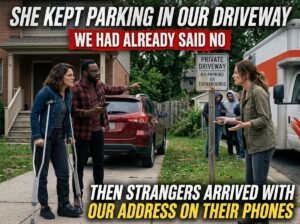
Our neighbor apologized every time we asked her to move her car. Then she parked in our driveway again. I thought her camper was the problem—until a stranger knocked on our door holding a pickup confirmation with our address, and three more cars pulled in behind him.
Part 1
The first time Lindsay parked in our driveway, I assumed she had a good reason.
We had lived beside her for fourteen months. She borrowed our ladder once, brought us a tin of biscuits at Christmas, and knew exactly which delivery driver left parcels where rain could reach them.
We weren’t close friends, but we were friendly.
So when I came home on Monday and found her silver car beside our garage, I didn’t immediately think we were about to become the subject of a neighborhood argument.
I parked at the curb and knocked on her door.
She answered holding a mug.
“Oh, that’s yours?” she said when I pointed toward the driveway.
I looked at our house.
Then back at her.
“Yes.”
She laughed.
“Sorry. Long day. I meant, are you home already?”
She collected her keys, moved the car, and waved.
I forgot about it.
On Tuesday, my husband Ben came home first.
Her car was there again.
He asked her to move it and explained that we needed our driveway available. She apologized, said the camper on her property made parking difficult, and promised it wouldn’t happen again.
On Wednesday, I returned from a doctor’s appointment wearing a rigid walking boot.
Six weeks earlier, I had slipped on wet stairs outside my office. I was healing, but walking any distance still made my ankle ache.
Lindsay’s car sat across the widest part of our driveway.
The space left beside it was too narrow for me to open my door properly.
I stopped at the curb, rested my forehead against the steering wheel, and counted to ten.
Then I knocked.
She opened the door with the same mug.
“What’s wrong?”
“You’re parked in our driveway again.”
She glanced past me.
“Right.”
“We’ve asked you twice not to.”
“I know. It’s just difficult with the camper.”
The camper was large, white, and parked on the left side of her driveway. It had appeared the previous weekend.
“Then you need to work out another arrangement,” I said.
She looked at my boot.
“Can’t you park on the street for now?”
I stared at her.
“I’m standing here because walking hurts.”
“I meant Ben could help you.”
“Ben is at work.”
Her expression tightened, as though I was introducing inconvenient details into an otherwise sensible plan.
“I’m only using it when you’re not there.”
“But I am here.”
“And I’ll move it.”
She said it with the weary patience of someone settling a small child.
For the first time, I understood that the apologies weren’t changing her mind. They were simply ending the conversations.
I shifted my weight onto my good foot.
“Lindsay, I need you to hear this clearly. You don’t have permission to park on our property.”
She folded her arms.
“The people who lived here before you never minded.”
“We’re the people living here now.”
She looked toward the street.
“Fine.”
She moved the car.
That evening, Ben and I ate dinner beside the open kitchen window.
We heard her car door close.
Then footsteps crossed the strip of gravel between our houses.
I looked outside.
Her car was back in our driveway.
This time, she had waited until we were both home.
Part 2
Ben put down his fork.
“Please tell me that’s a visitor’s car.”
“It isn’t.”
He stood, then sat again when he saw me reaching for my walking stick.
“I’ll go.”
“We’ll both go.”
By the time we reached her porch, Lindsay had switched on the television.
She answered with a puzzled expression.
“Again?”
Ben took a breath.
“Yes. Again.”
“I thought you meant you needed the space this afternoon.”
“We meant you cannot park there,” I said.
She looked at me, then at Ben.
“It’s an empty driveway most of the day.”
“That doesn’t make it available,” he replied.
“You have two spaces.”
“And two cars.”
“Which aren’t always here.”
I could feel the conversation trying to become a puzzle she might win if she rearranged enough facts.
Ben stopped it.
“We’re not negotiating which hours you can use it. We’re saying no.”
Her face changed.
“Well. That’s neighborly.”
She moved the car without another word.
Inside our house, Ben closed the blinds.
“I don’t want this becoming a thing,” he said.
“Neither do I.”
We had saved for years to buy the place. It wasn’t grand, but there was room for a vegetable patch, a garage Ben used as a workshop, and a driveway I had never imagined needing to defend.
We wanted quiet.
That night, I wrote Lindsay a short message.
I repeated that she did not have permission to park on our driveway or allow anyone else to use it. I asked her to keep access clear.
There were no insults.
No threats.
She replied with a thumbs-up.
The next morning, her car stayed on the street.
I thought the problem was over.
By lunchtime, she had posted in the neighborhood group.
A screenshot arrived from our neighbor across the road.
Some people move onto a friendly street and immediately forget how to be decent. Apparently an empty driveway is more important than helping someone manage a difficult family situation.
There was no name.
There was a photograph of our two houses.
Our driveway was empty.
My car was at work. Ben’s was at a repair shop because a warning light had appeared.
To anyone looking at the photograph, we owned a broad stretch of unused concrete and an unreasonable dislike of sharing.
Comments appeared quickly.
People have become so selfish.
My old neighbors would have given me the keys.
Has anyone actually asked them?
That last comment belonged to a man named Graham who lived three doors down.
Lindsay answered him.
Repeatedly. They’ve made their position clear.
I stared at my phone.
“They have,” I murmured.
My coworker glanced over.
“Everything okay?”
I nearly said yes.
Instead, I put the phone away and finished my lunch.
I wasn’t going to argue with strangers about my own driveway while a bowl of soup went cold.
That evening, Ben and I agreed on two things.
We would keep records.
And we would not retaliate.
No blocked cars. No sprinklers pointed at her windows. No notes designed to be photographed.
I wanted access to my front door, not a hobby.
Then, shortly after seven, someone rang our bell.
A man stood outside holding his phone.
“I’m here for the oak dining table,” he said.
I blinked.
“What dining table?”
He showed me a message.
Our address was listed beneath the words: COLLECTION POINT—PLEASE PULL INTO THE DRIVEWAY.
Part 3
The man’s name was Aaron.
He had driven forty minutes after finishing work, borrowed a trailer from his brother, and brought his teenage daughter to help carry the table.
He looked as confused as I felt.
“Are you not Lindsay?”
“No.”
Behind him, a trailer sat partly across our driveway entrance.
Ben came to the door.
Aaron showed him the message.
There was a photograph of an oak table, a collection time, and instructions to use the wide driveway beside the white camper.
“That’s next door,” Ben said.
“She told me to wait here.”
Lindsay appeared before we could ask another question.
“Aaron! Over here.”
She waved from beside the camper as though this was all perfectly ordinary.
He looked relieved.
“Sorry about that.”
He began moving his vehicle.
“Wait,” I said.
Lindsay stopped smiling.
“Why did you give him our address?”
“He’s collecting something.”
“From you.”
“The GPS gets confused.”
“Your message told him to use our driveway.”
She glanced at Aaron.
“Can we discuss this later?”
“No. Please correct the address now.”
Aaron looked down at his phone, clearly wishing he had bought a different table.
Ben stepped away from the doorway.
“You haven’t done anything wrong,” he told him. “But we need our access clear.”
Aaron nodded quickly and moved.
The table emerged from Lindsay’s garage ten minutes later.
So did two chairs, a bookcase, and a woman carrying a boxed lamp.
I watched from the window.
“Is she moving?” I asked.
Ben looked toward the garage.
“That’s a lot of furniture.”
We had seen boxes there before, but the door usually stayed closed.
Now it was open enough to reveal rows of items with paper labels attached.
Lindsay was running a secondhand furniture business.
There was nothing wrong with that in itself.
What bothered me was the clipboard hanging beside her garage door.
Several collection times were listed beneath the same handwritten instruction.
Use next-door drive for loading.
I took a photograph from our property.
Then I sent another message.
Do not direct customers to our address or driveway. Anyone collecting from you needs to use your property or arrange another suitable collection point.
This time, there was no thumbs-up.
There was a long reply about how we were making it impossible for a small business to survive.
She said the camper belonged to her father. He was downsizing. She was helping with his belongings. Everything was temporary.
Then she wrote: The previous owners agreed to help during sales.
I showed Ben.
“Sales,” he said.
Plural.
The next morning, I called the woman who had sold us the house.
We still exchanged the occasional message about misdirected post.
Her name was Judith.
“Lindsay’s using your driveway?” she asked.
“She says you had an arrangement.”
Judith sighed.
“Once. For a charity sale three summers ago. My husband moved our car so an older woman could load a cabinet.”
“Did you give her anything in writing?”
“A note for the volunteer collecting it. Why?”
I looked toward Lindsay’s house.
“I think,” I said, “your one afternoon has become a permanent arrangement.”
Judith was quiet.
Then she asked, “Has she shown you the note?”
“Not yet.”
“Ask her to show the whole page,” Judith said. “Especially the date.”
Part 4
By Friday afternoon, Lindsay had changed her explanation again.
When Ben asked her to remove the collection instructions, she said the driveway had always been shared.
“It’s how the houses were built,” she told him.
He looked down at the narrow strip of gravel separating our properties.
“No, it isn’t.”
“You should check before making accusations.”
So we checked.
We took out the documents from our purchase, including the survey we had paid for before completing. We contacted the professional who had handled the property work and asked him to review what Lindsay was claiming.
He confirmed what the documents showed about our driveway and explained that nothing in the papers supported the arrangement she described.
We weren’t relying on a fence, a guess, or a neighborhood opinion.
Then Ben asked Lindsay to show us her note.
She sent a photograph.
The image was cropped tightly around two lines.
Lindsay may direct collection vehicles into our driveway for loading. Please leave access clear afterward.
At first glance, it looked useful to her.
I forwarded it to Judith.
Twenty minutes later, Judith sent back a photograph of the original page from an old folder.
Above the two lines was a heading.
Community Furniture Collection—Saturday, June 12.
Below them was another sentence.
This permission applies to the charity collection between ten and two only.
I sat at our kitchen table holding the phone.
Ben read it over my shoulder.
“She cut it off.”
“Yes.”
He pulled out a chair.
“I was hoping she was just being thoughtless.”
So had I.
Thoughtlessness could be corrected by information.
This required her to stop benefiting from something she already knew wasn’t hers.
Judith gave us permission to share the full note with the people directly involved.
I sent Lindsay the complete image.
I repeated, once more, that there was no permission to use our driveway.
Then I stopped typing.
For an hour, nothing happened.
At six, the neighborhood post disappeared.
At six fifteen, Graham knocked on our door holding a bag of tomatoes from his greenhouse.
“Peace offering,” he said.
“For what?”
“For living on a street where everybody has internet access.”
I laughed for the first time in days.
He told us he had asked the group administrator to look at the post because our house was identifiable.
“I don’t know what’s going on,” he said. “But posting half a story usually makes the other half more interesting.”
We showed him the messages and the complete note.
He shook his head.
“I’ll keep an eye out if anyone blocks you.”
We thanked him.
For the rest of Friday evening, the driveway stayed empty.
I began to relax.
Ben installed a small camera covering our entrance and checked that it was aimed at our property, not Lindsay’s windows.
We had planned to do it after a parcel disappeared months earlier.
Now there was another reason.
At nine thirty, a message arrived from an unfamiliar number.
Hello! Lindsay says you’re helping with tomorrow’s clearance. Can we arrive early to set up the card table?
I read it aloud.
Ben closed his eyes.
“Tomorrow’s what?”
I looked outside.
Lindsay was attaching a bright yellow sign to the front of her camper.
WEEKEND CLEARANCE. COLLECTIONS FROM NINE.
Part 5
I called the number.
The woman who answered introduced herself as Mia.
She organized small secondhand sales for people clearing houses, closing workshops, or moving into smaller homes.
Lindsay had hired her to help manage a weekend clearance.
“She said the neighboring driveway was available for loading,” Mia explained.
“It isn’t.”
There was a pause.
“I’m sorry?”
I told her exactly what had happened.
No commentary about Lindsay’s personality. No guesses about her finances.
Just the parking, the messages, the advertisement, and the cropped note.
Mia asked me to forward the relevant records.
When she called back, her voice had changed.
“I’ve told her we cannot use your property. I’m contacting the customers whose details I have.”
“Thank you.”
“Unfortunately, she also posted collections herself. I don’t have all those names.”
I looked toward the yellow sign.
“Of course she did.”
Mia sighed.
“I’ll come early and keep people moving to the right place.”
After the call, Ben and I stood at the kitchen window.
“We could go away for the morning,” he said.
“And come back to a wardrobe on the lawn?”
He rubbed his forehead.
“Fair point.”
I didn’t want a confrontation.
I wanted tea, a quiet Saturday, and enough space to get from my car to my front door without carrying out negotiations on one working ankle.
Instead, we spent the evening checking the appropriate local procedure for dealing with unauthorized parking on our property.
We contacted the relevant local service, explained the situation, and followed the instructions we were given. We kept the messages showing Lindsay had been clearly informed.
We didn’t improvise a punishment.
We prepared for the possibility that she would ignore us again.
Then we put a plain sign at our entrance.
PRIVATE DRIVEWAY. NO CUSTOMER PARKING OR COLLECTIONS.
It looked absurd beside the little planter where I grew rosemary.
On Saturday morning, I woke to the sound of a reversing alarm.
It was eight twelve.
Ben was already at the window.
“You need to see this.”
A small delivery lorry had stopped outside Lindsay’s house.
A man in a high-visibility vest was looking at a clipboard.
Behind him sat Lindsay’s silver car.
In our driveway.
I stared.
“She moved it there before we woke up.”
Ben checked the camera.
Seven forty-three.
The recording showed Lindsay getting out, glancing toward our window, and walking home.
She had parked directly beneath the sign.
I laughed.
It wasn’t a cheerful laugh.
It was the sound you make when the situation has become too ridiculous for your brain to process normally.
Ben put on his shoes.
“I’ll tell her to move it.”
“Once,” I said.
He nodded.
Across the street, Graham emerged in his dressing gown holding a mug.
He looked at the car.
Then at the sign.
Then at us.
He slowly shook his head.
Lindsay answered her door after Ben knocked.
I watched from our porch.
He spoke.
She folded her arms.
Then she shut the door.
Five minutes later, the first customer tried to park behind her.
Part 6
Mia arrived at eight thirty and immediately began earning every penny of her fee.
She stood at the pavement directing customers away from our entrance.
“Next property, please. This driveway is not part of the sale.”
Some people apologized.
Some looked annoyed at being given conflicting instructions.
One man held up his phone and announced that he had already paid for a cabinet and therefore needed somewhere convenient to collect it.
Mia looked at him.
“Convenient doesn’t mean this address.”
I decided I liked her.
Meanwhile, the delivery driver was trying to explain something to Lindsay.
He had come to collect several large pieces for a buyer.
He needed a clear loading area on her property.
Her camper occupied one side.
Her garage was full of stock.
And the narrow space between the two was blocked by boxes she had dragged out before breakfast.
“Use next door,” she said, pointing.
The driver looked at our sign.
Then at Ben.
“Are you agreeing to that?”
“No.”
He nodded.
“Then we’re not doing that.”
Lindsay spread her hands.
“You can see what I’m dealing with.”
“I can,” he said.
She seemed pleased for half a second before realizing he wasn’t looking at us.
At eight forty, a woman arrived for a mirror.
At eight forty-two, two men came for a sofa.
At eight forty-five, someone asked whether the blue bicycle leaning against our garage was for sale.
“No,” Ben said.
“Everything must go, the sign says.”
“Not our things.”
I sat on a chair by the doorway with my ankle raised, watching the morning unfold like a poorly organized play.
The driveway problem had become a traffic problem, a sales problem, and apparently a threat to Ben’s bicycle.
Then a customer backed a small trailer toward our entrance despite Mia waving him away.
He stopped when Ben called out.
But one wheel had already clipped the wooden edge of our front planter.
The timber split.
The rosemary tipped sideways.
Everyone went quiet.
The driver got out, horrified.
“I’m sorry. I thought—she said—”
He looked toward Lindsay.
She was suddenly very interested in a lamp.
Ben spoke to him calmly, photographed the damage, and exchanged the information needed to deal with it.
The man apologized again.
“I wouldn’t have come in if I’d known.”
“We understand,” Ben said.
I looked at Lindsay’s car still sitting beneath our sign.
Then I took out my phone.
We had warned her.
We had given clear written notice.
We had checked the appropriate procedure instead of guessing.
I made the call we had hoped not to make.
When I finished, Mia came over.
“I’m stopping the collections I’m responsible for,” she said. “She hasn’t provided the access she promised.”
“I’m sorry your morning is like this.”
She looked at the broken planter.
“I’m sorry yours is.”
A few minutes later, Lindsay finally came toward us.
“You need to stop making a scene.”
I looked at the crowd, the trailer, the delivery lorry, the damaged planter, and her car.
“Which part do you think we arranged?”
Before she could answer, a recovery vehicle turned onto the street.
Lindsay saw it, looked at her car, and reached into her pocket for keys that weren’t there.
Part 7
She checked her other pocket.
Then her jacket.
“Wait,” she said.
The recovery driver stopped where he had been instructed and spoke with Ben. He checked the information and completed his own assessment before proceeding.
Lindsay hurried back to her house.
For several seconds, she disappeared.
Then she came out holding a handbag upside down.
Receipts fluttered onto the porch.
“I can’t find them.”
No one answered.
The delivery driver glanced at his watch.
Mia told another arriving customer that the collection arrangements had changed.
Graham put down his mug and helped move the woman’s empty trolley away from the road.
The entire street seemed to be correcting a problem Lindsay still insisted belonged to us.
“Just give me ten minutes,” she told Ben.
“You’ve had several days.”
“You’re seriously doing this over a parking space?”
I stood carefully.
“We asked you to move it this morning.”
“I was busy.”
“You shut the door.”
She looked at the recovery driver.
Then at the watching customers.
“This is harassment.”
Mia spoke before I could.
“Lindsay, I saw their messages. You told me you had permission after they explicitly said you didn’t.”
Lindsay turned toward her.
“Whose side are you on?”
“The side of not sending my customers into someone else’s property.”
That was when an older man arrived in a blue pickup.
He parked farther down the road and walked toward the camper.
He had a broad face, white hair, and the cautious expression of someone who had expected an ordinary errand.
“Lindsay?”
She turned.
“Dad.”
He looked at the recovery vehicle.
“What’s happening?”
“They’re having my car removed.”
He followed her gesture toward us.
“Why?”
“Because they won’t let me park here while your camper is in my drive.”
The older man looked at his camper.
Then back at her.
“Why is it still here?”
The question changed the air.
Lindsay’s mouth tightened.
“Dad, not now.”
“You said the storage place couldn’t take it until Monday.”
“They couldn’t.”
“I spoke to them yesterday. The space has been ready since last week.”
I looked at Ben.
He looked as surprised as I felt.
The older man introduced himself as Arthur.
He had left the camper temporarily while arranging storage. He had also asked Lindsay to sell some furniture from his old house after he moved into a smaller place.
She was welcome to sell her own stock alongside it.
He had not known our property was involved.
“She said the neighbors were helping,” he told us.
Lindsay closed her eyes.
“You don’t have to explain everything.”
Arthur looked at our sign.
Then at the broken planter.
Then at me, standing in a walking boot.
“Apparently,” he said, “someone does.”
The recovery driver completed the process he had confirmed was appropriate.
Lindsay watched her car being taken away.
There was no cheering.
No one filmed her face for entertainment.
I felt no triumph.
I felt tired.
All of this had begun because she believed apologizing afterward was easier than asking permission first.
Part 8
Arthur stayed until the collections were sorted.
He moved boxes on Lindsay’s property, helped the delivery driver load from a suitable position, and apologized to every customer who had been given the wrong instructions.
Mia coordinated the remaining arrangements without using our driveway.
It was slower.
It was less convenient.
It was also entirely possible.
By early afternoon, the street was quiet again.
Our planter lay broken beside the rosemary.
The yellow sale sign had come down.
Lindsay had gone to arrange collection of her car.
Arthur knocked on our door before leaving.
“I owe you an apology.”
Ben shook his head.
“You didn’t tell anyone to use our driveway.”
“No. But my things have contributed to a mess you didn’t ask for.”
He looked at the damaged planter.
“May I help with that?”
We explained that Ben had already exchanged details with the customer involved.
Arthur nodded.
He didn’t insist on being the person who fixed everything.
Then he said something that stayed with me.
“I’ve spent years helping her around problems. I should have asked more often whether she was creating them.”
He sounded sad, not angry.
There was little to say to that.
The camper left the following morning with an appropriately arranged towing vehicle.
I watched from the kitchen while making tea.
As it rolled away, Lindsay’s driveway opened into a broad, completely usable space.
There was enough room for her car.
There would have been enough room earlier if she had moved the furniture boxes she didn’t want to rearrange.
Ben stood beside me.
“Look at that,” he said. “A driveway.”
I laughed.
For the rest of Sunday, we did nothing dramatic.
He repaired a cupboard hinge.
I sat outside with a book.
Our cars remained exactly where we wanted them.
Then Graham came over carrying his phone.
“Before you hear it from someone else,” he said.
Lindsay had posted again.
This time, she wrote that we had her car removed without warning while she was helping her elderly father.
There was a photograph of the recovery vehicle.
Our sign was cropped out.
I stared at the image.
“She likes cropping things.”
Graham nodded.
“I’ve noticed.”
Ben looked ready to throw his phone into the hedge.
I understood the impulse.
Instead, we contacted the group administrator privately.
We sent the relevant messages, the complete old note, the time-stamped image of Lindsay parking beneath our sign, and the written account we had kept.
We avoided sharing customer faces or unrelated footage.
We asked for the post to be reviewed and for our house to stop being used as scenery in an inaccurate story.
The administrator, a retired teacher named Pauline, called that evening.
“I’ve read everything,” she said.
“Thank you.”
“I’m removing the post. I’m also asking Lindsay not to post further accusations about you in the group.”
I let out a breath.
Pauline paused.
“There is one thing you should know.”
My stomach tightened.
“What?”
“When I asked her whether you had withdrawn permission, she said yes.”
I looked toward Lindsay’s house.
“Then she knew,” I said. “She just didn’t think our answer counted.”
Part 9
For three days, Lindsay avoided us.
If she came outside while we were near the front garden, she found something urgent to do inside.
Her car stayed on her property.
No customers arrived at our door.
Silence, after a week of explanations, felt luxurious.
We dealt with the damaged planter through the information already exchanged. The customer who clipped it apologized again and followed through on the agreed repair arrangements.
Ben replaced the split timber.
The rosemary survived, though it leaned permanently toward the path.
“It has developed an opinion,” Graham said.
I told him that made it a proper resident of the street.
By Wednesday, I was walking more comfortably.
My doctor was pleased with the progress.
Coming home and parking close to the door felt like an ordinary privilege I had previously taken for granted.
That evening, Lindsay knocked.
She stood outside holding an envelope.
I didn’t invite her in.
Ben came to stand beside me.
“I wanted to talk,” she said.
“All right.”
She looked toward the repaired planter.
“Dad says I owe you an apology.”
I waited.
She heard it too, apparently.
“I mean, I know I do.”
She held out the envelope.
Inside was a short handwritten note.
I read it.
She acknowledged parking without permission, directing customers to our property, and sharing an inaccurate version of events online.
There were no references to how difficult we had been.
That was something.
“Thank you for writing this,” I said.
She nodded.
“I thought you’d get used to it.”
The honesty startled me.
Ben looked at her.
“To what?”
“The parking. The loading. It was easier from your side.”
I looked at the stretch of concrete between us.
She continued.
“The first time, you were nice. I thought when you complained, it was just because you happened to need it then.”
“We explained,” I said.
“I know.”
“Several times.”
“I know.”
She rubbed her hands together.
“I kept thinking once the sale was finished, none of it would matter.”
“It mattered while it was happening.”
Her eyes moved to my walking boot.
“Yes.”
There was a long pause.
“I’m sorry,” she said.
This time, it sounded like a complete sentence.
Ben nodded.
“We want to be able to live next door without this continuing.”
“It won’t.”
“That means no parking here, no collection instructions, and no assuming our absence is permission.”
She nodded again.
“Understood.”
She hesitated.
“Could we start over?”
I thought about that.
I didn’t want a permanent feud.
I also didn’t want to make her comfortable by pretending we were back at Christmas biscuits.
“We can be civil,” I said. “Trust will take longer than this conversation.”
She looked disappointed.
Then she accepted it.
After she left, Ben closed the door.
“Do you believe her?”
I looked at the note.
“I believe she knows we mean it now.”
He nodded.
Outside, Lindsay walked back across the gravel strip between our houses.
She went around our driveway instead of through it.
It was a small thing.
I noticed.
Part 10
Six weeks passed without another car appearing where it didn’t belong.
The camera mostly recorded parcels, birds, and Ben carrying tools he had forgotten to put away.
I stopped checking it every time an engine sounded outside.
My walking boot came off.
The first evening I managed the front steps without thinking about my ankle, Ben applauded from the kitchen.
“Very impressive,” he said. “Next week, stairs with a cup of tea.”
“Let’s not rush greatness.”
Life became boring again.
I had never appreciated boring so much.
Lindsay continued selling furniture, but she changed how she handled collections. Larger items went through a different arrangement with Mia. Smaller ones were collected from her own property at specified times.
She moved stock before customers arrived.
Sometimes it took her longer.
That no longer became our problem.
Arthur visited occasionally.
He parked carefully and always waved.
Once, he brought a small terracotta pot for the rosemary.
“In case the old one holds a grudge,” he said.
I told him the plant seemed more forgiving than I was.
He smiled.
“Plants don’t have to answer the neighborhood group.”
We never became close friends with Lindsay.
We spoke about bins, weather, and a loose roof tile after a storm.
She returned a misdelivered parcel without opening it or attaching a favor.
I thanked her.
That was enough.
One Saturday, a young man arrived to collect a desk from her garage.
He stopped outside our entrance, checked his phone, and began turning toward the driveway.
I was watering plants near the porch.
Before I could speak, Lindsay hurried over.
“Not there,” she said. “That belongs to my neighbors.”
He straightened the car.
“Sorry. Where should I go?”
She pointed to the clear space on her own property.
“Here. I’ll move the boxes.”
She looked toward me.
I nodded.
No speech was needed.
Later, Ben and I sat outside with tea while the evening light reached across the repaired planter.
The private-driveway sign was still there.
We had discussed removing it.
Neither of us felt any urgency.
Graham passed with a basket of greenhouse tomatoes.
“Any trouble?” he asked.
“Terrible,” Ben said. “Nora keeps parking where I want to unload timber.”
“Does she own the driveway?”
“Unfortunately, half of it.”
“Sounds difficult.”
They laughed.
I took the tomatoes and told both of them to find something useful to do.
Across the gravel strip, Lindsay closed her garage.
Her car was parked neatly beside it.
There was room.
There had always been a way to make room.
I carried my empty cup inside, then paused at the kitchen window.
Our driveway held one car, a few fallen leaves, and the soft shadow of the house.
Nothing remarkable.
After weeks of being told we were unreasonable, the ending we wanted was simply coming home and finding our own driveway available.