Five minutes after firing me, my boss ordered me to repair the machine holding up his biggest contract. I raised my termination notice. “That service was free five minutes ago. Now it costs $600,000 an hour.” He laughed—until I asked who had authority to sign.
Part 1
Richard Cole fired me at 9:17 on a Thursday morning.
I remember the time because he insisted it be printed on the notice.
“Effective immediately,” he told the human-resources manager. “There should be no confusion.”
There wasn’t.
At forty-six, after eleven years at Cole Precision Systems, I understood the difference between being asked to leave at the end of a shift and being removed before I could finish my coffee.
Richard sat behind his glass desk while Mara from HR placed the document in front of me.
My name.
My employee number.
The date.
9:17 a.m.
The reason was listed as restructuring.
Richard added an explanation of his own.
“We need people who support the direction of the business.”
I looked at him.
Three days earlier, I had refused to sign a readiness report for our largest production line.
The line was called the Atlas cell. It assembled and tested high-value industrial control modules, and that morning it was supposed to demonstrate a full production run for a customer considering a major expansion contract.
I had documented an intermittent cooling-control fault.
We could operate the line safely under defined limits, but we could not truthfully call the problem resolved.
Richard wanted the report clean.
I wanted it accurate.
Apparently, the company’s direction required less accuracy.
Mara slid a pen toward me.
“This acknowledges receipt. It does not mean you agree.”
I signed.
Richard looked disappointed.
He expected a speech.
Perhaps a threat.
Perhaps a plea from the man who answered weekend calls and knew which cabinet door required a lift before the latch would close.
I gave him nothing.
“Your access will end immediately,” Mara said. “You can collect your personal belongings.”
“My notebook is at my desk.”
“Personal material only,” Richard said.
“The one with my daughter’s photograph inside.”
He looked away.
I stood.
The engineering department was unusually quiet when I returned.
People looked at their screens too hard.
My coworker, Luis, rose halfway from his chair, then sat again when he saw Richard walking behind me.
I put a mug in a cardboard box.
A framed photograph of my daughter, Emma, at her graduation.
A little wooden bird my late wife carved during the last winter she felt well enough to use her hands.
I left the company drawings.
The manuals.
The notes belonging to the job.
At 9:22, an alarm sounded from the production floor.
Not the evacuation alarm.
The Atlas cell’s fault tone.
I knew it before anyone spoke.
Richard stopped near my desk.
He looked toward the glass doors overlooking the line, then back at me.
“Go reset it.”
I picked up my box.
“I’m leaving.”
“Fix the machine first.”
I looked at the termination notice resting on top of the mug.
“That service was free five minutes ago.”
He gave a short, incredulous laugh.
“It wasn’t free. We paid your salary.”
“You stopped paying for my work at 9:17.”
“Don’t be childish.”
I lifted the notice.
“Now it costs six hundred thousand dollars an hour.”
His smile vanished.
Then he said, “You wouldn’t dare.”
I set the box beside my desk.
“Who here has authority to authorize emergency service?”
Part 2
I did not expect Richard to accept.
The number was outrageous.
I knew it.
He knew it.
Everyone close enough to hear knew it.
It was the price I named because I had no intention of letting him dismiss me and continue using me as though nothing had changed.
At that moment, I was prepared to walk out.
I had not disabled the machine.
I had not removed a password.
I had not hidden a tool, a drawing, or a spare part.
The documentation was complete, the fault was recorded, and the company had every right to use what belonged to it.
What it no longer had was my obligation to perform work.
Richard pointed toward the floor.
“We have visitors.”
“I know.”
“The demonstration starts in forty minutes.”
“I know.”
He stepped closer.
“You are going to repair that line.”
I looked toward Mara.
She had followed us out of his office.
“Am I still an employee?”
She hesitated.
Richard answered for her.
“For the purpose of finishing your responsibilities, yes.”
Mara looked at the notice.
“The termination is effective immediately.”
Richard turned.
“Then change it.”
She did not move.
The fault tone continued.
Beyond the glass, technicians stood around the control panel. The production supervisor was speaking into a radio.
I wanted to go down there.
That was the hardest part.
Eleven years of habit pulled me toward the sound. I could picture the temperature trace, the actuator delay, the sequence that should be checked before anyone touched a reset.
I cared about the people beside the line.
I also knew the machine had stopped safely.
Nobody needed me to sprint downstairs to prevent an injury.
Richard pulled out his phone.
“Get Helen down here.”
Helen Ward was the chief financial officer.
She arrived carrying a tablet and wearing the expression of someone whose morning had already become expensive.
“What happened?”
“The line stopped. Daniel is refusing to finish his job.”
Helen looked at the cardboard box.
Then at Mara.
“What job?”
“He was terminated at 9:17,” Mara said.
Helen turned back to Richard.
“You did that today?”
“We discussed reducing engineering overhead.”
“We discussed a staffing proposal. We did not discuss removing the lead engineer before a customer acceptance run.”
Richard’s jaw tightened.
Helen looked at me.
“Can the machine be recovered?”
“I need to inspect the current fault before I promise anything.”
“Is it safe?”
“It stopped in a protected state. Keep it there. No bypasses.”
She nodded to the supervisor beyond the glass.
Then she asked, “What did you quote?”
I said the number.
Her expression did not change.
For several seconds, she looked at me as though deciding whether I was joking.
“I assume you understand that is an extraordinary price.”
“Yes.”
“And not a bill you can simply impose.”
“Yes.”
Richard folded his arms.
“Then we’re finished with this nonsense.”
Helen ignored him.
“Does the quote cover one reserved hour with a fixed maximum?”
“It can.”
“No open-ended billing?”
“No.”
“No guarantee before diagnosis?”
“No.”
She looked toward the production floor.
Then she said, “I need to make a call.”
Part 3
Helen stepped into an empty meeting room.
Richard stayed beside me.
“You think you have leverage.”
“I think I have a termination notice.”
“We’ll call the manufacturer.”
“You should.”
“We have a support contract.”
“Yes.”
“You’re replaceable.”
“Yes.”
That answer annoyed him more than disagreement would have.
I was replaceable.
The company should have trained another engineer to handle the specialized recovery work. I had recommended that for years.
There were service firms that could help.
There were qualified people who could learn the line.
Somebody else could repair it.
The problem was the time Richard had chosen to leave himself.
The manufacturer’s nearest specialist was several hours away. Remote support could help diagnose the fault, but a previous service call had established that this issue sometimes required measurements at the cabinet and a controlled validation run.
I had explained all of that in the readiness report.
The report Richard wanted me to sign without qualification.
Luis stood from his desk.
“I have the service file.”
Richard snapped, “Stay out of this.”
Luis remained standing.
“I’m getting the file.”
He placed the binder on the table near the glass doors.
I was grateful he did not look at me for approval.
He was doing his job.
Helen returned ten minutes later.
With her came Priya Shah, the company’s general counsel, who joined through a video call on Helen’s tablet.
Helen spoke first.
“We have contacted the manufacturer and two independent service firms. Nobody can commit to an onsite response inside the available window.”
Richard looked relieved, as though that proved I had trapped them.
Helen continued.
“The customer’s team has agreed to delay the demonstration by forty-five minutes. They have not agreed to change the milestone conditions.”
I knew the broad outlines of the contract.
The acceptance run would unlock funding for an expansion program and a large follow-on order. Failure would not automatically cost a fixed amount that morning, but it could reopen pricing, delay financing, and give the customer alternatives.
A number far larger than mine was at risk.
That did not make my quote ordinary.
It made their decision possible.
Priya asked to see the termination notice.
Mara held it toward the camera.
Then Priya looked at me.
“Are you offering service through an existing business?”
“Yes.”
Before joining Cole, I had operated Mercer Industrial Service. I kept the business registered and maintained insurance for occasional approved work outside the company.
Cole knew about it.
It was listed in my employment disclosures.
“This would require a separate agreement,” Priya said. “Defined scope. Clear authority. No suggestion that payment comes from continued employment.”
“I agree.”
She asked whether I had taken any action to cause or prolong the fault.
“No.”
Helen said, “The maintenance log supports that. The fault is already documented.”
Richard shifted.
Priya asked about the rate.
I repeated it.
“One reserved emergency hour. Six hundred thousand dollars. Diagnosis and, if technically feasible within safe limits, recovery and validation. No additional time without separate approval.”
“And if the machine cannot be recovered?”
“The reserved response fee still applies, but I won’t promise an outcome I haven’t inspected.”
Helen watched me.
I expected her to refuse.
Instead, she said, “Put it in writing.”
Part 4
I took out my own phone.
My hands were steadier than I expected.
The rate had begun as a refusal with a number attached. Now the company was asking me to turn it into an actual offer.
That changed the responsibility.
I could no longer rely on anger.
The wording had to be clear.
Priya dictated several conditions.
Helen added a one-hour limit and a requirement that all findings, changes, and validation results be documented and handed over.
I added that normal safety procedures remained mandatory and that the company would provide access, equipment, and an authorized operator.
Nobody would ask me to work under the credentials they had just disabled.
Nobody would expect me to sign the original readiness report.
The service was a response to the fault, not an endorsement of claims I could not support.
Richard interrupted twice.
“This is absurd.”
Helen looked up.
“Yes, Richard. It is an absurd situation.”
He fell silent.
The agreement described the reserved hour, the fee, the scope, the lack of an unconditional recovery guarantee, and the company’s acceptance process.
It did not pretend the number was a standard market rate.
It stated that it was an extraordinary emergency quotation.
I read it.
Priya read it.
Helen read it.
Then she turned the tablet toward Richard.
He stared at the signature field.
“You approve expenditure at this level,” he said.
“I have obtained the additional approval required. Your signature confirms the operational request and the circumstances.”
“Why do you need mine?”
“Because you are requesting the service.”
He glanced at me.
There was something new in his face.
Not remorse.
Concern that the decision would have a record.
He signed.
Helen signed after him.
I signed last.
At 9:43, Helen looked at the clock.
“Your reserved hour begins now.”
I put my phone away.
Then I took my safety glasses from the box.
My daughter’s photograph lay beneath them.
For a second, I looked at her smiling in the sunshine outside her school.
She had called the previous night to ask whether I would help her move a sofa on Saturday.
I had told her I might be working.
Again.
I left the box where it was and followed the supervisor onto the production floor.
The Atlas cell stood still behind its guards.
Yellow lights flashed along the control enclosure.
Technicians waited near the panel.
Luis joined us with the binder.
“Current trace is saved,” he said. “Nobody’s reset it.”
“Good.”
The production supervisor, Amir, looked from me to Richard, who had followed.
“What’s the arrangement?”
“Helen authorized a separate emergency service,” I said. “We’re inspecting the fault. No shortcuts.”
Amir nodded.
Richard looked at his watch.
“Can we stop discussing it and get moving?”
I turned toward the panel.
The temperature curve was familiar.
The shutdown sequence was not quite the one I expected.
I read it again.
Then I noticed a setting that had changed since my last inspection.
I looked at Amir.
“Who modified the restart threshold?”
Part 5
Amir frowned.
“I didn’t authorize a change.”
Luis leaned closer to the screen.
“That isn’t the recorded value.”
Richard spoke before anyone could check.
“The team adjusted it last night.”
I looked at him.
“Which team?”
“The controls contractor.”
“Under whose approval?”
He sighed.
“We needed the line ready.”
I asked Luis to retrieve the revision log.
Then I told Amir to keep the cell isolated while we examined the relevant section.
Richard pointed toward the waiting customer team upstairs.
“Do you understand what’s happening here?”
“Yes.”
“Then why are we stopping?”
“Because I’m not going to treat an undocumented change as safe simply because it’s inconvenient.”
The line had multiple protections.
The changed threshold had not removed all of them. It had altered the conditions for automatic recovery, making the sequence less stable when the cooling actuator responded slowly.
The protective shutdown worked.
That was why we were all standing beside a stopped machine rather than dealing with a worse problem.
The underlying actuator issue still needed attention.
The new setting complicated it.
Luis found the approval email.
The contractor warned that the adjustment should only be tested under observation and should not be treated as a permanent correction.
Richard had replied:
*Proceed. We need the morning run available.*
Nobody had documented a completed validation.
I photographed the screen for the service record using the company’s authorized process, not my personal phone.
Then I explained the recovery plan.
Restore the validated setting.
Inspect the actuator and confirm its behavior.
Replace the available service component if measurements supported it.
Run a limited test.
Verify the response before restarting production.
Amir gathered the required personnel.
Richard began to say something.
Helen, who had come down from the meeting room, spoke first.
“Let the engineer work.”
For the next twenty minutes, the world became measurements and decisions.
I liked that part of the job.
Not because machines were simple.
Because they did not care whether a person sounded confident.
A delayed response remained a delayed response.
A value was either within tolerance or it wasn’t.
We identified a sticking actuator assembly and replaced the service component already stocked after my previous recommendation.
The maintenance technician performed the physical work under the required procedure. I supervised the diagnosis and verification.
Luis restored the validated parameters with a second-person check.
Amir documented the steps.
We ran the test.
The first cycle passed.
So did the second.
I watched the trace through the third, resisting the pressure to declare victory too early.
The response remained stable.
At 10:27, I cleared the cell for the limited demonstration conditions stated in the revised report.
Richard stepped toward the panel.
“So it’s fixed.”
“The immediate fault is resolved. The recommended follow-up remains.”
“Can we run?”
“Under the documented conditions, yes.”
He exhaled.
Then he held out his hand for the report.
“Give me something saying the machine was ready all along.”
I looked at him.
“No.”
Part 6
Richard’s hand remained outstretched.
Behind him, the line began its controlled restart.
The sound returned gradually: air, conveyors, the measured movement of the handling stations.
For eleven years, that sound meant I could let my shoulders drop.
This morning, I kept them level.
“I will sign what happened,” I said. “Not what you wish happened.”
He lowered his hand.
“We don’t need a history lesson.”
“The service report includes the fault, the unvalidated adjustment, the correction, and the operating limits.”
“The customer doesn’t need every internal detail.”
Helen stepped beside him.
“They need an accurate statement of what we are demonstrating.”
Richard looked at her.
She did not look away.
I completed the report with Luis and Amir.
It took the rest of the reserved hour.
The service ended at 10:43.
I handed over the findings, the settings record, the test results, and the follow-up recommendations.
Then I returned to the engineering office.
My cardboard box was still beside my desk.
The mug leaned against the framed photograph.
The wooden bird rested on top.
Nothing had moved.
That hurt more than I expected.
I had left the desk hundreds of times, assuming I would return.
Now I was standing beside it with no remaining task.
Luis followed me in.
“I’m sorry.”
“Don’t.”
“I should have said something earlier.”
“You got the file. You saved the trace. You helped keep the work accurate.”
He nodded.
“Are you going to be all right?”
“I don’t know yet.”
The honest answer surprised both of us.
Six hundred thousand dollars was still a signed agreement and a future invoice.
It was not money in my account.
It did not make losing my job feel pleasant.
Mara came over.
She explained the remaining employment paperwork and gave me a contact for questions.
Her eyes moved to the service report in my hand.
“I wish the morning had gone differently.”
“So do I.”
Outside, the customer’s vehicles waited near the entrance.
I could hear the demonstration beginning through the open loading-bay door.
I carried my box to the car.
Before driving, I called Emma.
“Dad?”
“Have you eaten?”
She laughed.
“Yes. Have you?”
“No.”
“What happened?”
I looked at the box on the passenger seat.
“I got fired.”
She stopped laughing.
“What?”
“Effective immediately.”
“Are you okay?”
“I’m sitting in the car.”
“Where?”
“Outside work.”
“Stay there. I’m coming.”
“You don’t need to—”
“I know.”
That was my daughter.
She had learned when my first answer meant very little.
I waited.
While I waited, I opened the service agreement on my phone and read it again.
Richard’s signature was still there.
So was Helen’s.
For the first time since 9:17, I felt the full weight of what had happened.
They had accepted.
Now I needed to send the bill.
Part 7
Emma arrived carrying two sandwiches and the expression her mother used when I claimed I wasn’t tired while falling asleep in a chair.
She sat in the passenger seat, moving the box onto her lap.
“What happened?”
I explained the firing.
Then the machine.
Then the quote.
She stared at me.
“How much?”
I repeated it.
“Dad.”
“I know.”
“Is that real?”
“It’s in a signed service agreement.”
“Have you been paid?”
“No.”
She nodded slowly.
“Then eat before you do anything else.”
We ate in the car.
I told her I had expected to walk away when I named the rate.
I told her Helen had contacted alternatives, consulted counsel, and obtained approval before accepting.
I told her I had not promised a miracle.
Emma listened carefully.
Then she asked the question I should have asked myself years earlier.
“Why were you always the emergency plan?”
I looked toward the building.
“Because I knew the line.”
“Did you try to teach somebody else?”
“Yes.”
“Did they let you?”
“Not enough.”
She lifted the wooden bird from the box.
Mom made it from a scrap of walnut.
One wing was slightly higher than the other.
I kept it on my desk because she said anything made by hand should be allowed one imperfection.
Emma held it gently.
“You were supposed to help me move on Saturday.”
“I can.”
“You said you might work.”
“I remember.”
She placed the bird back.
I had worked through birthdays.
Canceled meals.
Taken calls during hospital visits before my wife died.
Some emergencies were real.
Others were plans that became emergencies because management found it cheaper to depend on me than to prepare.
I had helped make that arrangement possible.
Not by causing the failures.
By continually absorbing their consequences.
That afternoon, I contacted the accountant who handled my small service business.
He read the agreement.
Then he asked for the service report and the written authorization.
“Keep the documents together,” he said.
“I have.”
“The invoice should reflect exactly what was agreed.”
“No extra charges.”
“Correct.”
We prepared it.
One reserved emergency service hour.
Six hundred thousand dollars.
Service start and completion times.
A reference to the signed agreement.
And a separate note establishing that my employment ended at 9:17, before the external service engagement began.
The distinction mattered.
Richard had tried to blur it from the moment the alarm sounded.
I sent the invoice to the authorized billing address.
Copied Helen and Priya.
No dramatic message.
No insult.
Just the invoice and supporting documents.
The next morning, Helen called.
“The board has requested a meeting.”
“About the invoice?”
“About the whole sequence.”
“Do I need advice before attending?”
“That would be sensible.”
I appreciated her saying it.
I asked an attorney to review the documents and accompany me.
The meeting was set for Monday.
On Saturday, I helped Emma move her sofa.
We got it stuck in the doorway.
For once, the emergency belonged to us.
Part 8
The boardroom had a view of the factory roof.
I had attended meetings there before.
Usually, I stood near the screen while other people sat, explaining technical risks they hoped I could make smaller.
This time, my attorney, Elise Warren, sat beside me.
Helen was across the table.
Priya joined in person.
Richard sat at the end nearest the window.
Three board members occupied the remaining chairs.
The chair, Margaret Voss, had a copy of the invoice in front of her.
She read the rate aloud.
“Six hundred thousand dollars per hour.”
Nobody spoke.
Richard stared at the paper.
It was printed beside the service period and the note identifying my termination time.
“You were still an employee five minutes ago,” he said.
I lifted the termination notice.
“Exactly.”
He looked toward Margaret.
“This was pressure. He knew the machine would fail.”
I answered carefully.
“I knew there was an unresolved fault. I documented it. I did not know the exact moment it would stop.”
“You waited until we were exposed.”
“You terminated me before the demonstration.”
Margaret looked at Mara’s written record, which had been provided in advance.
“Effective immediately. At your instruction.”
Richard said nothing.
Helen explained the decision to accept the quote.
The manufacturer’s response.
The alternatives contacted.
The customer’s limited delay.
The approval obtained.
The maximum fee.
The lack of an unconditional outcome guarantee.
She did not defend the price as reasonable in ordinary circumstances.
She explained why the company accepted it in the circumstances it had created.
Then Priya addressed the agreement.
Defined parties.
Defined work.
Explicit authorization.
My former employment separate from the engagement.
Richard leaned forward.
“He was angry. This was retaliation.”
Elise spoke.
“Anger does not alter the wording of an agreement your company reviewed and authorized. If there is a concern about the documents, please identify it specifically.”
Margaret lifted a hand.
“We are not resolving every legal question in this room today. We are establishing the facts.”
She turned to me.
“Did you withhold access or information necessary for another provider to perform the work?”
“No.”
“Did you alter the machine before the fault?”
“No.”
“Was there another engineer who could safely perform the same recovery inside the window?”
“Not to my knowledge. The company should verify that independently.”
She nodded.
I liked that she did not ask me to declare myself irreplaceable.
Then she turned to Richard.
“Why was the employee responsible for this recovery terminated before the acceptance run?”
“Restructuring.”
“Why that morning?”
He looked toward Helen.
She did not help him.
Margaret opened another document.
The original readiness report.
The unresolved fault.
My refusal to certify it as corrected.
The room grew quieter.
Richard said, “He was obstructing progress.”
I looked at the report.
“By recording the fault?”
He did not answer.
Then Margaret asked the question I had not expected.
“How long had the company known it depended on one person for this response?”
Part 9
Helen supplied the records.
Training requests.
Staffing proposals.
Maintenance recommendations.
Emails asking for a second engineer to become competent on the Atlas recovery process.
Some were mine.
Some came from Amir.
One was more than two years old.
The proposals had been deferred because of cost, scheduling, or the assumption that I remained available.
Margaret read the dates.
Then she looked at Richard.
“You rejected a training expense and accepted this invoice.”
“It isn’t that simple.”
“No,” she said. “It appears substantially worse.”
I did not smile.
Luis and Amir still worked there.
The maintenance team still needed resources.
An expensive lesson would mean little if the company returned to the same habits once the meeting ended.
Margaret asked me to explain the technical sequence in ordinary language.
I did.
The longstanding fault.
The protective stop.
The unvalidated restart adjustment.
The corrective work.
The successful limited demonstration.
The follow-up still required.
I emphasized that the machine’s safeguards worked.
Nobody should interpret the recovery as permission to bypass them next time.
The meeting lasted almost two hours.
At the end, Margaret said the company would complete its review of the invoice and the management decisions separately.
Richard looked relieved at the word review.
I did not assume payment would arrive simply because the room had gone quiet.
Elise and I left with copies of the relevant correspondence and an agreed contact for further discussion.
Outside, she asked how I felt.
“Tired.”
“That makes sense.”
“Was I wrong to name the price?”
She considered the question.
“You were entitled to decline the work. You made a very unusual offer. They chose to review and accept it. Those are different questions from whether you feel comfortable with the number.”
I thought about that.
Comfort was not the same as validity.
Nor was a signed document a substitute for sensible judgment.
I had made a decision in anger, then slowed down enough to put it into a clear agreement.
They had made a decision under pressure, but with counsel, authority, alternatives considered, and the option to refuse.
The review continued.
There were questions.
Requests for clarification.
A proposed reduction that Elise and I discussed before responding.
We did not turn the matter into a public performance.
I did not post the invoice online.
The technical details belonged in the proper records.
The money belonged in a business discussion.
Several weeks later, the company confirmed it would honor the authorized invoice.
The payment arrived according to the agreed terms.
I stared at the bank notification longer than I cared to admit.
Then I called my accountant.
Taxes first.
Obligations.
A reserve.
No sudden purchases.
No pretending one extraordinary payment meant I could stop thinking.
Richard’s situation took longer.
I heard through formal correspondence that he no longer controlled operations.
I did not ask Luis for gossip.
What mattered more was the next message I received from Amir.
*They approved the second-engineer training.*
I read it twice.
Then I put down the phone.
For the first time, I felt something better than victory.
Part 10
I did not return to Cole as an employee.
They asked whether I would consider a new position after the review.
I considered it.
That surprised Emma.
“I thought you’d say no immediately.”
“So did I.”
But decisions made only to continue a confrontation could become another way of staying attached to Richard.
I needed to decide what kind of life I wanted, not merely which answer would upset him.
In the end, I declined.
I offered a limited transition service through my business at an ordinary professional rate.
Defined hours.
Defined scope.
Training.
Documentation.
No permanent availability.
The company accepted.
For six weeks, I worked with Luis and a new engineer named Hannah.
She asked good questions.
She wrote down answers.
She challenged one assumption in the procedure, and we found a better way to explain it.
That pleased me more than being told I was the only person who could fix the line.
The job became safer when knowledge stopped depending on one person’s memory.
On my last transition day, Luis walked me to the door.
“No box this time.”
“No.”
“Coffee?”
“Only if it’s not followed by an alarm.”
He laughed.
We went to a café across the street.
For years, I had eaten lunch at my desk.
I knew the café existed.
I had never been inside.
After the transition ended, Mercer Industrial Service became my main work.
I chose clients carefully.
I wrote clear agreements.
I kept insurance current.
I quoted rates I could explain without anger.
I also said no.
The first time, a prospective customer asked me to inspect a system without documenting the safety concerns.
I declined.
My hands shook after the call.
Apparently, boundaries required practice even after a six-hundred-thousand-dollar lesson.
The second time was easier.
Emma helped me set up a small office in the spare room.
We moved the wooden bird onto the shelf.
Her graduation photograph stood beside it.
She asked what I wanted to do with the cardboard box.
I had kept it in the garage.
“Throw it away,” I said.
“You sure?”
“Yes.”
The objects mattered.
The box did not.
Sometimes people who heard a simplified version of the story asked whether I really charged six hundred thousand dollars for an hour’s work.
I told them the company purchased a reserved emergency response under a separately reviewed agreement.
Then they asked whether Richard’s face was worth it.
I never knew how to answer that.
His expression lasted seconds.
The work that brought us to that morning took years.
The missed training.
The repeated warnings.
The calls answered because I cared about the crew.
The way I confused being depended on with being respected.
I did not want to build my future around remembering his humiliation.
I wanted to remember how easily a machine could stop when preparation was replaced with confidence.
And how easily a person could be expected to keep working after someone formally told him he no longer belonged.
The payment changed my financial position.
It let me create a proper reserve, replace worn equipment, and choose my next work without panic.
It did not give me back the evenings I missed with my wife.
That was the part nobody saw on the invoice.
During her illness, I answered calls from hospital corridors.
She never asked me to stop working.
Once, she touched my sleeve while my phone vibrated and said, “You’re allowed to let someone else solve a problem.”
I told her it would only take a minute.
Some minutes became hours.
Some opportunities did not return.
I began taking Fridays off when the schedule allowed.
I visited Emma.
We repaired things in her apartment badly enough to make each other laugh.
I played cards with friends.
I sat in the garden without checking whether a message had arrived.
One Thursday morning, almost a year after the firing, my phone rang while I was making breakfast.
A new client.
A machine had stopped.
I asked the necessary questions.
Was anyone hurt?
Was the equipment in a safe state?
What information was available?
Who had authority to approve the work?
We agreed on a normal emergency response.
I finished my breakfast before leaving because there was no reason not to.
In the car, I thought about 9:17.
The printed time.
Richard’s insistence that there be no confusion.
He had been right about one thing.
Clarity mattered.
I reached the client’s site, reviewed the authorization, and began.
No speech.
No impossible rate.
Just work I had chosen to do, on terms everyone understood.
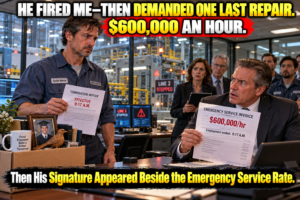
At 9:22, the machine holding up his biggest customer demonstration stopped.
“Repair it before you leave,” he ordered.
I looked at the termination notice in my hand.
“That service was free five minutes ago. Now it costs $600,000 an hour.”
He laughed.
I set my cardboard box beside my desk.
“Who has authority to authorize emergency service?”
Then the chief financial officer arrived—and asked why he had fired me that morning.
👉 …Continue Read More…
