My sister inherited Mom’s house and $145,000. My brother got the family land. After four years of caring for her, I received twelve chipped kitchen jars. That night, I washed the pig-shaped jar and heard something shift beneath its lid. Mom had left something inside.
Part 1
My sister slid the cardboard box across the attorney’s conference table as though she were passing me something she had meant to throw away.
“You always did love junk.”
A ceramic lid rattled against another.
I put my hand over the open box to steady the contents.
Twelve jars. Chickens, cows, sheep, a sleepy brown horse, and the round pink pig that had stood beside my mother’s stove for as long as I could remember.
The attorney looked up from his papers.
“These were specifically designated for Rachel.”
“I know,” Vanessa said. “That’s why I brought them.”
She smiled at me.
Her smile had looked different when we were children. Back then, it usually meant she had hidden something behind her back and wanted me to guess.
Now it meant she expected me to understand my place.
Across the table, our brother, Luke, examined the documents concerning the family land.
Forty acres outside town.
He had already asked whether the boundary survey was current.
Vanessa received the house and one hundred forty-five thousand dollars from the savings account listed in Mom’s will.
I received the jars.
The attorney, Mr. Ellis, read the final paragraph slowly.
“My collection of ceramic kitchen canisters shall go to my daughter Rachel, who will understand why they matter.”
Vanessa gave a small laugh.
“She certainly will.”
I looked into the box.
The pig’s left ear had a pale crack running through it. Mom repaired it when I was twelve, after I knocked it from the counter while reaching for a biscuit.
She never let me forget the accident, but only because I cried so hard she had to assure me it was an ear, not a funeral.
Four years caring for her had taught me how much could change while familiar objects stayed in place.
I knew which medication made her nauseated.
I knew how to coax her into drinking water without making her feel like a child.
I knew she preferred the curtains open in the morning, even on days when she couldn’t get out of bed.
Vanessa knew the house had appreciated in value.
Luke knew a neighboring farmer wanted to lease the acreage.
Neither asked whether I wanted help carrying the box.
Mr. Ellis gathered the signed acknowledgments.
“There are a few administrative matters still to complete. Please contact me before disposing of any estate documents.”
Vanessa nodded.
Luke checked his phone.
I lifted the box.
It was heavier than I expected.
Outside, the afternoon was bright enough to hurt my eyes. I put the jars carefully on the passenger seat of my old hatchback, buckled the seat belt around the box, and sat behind the wheel.
I didn’t cry.
That surprised me.
For weeks after Mom’s funeral, I cried over everything: the unused milk in her refrigerator, a voicemail from the pharmacy, a cardigan that still held the shape of her shoulders.
But the will left me quiet.
Perhaps I had spent too long expecting little.
My apartment was twenty minutes away, above a small insurance office. I had lived there since selling my townhouse during Mom’s second year of illness.
Reduced hours at work, rent, and helping with her expenses had made the townhouse impossible to keep.
That evening, I spread a towel across my kitchen table.
One by one, I lifted out the jars.
I washed the chicken first.
Then the cow.
Then the sheep with the missing painted eye.
The pig waited until last.
When I picked it up, something inside shifted with a soft, heavy scrape.
I stopped.
The jar had always held tea bags.
Tea bags didn’t sound like that.
Part 2
I tilted the pig again.
Something slid a short distance inside, then caught against the curved wall.
I placed it on the table.
Its lid was shaped like the pig’s head, with two small ears and a snout painted a darker pink than the body. A faded red ribbon remained tied around its neck.
Mom had put that ribbon on years earlier and never removed it.
I gripped the head and pulled.
Nothing.
The lid had always been stubborn, but this time it felt stuck.
“Come on,” I whispered.
I wrapped a damp towel around it, held the body firmly, and twisted.
The lid loosened with a faint scraping sound.
I lifted it.
An old yellow dishcloth had been folded beneath the opening.
I recognized the cloth immediately. There was a blue stitched flower in one corner, crooked because I embroidered it during a school lesson and gave it to Mom as a present.
She used it for special dishes until it grew too thin.
Then she kept it anyway.
I unfolded it.
Beneath it lay a brass key attached to a small wooden tag.
The tag read:
MAPLE STREET.
Beside the key was an envelope.
My name appeared on the front in my mother’s handwriting.
Rachel.
I sat down.
I hadn’t seen my name written by her since the birthday card she gave me six months before she died.
My thumb moved over the ink.
Inside were two folded pages and a smaller sealed envelope.
The first page began:
*Before you call your sister or your brother, please read this all the way through.*
My stomach tightened.
*I know how the jars must have looked today.*
*I am sorry for the hurt you may be feeling. I wanted to explain while I was alive. Every time I tried, we ended up discussing my next appointment, your work schedule, or whether I had eaten enough.*
I could hear her voice.
Tired, practical, still trying to make light of something difficult.
*Take the key and the sealed envelope to Mr. Ellis. Ask him about Maple Street. He will know what to do.*
Maple Street meant nothing to me at first.
Then I remembered a little row of buildings near the old railway crossing: a florist, a tailor’s shop, and a narrow brick property with white curtains above a green front door.
Mom used to turn her head when we drove past.
Once I asked whether she knew someone there.
“An old friend,” she said.
I unfolded the second page.
It was a copy of a property document.
At the top, beneath the address, I saw my full name.
Rachel Anne Mercer.
Not Mom’s.
Mine.
I read it again, searching for some explanation in the dense paragraphs.
There was a date from eighteen months earlier.
I had driven Mom to several appointments that autumn. One had been with Mr. Ellis, who told me she wanted to discuss private matters.
I waited in the car and answered work emails.
Afterward, she looked exhausted.
“Everything all right?” I asked.
“Getting things in order.”
I thought she meant her will.
I looked at the key.
Then at my apartment: the little table, the patched sofa, the cartons of medical paperwork I hadn’t yet been able to discard.
My phone began ringing.
Vanessa.
I let it ring.
A message appeared.
*Don’t throw the jars away yet. I may want the pig back.*
Part 3
I stared at Vanessa’s message.
She had mocked the collection only hours earlier.
Now she wanted the pig.
I typed, *Why?*
Her answer came quickly.
*I remembered it was one of Mom’s favorites. It would look nice in the kitchen.*
I looked at the chipped ear and faded ribbon.
*The will left it to me.*
Three dots appeared.
Disappeared.
Then:
*Rachel, don’t make everything an argument.*
I put the phone aside.
For years, those words had ended conversations before they began.
If I asked Vanessa to take Mom to an appointment, I was making an argument.
If I asked Luke to sit with her so I could work a full shift, I was making an argument.
If I said I was exhausted, someone reminded me that everyone had responsibilities.
I placed the letter, key, and document in a folder and called Mr. Ellis’s office the next morning.
His assistant asked what the call concerned.
“Something my mother left inside one of the kitchen jars.”
A pause.
“Was there a sealed envelope?”
“Yes.”
“Please don’t open that one. Mr. Ellis can see you at eleven.”
Her certainty unsettled me.
This wasn’t merely an old key Mom forgot to explain.
Someone had been waiting.
I arrived early.
Mr. Ellis met me in the doorway himself.
He was in his sixties, with neatly combed gray hair and the patient manner of someone who had spent decades listening to families disagree over things they once shared.
“Rachel. Come in.”
I put the folder on his desk.
He looked at the key, then the envelope.
“She chose the pig.”
“You knew?”
“I knew she intended to leave the envelope with one of the jars. I didn’t know which one.”
“Why didn’t you tell me yesterday?”
“Your mother asked that you have the chance to find her letter privately. She also instructed me to contact you within a week if you hadn’t contacted me.”
I sat back.
“So I wasn’t going to lose whatever this is because I failed to clean a jar.”
“No.”
Something in my chest loosened.
Mr. Ellis opened the sealed envelope.
Inside was a signed instruction sheet and a small photograph.
He read the sheet first.
Then he turned the photograph toward me.
It showed Mom standing outside the narrow brick building on Maple Street.
Beside her stood a woman with short white hair.
They were smiling.
On the back, Mom had written:
*June and me, after the final repairs.*
“Who is June?”
“June Parker. Your mother’s cousin.”
I vaguely remembered the name from Christmas cards.
“She died several years ago.”
“Yes. She left this property to your mother.”
I looked again at the copied document.
“And Mom put it in my name?”
“She transferred it into a trust eighteen months ago, with arrangements for you to receive the property after her death. The documents were completed separately from the assets distributed under her will.”
I listened carefully.
Then I asked the question I had been afraid to ask.
“Is it real?”
Mr. Ellis’s expression softened.
“Yes, Rachel.”
“Why didn’t she tell me?”
He paused.
“I can explain the paperwork. Her letter may explain the rest.”
He opened another folder.
There were photographs of the inside: two rooms downstairs, a small kitchen, and an apartment above.
A modest building.
A whole building.
“What is it worth?”
“We’ll obtain a current valuation. Your mother wasn’t primarily thinking about its sale value.”
“What was she thinking about?”
He slid the final page toward me.
At the bottom, in my mother’s handwriting, was a sentence I recognized from a conversation I thought she had forgotten.
*Rachel once said she wanted a place where she could work downstairs and live upstairs.*
Part 4
I said those words when I was twenty-seven.
Before Mom became ill.
Before my work hours shrank around appointments and emergency calls.
Before I learned to sleep with my phone beneath my pillow.
I worked at a alterations shop then, mostly repairing clothes other people considered worth saving.
School uniforms.
Wedding dresses.
Winter coats with torn linings.
I loved the work.
I loved the moment someone tried on a garment and looked at themselves differently because it finally fit.
One Saturday, Mom came to the shop near closing.
She watched me finish the hem on a little girl’s party dress.
“You’re good at that,” she said.
“I’d like my own place someday.”
“What kind?”
“Something small. Shop downstairs. Apartment upstairs. I’d save myself the commute.”
She smiled.
“Keep an eye out.”
I had laughed.
“On what money?”
“Dream first. Count later.”
I forgot the conversation.
Apparently, she didn’t.
Mr. Ellis explained that the ground-floor tenant had recently retired. The upstairs apartment had remained vacant while repairs were completed.
“The property has expenses,” he said. “Insurance, taxes, maintenance. Your mother left a reserve within the trust for those costs. We should review everything before you decide how to use it.”
“How much?”
“Twenty-three thousand dollars.”
I looked down at my hands.
The nail beside my thumb had split from washing the jars.
I felt foolish for noticing it.
A building. A reserve fund. My name on papers I had never seen.
And there I was thinking about a broken nail.
“Was this money taken from Vanessa’s share?”
“No. It was accounted for separately. Your mother’s estate plan included both arrangements.”
“And Luke’s land?”
“Unchanged.”
I breathed out slowly.
I didn’t want something that belonged to them.
I wanted to understand what belonged to me.
Mr. Ellis gave me copies and arranged for me to meet the property manager the following afternoon.
Before I left, he handed me another envelope.
“Your mother left this with me to give you after we spoke.”
I looked at him.
“There’s another letter?”
“She had a great deal she wanted to say.”
I opened it in my car.
*Rachel,*
*You will probably ask whether this is fair.*
*You have been asking that question for everyone else since you were little.*
My eyes filled.
*I know you helped because you loved me. I also know love did not pay your mortgage or return the work you turned down.*
*Please don’t turn this into proof that I loved you more than your sister or brother. I didn’t.*
*I was trying to notice what each of you needed.*
I read that paragraph twice.
Then the next.
*Vanessa wanted the house. Luke wanted the land. You kept saying you didn’t need anything.*
*But I watched you pack up your sewing machine when you sold your home.*
I remembered the day.
Mom sat in my kitchen, wrapped in a blanket, while I put the machine into its carrying case.
“It’s just for a while,” I told her.
She didn’t answer.
*I wanted you to have somewhere to unpack it again.*
I lowered the letter.
Across the parking lot, people hurried in and out of offices, carrying lunches and papers, moving through ordinary days.
Mine had become impossible to recognize.
My phone rang.
Luke this time.
“Vanessa says you found something in the pig.”
Part 5
I closed my eyes.
“What did she say I found?”
“She doesn’t know. She says you’re acting strange.”
“I’ve had a strange week.”
“Rachel.”
His voice grew impatient.
“What was in it?”
“A letter from Mom.”
“And?”
I watched a leaf blow beneath a parked car.
“And some documents I’m reviewing with Mr. Ellis.”
“What documents?”
“I’ll explain when I understand them.”
“Why the secrecy?”
The question stung.
For four years, I sent updates nobody answered for days.
Mom’s blood pressure.
A fall.
An appointment changed.
A bill paid.
I had begged for attention to things that mattered.
Now they wanted immediate access to something I had barely had time to hold.
“I’m taking some time.”
“You can’t keep estate information from us.”
“If something affects your inheritance, Mr. Ellis will explain it.”
Luke exhaled sharply.
“Vanessa’s worried.”
“About what?”
“She thinks Mom may have been confused near the end.”
I straightened.
“The documents aren’t from the end.”
A silence.
“When are they from?”
“I’m not discussing this on the phone right now.”
I ended the call before he could turn my answer into another question.
Then I sat there shaking.
Saying no did not feel powerful.
It felt like stepping off a curb without checking for traffic.
I drove home, put the folder in a drawer, and took out my sewing machine.
It had been beneath my bed for nearly two years.
Dust covered the case.
I wiped it off and set it on the table beside the jars.
For a while, I looked at it.
Then I threaded it.
The familiar movements steadied me.
A bobbin.
The needle.
The little lever I always forgot to lift until the thread caught.
I found a torn pillowcase and repaired the seam.
Nothing important.
Nothing that would earn money.
But when the machine began humming, I remembered a life that included more than waiting for the next call.
The following afternoon, I met the property manager outside the Maple Street building.
His name was Martin. He wore paint-speckled trousers and carried a thick ring of keys.
“Your mother was particular,” he said.
“About what?”
“Everything.”
He pointed to the green door.
“She wanted that color changed twice. First one was too bright. Second one looked gray in the rain.”
I smiled.
“That sounds like her.”
Inside, sunlight fell across worn wooden floors.
The downstairs rooms smelled of fresh paint and old timber. Shelves stood along one wall, and a broad front window overlooked the street.
There was room for a cutting table.
Room for customers to stand before a mirror.
Room for my machine.
Upstairs, the apartment had a small bedroom, a living room, and a kitchen with cream cupboards.
The kitchen wasn’t much larger than mine.
It didn’t need to be.
Martin opened the back window.
Below us was a narrow courtyard with enough space for two chairs and a few pots.
“Your mother asked whether herbs would grow here.”
“She liked mint.”
“She said that.”
I looked away before he could see me crying.
He gave me a moment.
Then he led me downstairs to a storage cupboard.
“There’s one item she insisted we leave.”
Inside stood a wooden table covered with a sheet.
On top was a small cardboard box.
Written across it were three words.
*For your shop.*
Part 6
Inside the box were objects I thought had disappeared years earlier.
My good fabric scissors.
A tin of buttons.
The little wooden sign Dad made when I first talked about opening a business.
RACHEL’S ALTERATIONS.
The paint had faded, but the letters remained clear.
I sat on the covered table.
“Where did she get these?”
Martin shook his head.
“She brought them here with your sister’s old friend. A woman named Elaine.”
Elaine had helped me move.
When I sold my townhouse, I gave her several boxes to store because my apartment had no room.
I thought she still had them.
“She never told me.”
“Your mother asked everyone to keep it quiet.”
I took the sign out.
Dad had died before Mom’s illness.
He made it as a joke, then grew serious when he handed it to me.
“Now you’ll have to make the place,” he said.
I never did.
Until this moment, I had thought that meant the idea was finished.
Martin showed me where the plumbing repairs had been made and gave me a list of remaining work.
A loose back step.
One window that needed attention.
A downstairs socket that an electrician had recommended replacing.
Practical things.
The building felt less like a dream once I saw what needed fixing.
That helped.
I could understand a broken step.
I could plan for a socket.
Before leaving, I stood in the downstairs window and imagined someone opening the green door with a coat over one arm.
“Could you repair this?”
“Yes,” I whispered into the empty room.
When I returned to my apartment, Vanessa was waiting outside.
She had never visited without calling first.
Her car occupied two spaces.
“I’ve been trying to reach you.”
“I was out.”
“Where?”
I held my bag closer.
“Looking at something Mom left me.”
Her eyes moved to the folder beneath my arm.
“So there is something.”
“Yes.”
She folded her arms.
“What?”
“A property on Maple Street.”
For a second, her expression emptied.
Then she laughed, but there was no amusement in it.
“That little building?”
“You know it?”
“Mom mentioned June’s place. I thought she sold it.”
“She didn’t.”
Vanessa looked at the folder.
“How much is it worth?”
“I don’t know yet.”
“Who gets it?”
“I do.”
The word hung between us.
She looked toward the street.
Then back at me.
“That can’t be right.”
I unlocked my door.
“Mr. Ellis can explain the paperwork.”
“I’m your sister. You can explain it.”
“I just did.”
Her face tightened.
“You had four years alone with her. We don’t know what she was told.”
I turned fully toward her.
“Be careful.”
She blinked.
“What?”
“Be careful what you accuse me of.”
For the first time that afternoon, she had nothing ready to say.
Then she pointed at the box of jars on my table.
“I handed you those. I didn’t even look inside.”
“I know.”
“If I had known—”
She stopped.
We both heard what she almost said.
Part 7
Vanessa stepped into my apartment without waiting for an invitation.
She looked around as though the room might contain evidence.
The sewing machine on the table.
The folders beside it.
The washed jars lined up on a towel.
“Did Mom buy that place for you?”
“No. June left it to her.”
“And she just decided to give it away?”
“She made arrangements with her attorney.”
Vanessa touched the pig’s lid.
I moved it closer to me.
“It’s mine.”
“I’m not taking it.”
“Then leave it there.”
Her hand withdrew.
For a moment, she looked less like my confident older sister and more like the child who hated discovering I had been given something she wanted.
“I don’t understand why she hid it.”
“Neither did I.”
“Because it looks dishonest.”
I thought of Mom struggling to speak after an exhausting appointment. Of the way Vanessa could turn a simple conversation into a negotiation without noticing.
“I think she wanted me to read her words before anyone else explained them to me.”
Vanessa’s mouth tightened.
“Meaning me.”
“I didn’t say that.”
“You didn’t have to.”
She sat on the edge of the sofa.
I remained standing.
For once, I didn’t make tea.
She told me the house needed repairs. The roof was aging. The savings would disappear faster than people thought.
“I’m not asking you for your money,” I said.
“But now everyone’s going to say you got nothing and I got everything.”
“Who is everyone?”
“People.”
“What have you told them?”
She looked away.
That answered the question.
She had already told our aunts, cousins, and perhaps her friends about the inheritance.
Maybe she enjoyed explaining that I got the little collection because I liked sentimental things.
Maybe it made a complicated story easy.
“You can tell them the truth now.”
“That you found another inheritance in a cookie jar?”
“That Mom made separate arrangements.”
Vanessa stood.
“I want copies.”
“Ask Mr. Ellis.”
“You’re making this difficult.”
“No. I’m making sure I understand it before we argue about it.”
She left without saying goodbye.
That evening, I wrote a list of the caregiving years.
Not every task.
The broad things I had begun minimizing even to myself.
Reduced hours.
The townhouse sale.
Hospital nights.
Driving.
Meals.
Bills I covered because reimbursement felt awkward to request.
I did not total them.
I didn’t need a number to prove those years had happened.
At the bottom, I wrote:
*I loved her. I was also tired.*
Both sentences belonged on the page.
The next day, Mr. Ellis called.
“Your sister has asked for a meeting.”
“Do I have to attend?”
“No. But it may help to address the questions together.”
“What questions?”
He paused.
“She has raised concerns about your mother’s understanding of the arrangements.”
I looked at Mom’s letter.
“She wasn’t confused.”
“I have records of our meetings. We can explain the dates and process.”
“Will Luke be there?”
“He has asked to attend.”
I agreed.
Then Mr. Ellis added something that made me sit down.
“Your mother anticipated this conversation. She left a letter addressed to all three of you.”
Part 8
We met in the same conference room.
Vanessa arrived first.
Luke sat beside her.
I chose the chair across the table, where I could see both of them without turning.
Mr. Ellis placed a folder before him.
“The Maple Street property was addressed separately from the will. Your mother instructed me regarding it eighteen months before her death.”
Vanessa leaned forward.
“She was already ill.”
“Yes. Illness alone did not prevent her from making decisions. At our meetings, she explained what she owned, whom she wished to benefit, and why.”
He spoke evenly.
He described the paperwork without promising that words could erase every possible disagreement.
Luke asked whether my presence influenced the discussions.
“Rachel waited outside during the substantive meetings.”
I remembered the car.
The cold coffee.
The work emails.
Mom emerging tired, clutching her handbag.
Vanessa looked at me.
“Did you know?”
“No.”
Mr. Ellis opened the letter.
“Your mother asked me to read this if questions arose.”
He began.
*My children,*
*If you are hearing this together, I expect someone is upset.*
Luke looked down.
*I have tried to make careful decisions. I know careful decisions can still hurt.*
*Vanessa, I left you the house because you have said for years that you wanted to keep it in the family.*
Vanessa’s face softened briefly.
*Luke, I left you the land because you have worked on it and understand it.*
He nodded once.
*Rachel, I made arrangements for Maple Street because I watched you give up the place you had made for yourself while helping me remain in mine.*
I stared at my hands.
*This is not a payment for loving me. No document could settle that.*
*It is an attempt to help you begin again.*
Mr. Ellis paused, allowing us to sit with it.
Then he continued.
*There are things I should have said while I was alive.*
*I should have asked Vanessa and Luke more directly for help. I should have stopped accepting Rachel’s answer that she was managing when I could see she was worn out.*
Vanessa opened her mouth.
Mr. Ellis raised his eyes.
“May I finish?”
She sat back.
*I was frightened of becoming a burden. Sometimes that made me unfair to the child who stayed closest.*
My tears fell before I could stop them.
Mom had never written herself as a perfect mother.
Even here, she was trying to tell the truth.
*Do not use these gifts to decide who loved me most.*
*Look instead at how you treat each other after I am gone.*
He finished the letter.
No one spoke.
Outside the room, a telephone rang.
Someone laughed faintly down the corridor.
Ordinary office sounds continued while ours remained still.
Luke rubbed his jaw.
“I thought you wanted to handle the appointments.”
I looked at him.
“Why?”
“You were always already doing it.”
“That doesn’t mean I didn’t need help.”
“You never—”
“I asked.”
He stopped.
I didn’t list every unanswered message.
I named one.
“The night she fell. I called you because I hadn’t slept and had work in the morning.”
He remembered.
I saw it.
“You said you had an early start.”
He looked down again.
Vanessa stood too quickly.
“I need some air.”
She left the room.
Mr. Ellis gathered the documents.
Luke waited until we were alone.
Then he said, “There’s something I should have told you about those four years.”
Part 9
I sat back down.
“What?”
Luke looked toward the door.
“Mom called me once. Near the end of the second year. She said you needed a break.”
I remembered that winter.
I had bronchitis.
I kept driving to her house because she couldn’t manage meals alone.
“What did you say?”
“That I’d come the following weekend.”
“Did you?”
“No.”
He swallowed.
“I got busy. Then you sent a message saying the visiting nurse was coming, and I told myself things were covered.”
I closed my eyes.
“I wasn’t covered.”
“I know that now.”
The apology came slowly, with none of the easy language people use when they hope a word will finish a conversation.
“I should have come.”
“Yes.”
He nodded.
I let him sit with my answer.
Then I said, “You don’t have to agree with every decision Mom made. But don’t pretend I invented the years that led to them.”
“I don’t.”
“Vanessa does.”
“She’s angry.”
“That doesn’t make it all right.”
“No.”
When we left the room, Vanessa stood by the window at the end of the corridor.
She didn’t come over.
Luke went to speak with her.
I walked outside.
For the first time since the will meeting, I could breathe without feeling something lodged beneath my ribs.
The inheritance didn’t repair four years of being overlooked.
It didn’t give me back my townhouse.
It didn’t make my siblings understand everything.
But it gave me choices.
I went to Maple Street that afternoon.
I opened the green door with the brass key and carried my sewing machine inside.
There was no grand opening.
No customers.
I set the machine on Dad’s old table, pulled a chair up, and sat.
Sunlight reached the floor.
A bus passed outside.
Someone walked by carrying flowers wrapped in brown paper.
I took a scrap of fabric from my bag and stitched a straight seam.
Then another.
Over the next several weeks, I moved slowly.
I reviewed the property expenses with Mr. Ellis and an accountant.
I obtained estimates for the repairs.
I spoke with the local office about what I needed before opening a shop.
I kept my existing part-time work until I could see what the business might earn.
The reserve stayed mostly untouched.
A building could be a gift and a responsibility at the same time.
Elaine helped me move the boxes she had stored.
“She made me promise,” she said.
“I know.”
“She was so pleased with that little sign.”
We hung it inside the front window.
RACHEL’S ALTERATIONS.
The first person to inquire was a woman with a school uniform that needed shortening.
I wrote down her name and measured carefully.
My hands remembered the work.
Luke came one Saturday with tools.
“I heard the back step needs fixing.”
“It does.”
“May I?”
I stepped aside.
He worked for an hour, then stayed to help carry shelving upstairs.
We didn’t settle our childhood or the caregiving years.
We talked about the screws he needed and whether the rain would hold off.
It was enough for one afternoon.
Vanessa sent no apology.
Then, two days before I opened, a package arrived.
Inside was the pig’s missing original saucer.
Beneath it lay a note.
*I found this in Mom’s cupboard.*
On the next line, she had written:
*I shouldn’t have called them junk.*
Part 10
I read Vanessa’s note twice.
Then I placed it in the drawer with Mom’s letters.
I didn’t call immediately.
An apology could be received without turning it into a larger reconciliation than either person was ready to offer.
That evening, I sent a message.
*Thank you for finding it.*
She replied with a photograph of Mom’s kitchen.
The counter looked unfamiliar without the jars.
*It feels strange here,* she wrote.
I stared at the picture.
For weeks, I had thought about the house as something Vanessa received.
I forgot she also had to walk through rooms where Mom no longer was.
*It feels strange everywhere,* I answered.
For once, neither of us tried to win.
Opening day was quiet.
Three customers came.
One brought trousers.
One wanted new buttons sewn onto a coat.
The woman with the school uniform returned to collect it and said the hem was perfect.
I had imagined an important first day might feel larger.
Instead, it felt like work.
Good work.
The kind that left me tired because I had done something, rather than because I had waited for something to go wrong.
Upstairs, I had unpacked only what I needed.
A bed.
A kettle.
Two plates.
My books stood on a shelf Luke secured to the wall.
There was space for more, but I liked seeing the floor.
For years, every part of my life felt crowded with obligations.
Now there was a little room.
I placed eleven jars on the kitchen shelves.
The chicken held rice.
The cow held flour.
The sheep with the missing eye held sugar.
I lined them up carefully, touching the chips I knew so well.
The pig stayed downstairs beside my sewing machine.
Inside, I put Mom’s first letter, folded around the brass key.
Customers noticed it.
“That’s a cheerful fellow,” one woman said.
“He’s older than he looks.”
“Family?”
“Yes.”
That was all I needed to explain.
Luke began visiting occasionally.
Sometimes he brought a practical excuse: a hinge, a shelf, a bag of vegetables from the land.
Sometimes he came with nothing and asked whether I had time for coffee.
I stopped pretending I was always available.
If I was busy, I said so.
He learned to return another day.
Vanessa came six weeks after the shop opened.
She stood in the doorway, holding a blouse.
“Could you fix the cuff?”
I looked at it.
“Yes.”
“How much?”
I told her my ordinary price.
She nodded.
There was an awkwardness between us that neither of us could sew away.
While I pinned the cuff, she looked around.
“The place suits you.”
“Thank you.”
She touched the wooden sign in the window.
“Dad made that?”
“Yes.”
“I’d forgotten.”
“I had too, for a while.”
She glanced at the pig.
Then she looked at me.
“I thought the house meant I’d finally done something right.”
I stopped pinning.
“What?”
“With Mom. I know I wasn’t around enough. When the will was read, I thought maybe she understood why.”
I considered my answer.
“She probably did understand some of it.”
Vanessa nodded, eyes lowered.
“But you didn’t?”
“I understood that you had a life. I needed you to understand that I did too.”
She pressed her lips together.
For a long time, the shop was quiet.
Then she said, “I’m sorry.”
There was no immediate forgiveness speech.
I didn’t tell her everything was fine.
I said, “Thank you.”
We began there.
That winter, I invited both of them upstairs for dinner.
I made Mom’s vegetable soup and bought bread from the bakery down the street.
Luke brought apples.
Vanessa brought a small plant for the courtyard and admitted she had no idea whether it would survive.
We ate at a table Dad once repaired.
The conversation stayed ordinary until Vanessa looked toward the kitchen shelves.
“Do you remember when Rachel broke the pig’s ear?”
Luke laughed.
“Mom thought someone had been badly hurt because she was crying so much.”
“I was twelve.”
“You cried for an hour,” Vanessa said.
“Because I thought she’d be angry.”
“She wasn’t,” Luke said.
“No.”
I looked toward the stairs, where the pig sat below us in the darkened shop.
“She just found the glue.”
After dinner, they helped wash up.
It was a small thing.
I noticed anyway.
When they left, I locked the downstairs door, checked the till, and straightened the work waiting for morning.
A coat lining.
Two dresses.
A little boy’s trousers.
I sat beside the sewing machine and took Mom’s letter from the pig.
The paper was soft now from rereading.
*I wanted you to have somewhere to unpack it again.*
I laid my hand on the table.
For four years, I measured my days by how much I could do for someone else.
Now I was learning to include myself.
Mom had not left me a life without grief, expense, or difficult conversations.
She had left me a place to begin.
I folded the letter, tucked it back beneath the old yellow dishcloth, and replaced the lid.
The repaired ear remained crooked.
I left it that way.
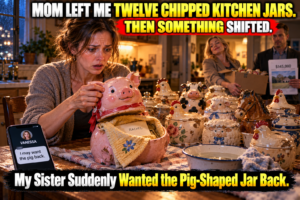
“You always did love junk,” my sister said.
That night, I washed them one by one. The pig-shaped jar felt unusually heavy. Something shifted when I tilted it.
Beneath an old dishcloth, I found an envelope with my name on it.
Before I finished reading, my sister sent a message: “I may want the pig back.”
👉 …Continue Read More…

One Comment on “My Sister Inherited Mom’s House and $145,000 While I Received Twelve Chipped Kitchen Jars—That Night, Something Shifted Inside the Pig-Shaped Jar, and I Discovered What My Mother Had Hidden”