My widowed son’s bride refused a wedding photograph with his five-year-old boy. When I questioned her, she said they had agreed their life would be “just the two of us.” I took my grandson somewhere he couldn’t hear. Then, at the reception, I raised my glass.
Part 1
My grandson had practiced smiling for the photograph.
That is the detail I still find hardest to remember.
Not the white flowers climbing the doorway. Not the polished glasses on the reception tables. Not Wendy standing beneath a chandelier in a dress that cost more than my first car.
Oliver’s smile.
He practiced it in my bathroom mirror while I straightened the collar of his little blue shirt.
“Too many teeth, Grandma?”
“No, sweetheart. Your teeth are very nice.”
He closed his mouth, considered himself, and smiled again.
“Daddy smiles like this.”
He lifted one side of his mouth.
I laughed.
“Yes. He does.”
Oliver was five. His mother, Claire, had died when he was three, after an illness that moved far faster than any of us could understand.
For months afterward, he asked whether she was still at the hospital.
Then he stopped asking.
That silence frightened me more than the questions.
My son, Matthew, grieved differently. He returned to work too quickly, forgot meals, and sometimes sat in his parked car outside my house for twenty minutes before coming in.
I helped.
At first, Oliver stayed with me during the day.
Then some evenings.
Then three or four nights a week when Matthew’s work became demanding and sleep still eluded him.
It happened gradually enough that we called each change temporary.
When Wendy entered his life, I wanted to be glad.
She was organized, confident, and capable of drawing him into conversations that weren’t about hospitals or loss. He began laughing again. He bought new clothes. He called me one afternoon to tell me about a restaurant they had discovered.
I cried after we hung up because I had missed hearing happiness in his voice.
But there were things I should have asked sooner.
Wendy rarely came when Oliver was visiting.
If we planned Sunday lunch, Matthew sometimes asked whether Oliver could stay overnight afterward because Wendy wanted a quiet evening.
When the wedding invitation arrived, it named only me.
I called Matthew.
“What about Oliver?”
“It’s a small ceremony, Mom.”
“There are eighty guests.”
“I mean, we’re keeping it adults only.”
“Your son isn’t a distant cousin.”
He sighed.
“Please don’t start.”
I didn’t like his tone.
I also knew how tired he had been, how hard he had worked to feel hopeful again.
So I let the conversation end.
The week before the wedding, Oliver found the invitation on my kitchen table.
“Is that Daddy’s party?”
“Yes.”
“Can I wear my blue shirt?”
I should have called Matthew again.
I should have insisted we settle the question before the day itself.
Instead, I made a decision without telling him.
I would bring Oliver after the ceremony.
One photograph. One hug from his father. Then my sister, June, would take him home while I attended the reception.
I told myself it was a small, reasonable thing.
I did not think enough about what might happen if someone refused.
At the venue, Oliver carried a folded drawing in his pocket.
He had drawn his father, Wendy, and himself outside a house.
Three people.
He kept touching the paper to make sure it was there.
We found Matthew near the garden doors, speaking with the photographer.
Oliver ran toward him.
“Daddy!”
Matthew turned.
His face changed before he knelt to receive his son.
He looked pleased.
Then surprised.
Then toward me.
“Mom. What are you doing?”
Before I could answer, Wendy appeared beside him.
And Oliver’s practiced smile began to fade.
Part 2
For a moment, nobody said anything.
Matthew held Oliver against his chest, one hand resting on the back of the little blue shirt.
Wendy looked at me.
“I thought we discussed this.”
“We did,” I said. “I hoped we could have one photograph. June is here to take him home afterward.”
“That isn’t what we arranged.”
The photographer lowered his camera.
Oliver stepped back from his father and looked at Wendy’s dress.
“You look like a princess.”
Her expression barely changed.
“Thank you.”
He pulled the drawing from his pocket.
“I made this.”
Matthew took it.
“That’s lovely, buddy.”
Oliver pointed to the figures.
“That’s you. That’s Wendy. That’s me.”
Wendy glanced at it, then toward the photographer.
“We’re already behind.”
“Just one picture,” I said.
Matthew looked at her.
“Could we do a quick one?”
She turned sharply.
“No.”
Oliver stood very still.
I reached for his hand.
The photographer, a kind-looking man with gray at his temples, quietly moved toward a different group of guests.
Wendy lowered her voice, but not enough.
“He’s not my child. I don’t want him in the wedding photos. Please take him away.”
I felt Oliver’s fingers tighten around mine.
Matthew said her name.
“Wendy.”
“What? We agreed.”
I looked at my son.
“What did you agree?”
He rubbed the back of his neck.
“Mom, this isn’t the time.”
It was exactly the time, but Oliver was beside us.
I bent toward him.
“Sweetheart, Aunt June has something for you in the lounge. Go show her your drawing.”
“I gave it to Daddy.”
“I know. She’ll want to hear about it.”
June stood a few steps away. She had heard enough to understand without questions.
She held out her hand.
“Come help me find the biscuits.”
Oliver hesitated.
Then he looked up at Matthew.
“Will you come?”
“In a minute,” Matthew said.
I hated how often grown-ups used those words when they had no intention of measuring the minute.
June led Oliver away.
I waited until the lounge door closed.
Then I asked Wendy to step aside with me.
Matthew began to follow.
“Please give us a moment.”
He remained near the flowers, holding his son’s drawing.
In a narrow corridor beside the cloakroom, I turned to Wendy.
“What do you mean, he’s not yours? He’s Matthew’s son. You’re his wife now. You have to accept the child.”
“No, I don’t.”
She folded her arms carefully, protecting the silk of her dress.
“You don’t have to replace Claire,” I said. “Nobody is asking that. But you cannot marry his father and act as though he doesn’t exist.”
“We agreed it would be just the two of us.”
“Today?”
She stared at me.
“No.”
The word seemed to empty the corridor of air.
“What are you saying?”
“I don’t need the boy. Got it? Matthew knew I didn’t want children. You already do everything for him. I don’t know why you’re pretending this is a surprise.”
I searched her face for some sign that she had spoken in anger and would correct herself.
Instead, she added, “You’re supposed to keep him. That was the arrangement.”
Part 3
I could hear music from the reception room.
A piano. Laughter. The ordinary sounds of people preparing to celebrate something.
In the corridor, I stood so still that Wendy shifted impatiently.
“Matthew said that?”
“He said Oliver was settled with you.”
“For now.”
“That isn’t how he described it.”
I looked toward the doorway.
My son stood beyond it, speaking to a guest who had caught him on the way past.
He still held the drawing.
Three figures outside a house.
“What exactly did he tell you?” I asked.
Wendy lifted her chin.
“That you loved having Oliver. That the two of you had a routine. That he wasn’t going to uproot him.”
I had said I loved having Oliver.
Of course I loved having him.
I had never said Matthew could step out of being his father.
“Did you ask whether Oliver would live with you eventually?”
“Yes.”
“And?”
“He said we’d work it out.”
I stared at her.
She saw something in my expression and frowned.
“What?”
“Those are not the same promises.”
Her face hardened again.
“I made my position clear.”
Perhaps she had.
Perhaps Matthew had spent months offering each of us whichever answer would end the conversation.
I had come into the corridor ready to confront a cruel bride.
Now I understood there was another conversation I could no longer avoid.
“Oliver heard you,” I said.
“He wasn’t supposed to be here.”
“That doesn’t excuse what you said.”
“You brought him without permission.”
“Yes. I did.”
The admission surprised her.
“I should have resolved it beforehand. But he did not decide any of this. He is five. You spoke as though he were something we needed to remove from the room.”
Wendy looked toward the reception hall.
“I’m not arguing about this on my wedding day.”
“I’m not asking you to argue. I’m asking you to understand that a child’s life is involved.”
She brushed past me.
I stood alone for a few seconds, collecting myself.
Then I went to the lounge.
Oliver sat beside June on a sofa, holding a biscuit he had not eaten.
When he saw me, he sat upright.
“Is Daddy coming?”
I knelt in front of him.
“I’m going to speak with him.”
“Did I do something?”
“No.”
“Was my shirt wrong?”
My throat tightened.
“Your shirt is lovely.”
He looked down at the biscuit.
“Wendy said take me away.”
June’s eyes filled.
I kept my voice steady.
“The grown-ups didn’t handle something properly. That is not your fault.”
“Does Daddy want me here?”
I could not answer for Matthew.
I could answer for myself.
“I love being with you. You’re coming home with Aunt June now, and I’ll be there soon.”
He studied me.
Children can hear the places where we hesitate.
“Can Daddy have the picture?”
“He already has it.”
“Oh.”
June gathered his little jacket.
I walked them to the side entrance.
Before getting into her car, Oliver reached up and touched my cheek.
“Don’t be sad, Grandma.”
I kissed his hand.
“I’m going to take care of something.”
When June’s car disappeared around the drive, I returned to the reception room.
The speeches had begun.
Matthew sat beside Wendy beneath the flowers.
He smiled at something the best man said.
I looked at the empty chair where a little boy might have sat.
Then I picked up my glass.
Part 4
“To clear promises,” I said.
The microphone had been passed to me for the traditional mother’s toast.
I had prepared something warm about second chances, patience, and the happiness I hoped Matthew and Wendy would build.
The folded speech remained in my handbag.
Around the room, guests smiled and lifted their glasses.
Matthew looked relieved.
He thought I had decided to let it go.
“And to the responsibilities we bring into a marriage,” I continued.
His smile disappeared.
I did not tell the room what Wendy said.
I did not describe Oliver’s face.
My grandson’s hurt did not belong in a wedding speech for eighty people to examine.
Instead, I looked directly at my son.
“Matthew, there is one important promise we need to make clear before this day goes any further.”
The best man shifted beside him.
Wendy’s hand tightened around the stem of her glass.
“Will you step outside with me?”
A silence settled over the nearest tables.
I put down the microphone.
“Excuse us for a few minutes.”
Someone near the back began clapping uncertainly, then stopped.
Matthew rose.
Wendy leaned toward him.
“We are in the middle of our reception.”
“I know,” he said.
For once, he sounded as though he actually did.
We went into the small office the venue manager offered when she saw our faces.
Wendy followed.
The manager closed the door.
I remained standing.
“Your son asked whether he did something wrong.”
Matthew looked down.
“Mom—”
“He asked whether his shirt was wrong.”
“Please.”
“Listen.”
He stopped.
I had rarely spoken to him that way since he was a teenager.
“I brought him without settling it with you. That was my mistake, and I will apologize to him for putting him in that situation. Now you need to explain what you promised Wendy.”
Wendy answered first.
“He told me Oliver would stay with you.”
Matthew shook his head.
“I said he was comfortable there.”
“You said our home would be ours.”
“For the beginning.”
“That’s not what you said.”
I watched them.
There it was: the life they had built out of unfinished sentences.
“What did you tell her about your plans as Oliver’s father?” I asked.
Matthew pulled at his collar.
“We were going to figure it out.”
“When?”
“I don’t know.”
“Did you tell her he would spend nights with you?”
“Yes.”
“No,” Wendy said.
He looked at her.
“I said he’d visit.”
“Visit,” she repeated. “That is what you said.”
The word chilled me.
Visit.
His own child.
I sat down because my legs suddenly felt unreliable.
“Matthew, did you intend for Oliver to keep living with me?”
He did not answer.
Wendy turned toward him.
“Tell her.”
He closed his eyes.
Then, very quietly, he said, “I thought it would be easier for everyone.”
Part 5
I looked at my son and tried to recognize the man sitting before me.
He had once held Oliver against his chest for an entire afternoon because the baby cried whenever he was put down.
He had learned to braid a stuffed lion’s mane because Oliver insisted it needed hair like Mommy’s.
After Claire died, he slept on the floor beside his son’s bed for weeks.
I remembered those things.
They did not cancel what he had just said.
“Easier for whom?”
Matthew rubbed his face.
“He’s happy with you.”
“He can be happy with me and still need his father.”
“I didn’t mean I’d disappear.”
“What did you mean?”
He looked toward Wendy.
“I wanted a chance to start again.”
She sat beside him now, her dress filling the narrow space.
“So did I,” she said. “I told you I didn’t want to raise a child.”
“You knew he had a son,” I said.
“I knew he had you caring for his son.”
“That is an arrangement during grief. It isn’t permission to build a life around excluding him.”
“I didn’t create the arrangement.”
She was right about that.
I did.
Matthew did.
Week after week, we allowed temporary help to become a structure neither of us examined.
I covered the gaps because Oliver needed care.
Matthew learned that if he delayed deciding, I would make sure his son was safe anyway.
“What happens when I’m ill?” I asked.
“Mom, don’t.”
“What happens when I’m too old to do this? What happens tomorrow when Oliver asks why his father lives in a house where he isn’t welcome?”
Matthew’s eyes reddened.
“I don’t know.”
“You need to know.”
Wendy rose.
“I’m not being made into the villain because you two failed to tell each other the truth.”
“I am asking both of you to tell it now.”
She looked at Matthew.
“Do you expect him to live with us?”
He stared at the carpet.
For several seconds, I thought he would evade the question again.
Then he said, “He is my son.”
“That isn’t an answer.”
He lifted his head.
“Yes. I need to make a home that includes him.”
Wendy’s face changed.
“You should have said that before today.”
“Yes.”
“You let me marry you.”
“I did.”
The room fell quiet.
Outside, the reception music resumed tentatively.
Wendy looked at me, but whatever she might have wanted to say, she directed it toward Matthew instead.
“I have been honest about what I wanted.”
“I know.”
“No, I don’t think you do.”
She left the office.
Matthew started to follow, then stopped.
I could see him wanting someone to tell him how to fix it quickly.
I had been that person for years.
This time, I stayed in the chair.
“What do I do?” he asked.
“Begin by thinking about Oliver before thinking about appearances.”
He nodded.
Then he pulled the folded drawing from his jacket pocket.
He opened it carefully.
Beneath the three figures, Oliver had asked me to write the names.
Daddy.
Wendy.
Oliver.
My son pressed his hand over his mouth.
For the first time that day, he seemed to understand what his little boy thought the wedding meant.
Part 6
Matthew cried quietly.
I did not move to comfort him immediately.
That was difficult.
A mother’s habits do not disappear because her child has grown or made a terrible decision.
I wanted to put my hand on his shoulder.
I wanted to tell him he could repair everything.
But I could not promise that.
“I kept thinking,” he said, “that if I got through the wedding, things would settle.”
“What things?”
“The arguments. The questions.”
“Whose questions?”
“Yours. Wendy’s. Mine.”
He looked at the drawing.
“When I’m with Oliver, he asks about Claire. He looks like her more every month.”
I waited.
“Sometimes I can’t bear it.”
The admission was painful.
It was also something he should have said long before he began planning a marriage that depended on leaving his son elsewhere.
“Then you need help with that,” I said.
“I know.”
“Oliver cannot become the place you put your grief.”
Matthew looked at me.
His eyes were wet and startled.
“I don’t want him to think I don’t love him.”
“He needs more than being told.”
“I know.”
“You’ve said that twice. Now decide what follows.”
We sat in silence.
Then he asked whether he could see Oliver that evening.
“Call June. Ask what he’s doing. If he’s asleep, let him sleep. This is not about making you feel better tonight.”
He took out his phone.
June answered.
I heard her firm voice through the speaker.
“He’s watching a film. He asked whether his daddy had his drawing.”
Matthew looked at the paper in his hand.
“I do.”
“Then tell him.”
June put Oliver on the phone.
“Daddy?”
“Hi, buddy.”
“Did you see the house?”
“Yes. I’m looking at it now.”
“Grandma helped with the names.”
“She did a good job.”
“I did the roof.”
“It’s a very good roof.”
Matthew closed his eyes.
“I’m sorry about today.”
Oliver was quiet.
Then: “Are you coming?”
“I’d like to, if that’s all right.”
“Can we finish the film?”
“Yes.”
“Okay.”
It was such a small answer.
Permission to sit beside him.
Not forgiveness.
Not proof that nothing had happened.
Matthew understood enough to say thank you.
He returned to the reception room to speak privately with Wendy.
I waited near the entrance.
After several minutes, the venue manager came over and asked whether we needed assistance.
Matthew emerged with the best man.
They arranged a brief announcement that the couple needed to leave early. Guests could finish their meals. No explanation about Oliver was offered.
There would be speculation.
There always is when adults make private decisions in public places.
My grandson’s story would remain his.
Wendy left with her sister.
Matthew came to my car.
“Can I follow you?”
“Yes.”
At my house, Oliver lay beneath a blanket beside June.
When Matthew entered, he sat up.
“Daddy.”
My son knelt by the sofa.
He held out the drawing.
“I kept it safe.”
Oliver took it.
Then he looked toward the hallway behind his father.
“Where’s Wendy?”
Part 7
Matthew looked at me.
I did not answer for him.
He turned back to Oliver.
“She’s somewhere else tonight.”
“Does she like my picture?”
Matthew took a breath.
“You worked hard on it.”
“That’s not what I asked.”
Five years old.
Already recognizing when grown-ups answered a different question.
My son lowered his head.
“I know.”
Oliver picked at the edge of the blanket.
“Was she mad because I came?”
“The adults made mistakes today,” Matthew said. “You didn’t.”
“She said I wasn’t her child.”
“You’re my child.”
Oliver looked at him.
“And I love you. I should have made sure you felt welcome with me.”
My son’s voice broke, but he steadied it.
Oliver did not leap into his arms.
He sat quietly.
Then he asked, “Can we watch the film?”
“Yes.”
Matthew took off his jacket, sat beside him, and stayed.
June and I went into the kitchen.
She held my hand while I boiled water.
“Are you all right?”
“No.”
She nodded.
“Neither am I.”
I told her what Matthew admitted.
She listened without interrupting.
When I finished, she said, “You’ll need to change things too.”
“I know.”
“You can help Oliver without hiding Matthew from the work of being his father.”
I looked toward the living room.
On the screen, a little animated bear was trying to repair a boat.
Oliver leaned against the sofa cushion.
Matthew sat close enough to offer comfort, waiting for it to be accepted.
The next morning, I made breakfast.
Matthew had slept in the spare room.
Oliver insisted on pancakes and then changed his mind when he smelled toast.
An ordinary child’s morning.
I watched my son handle it.
He found the wrong cup.
Oliver corrected him.
He spread too much butter.
Oliver complained.
He reached for his phone, then put it away before answering the message.
Small things.
Necessary things.
After breakfast, June took Oliver into the garden.
Matthew and I sat at the kitchen table.
“I need us to talk about what happens now.”
He nodded.
“I’m not withdrawing help. Oliver is safe here. But we are going to stop calling an arrangement temporary when you have no plan to change it.”
“All right.”
“I want you involved in his days. Appointments. School messages. Meals. Bedtime. The difficult questions.”
“I can do that.”
“You’ll need to learn some of it.”
“Yes.”
“And you need professional help with the grief.”
He stared at his hands.
“I thought remarrying meant I was moving forward.”
“It might have been part of moving forward. It couldn’t replace facing what hurt.”
He nodded slowly.
We discussed a practical plan for the next week, including school pickups, evenings together, and an appointment he would make for himself.
We agreed not to move Oliver abruptly just to prove a point.
His routines mattered.
Later that morning, Wendy called.
Matthew took the phone into the spare room.
When he came out, his face was pale.
“She wants to talk tomorrow.”
“Then talk.”
“She says there’s no marriage if Oliver lives with me.”
I looked at him.
This time, the answer had to come from him.
Part 8
Matthew met Wendy the next afternoon.
I knew only what he chose to tell me afterward.
He did not describe her as a monster.
He did not ask me to decide whether she was selfish.
He said they wanted incompatible lives, and he had avoided admitting it.
“She told me,” he said. “I kept thinking she’d feel differently once everything was settled.”
“And you let her think you would feel differently too.”
“Yes.”
He stared out my kitchen window.
“I wanted both answers.”
That was the clearest thing he had said since the wedding.
The happy marriage.
The son safely elsewhere.
The mother who would continue making it possible.
There had been no way to give him that life without someone else paying for it.
Oliver would have paid most.
Wendy and Matthew separated while they obtained advice about their circumstances and the practical arrangements.
There was no instant resolution.
There were calls, belongings to collect, deposits already spent, and painful conversations with people who thought a wedding guaranteed a marriage had been fully considered.
I stayed out of those details.
My role was not to manage the consequences for him.
Two weeks later, the photographer contacted me.
“I have a few images I thought you might want.”
My stomach tightened.
“Of Oliver?”
“One of him arriving. Your son is kneeling, and they’re holding each other.”
He sent a private link.
I opened it at my kitchen table.
Matthew’s surprise had not yet become discomfort.
Oliver’s arms were around his neck.
The little blue shirt was bright against the dark wedding suit.
It was the photograph I had wanted.
I cried when I saw it.
Then I closed the laptop.
I had wanted evidence that my grandson belonged with his father.
A photograph could capture a moment.
It could not build the relationship after it.
That work was slower.
Matthew began collecting Oliver from school twice a week.
The first time, he arrived twenty minutes early and sent me three messages asking where to stand.
I answered the necessary question.
Then I let him manage.
He learned which teacher to speak to, where Oliver kept his spare clothes, and why Thursdays required different shoes.
He attended a routine appointment.
He listened when Oliver described a stomachache that appeared whenever plans changed.
He found a counselor who helped him think about grief, parenting, and the way avoidance had become his answer to everything difficult.
Some evenings went badly.
Oliver cried when Matthew said it was bedtime.
Matthew looked wounded by the rejection.
I reminded him that being a parent sometimes meant staying kind while a child was angry.
He learned not to ask Oliver to reassure him.
He learned to say, “I understand you wanted Grandma. I’m here with you.”
One Saturday, they baked biscuits in my kitchen.
Flour covered the counter.
Oliver’s apron dragged around his ankles.
Matthew burned the first tray.
My grandson laughed.
Then, without looking up from his dough, Oliver said, “Will you send me away if you get married again?”
Part 9
Matthew put down the baking tray.
I stood near the sink, drying a cup.
For one terrible second, I saw my son preparing to say something cheerful and quick.
Of course not, buddy.
Don’t be silly.
He stopped himself.
He pulled a chair beside Oliver.
“No.”
My grandson kept pressing the dough.
“You said I’d stay with Grandma.”
“Yes.”
“Because you wanted Wendy.”
Matthew swallowed.
“I made choices that hurt you. I’m sorry.”
Oliver looked at him now.
“If I ever marry again, that person will have to understand that I’m your father. You will not have to leave so I can have a different life.”
“What if she doesn’t like me?”
“Then we won’t build a home together.”
Oliver considered that.
Then he asked, “Can we make these look like dinosaurs?”
Matthew nodded.
“Yes.”
The conversation ended because Oliver was ready for it to end.
My son did not follow him with more promises.
He helped shape a lopsided dinosaur.
Later, when Oliver went outside with June, Matthew stood beside me at the sink.
“Will he always remember?”
“Perhaps.”
His face tightened.
“I hate that.”
“I know.”
“I want to fix it.”
“You can give him many experiences that are different from that day.”
“How many?”
“As many as he needs. You don’t get to choose the number.”
He nodded.
The months passed.
Matthew moved into a modest apartment with a second bedroom.
He asked Oliver to help choose bedding.
My grandson selected bright green sheets and a lamp shaped like a moon.
At first, he spent evenings there and returned to my house to sleep.
Then one night.
Then weekends.
We changed the arrangement slowly, paying attention to how he managed rather than how quickly the adults wanted to feel successful.
Matthew kept showing up.
He learned that Oliver liked apples cut thin, disliked socks with heavy seams, and asked his hardest questions when someone turned off the bedroom light.
He learned to talk about Claire without ending every conversation in tears.
One evening, they invited me for supper.
Matthew made pasta.
Oliver laid the table.
There were three places.
Mine was beside his.
After dinner, my grandson showed me his bedroom.
On the wall hung a drawing of two houses.
One was mine.
One was Matthew’s.
A path connected them.
“Daddy said I can love both.”
“You can.”
“Is it okay if I miss Mommy at his house?”
My throat tightened.
“It’s okay to miss her anywhere.”
He nodded.
Then he opened the drawer beside his bed.
Inside lay the wedding drawing.
The one with three figures.
He had folded it smaller.
“I didn’t want to throw it away,” he said.
“You don’t have to.”
“But I don’t want it on the wall.”
“That’s all right too.”
He closed the drawer.
I went home thinking about the pictures children keep, even when the adults wish the memories would disappear.
The next morning, Matthew called.
“Oliver wants a photograph,” he said.
I sat down.
“What kind?”
“One with you and me.”
“And Wendy?”
“No. He said he wants one with the people who come back.”
Part 10
We took the photograph in my garden.
No expensive flowers.
No matching clothes.
No carefully arranged table waiting beyond a set of doors.
Oliver wore the blue shirt again.
It had grown a little snug across his shoulders.
“I might need a new one soon,” he said.
“I think you will.”
Matthew arrived carrying sandwiches because my grandson had declared that photographs required a picnic.
June brought her camera.
She stood beside the apple tree while we settled on the bench.
Oliver insisted on sitting between us.
Then he moved.
Then he moved again.
“I don’t know where to put my hands.”
“Anywhere comfortable,” June told him.
He put one hand in mine and the other in Matthew’s.
My son looked down.
His face changed.
Not with the startled joy of seeing a child appear where he wasn’t expected.
With recognition.
This was where his hand belonged.
June took the picture.
Then Oliver decided he wanted another with his father holding him.
Matthew lifted him.
My grandson laughed because his shoes brushed my son’s knees.
June took several more.
Afterward, we ate sandwiches beneath the tree.
Oliver told a long story about a classmate who claimed to have seen a fox behind the school.
Matthew listened without checking his phone.
When my grandson went inside to find a ball, I sat beside my son.
“I owe you an apology too,” I said.
He turned.
“For bringing him to the wedding without resolving it first.”
“Mom—”
“I need to say it. I put him in a situation where adults could hurt him. I meant well. That doesn’t undo it.”
Matthew nodded slowly.
“Thank you.”
“I should have asked harder questions sooner.”
“So should I.”
We watched Oliver come running across the lawn.
I had once believed motherhood meant making my children’s lives easier whenever I could.
Then I became a grandmother, and I learned how easily helping one generation could place weight on another.
There were things I would do differently now.
I would ask what “temporary” meant.
I would not treat my son’s pain as permission for him to avoid his own child.
I would not mistake silence for agreement.
But I would still open my door.
Oliver had never needed fewer people who loved him.
He needed the adults who loved him to speak clearly and keep coming.
Wendy did not become part of our lives again.
I heard she moved away, but I did not seek details.
She had not wanted to raise a child.
Matthew had wanted her while pretending that fact would not matter.
Both truths had existed before the wedding.
Neither should have been handed to a five-year-old to bear.
One afternoon, months later, Matthew brought over a box of Claire’s belongings.
For a long time, he had kept them closed.
Now he wanted to sort them with Oliver.
We sat on the living-room floor.
There were scarves, photographs, a recipe notebook, and a small stuffed rabbit Claire kept from childhood.
Oliver chose the rabbit.
Matthew showed him a photograph of his mother laughing beside the sea.
“What’s she laughing at?”
“Me. I fell over trying to take her picture.”
“Did she help?”
“After she finished laughing.”
Oliver giggled.
My son did too.
Then he cried a little.
This time, he didn’t turn away or end the conversation.
He said, “I miss her.”
Oliver leaned against him.
“Me too.”
They stayed that way until my grandson wanted to look at the next photograph.
When the garden pictures arrived, I framed two.
One for my hallway.
One for Matthew’s apartment.
Oliver chose his favorite himself.
He picked the picture where his father was holding him and both of them were laughing.
“Because Daddy didn’t drop me,” he said.
Matthew looked at the photograph for a long time.
Then he put it where Oliver could see it from the sofa.
I no longer thought a single picture could prove anything permanent.
But I understood why children want them.
They want something they can look at when a question returns.
Who is with me?
Where do I belong?
Will they come back?
The answer had to be given in ordinary days: at school gates, beside beds, over burnt biscuits, in conversations that hurt and were not avoided.
The photograph belonged among those days.
A few weeks later, Oliver stayed with me while Matthew worked late.
As I tucked him in, he asked whether his father would collect him in the morning.
“Yes.”
“After breakfast?”
“After breakfast.”
He settled beneath the blanket.
“Okay.”
There was no second question.
No worried glance toward the door.
I kissed his forehead and switched off the lamp.
In the kitchen, I checked the message Matthew had sent.
*I’ll be there at eight. Please tell him I love him.*
I answered:
*Tell him yourself in the morning.*
At eight, the doorbell rang.
Oliver ran down the hallway.
And his father was there.
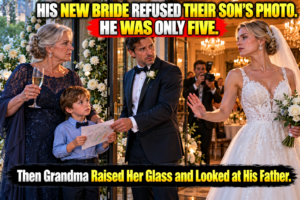
The bride refused.
“He’s not my child. Please take him away.”
When I questioned her privately, she said they had agreed their life would be “just the two of us.”
I took my grandson somewhere he couldn’t hear what came next.
Then, at the reception, I raised my glass—and looked directly at my son.
👉 …Continue Read More…


One Comment on “My Son’s New Bride Refused a Wedding Photo With His Five-Year-Old Boy—When She Told Me She Didn’t Need Him, I Raised My Glass and Asked His Father One Question”