The Marble He Carried for Sixty Years
A full emotional American family story about the Dust Bowl, poverty, shame, forgiveness, and a secret that finally reached the son who never knew the truth.
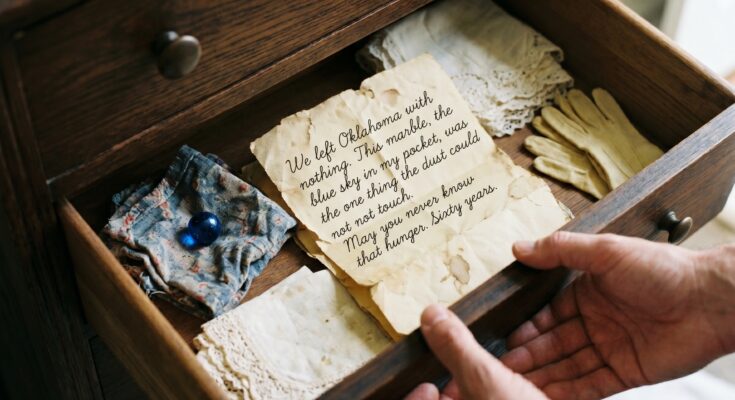
In the bottom drawer of my grandmother’s old dresser, beneath lace handkerchiefs and church gloves yellowed by time, I found a small blue marble wrapped inside a square of faded cloth.
Beside it was a letter.
The paper was thin, brittle, and folded so many times that the creases had nearly become cuts. Across the first page, in handwriting that trembled like a tired voice, my grandmother had written:
“It was the Dust Bowl. We lost everything in Oklahoma.”
I sat on the floor before reading more. Something about those words felt heavier than history. They felt personal, as if a door had opened in my family and a long-buried truth had finally stepped into the light.
She wrote about the farm first. Not a large farm, not a rich one, but enough to keep a family alive. There had been corn, a few chickens, a milk cow, and a little porch where my father, then just a boy, played with marbles in the dirt.
Then the sky changed.
The rain stopped coming. The land cracked open. Dust rolled across the fields like dark weather with no mercy. It entered the house through windows, doors, walls, and even closed cupboards. My grandmother wrote that she would wash a plate, turn away for a moment, and find dust settled on it again.
Her husband—my grandfather—left for California to find work. He promised he would send money. He promised he would come back for them. He kissed my father on the head and told him to be brave.
But no letter came.
No money came.
No father came home.
My grandmother waited until waiting became hunger. She sold what little they had. She traded blankets for flour. She walked miles asking for washing work, sewing work, kitchen work—anything. But every family was suffering. Every hand was empty.
Then came the line that made me stop breathing.
“I had to send your father to an orphanage. I couldn’t feed him.”
My father had never told us that. All my life, he said his mother died when he was young. He never said it with bitterness. He said it softly, like a man placing a flower on a grave no one else could see.
But now I knew death had not taken her.
Poverty had taken him from her.
She wrote that my father was six years old when she walked him to the orphanage. He wore shoes too small for his feet and carried his favorite blue marble in his hand. He kept asking when they were going home.
She told him, “Soon.”
She wrote that lie haunted her for the rest of her life.
At the orphanage door, he began crying. He held onto her dress and begged not to stay. She wanted to pick him up and run. She wanted to sleep hungry beside him forever if it meant keeping him close.
But hunger had already made the decision for her.
She left him there.
Outside, she realized his blue marble was still in her pocket. He must have slipped it into her hand before the door closed. Maybe he thought she would bring it back. Maybe he thought it meant she would return.
She never did.
Not because she did not love him.
Because shame swallowed her whole.
She wrote that she told people her husband had died in an accident. She told others her son was living with relatives. She lied because the truth felt too cruel to say aloud: that she had been too poor to keep her own child.
Years passed. She found work. She survived. But survival did not feel like victory. Every Christmas, she held the marble and cried. Every birthday, she whispered my father’s name. Every time she saw a boy around his age, she wondered what her son looked like now.
She carried that marble for sixty years.
Near the end of the letter, her handwriting grew weaker.
“If you are reading this, tell him I’m sorry. Tell him I never stopped loving him. Tell him I was a coward because I could not face what I had done.”
I read that sentence again and again.
My father was already gone. He had died five years earlier, still believing his mother had disappeared from the world when he was a child. He never knew she had lived with his name inside her heart.
The next morning, I drove to his grave with the letter and the blue marble in my coat pocket. The cemetery was quiet. The grass was wet from rain. I knelt beside his headstone and unfolded the letter with shaking hands.
Then I read it aloud.
I told him about Oklahoma. I told him about the dust. I told him about the hunger, the orphanage, the lie, and the mother who had loved him too much to forget him but feared the truth too much to find him.
When I finished, I placed the marble against his headstone.
For a long time, I said nothing.
Then I whispered, “She was sorry, Dad.”
The wind moved through the trees, soft and low. For the first time, I imagined my father not as the quiet old man I had known, but as a six-year-old boy standing behind an orphanage door, waiting for his mother to come back.
That thought broke me.
But it also healed something.
Because the truth had finally arrived.
Late, yes.
Too late for them to hold each other.
Too late for questions, explanations, and forgiveness spoken face to face.
But not too late for love to be understood.
Not too late for shame to lose its power.
Not too late for a son to receive the message his mother had carried for a lifetime.
After that day, I stopped seeing my family history as a simple story of abandonment. It was a story of hunger, fear, weakness, love, and regret. It was a story of people crushed by a hard time, making impossible choices with broken hearts.
And the marble became more than a keepsake.
It became proof.
Proof that my father had been loved.
Proof that my grandmother had remembered.
Proof that even the smallest object can carry the weight of an entire life.
Now, whenever I think of them, I do not imagine only the pain. I imagine a mother holding a blue marble in her palm, whispering her son’s name into the dark. I imagine a boy who deserved the truth. I imagine forgiveness traveling slowly across generations until it finally reached the right grave.
Some apologies come too late to change the past.
But they can still change the story.
And sometimes, changing the story is the only way a family learns how to breathe again.
Moral of the Story
Poverty can force impossible choices, but shame should never bury love. Truth may arrive late, but it can still bring peace. Even after generations of silence, forgiveness can find its way home.