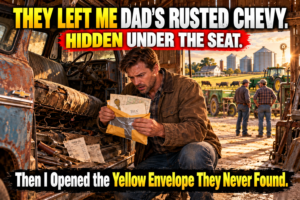
When Dad died, my brothers divided his farm before the funeral flowers had wilted. They laughed when all I received was his rusted Chevy. Weeks later, while cleaning it for the junkyard, I found a yellow envelope taped beneath the seat.
Part 1
When Dad died, my brothers moved fast.
Dale took the farm before the funeral flowers were even dead.
Eric claimed the equipment, the grain contracts, and the cattle like it had all been decided years ago.
By the time they got around to me, all that was left was Dad’s old rusted Chevy sitting behind the barn.
Dale tossed me the keys and said, “Fits you better anyway.”
Nobody said a word after that.
The truck barely ran.
The passenger door had to be kicked shut, and the seat smelled like oil and old cigarettes.
I honestly planned to haul it for scrap once the title cleared.
A few weeks later, I started cleaning it out before calling the junkyard.
There were old feed receipts stuffed in the glove box and rusted tools behind the seat.
When I reached underneath the driver’s side, my fingers caught on something taped deep against the springs.
It was a yellow envelope wrapped tight in duct tape.
I tore one side open, looked inside, and my heart stopped.
There was no money.
No stack of hundred-dollar bills.
No bearer bonds.
Instead, there were three things.
A small brass key.
A folded document.
And a letter.
My name was written across the front in Dad’s unmistakable handwriting.
BEN.
For several seconds, I just stared at it.
Dad had been dead for twenty-six days.
Yet seeing those three letters made it feel as though he were sitting beside me again.
I could almost hear him coughing as he started the Chevy on cold mornings.
“Give her a minute,” he’d always say. “Old things deserve patience.”
I climbed out of the truck and sat on the running board.
My hands were shaking when I opened the letter.
Ben,
If you’re reading this, then the truck ended up with you.
That means I was right.
I stopped.
Right about what?
I continued.
Don’t call your brothers yet.
Don’t show Dale the key.
Don’t show Eric the papers.
Go to First County Bank and ask for Margaret Ellis.
Tell her your father sent you.
Bring your identification and the brass key.
Most important: take the Chevy.
Dad
I read it twice.
Then a third time.
At the bottom, underneath his signature, Dad had added one final sentence.
And Ben—don’t let them sell the north field before you talk to Margaret.
My stomach tightened.
The north field.
Two hundred and twelve acres of the best farmland on Dad’s property.
The same field Dale had been bragging about leasing to a neighboring operation.
I unfolded the second document.
It was a photocopy of an old survey.
Most of Dad’s farm was outlined in black.
But the north field was outlined separately in blue.
In the corner was a handwritten notation.
Parcel 14B.
Not included.
I stared at those words.
Not included in what?
I pulled out my phone.
There were three missed calls from Dale.
That wasn’t unusual.
Since Dad died, Dale had been calling whenever he needed me to sign something or pick up something he considered worthless.
Then another call came through.
Dale.
I almost ignored it.
Instead, I answered.
“What?”
“Where are you?”
“At home.”
“You been out to Dad’s place?”
My eyes moved toward the yellow envelope.
“Why?”
“We’re cleaning the barn tomorrow. If you want anything from that junk truck, get it today.”
“I already did.”
Silence.
Then Dale laughed.
“Find your inheritance?”
I looked at the brass key resting in my palm.
“Something like that.”
“What’s that supposed to mean?”
“Nothing.”
I ended the call.
For the first time since Dad’s funeral, I wasn’t angry when I thought about my brothers.
I was curious.
I put the letter, survey, and key back inside the envelope.
Then I slid behind the wheel.
The Chevy protested when I turned the ignition.
Once.
Twice.
On the third try, the old engine coughed to life.
I rested both hands on the steering wheel.
The junkyard could wait.
Twenty minutes later, I was driving toward First County Bank.
I had no idea who Margaret Ellis was.
I had no idea what the key opened.
But when I arrived at the bank and gave the receptionist Dad’s name, her expression changed immediately.
“One moment, Mr. Mercer.”
She disappeared through a locked door.
Less than a minute later, a silver-haired woman in a navy suit came rushing toward me.
She looked at the Chevy through the bank window.
Then at the brass key in my hand.
“Oh,” she whispered.
“What?”
Her eyes filled with tears.
“Your father was right.”
“About what?”
She glanced toward the lobby.
“Not here.”
She led me into a private office, closed the door, and locked it.
Then she sat across from me.
“Before we go downstairs,” she said, “I need to ask you one question.”
“Okay.”
“Have Dale or Eric seen that key?”
“No.”
Her shoulders relaxed.
“Good.”
“Why?”
Margaret opened a drawer and removed a thick sealed folder.
Across the front, in Dad’s handwriting, were five words.
FOR BEN—ONLY WITH THE KEY.
Margaret placed it between us.
Then she looked me directly in the eyes.
“Because your brothers have spent the last month fighting over property your father may never have intended them to own.”
Part 2
I stared at Margaret.
“What does that mean?”
She didn’t answer immediately.
Instead, she asked for my driver’s license.
I handed it over.
She compared the information with a document in the folder.
“Full name?”
“Benjamin Thomas Mercer.”
“Date of birth?”
I told her.
“Your father’s full legal name?”
“Thomas William Mercer.”
She nodded.
Then she pushed the brass key toward me.
“Keep this with you.”
“What does it open?”
“A private document box downstairs.”
“A safe-deposit box?”
“Not exactly.”
Margaret explained that Dad had maintained a secured records box through the bank’s trust department.
He had visited it regularly during the last four years of his life.
The final visit had been eleven days before he died.
“Was he expecting to die?”
“He knew his health wasn’t good.”
I looked down.
Dad had never discussed his health with us.
He’d complain about doctors, complain about pills, complain about hospital food—but never admit he was frightened.
“Why didn’t he just put whatever this is in his will?”
Margaret’s expression became careful.
“Some of it is.”
That answer made me sit straighter.
“Some?”
“Ben, I’m not your attorney, and I don’t want to interpret legal documents for you. Your father anticipated that. There’s a name inside the box. I suggest you call that person before making any decisions.”
I rubbed my forehead.
“Margaret, my brothers already divided everything.”
“I know.”
“How?”
“Dale was here six days after your father’s death.”
My jaw tightened.
“For what?”
“He wanted information about farm operating accounts.”
“Did you give it to him?”
“Only what he was legally entitled to receive.”
“And Eric?”
“Two days later.”
Of course.
I almost laughed.
Even in grief, my brothers had managed to turn Dad’s death into a race.
Margaret stood.
“Ready?”
We went downstairs.
The secured records room was smaller than I expected.
Margaret used her key first.
Then I inserted Dad’s brass key into a second lock.
The compartment opened.
Inside was a metal box.
My hands felt numb as I lifted the lid.
There were no piles of cash.
Instead, Dad had filled it with documents.
Property records.
Tax statements.
Old photographs.
Bank records.
A flash drive.
A notebook.
And a sealed white envelope.
On top was another handwritten note.
Ben,
Start with the red folder.
I found it underneath the notebook.
Inside was a deed.
I recognized Dad’s name.
Then I saw mine.
Benjamin Thomas Mercer.
I looked at Margaret.
“What is this?”
“I think you should read the date.”
I did.
The deed had been executed almost nine years earlier.
I scanned the legal description.
Parcel 14B.
The north field.
Two hundred and twelve acres.
My heart started pounding.
“This says—”
“I know what it says.”
“But Dale inherited the farm.”
Margaret shook her head.
“That’s why you need an attorney.”
I kept reading.
The deed appeared to place the north field into something called the Thomas W. Mercer Land Trust.
Then came another document.
Beneficiary designation.
My name appeared again.
One hundred percent beneficial interest upon Dad’s death.
I couldn’t speak.
Margaret handed me a card.
“Call her.”
The card read:
REBECCA SHAW
ESTATE & AGRICULTURAL LAW
I recognized the name.
Rebecca had handled land transactions in our county for years.
“Did Dad use her?”
“For matters related to this trust.”
“Did Dale know?”
“I can’t answer what Dale knew.”
“Did Eric?”
“Same answer.”
I looked back into the box.
Under the deed was an appraisal.
The north field had been valued eighteen months earlier.
$1,184,000.
I stopped breathing for a second.
Over a million dollars.
My brothers had left me a rusted truck worth maybe eight hundred dollars.
Dad had apparently left me land worth more than a million.
But instead of feeling victorious, I felt sick.
Because something didn’t fit.
Why hide it?
Why the Chevy?
Why the key?
Why not tell us while he was alive?
Then I opened Dad’s notebook.
The first several pages contained dates.
Payments.
Equipment numbers.
Names.
Near the middle, I found a page titled:
WHAT I GAVE THEM ALREADY.
Under Dale’s name:
Farmhouse + main acreage arrangement.
Under Eric:
Equipment equity + cattle operation.
Under mine:
Nothing yet.
Then underneath, Dad had written:
Ben never asked.
My throat tightened.
I remembered the final year of Dad’s life.
Dale constantly talked about taking over the farm.
Eric constantly asked about tractors, cattle, and contracts.
I had avoided the subject.
Not because I didn’t care.
Because Dad was still alive.
Talking about who got what had felt like planning his funeral while he was sitting at the kitchen table.
Margaret touched my arm.
“There’s another envelope.”
I looked down.
The white envelope.
Across the front:
READ BEFORE YOU CALL YOUR BROTHERS.
I opened it.
The first line made my stomach drop.
Ben,
If Dale tells you I promised him the entire farm, ask him about the document he brought me on March 17.
Below that, Dad had written:
He knows exactly why Parcel 14B was removed.
Part 3
I called Rebecca Shaw from the bank parking lot.
She answered personally.
When I gave her my name, she didn’t sound surprised.
“Mr. Mercer. I’ve been expecting your call.”
That was becoming an unsettling phrase.
“Can you meet today?”
“Yes.”
“How soon?”
“Thirty minutes.”
Her office was above an insurance agency on Main Street.
I carried Dad’s red folder inside.
Rebecca was in her late fifties, with short gray hair and the efficient manner of someone who charged by the hour and disliked wasting minutes.
She closed her office door.
“Before we start, I’m sorry about your father.”
“Thank you.”
“He was difficult.”
I blinked.
Then she smiled slightly.
“But I liked him.”
“That sounds like Dad.”
I handed her the folder.
Rebecca opened it.
She wasn’t surprised by anything inside.
“You prepared these?”
“Some of them.”
“So the north field is mine?”
She leaned back.
“Beneficially, yes, subject to final administration and the terms of the trust.”
“Why didn’t anyone tell me?”
“Your father specifically instructed me not to contact you unless one of two things happened.”
“What things?”
“You contacted me with the key, or sixty days passed after his death.”
“Why sixty days?”
“He wanted to see whether the instructions he left elsewhere would be followed.”
I stared at her.
“That sounds like a test.”
Rebecca shook her head.
“He didn’t describe it that way.”
“What did he call it?”
“A safeguard.”
Against whom?
I didn’t have to ask.
“Tell me about March 17.”
Rebecca’s expression changed.
“You read Thomas’s letter.”
“Yes.”
She opened another file.
“On March 17, Dale brought your father a proposed transfer agreement.”
“What kind?”
“One that would have transferred substantially all remaining farm property to Dale in exchange for Dale assuming certain operating debts and agreeing to support your father.”
My stomach turned.
“Dad didn’t need Dale to support him.”
“Correct.”
Dad had income.
Savings.
Crop leases.
He wasn’t rich in cash, but he wasn’t helpless.
“Did he sign?”
“No.”
“Then why does Dale think he owns everything?”
“Because your father’s final estate plan did leave Dale a significant portion of the main farm.”
“Significant portion?”
“Not all of it.”
I felt another shift beneath my feet.
“What else is there?”
Rebecca turned a document toward me.
A map.
The original Mercer farm consisted of nearly six hundred acres.
I had grown up thinking of it as one property.
Legally, it wasn’t.
The north field was Parcel 14B.
The farmhouse and central acreage were another parcel.
The south pasture was another.
A wooded strip along the creek was another.
Dad had separated them over the years.
Dale received the farmhouse and 188 acres.
Eric received rights connected to the cattle operation, equipment interests, and a lease on the south pasture.
I received the north field trust.
“What about the rest?”
“Your father established provisions for taxes, debts, and several smaller gifts.”
I leaned back.
“So why did everyone act like Dale got the whole farm?”
Rebecca was quiet.
“That’s a question for Dale.”
I remembered the funeral.
Dale standing beside Dad’s coffin, greeting neighbors as if he had already become head of the family.
Three days later, he had changed the lock on Dad’s farmhouse.
When I asked why, he said insurance required it.
I believed him.
Eric removed two tractors the following week.
When I asked about them, he said Dad had promised them years ago.
I believed him too.
Then came the Chevy.
Fits you better anyway.
“Did they know what Dad left me?”
“Not the full details.”
“But Dale knew the north field wasn’t his.”
Rebecca looked directly at me.
“Yes.”
My jaw tightened.
“And he’s trying to lease it.”
“How do you know?”
“Dad mentioned it in his letter.”
Rebecca immediately picked up her phone.
“To whom?”
“What?”
“Who is Dale negotiating with?”
“Maybe Harlan Agricultural. That’s what I heard.”
She made a call.
The conversation lasted less than three minutes.
When she hung up, her expression was serious.
“We need to move quickly.”
“Why?”
“If Dale signs anything involving Parcel 14B while representing himself as having authority over it, we’ll have a mess.”
“Can he?”
“He can sign a piece of paper. Whether that paper is enforceable is another question.”
I rubbed my face.
“What do you need from me?”
“For now? Nothing except restraint.”
“Meaning?”
“Don’t confront Dale.”
I laughed bitterly.
“Everyone keeps telling me that.”
“There’s a reason.”
Rebecca opened Dad’s notebook.
“Your father documented more than property.”
She turned several pages.
There were columns of numbers.
Transfers to Dale.
Payments for Eric.
Loans.
Insurance premiums.
Equipment purchases.
“What is this?”
“Your father spent almost fifteen years keeping track of financial assistance he provided each of you.”
I found my column.
It was almost empty.
Rebecca tapped Dale’s total.
$286,400.
Then Eric’s.
$241,750.
Then mine.
$18,600.
I recognized most of mine.
Dad had helped with tuition one year.
Loaned me money for a used car.
Paid a medical bill when I was twenty-six.
“Why was he keeping score?”
“I asked him the same question.”
“What did he say?”
Rebecca looked down at the notebook.
“He said he wasn’t keeping score.”
“Looks like it.”
“He said he was trying to make things fair.”
Fair.
The word bothered me.
I didn’t want the north field because Dale got something.
I didn’t want a million dollars because Eric had received equipment.
I wanted Dad back.
No ledger could balance that.
Rebecca closed the notebook.
“There is one more issue.”
Of course there was.
“What?”
“Your father believed some equipment had been removed from the farm before his death without his permission.”
I stared at her.
“By who?”
“He didn’t write a name.”
“Dale?”
“I won’t speculate.”
“Eric?”
“I won’t speculate.”
She slid a photocopied page toward me.
Dad had written a series of equipment serial numbers.
Beside three of them was one word.
MISSING.
And beneath that:
Ask Ben to check the Chevy.
I looked at Rebecca.
“I already checked it.”
“Did you?”
“I found the envelope.”
She pointed toward the photograph of the truck attached to Dad’s note.
Not underneath seat.
Behind rear cab panel.
There was something else hidden inside the Chevy.
Part 4
I drove home without calling anyone.
The Chevy rattled the entire way.
Dad had driven that truck for twenty-three years.
Dale hated it.
Eric mocked it.
I used to beg Dad to replace it.
“Why?” he’d ask. “Starts, stops, carries things.”
“Sometimes it starts.”
“That’s why God invented jumper cables.”
Now that ugly truck had become the center of everything.
I parked inside my garage and closed the door.
Behind the bench seat was a thin metal panel.
Four screws held it in place.
Two were rusted nearly solid.
It took penetrating oil, a socket wrench, and forty minutes of swearing before I removed them.
I pulled the panel loose.
Dust fell everywhere.
Behind it was a narrow cavity.
Inside sat a black plastic document tube.
I pulled it out.
The cap was sealed with electrical tape.
Inside was another flash drive.
A small spiral notebook.
And six photographs.
The photographs showed farm equipment.
Dad had taken them himself.
Each included a handwritten date.
One showed the John Deere combine.
Another showed the cattle trailer.
Another showed an older tractor.
I checked the serial numbers against Dad’s list.
Three matched the equipment marked MISSING.
The notebook contained dates.
March 4.
March 11.
March 23.
Beside each date was a name.
Eric.
My stomach sank.
I called Rebecca.
“I found it.”
“What’s there?”
I explained.
“Don’t alter anything.”
“Too late. I opened it.”
“I mean don’t write on anything or give anything away.”
“Why would Dad hide this in the truck?”
“I don’t know.”
I sat on the garage floor.
Then I remembered something.
Dad had stopped driving six months before his death.
His eyesight had deteriorated.
The Chevy had been parked behind the barn ever since.
Nobody used it.
Nobody wanted it.
Which made it a perfect hiding place.
My phone buzzed.
Eric.
I stared at his name.
Then answered.
“Hey.”
“You talk to Dale today?”
“No.”
“He’s pissed at you.”
“What else is new?”
Eric laughed.
“He said you’re asking questions about the north field.”
My chest tightened.
“Who told him?”
“No idea.”
I did.
Small town.
Bank.
Attorney.
Someone had seen the Chevy.
“What questions?”
Eric asked.
“Nothing important.”
“Ben.”
His tone changed.
“What?”
“Don’t start something.”
“I’m not.”
“Dad’s estate is complicated enough.”
I looked at the photographs spread across my garage floor.
“Did you take equipment before Dad died?”
Silence.
Long enough.
“What?”
“You heard me.”
“Where is this coming from?”
“Answer.”
Eric’s voice hardened.
“Dad gave me that equipment.”
“Which equipment?”
Another silence.
He had walked into it.
I hadn’t named any machines.
“Look,” Eric said. “Dad and I had arrangements you weren’t part of.”
“Do you have paperwork?”
“I don’t need paperwork.”
“That sounds convenient.”
“What’s gotten into you?”
I almost told him everything.
Instead, I remembered Dad’s letter.
Don’t call your brothers yet.
Maybe Dad knew exactly how Eric would respond.
“I have to go.”
“Ben—”
I hung up.
Five minutes later, Dale called.
I ignored it.
Then he texted.
WE NEED TO TALK.
Another message.
NOW.
Then:
DON’T SIGN ANYTHING.
I stared at that one.
Why would he think I was signing something?
Another message arrived.
Whatever you found in that truck doesn’t change Dad’s will.
My entire body went cold.
I had never told Dale I found anything.
I called Rebecca.
“Dale knows.”
“Knows what?”
“That I found something in the truck.”
“How?”
“I don’t know.”
“Don’t answer him.”
“He specifically mentioned the truck.”
Rebecca was silent.
Then she asked, “Where is the Chevy?”
“My garage.”
“Keep it there.”
“Why?”
“Because Thomas didn’t leave you that truck accidentally.”
I looked toward the exposed rear panel.
Rebecca continued.
“I’ve been reviewing his instructions. There is a handwritten amendment in my file.”
“What does it say?”
“That the Chevy, including all contents present at the time of his death, goes solely to you.”
“So?”
“So your father made the truck a container for records he specifically wanted you to receive.”
I looked at Dad’s old driver’s seat.
Suddenly the joke Dale made while tossing me the keys sounded different.
Fits you better anyway.
Maybe Dad had known exactly what his sons would value.
Dale saw land.
Eric saw machinery.
I saw an old truck.
And Dad knew none of them would bother looking inside it.
That evening, I photographed every document.
Then I locked the originals in a fireproof box.
At 8:40 p.m., headlights swept across my living room.
A pickup stopped outside.
Dale climbed out.
He didn’t knock politely.
He hammered on the door.
“Ben!”
I opened it but kept the storm door locked.
“What?”
“We need to straighten something out.”
“Tomorrow.”
“No. Tonight.”
His face was red.
Then he looked past me toward the garage.
“I need the Chevy back.”
I almost laughed.
“Why?”
“It was transferred to you by mistake.”
“No, it wasn’t.”
His expression changed.
Just slightly.
But enough.
“You don’t know that.”
“Yes, I do.”
For the first time in my life, my oldest brother looked afraid of me.
Then he said something that confirmed Dad had hidden far more than an old deed.
“If you found a black notebook, you need to understand Dad wasn’t thinking clearly when he wrote it.”
I had never told Dale about any black notebook.
Part 5
I unlocked the storm door but didn’t invite Dale inside.
“How do you know about the notebook?”
He stared at me.
“What notebook?”
“You just said black notebook.”
“I meant whatever papers you found.”
“No, you didn’t.”
Dale rubbed his jaw.
“Ben, Dad was sick.”
“He wasn’t incompetent.”
“I didn’t say incompetent.”
“You’re getting close.”
Dale stepped nearer.
“I spent twenty years keeping that farm running.”
“I know.”
“You left.”
There it was.
The argument I had expected eventually.
I had moved forty miles away when I was twenty-four.
Dale stayed.
Eric stayed nearby.
I visited Dad almost every week, but I didn’t farm full-time.
“You think I don’t know that?”
“You don’t know what it took.”
“I never said I did.”
“Then don’t walk in after Dad dies and start questioning everything.”
I looked at him.
“You mean don’t question you.”
His jaw tightened.
“Same difference right now.”
“No.”
I shook my head.
“That’s exactly the problem.”
Dale looked toward the garage again.
“What did you find?”
“Why?”
“Because Dad kept old documents everywhere.”
“So?”
“Some were outdated.”
“Which ones?”
He didn’t answer.
“The north field?”
His face changed.
There it was.
I continued.
“You knew.”
“Knew what?”
“That Dad separated Parcel 14B.”
Dale swore under his breath.
Then he walked off the porch.
For a second, I thought he was leaving.
Instead, he turned around.
“Dad promised me the farm.”
“Maybe he promised you part.”
“The whole thing.”
“Then why did he put 212 acres in a separate trust?”
Dale froze.
Now he knew exactly what I had found.
“You went to Rebecca.”
“Yes.”
He laughed without humor.
“That woman poisoned Dad against me.”
“Don’t.”
“You don’t know.”
“Then explain.”
Dale looked exhausted.
For the first time, I noticed how much weight he had lost since Dad’s death.
“I brought Dad a transfer agreement.”
“March 17.”
His eyes widened.
“You know about that too?”
“Yes.”
“It wasn’t what you’re thinking.”
“What am I thinking?”
“That I tried to steal the farm.”
“Did you?”
“No.”
His answer was immediate.
“Then what happened?”
Dale sat on the porch step.
I remained standing.
“The farm had debt.”
“I know.”
“No, you know numbers on paper. You don’t know what it felt like when fertilizer doubled, diesel jumped, and we had two bad harvests.”
“Okay.”
“I talked to the bank. I talked to accountants. I thought transferring everything into one operating structure would make financing easier.”
“And Dad?”
“He thought I was trying to push him out.”
“Were you?”
“No.”
I studied him.
I couldn’t tell whether he was telling the truth.
Maybe even Dale didn’t know anymore.
“What about the north field?”
He looked toward the road.
“Dad removed it after our argument.”
“So you knew.”
“Yes.”
“Why did you tell everyone you inherited the whole farm?”
“I didn’t.”
“You sure acted like it.”
“I inherited the farmhouse and operating acreage.”
“And you were trying to lease the north field.”
Dale stood abruptly.
“Because nothing had been finalized!”
“It was put in trust nine years ago.”
That stopped him.
“What?”
I watched his face.
The surprise looked genuine.
“Nine years.”
“No.”
“Yes.”
“Dad told me he separated it after March.”
“Maybe he meant from the operating plan.”
Dale paced.
For the first time, his confidence disappeared.
Then he looked at me.
“Who gets it?”
I didn’t answer.
His eyes narrowed.
“You?”
“Yes.”
The word hung between us.
Dale laughed once.
Then again.
“You?”
I felt the old anger return.
“Apparently.”
“You don’t even farm.”
“There it is.”
“What?”
“The reason Dad hid it.”
Dale stopped laughing.
“I don’t care that you got something.”
“You sound thrilled.”
“I care that 212 acres of productive ground just got pulled out from under an operation I’ve spent my life building.”
“That’s different.”
“Is it?”
“Yes.”
He rubbed his face.
“What are you going to do with it?”
“I don’t know.”
“Sell it?”
“I don’t know.”
“To Harlan?”
“I said I don’t know.”
He stepped closer.
“Don’t sell to Harlan.”
“Why?”
“Because they’ll box us in on the north side.”
Us.
Interesting.
Suddenly it was us.
I opened the door.
“We’re done tonight.”
“Ben.”
“What?”
Dale’s anger disappeared.
“Whatever you think of me, don’t make a decision just to hurt me.”
I looked at him.
“I won’t.”
He nodded.
Then I added:
“But I’m also not going to make one just to save you.”
Dale left.
The next morning, Rebecca called.
“Come to my office.”
“Why?”
“I found the document Thomas wanted you to see after you spoke with Dale.”
“What document?”
“A lease.”
“With who?”
“No one yet.”
“I don’t understand.”
“You will.”
When I arrived, Rebecca handed me a signed document Dad had prepared five months before his death.
It granted Dale’s farming operation the right to lease the north field.
The term?
Ten years.
The rent?
One dollar annually.
I stared at Rebecca.
“Dad left me a million-dollar field and then basically gave Dale free use of it?”
“Read the next page.”
I turned it.
The lease contained conditions.
Dale could farm the land for ten years at nominal rent.
But only if he met one requirement.
He had to provide a complete accounting of all equipment and property removed from Dad’s farm during the previous five years.
Any intentionally concealed property voided the lease.
I looked at Rebecca.
“Dad knew.”
“He suspected.”
“About Eric?”
“Perhaps.”
“About Dale?”
“Perhaps.”
Then Rebecca slid one final page toward me.
Dad had written a note across it.
Ben decides whether they told the truth.
Part 6
I hated what Dad had done.
That was my first reaction.
Not gratitude.
Not satisfaction.
Anger.
He had put me in the middle.
He had made me judge my brothers.
Rebecca listened while I paced her office.
“I don’t want this.”
“The land?”
“This responsibility.”
“Those are different things.”
“Why couldn’t Dad just deal with them himself?”
Rebecca closed the file.
“Would you like my personal answer or legal answer?”
“Personal.”
“He tried.”
I stopped.
She continued.
“Your father loved all three of you. He was also stubborn, proud, and terrible at direct confrontation.”
“That sounds right.”
“He suspected property was being moved without adequate records. Every time he raised it, the conversations became arguments.”
“So he made me referee after he died?”
“I think he chose the son he believed would look at the facts before choosing a side.”
That didn’t make me feel better.
I took copies of the lease home.
Then I called both brothers.
“Dad’s house. Tomorrow. Six.”
Dale immediately asked why.
“Just come.”
Eric complained.
I hung up.
At 5:50 the next evening, I parked the Chevy beside Dad’s barn.
Dale was already there.
Eric arrived ten minutes late.
We sat at Dad’s kitchen table.
His coffee mug was still hanging from the hook near the sink.
For a second, none of us spoke.
Then Eric looked at the folder.
“What is this?”
“Dad’s instructions.”
Dale knew enough to remain quiet.
I laid out copies of the trust documents.
The lease.
The equipment list.
Eric’s face changed when he saw the serial numbers.
“Where did you get these?”
“Dad.”
“He’s dead.”
“I noticed.”
Dale shot me a look.
I continued.
“Dad left me the north field.”
Eric looked at Dale.
Dale nodded.
“You knew?” Eric demanded.
“Since yesterday.”
Eric turned back to me.
“So you got 212 acres?”
“Yes.”
“And I got equipment.”
“Yes.”
“And Dale got the house and main farm.”
“Yes.”
Eric leaned back.
“Well, then what’s the problem?”
I pushed Dad’s equipment list toward him.
“This.”
He looked down.
Silence.
“These three machines were marked missing before Dad died.”
“They weren’t missing.”
“Where were they?”
“At my place.”
“Why?”
“Dad gave them to me.”
“Show me.”
Eric’s face hardened.
“Show you what?”
“Anything proving that.”
“He was my father.”
“He was mine too.”
“You calling me a thief?”
“No. I’m asking for records.”
Eric shoved the paper away.
“This is ridiculous.”
Dale picked it up.
“What equipment?”
Eric glared at him.
“Stay out of it.”
“That’s Dad’s combine.”
“It was.”
“Where is it?”
“I traded it.”
Dale stood.
“You what?”
“Two years ago.”
“That combine was part of the farm operation.”
“Dad gave it to me.”
“Bull.”
The argument exploded.
I let it go for thirty seconds.
Then I slammed my palm on the table.
“Enough!”
Both stopped.
I placed the lease in front of Dale.
“Dad left this.”
Dale read.
His expression shifted.
Eric leaned over.
“What is it?”
“A lease.”
Dale kept reading.
Then he reached the condition.
His eyes moved to Eric.
“You idiot.”
Eric snatched the document.
He read it.
Then looked at me.
“This isn’t legal.”
“Rebecca says it is.”
“Rebecca Shaw?”
“Yes.”
Eric threw the paper down.
“Dad was trying to turn us against each other.”
“No,” I said. “I think he was trying to make us tell the truth.”
Eric stood.
“I’m done.”
He headed toward the door.
“Eric.”
He stopped.
“You can leave. But I’m not signing the lease until I know where Dad’s property went.”
He turned.
“You don’t know anything about farming.”
“Probably true.”
“You’ll destroy this place.”
“Maybe.”
Dale looked at me sharply.
I continued.
“Or I could sell the north field tomorrow.”
Neither brother spoke.
“I don’t want to. But for the first time since Dad died, you’re both going to stop acting like every decision has already been made.”
Eric stared at me.
Then he left.
The screen door slammed.
Dale remained.
He looked exhausted.
“There’s more equipment missing than those three.”
I stared at him.
“What?”
He opened one of Dad’s old desk drawers and pulled out a ledger.
“I didn’t tell Dad because I was trying to protect Eric.”
My stomach tightened.
“How much?”
Dale placed the ledger on the table.
“More than you think.”
I opened it.
Sixteen equipment entries had been crossed out.
Beside several were auction numbers.
Then Dale said quietly:
“Eric didn’t just take equipment.”
“What else?”
Dale looked toward the cattle pasture.
“Thirty-eight head disappeared from Dad’s records over three years.”
Part 7
The next two weeks were ugly.
Not dramatic.
Ugly.
There is a difference.
Drama happens quickly.
Ugly family problems unfold through phone calls, old receipts, bank statements, half-truths, and memories nobody agrees on.
Rebecca brought in an accountant familiar with agricultural estates.
Dale provided his ledgers.
I provided Dad’s notebook.
Eric refused to cooperate for four days.
Then Rebecca sent him a formal request through the estate administration.
He finally appeared at her office carrying a cardboard box.
Inside were receipts.
Bills of sale.
Auction records.
Dad had, in fact, given Eric some equipment.
But not all of it.
The combine had been Dad’s.
So had a cattle trailer and two implements.
Eric had sold them.
The cattle issue was more complicated.
Some had been transferred legitimately.
Others had been sold under Eric’s operation even though Dad still owned an interest.
The total amount was substantial.
But it wasn’t enough to destroy the family.
The lying nearly was.
One night, Eric came to my house.
I almost didn’t let him in.
He stood beside the Chevy in my garage.
“So this is where Dad hid everything?”
“Some of it.”
Eric touched the rusted hood.
“He always liked this piece of junk.”
“So do I now.”
He laughed sadly.
“I bet Dale loved that.”
“He wants it back.”
“Of course he does.”
We stood in silence.
Then Eric said, “I took the combine.”
“I know.”
“Dad knew.”
“I know.”
“He confronted me.”
That I didn’t know.
“When?”
“Last winter.”
“What happened?”
“We fought.”
Eric stared at the concrete floor.
“I told him he’d promised it to me.”
“Had he?”
“He said I could use it.”
“That’s not the same thing.”
“I know that now.”
“Did you know it then?”
Eric didn’t answer.
That was answer enough.
“Why sell it?”
“I was in trouble.”
“What kind?”
“Debt.”
He explained.
His cattle operation had been losing money.
A loan had come due.
He was terrified of losing his house.
“Why didn’t you ask Dad?”
“I had.”
“And?”
“He’d already helped me.”
I thought about Dad’s notebook.
$241,750.
“Why didn’t you ask us?”
Eric laughed bitterly.
“Dale would’ve lectured me for three hours.”
“And me?”
He looked at me.
“I didn’t think you had money.”
I almost smiled.
“I didn’t.”
“Exactly.”
“So you sold Dad’s combine.”
“Yes.”
“And cattle.”
“Yes.”
“How much did you keep?”
“Enough to cover the debt.”
I felt anger.
But also something else.
Sadness.
Three brothers.
All living within an hour of each other.
None capable of saying, I’m in trouble.
“What do you want from me?”
Eric looked toward the truck.
“Nothing.”
“Then why are you here?”
“To tell you before the accountant does.”
“He already did.”
Eric closed his eyes.
“Of course.”
“But I’m glad you came.”
He looked surprised.
“Really?”
“Yes.”
We stood there.
Then he asked, “Are you selling the north field?”
“No.”
“Giving it to Dale?”
“No.”
“What are you doing?”
“I haven’t decided.”
He nodded.
“I guess that’s fair.”
As he turned to leave, I asked one question.
“Eric?”
“Yeah?”
“Why did you and Dale give me the Chevy?”
He frowned.
“What?”
“After Dad died.”
“Because the will said it was yours.”
“Dale made it sound like you two were giving me leftovers.”
Eric looked embarrassed.
“I know.”
“Why?”
He shoved his hands into his pockets.
“Because we thought that’s what it was.”
That answer stayed with me.
They hadn’t known.
Dad had orchestrated the entire thing quietly.
He knew Dale would value the land.
He knew Eric would value machinery.
And he knew neither would fight me for an old truck.
Three days later, Rebecca called.
“We’ve finished the preliminary accounting.”
“And?”
“Eric owes the estate money.”
“How much?”
“Depending on final valuations, approximately $137,000.”
I closed my eyes.
“He doesn’t have that.”
“I suspect not.”
“What happens?”
“That depends partly on the estate documents.”
“And?”
“Thomas anticipated this possibility too.”
Of course he did.
“What did Dad do?”
Rebecca sounded almost amused.
“He left another instruction.”
I drove to her office.
She handed me a sealed envelope.
Across the front:
FOR MY THREE SONS—AFTER THE TRUTH COMES OUT.
We agreed not to open it without Dale and Eric.
That Sunday, we met again at Dad’s kitchen table.
For once, nobody fought over who sat where.
I placed the envelope in the middle.
Dale stared at it.
Eric looked sick.
“You open it,” Dale said.
I did.
Inside was a four-page handwritten letter.
The first sentence silenced all three of us.
Boys, if you’ve reached this letter, then you’ve finally done something I couldn’t get you to do while I was alive.
You’ve told each other the truth.
Part 8
I read Dad’s letter aloud.
Boys,
If you’ve reached this letter, then you’ve finally done something I couldn’t get you to do while I was alive.
You’ve told each other the truth.
Dale, you think carrying the farm means you carried the family.
It doesn’t.
Eric, you think being in trouble excuses hiding things.
It doesn’t.
Ben, you think staying out of every argument keeps the peace.
It doesn’t.
I stopped.
Dale looked down.
Eric stared at the wall.
Dad had managed to scold all three of us from the grave.
I continued.
I’ve made mistakes with each of you.
I let Dale believe responsibility meant ownership.
I helped Eric too many times without making him stand on his own feet.
And I leaned on Ben’s quiet nature because it was easier than asking what he wanted.
For that, I’m sorry.
My throat tightened.
I had never heard Dad apologize like that while he was alive.
Not once.
The next section concerned the estate.
Dad didn’t want Eric forced to sell his home to repay the missing property.
Instead, Eric’s remaining inheritance would be adjusted.
Certain cattle interests and proceeds would return to the estate.
The balance would be repaid over time.
Dale’s lease of the north field could become effective if the accounting was completed honestly.
Then came my section.
Ben,
The north field is yours.
Not because you’re better than your brothers.
Not because you stayed away from farming.
Because years ago, when I asked each of you what you’d do if this farm were yours, Dale talked about expanding it. Eric talked about new equipment.
You said you’d keep the north field exactly the way Grandpa left it because the soil there was too good to waste.
You probably don’t remember saying that.
I do.
I did remember.
Barely.
I had been nineteen.
Grandpa was still alive.
We were repairing a fence when Dad asked us the question.
I hadn’t thought he was listening seriously.
Dad continued.
I don’t care whether you farm it yourself.
I don’t care whether you lease it.
I don’t care if one day you sell it.
Once it’s yours, it’s yours.
But make the decision because you believe it’s right, not because either brother pressures you.
Then came the line that broke me.
And keep the Chevy running if you can.
Your mother and I brought all three of you home from the hospital in that truck.
I stopped reading.
“What?” Eric whispered.
I looked at him.
Dale’s eyes were wet.
None of us knew.
The Chevy had always seemed old.
But Dad had bought it used before Dale was born.
Mom had died twelve years before Dad.
Suddenly I pictured her sitting on that torn passenger seat holding newborn babies.
First Dale.
Then Eric.
Then me.
Dad had kept the truck because it wasn’t junk to him.
It was memory.
I continued reading.
The farm matters.
The equipment matters.
Money matters.
But none of it matters enough for three brothers to spend the rest of their lives hating one another over what belonged to a dead man.
I had my turn.
Now it’s yours.
Take care of what you receive.
More importantly, take care of each other.
Dad
Nobody spoke for several minutes.
Finally, Eric wiped his face.
“Old man couldn’t say any of that when he was sitting right here?”
Dale laughed through tears.
“Nope.”
I folded the letter.
Then Dale looked at me.
“So?”
“So what?”
“The north field.”
I stared at him.
“Dad gave you a ten-year lease for a dollar.”
“Subject to you deciding we told the truth.”
I looked at Eric.
Then Dale.
“Did you?”
Dale nodded.
“Yes.”
Eric took longer.
Finally:
“Yes.”
I believed them.
Not because every detail was clean.
It wasn’t.
Not because every mistake was forgiven.
It wasn’t.
But the accounting had exposed everything that mattered.
“I’ll honor Dad’s lease.”
Dale exhaled.
His shoulders dropped.
“But there are conditions.”
His expression tightened.
“What?”
“You maintain the soil properly. No selling development rights. No subleasing without asking me.”
“Fine.”
“And I want access.”
“It’s your land.”
“I know. I’m saying I want to be involved.”
Dale looked surprised.
“Involved how?”
“I don’t know yet.”
For the first time, he smiled.
“Then we’ll figure it out.”
Eric leaned back.
“Great. Everybody gets a happy ending except the guy who owes $137,000.”
Dale looked at him.
“You stole a combine.”
“I knew you’d bring that up.”
“You stole a combine.”
“I admitted it.”
I started laughing.
Eric looked offended.
Then Dale laughed.
A second later, Eric did too.
It was inappropriate.
It was ridiculous.
And it was the first time the three of us had laughed together since before Dad got sick.
Then Dale stopped.
“There is one problem.”
“What?” I asked.
“The Harlan contract.”
My smile disappeared.
“What about it?”
“I didn’t sign it.”
“Good.”
“But I signed a letter of intent.”
Rebecca had warned me about that.
“Can you get out?”
“Probably.”
“Probably?”
Dale rubbed the back of his neck.
“They’re not going to be happy.”
The next morning, we learned just how unhappy.
A representative from Harlan Agricultural arrived at Rebecca’s office with a signed document claiming rights over the north field.
And at the bottom of the document was a signature none of us recognized.
Mine.
Part 9
“That isn’t my signature.”
Rebecca already knew.
The document purported to authorize Dale to negotiate agricultural use of Parcel 14B on my behalf.
The signature looked vaguely like mine.
But it wasn’t.
“Who submitted this?” I asked.
“Harlan’s attorney.”
“Did Dale?”
“No.”
“Eric?”
“No.”
Rebecca examined the document.
Then she pointed to the date.
It had supposedly been signed twelve days after Dad’s death.
I had been at work that day.
“Could Dad have prepared something similar?”
“Not with your signature.”
Rebecca made copies.
The situation sounded frightening, but she remained calm.
“A forged signature doesn’t become valid because someone puts it on legal-looking paper.”
“So what happens?”
“We document it and challenge it.”
Within two days, the mystery became less dramatic than I feared.
One of Dale’s former office assistants had prepared several draft documents during negotiations.
The signature page had been copied from an unrelated farm authorization I had signed years earlier and attached to a draft without my knowledge.
Whether it was deliberate or reckless became a matter for the attorneys.
What mattered to me was simple.
The Harlan deal stopped.
Dale formally withdrew.
The north field remained untouched.
By spring, the paperwork was finally complete.
The trust interest transferred according to Dad’s plan.
For the first time, I walked onto Parcel 14B knowing it was legally mine.
Two hundred and twelve acres.
Dad had planted corn there the previous year.
Now the field was mostly stubble beneath a pale March sky.
Dale walked beside me.
“You sure about the lease?”
“Yes.”
“You could get a lot more money renting it somewhere else.”
“I know.”
“Then why?”
I looked across the field.
“Because Dad wanted the farm working together.”
Dale nodded.
“But the dollar thing is stupid.”
He laughed.
“You want two?”
“I want fair rent eventually.”
His smile faded.
“Seriously?”
“Not this year. Maybe not next. But I’m not interested in pretending money doesn’t matter. That’s how families end up angry.”
He considered that.
“Fair.”
We shook hands.
Not as brothers settling Dad’s estate.
As two adults making an agreement.
Eric’s situation took longer.
He sold some equipment he legitimately owned and applied the proceeds toward what he owed.
Dad’s estate plan absorbed part through inheritance adjustments.
The remainder became a structured repayment.
Nobody got everything they wanted.
That was probably why it worked.
As for the Chevy, I never called the junkyard.
I replaced the battery.
Then the fuel pump.
Then the tires.
The passenger door still required more force than it should.
The seat still smelled faintly like oil.
I refused to replace it.
One Saturday, Dale found me changing the plugs.
“You know you’re going to spend five times what that thing’s worth.”
“Probably.”
“Dad would love that.”
“I know.”
He handed me a wrench.
We worked for an hour.
Then Eric showed up.
He had brought beer.
Dale looked at him.
“You going to steal the alternator?”
Eric stared at him.
“Are you ever letting the combine go?”
“No.”
“I’m leaving.”
He didn’t.
We spent the afternoon working on Dad’s truck.
At one point, Eric climbed into the passenger side and kicked the door shut.
It bounced open.
He kicked it again.
Dale laughed.
“Dad did that for twenty years.”
“Why didn’t he fix it?”
“Because then he’d have nothing to complain about.”
We laughed.
As sunset approached, I opened the glove box.
Most of Dad’s receipts were gone.
I had stored them safely.
But one piece of paper remained wedged behind the owner’s manual.
I pulled it free.
It was an old photograph.
Mom sat in the passenger seat.
She looked maybe twenty-five.
A baby was wrapped in a blanket against her chest.
Dad stood beside the open driver’s door.
On the back, Mom had written:
Thomas bringing Dale home.
Our first ride as three.
I handed it to Dale.
He stared at it.
Then sat on the running board.
“I’ve never seen this.”
“Neither have I.”
Eric leaned over his shoulder.
Dale ran his thumb along the photograph.
For years, we’d measured Dad’s life in acreage.
Cattle.
Machinery.
Debt.
Contracts.
But the old truck had preserved another version of him.
A young husband.
A nervous father.
A man before any of us knew him.
Dale handed the photograph back.
“Keep it with the truck.”
“I will.”
Then Eric reached into the glove box.
“There’s something else.”
He pulled out a folded receipt.
On the back was Dad’s handwriting.
Just one line.
If Ben actually fixes this door, I’ll know miracles are real.
All three of us stared at it.
Then we laughed until Dale had tears running down his face.
That evening, after my brothers left, I sat alone behind the wheel.
The yellow envelope was stored safely at home.
The brass key had done its job.
Dad’s letter had done something more important.
He hadn’t left me the worst thing he owned.
He had left me the one thing he knew nobody else would fight over.
And hidden inside it was everything he needed me to find.
Still, there was one final question I hadn’t answered.
What would happen to the north field after Dad’s ten-year lease ended?
The answer came sooner than I expected.
Three years later, Dale called me from that field.
His voice was shaking.
“Ben, get out here.”
“What happened?”
“Nothing bad.”
“Then what?”
He was silent.
“Dale?”
Finally, he said:
“You need to see what Eric did.”
Part 10
I drove Dad’s Chevy.
By then, the truck ran better than it had in twenty years.
The body was still ugly.
I kept it that way deliberately.
New battery.
Rebuilt transmission.
Repaired brakes.
Original rust.
Some things deserved fixing.
Some things deserved remembering.
When I reached the north field, Dale and Eric were standing beside the old fence line.
Eric held a wooden sign.
“What is this?” I asked.
“Just read it.”
He turned it around.
MERCER NORTH FIELD
EST. 1958
THOMAS & MARY MERCER FAMILY LAND
Below that, in smaller letters:
KEEP IT WORKING. KEEP IT TOGETHER.
I stared at him.
“That’s not Dad’s quote.”
“No.”
“Yours?”
Eric shrugged.
“Ours.”
Dale pointed toward the field.
“We’ve been talking.”
“That sounds dangerous.”
“Shut up.”
He explained.
Over the previous three years, the farm had recovered.
Dale’s operation was profitable again.
Eric had nearly completed his repayment obligations.
The north field had produced three strong harvests.
They wanted to restructure the operation.
Not to take my land.
To include me formally.
“You don’t farm,” Dale said.
“Thank you for remembering.”
“But you own the best dirt.”
“Also true.”
“We want to create a family operating company.”
I looked at Eric.
“And whose idea was this?”
“Rebecca’s.”
“That explains why it sounds reasonable.”
Eric laughed.
The proposal didn’t require me to transfer ownership.
The land remained mine.
Dale’s lease remained in effect.
But I would receive a formal share of operating profits in exchange for extending certain long-term agricultural rights.
Everything would be written down.
Everything independently reviewed.
Everything transparent.
No promises made beside tractors.
No “Dad said.”
No handshakes everyone remembered differently.
I looked at my brothers.
“You two finally discovered paperwork.”
“Dad would be disappointed,” Eric said.
“No,” Dale replied. “Dad would’ve saved twelve copies.”
That was true.
I agreed to review the proposal.
Six weeks later, after Rebecca and an accountant had gone through everything, I signed.
Dale signed.
Eric signed.
Three brothers at one table.
Nobody hiding anything.
Nobody grabbing first.
Nobody deciding for the others.
Dad’s estate had taken almost two years to settle completely.
His family took longer.
But eventually, something changed.
Dale stopped acting like staying on the farm made him more entitled to Dad’s memory.
Eric stopped treating financial trouble like something shameful enough to hide.
And I stopped confusing silence with peace.
I learned to ask questions.
I learned to say no.
I learned that avoiding conflict doesn’t prevent resentment.
It just gives resentment somewhere quiet to grow.
Ten years after Dad’s death, his original one-dollar lease expired.
By then, Dale had grandchildren.
Eric’s cattle operation was smaller but debt-free.
I had spent more money restoring Dad’s Chevy than any sane person should admit.
On the anniversary of Dad’s death, the three of us met in the north field.
Dale pulled a dollar bill from his pocket.
“Last payment.”
“You haven’t paid the previous nine.”
“I’ve been saving up.”
He handed me ten dollars.
“Interest.”
I laughed.
“Generous.”
Eric brought three folding chairs.
We sat at the edge of the field as the sun dropped behind the barn.
For a while, nobody spoke.
Then Dale asked:
“You ever wonder what would’ve happened if we’d found the envelope?”
“Yes.”
“What do you think?”
I looked toward Dad’s Chevy parked by the fence.
“You would’ve opened it.”
“Obviously.”
“And?”
“I would’ve called a lawyer.”
Eric laughed.
“I would’ve looked for cash.”
“That too.”
Dale shook his head.
“Dad knew us pretty well.”
“Yes.”
Then Dale became serious.
“I was awful to you that day.”
“What day?”
“When I gave you the keys.”
I knew exactly which day he meant.
Fits you better anyway.
“I was angry,” he continued.
“At me?”
“At everything.”
He stared toward the field.
“Dad was dead. I was terrified about the farm. Eric was grabbing equipment. You were standing there not asking for anything.”
“So you gave me the truck.”
“I knew the will said it was yours.”
“But you made it sound like a joke.”
“Yes.”
“Why?”
Dale took a long breath.
“Because I thought I’d won.”
The honesty surprised me.
“Won what?”
“Dad.”
I looked at him.
“If I got the farm, I thought that meant Dad trusted me most.”
Eric stared at the ground.
Dale continued.
“When you got that truck, I thought it proved you mattered least.”
The words should have hurt.
Instead, they made me sad for him.
“And then?”
“Then I found out Dad had planned the north field years earlier.”
He laughed softly.
“And I realized none of us had won anything.”
Eric nodded.
“Dad wasn’t a contest.”
“No,” I said.
“He was our father.”
The field became quiet again.
Eventually, I stood.
“I’ve got something.”
I walked to the Chevy and opened the glove box.
Inside was the original photograph of Mom holding newborn Dale.
I had also found photographs of Eric and me over the years.
Dad hadn’t kept them together.
One had been in a kitchen drawer.
One in Mom’s old photo album.
I had made copies.
I handed each brother an envelope.
Dale opened his.
Mom sat in the Chevy holding him as a newborn.
Eric opened his.
Mom was laughing in the passenger seat while Dad stood outside holding baby Eric.
Then I opened mine.
Dad was behind the wheel.
Mom sat beside him holding me.
Dale and Eric, still children, leaned over the back of the bench seat.
Five people packed into an old Chevy.
Our entire family.
Before the land disputes.
Before debt.
Before Dad got sick.
Before Mom died.
Before three brothers convinced themselves inheritance could measure love.
Eric wiped his eyes.
“Where’d you find these?”
“Around.”
Dale stared at his photograph.
“Dad should’ve shown us.”
“Maybe.”
I looked at the truck.
“Or maybe we should’ve asked more questions while he was here.”
That was the part none of us could fix.
So we stopped trying.
We couldn’t go back and make Dad more open.
Couldn’t undo Eric’s mistakes.
Couldn’t erase Dale’s arrogance.
Couldn’t make me speak up sooner.
We could only decide what happened next.
That afternoon, we signed a new lease.
Not one dollar.
Fair market rent, adjusted reasonably for the family operation.
Dale insisted.
“You own it,” he said. “You should be paid properly.”
Dad would probably have argued.
But I think he would have understood.
Before leaving, we stood beside the new wooden sign.
Eric looked at the truck.
“You ever selling that thing?”
“No.”
“Even if someone offers you fifty grand?”
“Who would?”
“Some idiot.”
“No.”
Dale smiled.
“What if I offer you the farm?”
“Still no.”
“North field plus the farm?”
“It’s already my north field.”
“Fine. Eric’s cattle.”
Eric stared at him.
“Why am I always losing something in your deals?”
We laughed.
Then I climbed into the Chevy.
The engine started on the first turn.
That still surprised me.
I lowered the window.
Dale tapped the roof.
“See you Sunday?”
“Yeah.”
Eric pointed toward the passenger door.
“You still haven’t fixed that?”
I looked at it.
The latch had been repaired years earlier.
It closed perfectly now.
But I had never told them.
“Some things should stay original.”
Eric rolled his eyes.
I pulled the door closed gently.
Click.
Perfect.
Both brothers stared.
“You fixed it?” Dale shouted.
I smiled.
“Years ago.”
“You’ve been making us kick it shut?”
“Yep.”
Eric pointed at me.
“You’re more like Dad than either of us realized.”
Maybe I was.
I drove home with the windows down.
The brass key hung from the ignition beside Dad’s old truck key.
The yellow envelope remained locked in my desk.
Not because I needed the documents anymore.
The land was settled.
The equipment accounted for.
The estate closed.
I kept it because sometimes an object becomes more than the thing itself.
My brothers had looked at that Chevy and seen scrap.
For a while, I had too.
Dad saw something different.
He saw the only place on the farm nobody greedy would search.
The only inheritance nobody would fight me for.
The only object connected to every member of our family.
And maybe that was his final lesson.
The things people rush to claim aren’t always the things worth having.
Dale got the farmhouse and acreage.
Eric got equipment and cattle interests.
I got a rusted Chevy.
But taped beneath its broken seat was the truth about everything else.
Years later, when people asked how I ended up owning the north field, I never told them I beat my brothers.
I didn’t.
There had been no winner.
I simply told them:
“My dad left me an old truck.”
Sometimes they’d laugh.
Then I’d smile and add:
“Turned out he knew exactly what he was doing.”
And every time I drove that Chevy past the north field, I thought about the yellow envelope.
About Dad’s handwriting.
About Mom sitting in the passenger seat with three different newborn sons over the years.
About three brothers who nearly let property turn grief into resentment.
And about the man who had known us well enough to hide his most important message in the one thing none of us thought was worth fighting over.
Dad didn’t leave me the leftovers.
He left me the key.