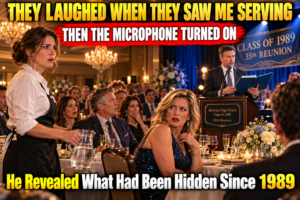
At our thirty-fifth reunion, my classmates laughed when they recognized me serving their table. They remembered the girl who left school under a cloud of shame. Then the class president switched on the microphone—and looked straight at me before mentioning 1989.
Part 1
The microphone made a sharp, thin sound as Martin adjusted it.
People turned toward the stage with drinks still in their hands. A few continued talking, assuming he was about to announce another photograph or invite us to look at the memory table near the entrance.
I stood beside Vanessa’s table holding a pitcher of water.
My right wrist ached. I had worked since four that afternoon, helping set the tables before the guests arrived. Dinner was finished now, but there were plates to clear, glasses to collect, and another hour of work before the room would be ours again.
“While organizing this reunion,” Martin said, “I found something that was hidden for thirty-five years.”
His gaze settled on me.
I felt the handle of the pitcher press into my fingers.
“Tonight, everyone deserves to know what really happened back in 1989.”
Vanessa’s smile faded, though only a little. She glanced around her table, then back toward the stage.
I had known her instantly when she arrived.
The years had changed her hair and the lines around her eyes, but they had done little to change the way she entered a room. She still paused long enough to be noticed. She still greeted people as though granting them permission to be pleased she remembered their names.
When she recognized me carrying a tray, she laughed.
“Look who’s serving us now.”
I had been arranging a bread basket between two plates.
“Hello, Vanessa,” I said.
“Some people moved up in life,” she told the others. “Some stayed behind.”
Several people laughed because she had laughed first.
I refilled her water glass. I had learned how to keep my hand steady through much worse than a table full of former classmates.
Then I moved on.
My supervisor, Lena, saw my face when I reached the service station.
“Someone giving you trouble?”
“Nothing I can’t manage.”
She studied me. “You went to school with them?”
“Yes.”
“Want to switch sections?”
I wanted to say yes. I also knew another server would inherit Vanessa’s table, and I needed the full shift.
“I’m all right,” I told her.
Now Martin was looking at me from the stage, and I was no longer certain of that.
I had not bought a ticket to the reunion. I had seen the booking on the hall’s calendar weeks earlier and thought I could work through it without drawing attention. My married name was on my badge. The guest list contained people who had not seen me since we were teenagers.
I had hoped that would be enough.
Martin placed a worn folder on the lectern.
Before he opened it, he looked away from the room and spoke directly to me.
“Claire,” he said, “I owe you an apology.”
My maiden name had been Claire Miller. I had not heard it spoken in that room until now.
Someone near the front whispered it.
Vanessa put her glass down.
The folder on the lectern was blue, faded almost gray at the edges. There was a round white sticker on its front.
I knew that sticker.
I had written my student number on one just like it, then handed the folder to Mrs. Avery on a spring afternoon in 1989.
Inside had been the scholarship essay I believed would change my life.
Three weeks later, I was told I had copied it.
Martin touched the cover carefully.
“I found the original,” he said.
Part 2
In 1989, I worked afternoons at a grocery store and Saturdays at a laundromat.
My father worked at the paper mill until an injury put him out of work for several months. My mother cleaned offices. We had food and a home, but college was something we discussed cautiously, as though saying it too confidently might tempt fate.
Mrs. Avery taught English and supervised the school’s scholarship entries.
She was the first adult outside my family who told me I could write.
Not that I was clever enough to pass a test. Not that my handwriting was neat.
She said I noticed things other people walked past.
For the county scholarship, she asked us to write about someone whose work had shaped our understanding of responsibility.
I wrote about my father.
I described his work boots drying beside the kitchen vent. I wrote about the crease in his lunch bag where he folded it the same way every morning. I wrote about the night he repaired our neighbor’s furnace after a twelve-hour shift and refused payment because the neighbor had a newborn.
The final paragraph described his hands.
There was a small pale scar beside his thumb. He had gotten it reaching beneath a broken machine years earlier. When I was little, I pressed my own thumb against it and asked whether it still hurt.
He told me some injuries stopped hurting before you stopped remembering them.
I spent two weeks on the essay.
Mrs. Avery read an early draft and suggested changes. I typed the final version at school because we did not own a typewriter. When a letter came out faint, I went back over it carefully rather than waste another sheet.
I remembered every page.
Vanessa asked to read it during study hall.
She said she wanted to understand what Mrs. Avery meant by a personal essay. She was applying for the same scholarship, but hers was about her grandfather’s business.
I handed over my draft.
I had no reason to think she would do anything but read it.
Three weeks after I submitted the final copy, the vice principal called me into his office.
Mrs. Avery was not there.
He told me two entries contained substantial passages in common. Vanessa had supplied an earlier typed version. Mine, he said, appeared to be the later submission.
I tried to explain.
I described the draft, the borrowed typewriter, the corrections Mrs. Avery had marked.
He asked whether I could prove when I wrote it.
I could not put a date on every sheet. I had thrown some drafts away. Mrs. Avery’s marked copy was not in the file he showed me.
He said it would be best if I withdrew quietly.
“An accusation like this can follow a student,” he told me.
It followed me anyway.
By lunch, people were whispering that I had stolen Vanessa’s essay.
A week later, she won the scholarship.
I graduated, but the last weeks of school were so miserable that I stopped attending every event I could avoid. I did not go to the senior picnic. I skipped the class photograph. I collected my diploma with my parents in the audience and went straight home afterward.
Martin had been our class president then too.
He had heard the story everyone else heard.
On the stage thirty-five years later, he said, “I believed what I was told. I never asked Claire.”
Several people shifted in their seats.
Vanessa folded her napkin.
I set the water pitcher on the service station. My fingers had started to tremble.
Martin opened the folder and held up a page with a familiar red mark across the margin.
It was Mrs. Avery’s handwriting.
The date above her comments was two weeks earlier than the version Vanessa had claimed as her own.
“I found the draft,” he said. “And a letter explaining why it disappeared from the school’s file.”
Part 3
Lena came to stand beside me.
“You can put the pitcher down,” she said quietly, though I already had.
I looked at her and realized I was still holding my hand as if the handle were in it.
Martin did not read the letter immediately.
He stepped away from the microphone and came down from the stage. The room followed him with its eyes as he crossed toward us.
When he reached me, he lowered his voice.
“I should have spoken to you first.”
“Yes,” I said.
His face tightened.
“I tried to find you through the old class list. I had your maiden name and an address that was years out of date. I didn’t realize you worked here until you came into the room.”
“You saw me an hour ago.”
“I know. I was trying to decide how to approach you.”
I looked toward the stage.
“You decided.”
He glanced back at the microphone, then at me.
“I’m sorry.”
That apology mattered more than the one he had made to the room. It admitted that he had almost repeated something familiar: arranging my life into a story before asking whether I wanted to be part of it.
“What have you found?” I asked.
“Your draft. Mrs. Avery’s notes. A letter from her to the principal. And a written statement from Vanessa.”
The last words made me look toward her table.
She was watching us.
“What statement?”
“An acknowledgment that the essay wasn’t hers.”
For a moment, the room seemed too bright.
I had spent years wondering whether my memory had made the injustice simpler than it had been. Maybe the papers had been confused. Maybe someone had genuinely misunderstood. Maybe Mrs. Avery had never known how the vice principal handled it.
I never doubted that I wrote the essay.
I had doubted whether anyone else had known.
Martin explained that Mrs. Avery had died the previous winter. Her daughter had contacted the reunion committee while sorting school photographs and papers stored in her mother’s house.
Mrs. Avery had kept copies of student work she admired.
She had also kept a box marked with the name of the scholarship.
Her daughter had let Martin examine it because he was collecting memories of their class.
The folder contained the draft I submitted before Vanessa borrowed it. Mrs. Avery had dated her comments. There were also notes from a meeting after the scholarship decision.
Vanessa had admitted taking passages from my essay and presenting them as her own.
The school had handled the matter privately.
My entry had never been reinstated.
“Why didn’t anyone tell me?” I asked.
“There’s a letter about that too,” Martin said.
I stared at him.
He looked deeply uncomfortable.
“I don’t want to explain your own history to you from a stage. I want you to read it first.”
Lena pointed toward a small office off the corridor.
“You can use that room,” she said. “I’ll cover your tables.”
“I’m working.”
“I know. I’m covering them.”
Her tone allowed no argument.
Martin retrieved the folder while I went into the office. He brought it to me and waited near the door.
I sat at a desk beneath a bulletin board covered with staff schedules.
On top was my essay.
I recognized the faint letter on the second page. I had corrected it by hand.
Beneath it lay Vanessa’s statement.
Her signature was young and loopy.
I read the first line.
*I used Claire Miller’s essay without her permission.*
Then I turned the page and found a letter from the vice principal.
It instructed Mrs. Avery to keep the resolution confidential.
At the bottom, one sentence made me grip the edge of the desk:
*Claire has already withdrawn, and reopening the matter would serve no useful purpose.*
Part 4
I read that sentence until it stopped looking like language.
Claire has already withdrawn.
As though I had calmly reconsidered my application.
As though I had not sat across from a man who told me an accusation could follow me for the rest of my life.
As though the shame had been something I chose.
Martin stood by the door, keeping quiet.
Lena brought water and placed it on the desk. She asked whether I wanted anyone called.
My husband would have been the person.
For a second, I nearly said his name.
Tom had died three years earlier.
His illness had lasted long enough to turn our routines into a series of appointments, prescriptions, and careful conversations about what we could afford. We used our savings, then more than our savings. He worried about leaving me with bills even when he was too weak to sit at the kitchen table.
I began working at the banquet hall during the last years of his illness. The hours were irregular, but the manager let me trade shifts around appointments.
After Tom died, I stayed.
I needed the income. I also needed a place where people expected me to show up and knew when I did not.
Tom knew about the scholarship.
He listened the first time I told him, years into our marriage, and asked whether I had kept the essay.
I said no.
I thought I had lost everything connected to it.
He told me I should write it again.
“Not for a committee,” he said. “For you.”
I tried once. I got as far as describing my father’s boots and cried so hard I put the notebook away.
Now the original pages sat in front of me.
I ran a finger beside the red comments without touching the ink.
Mrs. Avery had written: *Keep this detail. It belongs to your father.*
I turned to her letter to the principal.
She had challenged the way the complaint was handled. She said the dated draft proved authorship and asked that my scholarship application be reconsidered. She also asked for a written correction to the students who had heard the accusation.
There was no response from the scholarship committee in the folder.
There was only the vice principal’s instruction to leave the matter closed.
A later note, written by Mrs. Avery, said she had been told my family wanted no further involvement.
“That wasn’t true,” I said.
Martin looked up.
“My parents thought I withdrew because I was frightened. They never said we wanted it closed.”
He nodded slowly.
“Mrs. Avery tried to call you after graduation. Her notes say the number had changed.”
We had moved that summer.
My father found work in another town. I took a job there too and stopped hearing from most of my classmates.
The distance became easier than trying to explain myself.
I looked through the remaining papers. Nothing could tell me exactly why every adult made the choice they made. But the documents showed enough: Mrs. Avery knew, Vanessa admitted what happened, and the school decided silence was more convenient than correcting the damage.
Someone knocked.
Martin opened the door a little.
Vanessa stood outside.
She looked past him at the folder on the desk.
“Claire,” she said, “we should talk.”
I asked her to come in.
She closed the door behind her, smoothing the front of her dress.
“I was seventeen,” she said.
It was the first thing she offered me.
I looked at the young signature beneath her admission.
“So was I.”
Part 5
Vanessa remained standing.
She looked different without the table around her. There was no audience waiting to laugh and no glass in her hand to give her something graceful to do.
“I knew Martin had found papers,” she said. “I didn’t know he would bring them tonight.”
“You knew before tonight?”
“He contacted me last week.”
Martin nodded.
“I asked whether she remembered the meeting Mrs. Avery documented.”
Vanessa looked at him sharply, then back at me.
“I told him it was a long time ago.”
“It was,” I said. “I’ve had all that time to wonder why nobody believed me.”
She swallowed.
“The scholarship meant a lot to my family.”
“It meant a lot to mine.”
“I understand.”
“No. You knew why I wrote the essay. You read about my father. You knew we didn’t have money for college.”
She lowered her eyes.
I did not raise my voice. I had imagined this conversation often enough to think I might shout if it ever happened. Instead, I found myself wanting accurate answers.
“Did you tell people I copied you?”
She hesitated.
“Yes.”
“Even after you signed this?”
“I didn’t know how to take it back.”
“You knew how to say it.”
Martin looked down.
Vanessa clasped her hands in front of her.
Her father had been active in school fundraising. When the problem surfaced, he spoke to administrators. Vanessa said he told her to admit it privately, apologize to Mrs. Avery, and leave the rest to the adults.
“He said public consequences would be out of proportion.”
I thought of my father waiting in our driveway after my graduation ceremony, proud and worried because he could see I wanted to leave.
“What did he think the consequences were for me?”
She had no answer.
I asked whether she knew I had withdrawn only after being accused.
“Yes.”
“And you accepted the scholarship.”
“Yes.”
The second answer was barely audible.
We sat with that.
I had not expected her to confess every thought she had at seventeen. I needed her to stop hiding behind age, confusion, and the instructions of adults.
Then she said something that finally sounded like an answer.
“I wanted to win. When you handed me that essay, I knew it was better than mine. I told myself I would change enough of it. Then I kept more because it sounded right.”
“It sounded right because it happened.”
“I know.”
“My father’s scar. His lunch bag. The furnace.”
She nodded, tears beginning to spill.
“They weren’t details you improved. They were my family.”
“I know.”
For the first time, I believed she was hearing what she had taken.
It had never been only the scholarship money. She took the story I trusted her with, then allowed the school to call me dishonest for recognizing it.
I asked about her comment at the table.
She wiped beneath her eyes.
“I was trying to be funny.”
“You saw me working and decided it meant you’d won again.”
She flinched.
I let the silence stand.
Finally, she said, “I’m sorry. For the essay. For what I said tonight. For letting people believe you copied me.”
I accepted that she had spoken the words. I did not tell her everything was forgiven.
Martin asked what I wanted him to do with the microphone.
Vanessa turned toward him.
“Do you really need to read all of it?”
I looked at her, then at the folder.
“Not all of it,” I said. “Enough to correct what people were told.”
I stood.
“And this time, I’m going to be in the room.”
Part 6
Lena found me a clean place to put the folder while I took off my apron.
“You don’t have to change anything else,” she said.
I looked down at my white shirt and black trousers. There was a small mark near one cuff from clearing a plate. My shoes were practical, worn at the heels, and chosen because I could stand in them for hours.
I had spent much of the evening wishing I could disappear inside that uniform.
Now I left it on.
When we returned to the banquet room, most people were still seated. A few stood near the bar. Conversations quieted as Martin climbed the steps.
He asked the staff to pause the background music.
Then he said he needed to correct something he had believed and repeated when we were young.
He explained that the documents came from Mrs. Avery’s retained copies of school papers. He said her daughter had given him permission to examine them for the reunion archive, and that I had now read them.
He did not tell my classmates about Tom’s illness or my finances.
I had asked him not to.
Those things were mine.
The truth of the essay did not need to be made more sympathetic by adding my losses.
Martin read the dated comments from Mrs. Avery. Then he read Vanessa’s acknowledgment that she had used my work without permission.
Vanessa stood beside the stage.
People looked toward her.
She stayed where she was.
Martin read the portion of Mrs. Avery’s letter asking the school to reconsider my application. He explained that the record showed the matter had been closed privately and that I had never received the correction she requested.
Then he stepped back.
I walked to the microphone.
From the stage, the room looked smaller than it had when I was carrying water between the tables. I recognized faces one at a time: people who laughed tonight, people who had been kind at school, people who had avoided me after the rumor spread.
I placed my hands on the lectern.
“I wrote the essay,” I said.
My voice sounded unfamiliar through the speakers.
“It was about my father. I worked on it for two weeks. I let Vanessa read a draft because she asked.”
No one moved.
“When the school accused me, I couldn’t prove everything they asked me to prove. I was frightened. I withdrew because I thought that was the only way to stop the accusation from becoming worse.”
I looked toward the table where Vanessa had been sitting.
“Then I spent the last weeks of school being known for something I hadn’t done.”
Someone near the back lowered her head.
“I don’t know what my life would have been if the application had been judged fairly,” I continued. “I won’t pretend one scholarship explains every year that followed. I had a marriage I loved. I had work I was proud of. I had people who cared about me.”
My throat tightened at the thought of Tom.
I paused until I could speak again.
“But I deserved a fair chance. And I deserved the truth.”
Martin handed me the essay.
I opened to the final page.
“I want to read one paragraph,” I said.
I read about my father’s scar, about pressing my thumb against it, about the injuries he stopped feeling before he stopped remembering.
The room stayed quiet.
When I finished, I folded the pages carefully.
“My father died believing people at my school thought I was dishonest,” I said. “He believed me. I wish he could have heard this.”
At Vanessa’s table, someone began to cry.
Then Vanessa stepped toward the microphone.
Part 7
I moved aside, leaving enough space for Vanessa to stand without standing close to me.
She looked out at the room.
“I took Claire’s work,” she said.
Her voice shook.
“I told people she copied me. That was false. I knew it was false.”
She gripped the edge of the lectern.
“When Mrs. Avery confronted me, I admitted it privately. I let adults handle it in a way that protected me. I accepted that because it was easier than facing what I’d done.”
A man at her table looked away.
Vanessa continued.
“I should have corrected the story then. I didn’t. And tonight I insulted her for doing her job.”
She turned toward me.
“You had nothing to be ashamed of. I did.”
I nodded once.
That was all I could give her.
She left the stage without waiting for applause.
Martin did not ask anyone to clap.
He thanked me for choosing to speak and said the reunion committee would contact people who had already left so the correction did not stop with those still in the room.
Then he turned off the microphone.
For several seconds, no one seemed to know how to return to the evening.
Lena met me at the bottom of the steps.
“Come sit,” she said.
She brought me to an unused chair near the wall and put water in front of me.
Martin joined us.
“I’m sorry for how I began,” he said. “I wanted to put it right, and I nearly made you part of a presentation.”
“You stopped and asked.”
“I should have asked sooner.”
“Yes.”
He accepted that.
Classmates approached slowly. Some apologized for what they had said in 1989. Others admitted they remembered the rumor but had never questioned it.
One woman, Susan, stood with her hands clasped.
“I sat behind you in English,” she said. “I remember Mrs. Avery returning your drafts. I could have said something.”
“Did you know what the accusation was?”
“Not at first. Later I did.”
She looked at the floor.
“I didn’t want to get involved.”
I had heard that phrase in many forms over the years. It was often spoken as though staying uninvolved meant leaving no mark.
Susan apologized.
I told her I appreciated hearing it.
Another man said he had laughed when Vanessa called me a servant earlier. He said he had followed the table without thinking.
“That’s what happened back then too,” I said.
He nodded.
The conversations tired me more than carrying trays had. Eventually, Lena told people I needed a break and guided me toward the corridor.
In the service area, two other servers were loading racks of glasses.
One of them, a young woman named April, looked up.
“You wrote that?”
“Yes.”
She smiled. “It was beautiful.”
No elaborate speech. No comparison between my past and hers. She had heard the paragraph and liked it.
I thanked her.
I put my apron back on because there was work left to do.
Lena stopped me.
“You’re done for tonight. Full shift pay.”
“I can help.”
“You already did.”
She asked another staff member to drive me home because I looked too shaken to drive myself.
Before I left, Martin brought the folder.
He said Mrs. Avery’s daughter wanted the originals preserved, but she had agreed I should receive complete copies and my own essay back after it was scanned.
I held the folder against my chest.
Then I noticed a smaller envelope tucked into the rear pocket.
Across it, in Mrs. Avery’s handwriting, were the words:
*For Claire, if I find her.*
Part 8
I waited until I was home to open the envelope.
The house was quiet.
I hung my coat by the door, put my work shoes beneath the bench, and turned on the lamp beside the sofa.
Tom’s reading glasses still rested in the drawer of the side table. I had moved most of his things when I was ready. Those glasses remained because I liked knowing where they were.
I made tea and set the folder on my lap.
The envelope contained a letter dated several years after graduation.
Mrs. Avery wrote that she had tried to find me through old school records and mutual acquaintances. She said she regretted accepting assurances that my family wanted to leave the matter alone.
She should have checked with us herself.
She explained what she had found, what Vanessa admitted, and how the school responded. She did not present herself as the only decent person in the story. She wrote that keeping copies was useful, but keeping them in a box was not enough.
*I defended your work in meetings,* she wrote. *I should have made certain you heard that defense.*
I cried at that.
Not because the letter repaired everything. It could not.
It gave words to something I had struggled to explain: how lonely it felt to be told, years later, that someone privately believed you, when you had needed them to stand beside you.
Mrs. Avery said she hoped I continued writing.
She remembered the essay about my father, but also a short piece about the laundromat where I worked. In it, I described people waiting for dryers, each protecting a small patch of space with baskets and coats.
I had forgotten that piece.
She had not.
At the end, she wrote:
*Please do not let the way we failed you become your measure of what you can do.*
I read the letter again.
Then I opened the essay.
My father’s hands came back to me so clearly I could almost see them around the mug he used every morning. His injured wrist had made him impatient when it slowed him down. He hated asking for help. Yet he never suggested that work done with the body mattered less than work done at a desk.
I thought about Vanessa looking at my tray.
I wondered whether I had believed some of her judgment before she spoke it.
Since Tom’s death, I had often described my job apologetically. I said I was only working at the hall for now. I said it was something to keep bills paid.
It was work.
It required stamina, care, and attention. I noticed when an older guest needed help with a chair. I remembered dietary instructions. I carried hot plates without spilling them and kept celebrations moving when the hosts were too distracted to see what was needed.
There was no reason to diminish it.
I found the notebook Tom once encouraged me to use.
It was in a drawer beneath old photographs and a warranty for an appliance we no longer owned.
The first pages held my abandoned attempt to rewrite the essay.
I turned to a clean page.
I wrote the date.
Then I described Vanessa’s glass beneath the pitcher, the sound of water, and the way laughter travels around a table before anyone stops to consider what they are laughing at.
I wrote until the tea was cold.
The next morning, Martin called.
He asked if I wanted to speak to Mrs. Avery’s daughter.
I said yes.
Then he added that the reunion committee wanted to send a correction to the entire class.
Before approving it, I asked him to send me the wording.
This time, he did.
Part 9
The correction was brief.
It said the accusation against me in 1989 was false. It identified the dated draft, the written acknowledgment, and the school correspondence that established what happened.
It did not call my life ruined.
It did not describe Vanessa as a monster.
It told people what they should have been told thirty-five years earlier.
I changed one sentence that implied the situation was a misunderstanding.
It had not been.
Martin accepted the change and sent the notice after I approved it.
Messages arrived for several days.
Some people apologized sincerely. A few offered long explanations of why they had believed the rumor. Others wrote only that they were glad the truth had come out.
I answered when I wanted to.
I did not answer everything.
Vanessa sent a letter rather than calling.
She apologized again and offered to help with any effort to contact the school or scholarship organization. She said she understood if I did not want personal contact.
I put the letter in a drawer.
I had no immediate reply.
Mrs. Avery’s daughter, Ellen, called on a Sunday afternoon.
She sounded like her mother in small ways: the careful pace, the little pause before asking a question she thought might be difficult.
She told me she found the box while clearing a closet.
At first, she assumed it held ordinary schoolwork her mother could not bear to discard. Then she read the letters and realized it was something else.
“I’m sorry it took this long,” she said.
“You brought it to someone who could find me.”
She asked whether I would like the other pieces her mother kept.
There were two short assignments and a handwritten page from my notebook.
She sent copies.
I read them at the kitchen table after work.
They were imperfect. One ending was too abrupt. A sentence about the laundromat tried far too hard to sound impressive.
I loved them anyway.
They sounded like a young woman learning what she could do.
They sounded like me.
I began writing on my days off.
Sometimes I wrote about Tom. Sometimes I wrote about people I met at the hall, changing identifying details and keeping what I remembered about the moment itself.
I did not quit my job.
I needed it, and I liked many parts of it.
What changed was the way I spoke about it.
When someone asked what I did, I said I worked at the banquet hall.
Then, if the conversation continued, I said I wrote too.
Lena noticed I stopped apologizing for taking my breaks. April asked to read the piece about the reunion. I told her it was not ready, and she said she would wait.
One afternoon, I visited my parents’ graves.
I brought a copy of the essay in a clear sleeve because it had rained that morning.
I sat on the bench nearby and read the paragraph about my father’s hands aloud.
There was no dramatic sign that anyone heard.
A maintenance worker passed with a wheelbarrow. Birds moved in the trees. A car rolled slowly along the narrow lane.
I stayed until I felt ready to leave.
On the way home, I stopped at a small stationery shop and bought a notebook with thick paper.
At the counter, the owner asked whether it was a gift.
I said no.
That evening, I opened it beneath the lamp.
For the first time, I did not begin by trying to defend myself.
I began with a sentence I wanted to write.
Part 10
Months after the reunion, I was serving a retirement dinner when a guest recognized me.
For a second, my body remembered Vanessa’s table. I felt the old impulse to lower my eyes and finish whatever task brought me close enough to be noticed.
The guest was Susan, the woman who sat behind me in English.
She greeted me by name.
I asked whether she wanted more coffee.
“Yes, please,” she said.
There was no embarrassed pause and no attempt to make the encounter into a lesson. I poured the coffee. She thanked me.
Later, as I cleared her table, she asked whether I was still writing.
“I am.”
“I’d like to read something, if you ever want to share it.”
“I’ll let you know.”
It was an ordinary conversation.
I was grateful for that.
Near the end of the evening, the retiring guest stood and thanked the people who helped make the dinner happen. He mentioned the kitchen and serving staff. We were clearing plates at the time, and several guests turned to thank us directly.
I looked toward April, who smiled while balancing a tray.
The work continued.
After my shift, I sat in the car for a moment before driving home.
The folder from the reunion no longer traveled with me. It stayed in a safe place at home with the essay, the letters, and the copies of my early writing.
I did not need to carry proof everywhere.
I knew what happened.
Other people knew now too.
I still thought about the lost scholarship. There were days when the unfairness felt fresh and sharp, especially when I remembered how young I was and how easily the adults could have corrected it.
On other days, I thought about my father reading the newspaper at our kitchen table, or Tom telling me to write again.
Those memories had room beside the hurt.
At home, I reheated soup and sat at the table with my new notebook.
I was writing about a woman who packed away her husband’s winter coat long after spring arrived. I had not decided whether she would find something in the pocket. For now, she was simply learning how to touch the fabric without expecting him to need it again.
I wrote three pages.
Then I stopped because I was tired.
That was allowed.
Before going upstairs, I opened the drawer containing Mrs. Avery’s letter.
I read the final line once more, then put it back.
I wished she had found me while she was alive. I wished the correction had arrived before my parents died. I wished Tom could have sat in the banquet room and heard me read.
I could not make those things happen.
I could write the next page.
The reunion had given me the truth I should have received at seventeen. What I did afterward would take time, and some of it would be small: a notebook purchased for myself, a break taken without apology, a sentence finished after a long shift.
I turned off the kitchen light.
My work shoes stood neatly beneath the bench by the door. Beside them was the bag I would carry to the hall the next afternoon.
I had placed my notebook inside.