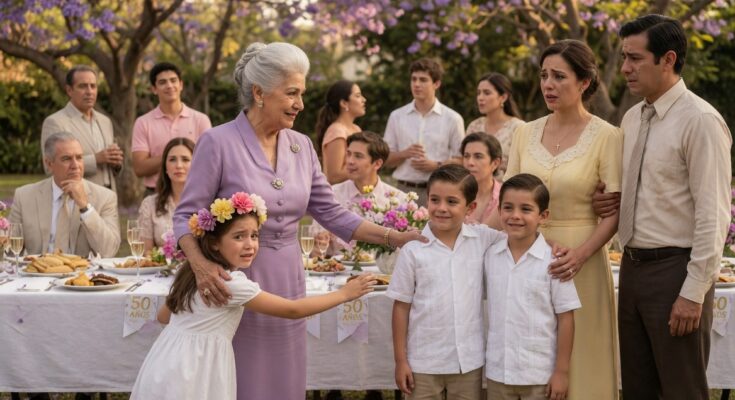
When my mother put both hands on my daughter’s shoulders and gently moved her out of the center of the family photo, she smiled as if she were fixing something small and harmless.
“Let the boys stand here, mi amor,” she told Lucía. “They’re the ones who carry the family name.”
The photographer gave an awkward little laugh, the kind people use when they know they have just witnessed something wrong but do not want to be the one to name it. My father looked down and pretended to straighten his cuff. My brother Adrián, standing behind his two sons in a pressed linen shirt he could not have afforded on his own, said nothing at all.
Lucía looked up at me, confused, still holding the paper flower crown she had made that morning for her grandparents’ anniversary lunch. She was six years old, wearing white sandals that had already rubbed one heel raw, and for a second she had the expression children get when they are trying to understand whether something painful was accidental or not.
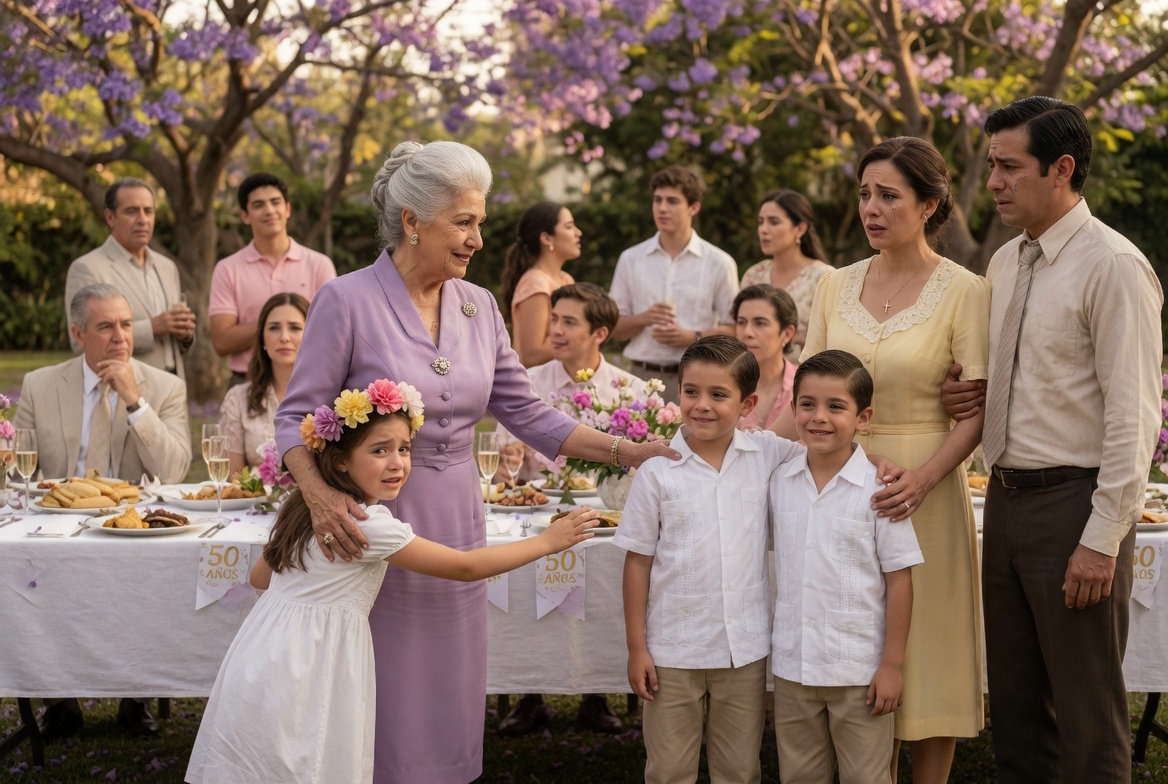
I heard my own voice before I felt it.
“So Lucía doesn’t count the same?”
I asked it quietly. Calmly. Too calmly.
My mother turned toward me with a frown, annoyed more than ashamed.
“Don’t start, Valeria. You know that’s not what I meant.”
But it was exactly what she meant.
And in that instant, with a photographer waiting, my daughter blinking in the sun, and my brother’s boys placed proudly in the middle like little heirs to a kingdom built with other people’s labor, I understood something that should have been obvious years before.
I had not been helping my parents survive.
I had been financing their preferences.
My name is Valeria Mendoza. I was twenty-nine that summer, married to Tomás, mother to a six-year-old girl named Lucía, and for almost four years I had been sending my parents money every Friday morning at 8:30 without fail.
Four thousand eight hundred pesos.
Every week.
The transfer had become so automatic that my fingers could almost do it without my brain. Open the banking app. Confirm the account. Type the amount. Ignore the tightening in my chest. Tell myself I was a good daughter.
My parents’ names were Estela and Rubén Mendoza. They lived in the same modest two-story house in Puebla where I had grown up, the one with the bougainvillea vine my mother took credit for even though my grandmother had planted it. When my father hurt his back unloading construction materials and my mother called me crying, I never imagined that one phone call would become the financial structure of my adult life.
She had sounded desperate.
“Your father can barely get out of bed,” she had said. “We’re behind on the mortgage. The medication is expensive. We may lose the house.”
At the time, Lucía was just two. Tomás and I were living in a small rented apartment with thin walls and a front door that stuck in humid weather. We were not comfortable, but we were stable in the fragile way young families sometimes are. Tomás drove deliveries for a distribution company. I worked the front desk at a private clinic during the day and helped a cousin with payroll paperwork on weekends for extra cash.
We had a little. Not much. Enough to dream in small ways.
I didn’t even consult Tomás before I sent the first transfer.
It was two thousand pesos then.
Then three.
Then “just for this month,” an extra fifteen hundred because the medicine had changed.
Then another amount because the bank was threatening them.
Then regular transfers because “you know how unstable things still are.”
Somewhere along the way, temporary became routine. Routine became obligation. Obligation became identity.
A good daughter helps.
A daughter who has any decency doesn’t let her parents drown.
A daughter who remembers what her parents sacrificed doesn’t ask too many questions.
Those were the sentences that sat in my head every Friday morning while I sent money we could not really afford to lose.
Tomás did ask questions at first.
Not because he was stingy. Never that.
Because he was practical in the way I had not yet learned to be.
The first year, he approached the subject gently. The second, carefully. By the third, with a kind of tired love that hurt more than anger would have.
One November night, he sat at our kitchen table with a pencil tucked behind one ear and a receipt in his hand while the fan rattled uselessly in the window. Lucía was asleep on the pullout sofa because the bedroom was too hot, one hand still wrapped around a stuffed rabbit whose left ear I had sewn back on twice.
Tomás pushed the notebook toward me.
“We are short again,” he said.
The notebook was where we kept everything: rent, gas, groceries, school supplies, internet, medicine, transportation, the little unpredictable leaks that life always finds. In the margin, next to the Friday transfer to my parents, he had drawn a line too hard, like he had nearly ripped the paper.
“I can take another Saturday with your cousin’s paperwork,” I said automatically.
He leaned back in the chair and rubbed his face. “Valeria.”
“I know.”
“No, I don’t think you do.” His voice was still soft. “We need to buy Lucía new school shoes. The soles on the ones she has are separating. The landlord has already reminded us twice about the increase next year. The car needs service. You haven’t been to the dentist in almost two years because every extra peso leaves this house on Fridays.”
“They need it,” I said, faster than I meant to. “You know Papá can’t work the same way.”
Tomás was quiet long enough for the refrigerator motor to click on and off.
Then he asked, “And if we need it?”
That question sat between us like a third person.
I hated it because it forced me to choose a shape for the guilt. If I admitted we also needed help, then what did it mean that I kept sending money out of our home? That my parents mattered more? That I had been trained to measure love in sacrifice, specifically my sacrifice?
“I’ll find a way,” I whispered.
Tomás looked at me for a long moment. Not angry. Just sad.
“You always do,” he said.
In the next room, Lucía stirred in her sleep and said something I couldn’t make out.
We both turned toward the sound.
That was the thing about children. They make every adult decision feel more honest because there they are, small and breathing, the reason excuses stop working.
Lucía was the sunniest person in our home, the kind of child who sang to herself while putting on socks and believed any cardboard box could become a palace if you drew windows on it. She loved glitter, dogs, juice with too much ice, and stories where someone poor turned out to be secretly important.
She also loved my parents.
Or at least, she tried very hard to.
At three, she called them every Sunday to show them her drawings.
At four, she made up dances to perform when they visited.
At five, she began to notice who arrived when they promised and who didn’t.
That was the year I started seeing the pattern clearly, though I still refused to name it.
My brother Adrián was two years younger than me and had been the emotional center of my parents’ world since he was born. If I’m being fair, he was not a monster. He was charming, handsome, warm when he wanted something, and utterly convinced that life’s inconveniences were evidence that someone else should step in.
As children, he was “sensitive” when he forgot homework and I was “responsible” when I remembered mine.
As teenagers, he was “finding himself” while I was expected to help my mother with dinner, remember bills, and keep peace in the house.
As adults, he became what my aunt once described as “full of ideas,” which was a polite family phrase meaning he drifted from one failed plan to the next without ever fully absorbing the consequences.
He sold insurance for six months.
Then imported phone cases.
Then tried online trading.
Then decided he was going to start an artisanal burger business with a friend who disappeared as soon as money was required.
My parents narrated every one of his failures as if he were a misunderstood visionary persecuted by bad timing.
When Tomás lost a week of work because of a fever, my mother said, “Well, everyone has difficulties.”
When Adrián’s food cart permit was denied, she said, “Some people are simply not supported the way they deserve.”
He married Paola, who was always beautifully dressed and somehow eternally exhausted by the burden of other people not recognizing Adrián’s potential. They had twin boys, Nico and Bruno, who were not bad children but had already learned to expect applause for breathing. My parents adored them with a hunger that made the air change when they entered a room.
There was always extra dessert for the boys.
Extra gifts.
Extra patience.
Extra photographs.
I told myself it was because they lived closer. Because twin boys were more demanding. Because Lucía was shy sometimes and didn’t climb into laps the way Nico and Bruno did.
I told myself many things.
Then came Grandparents’ Day at Lucía’s kindergarten.
She had been practicing a little song for two weeks. She drew a picture of my parents in purple crayon and wrote ABUELOS in large uneven letters that tilted upward across the page. Every night she asked me the same question.
“They’re really coming, right?”
“Yes,” I told her each time. “Grandma promised.”
I had called my mother twice to confirm.
The first time, she sounded pleased.
“Of course we’ll be there. Tell Lucía her grandpa already ironed his shirt.”
The second time, she sounded offended.
“Valeria, honestly. We are not children.”
On the morning of the event, Lucía wore a yellow dress borrowed from our neighbor’s daughter and a pair of white ribbons in her braids. She held my hand so tightly on the walk to school that my fingers tingled.
The classroom had been decorated with tissue paper flowers. Tiny chairs were arranged in rows. Some grandparents arrived carrying balloons, flowers, cell phones ready to film. When Lucía saw every other child pointing out their grandparents, she turned to the door three separate times.
“They’re late,” she told me, with forced confidence. “But they’re coming.”
I texted my mother at 9:12.
No answer.
At 9:25, the teacher began.
At 9:31, my phone buzzed.
Sorry, mi amor. Adrián needed help with the boys. Bruno has a stomach issue and Paola had an appointment. Kiss Lucía for us.
That was it.
No apology for the promise.
No recognition of the little girl standing in the second row, craning her neck toward an empty doorway.
During the song, Lucía sang the first verse loudly and the second almost not at all. By the end, her lower lip trembled. When the children were invited to hand their drawings to their grandparents, she gave hers to me.
“Can you keep it?” she whispered. “I don’t want it to get wrinkled.”
That afternoon, after I tucked her into bed for a nap she didn’t really want, I sat on the bathroom floor and cried silently so Tomás wouldn’t hear and say the thing I already knew.
He didn’t say it when he found me, though.
He only leaned against the doorframe and asked, “What are you protecting now? Them or yourself?”
I didn’t answer.
Because I knew the answer.
And I hated it.
The next week my mother called asking for an additional seven thousand pesos.
“Your father needs a scan,” she said, voice tight with urgency. “The doctor wants to rule something out.”
I sent it.
Of course I sent it.
Tomás sold an old set of tools he had been saving to replace.
I picked up two Sunday shifts helping my cousin reconcile invoices.
Lucía asked whether she could start dance classes like the girl in our building who wore pink slippers and practiced spins in the courtyard.
“Maybe after Christmas,” I told her, because by then I would certainly have found a way.
That phrase became the soundtrack of my motherhood.
Maybe next month.
Maybe after this bill.
Maybe once Grandpa gets better.
Maybe when things calm down.
Things never calmed down.
They only rearranged their demands.
Then summer came, and my parents invited us to lunch for their thirty-fifth wedding anniversary.
“Nothing fancy,” my mother said. “Just family.”
The words just family would have made me laugh if I had understood earlier what they really meant in her mouth.
Lucía was thrilled. She spent the morning making a crown out of pink paper flowers and insisted on carrying a hand-drawn card that said FOR THE BEST GRANDPARENTS IN THE WORLD. I almost corrected her. I didn’t. Some lies feel crueler coming from a mother than from life itself.
The lunch was at a rented garden behind a small event hall on the edge of the city. White tablecloths. Plastic flowers in glass vases. A playlist of old romantic songs my mother pretended not to like while singing every chorus. Adrián arrived last, as usual, with Paola in sunglasses and the twins in matching guayaberas. My mother greeted them like returning royalty.
“Mis niños hermosos!” she cried, bending to kiss each boy twice.
Lucía held out the card she had made.
My mother accepted it absently with one hand, then turned to ask Paola whether the boys had eaten enough before coming.
I saw Lucía’s smile flicker.
Not disappear.
Just flicker.
Children who love unreliable adults become experts in recovering quickly.
The lunch itself was ordinary in the way family events often are until one moment makes the whole thing irreversible. Plates of mole. Sweating glasses of agua fresca. My father telling the same story about the first time he took my mother dancing. Tomás sitting beside me, polite but watchful. Lucía and the twins playing tag between tables until one of the boys snapped at her for not following the “right” rules of a game he had invented.
After the meal, someone suggested a family photo.
The photographer, a teenager hired cheaply by the hall, arranged us under a jacaranda tree. Grandparents seated in front, grandchildren near them, then children and spouses behind.
Lucía instinctively went to stand between my parents.
She had the flower crown in her hand and a hopeful little smile on her face.
That was when my mother touched her shoulders and moved her.
“Not there, mi amor. Over here.”
She repositioned Lucía toward the side, then pulled Nico and Bruno in front of my father’s knees.
“Let the boys stand in the center,” she said. “They’re the ones who carry the family name.”
There are humiliations so specific that time slows down around them.
Lucía did not fully understand the sentence, but she understood the motion. She understood being moved. She understood being less wanted than a moment earlier.
Her smile vanished.
I asked my question.
“So Lucía doesn’t count the same?”
My mother exhaled hard through her nose. “Valeria, please. Not everything needs drama.”
“She’s your granddaughter.”
“Of course she is.”
“Then why are you moving her out of the photo?”
My father finally spoke, but only to murmur, “It’s one picture.”
Tomás stepped closer to Lucía without saying anything. She reached for his hand.
Adrián lifted both palms in fake innocence. “Can we not ruin Mom and Dad’s anniversary over a photo?”
That was the moment I looked at him properly. His watch. His shoes. Paola’s manicured nails. The twins’ expensive shirts. Things people supposedly drowning in family financial emergencies did not seem to struggle to afford.
And then my mother said it.
“Adrián’s children are different, Valeria. Don’t make me explain traditions to you.”
Traditions.
Such a clean word for an ugly belief.
I walked to Lucía, knelt, and took the flower crown from her hand because she was crumpling it without realizing it.
“We’re leaving,” I said.
My mother’s face hardened instantly. “Seriously?”
“Yes.”
“For this?”
“No,” I said, standing up. “For everything this is.”
Tomás didn’t need further explanation. He gathered our bag, lifted Lucía into his arms because her sandals were slippery with grass, and followed me out while my mother called after me that I was embarrassing her.
In the car, Lucía was quiet for several minutes.
Then she asked, “Why did Grandma only want the boys in the middle?”
I turned in my seat to face her. Her flower crown lay bent on the dashboard between us.
“Because Grandma was wrong,” I said.
Lucía absorbed that. “Was she mad at me?”
“No.”
“Then why?”
I looked at Tomás. He kept his eyes on the road, jaw tight.
“Sometimes adults believe unfair things for a very long time,” he said gently. “And because they’ve believed them so long, they stop hearing how cruel they sound.”
Lucía leaned her forehead against the window and watched the city slide by.
A few minutes later she asked, so softly I almost missed it, “Would I count more if I were a boy?”
I have never hated anyone as immediately as I hated my mother in that moment.
“No,” I said, too fiercely. “You do not need to be anything other than exactly who you are.”
That night my father called.
I almost didn’t answer, but old habits are powerful. So much damage enters life because we still pick up when the screen shows family.
His voice was already sharp.
“You made a spectacle today.”
“I made a spectacle?”
“You disrespected your mother in front of everyone.”
“She told my daughter she mattered less.”
“She did not say that.”
“She moved her out of the center of the photo because Adrián has sons.”
He sighed in the theatrical way men do when they want your pain to sound like inconvenience.
“You are too intelligent to pretend you don’t understand family customs.”
“Then explain them to me, Papá.”
Silence.
Then: “A son’s family is not the same as a daughter’s family. It has always been that way.”
I felt cold all the way to my elbows.
“So Lucía really does count less.”
“I didn’t say less.”
“What word would you like, then? Smaller? Temporary? Decorative?”
“Valeria, don’t be insolent.”
I laughed then. A short, shocked sound. “You took almost a million pesos from us over four years.”
His voice changed instantly. “What does that have to do with today?”
Everything, I thought.
But I didn’t say it yet, because I still did not know all of it.
I slept badly that night. Or maybe I didn’t sleep at all. Tomás lay awake beside me longer than usual, though he didn’t push. He knew enough by then to let me arrive at truths under my own power.
The next afternoon my mother texted asking if I could drop off the supplements I had bought for my father’s back because she had “no time” to go out.
I almost ignored it.
Instead, I bought the supplements and drove to their house straight from the clinic.
The gate was ajar. My mother’s car was in the driveway. I knocked once on the open front door and got no answer, but I could hear voices from the dining room.
I would like to tell you that I announced myself immediately and walked in with dignity.
What I actually did was freeze.
My brother was laughing.
My mother said, “I told you she’d calm down by today.”
My father answered, “She always does.”
Then Adrián said the sentence that broke the last soft place in me.
“Just make sure she deposits on Friday. The lease payment for the new location is due, and Paola is already complaining that we had to postpone the boys’ weekend again.”
My mother lowered her voice, but not enough.
“If she asks, we’ll say your father needs another specialist. Don’t worry.”
Adrián gave a dismissive little snort. “She won’t ask. Valeria loves feeling necessary.”
I did something then that I had never imagined doing with my own family.
I took out my phone and pressed record.
My hands were shaking so badly that I nearly dropped it.
My father spoke next. “Anyway, it’s fair. Adrián is the son. What goes to him stays in the family.”
My mother replied, “Exactly. And he has responsibilities. Two boys. A business. Valeria has a husband. They manage.”
Adrián laughed again. “And Lucía is just one little girl. She’ll marry and leave one day.”
There it was.
Not implied. Not hidden under custom or phrasing or old sayings.
Spoken plainly over the dining room table while I stood in the hallway holding vitamin supplements I had paid for with money I didn’t have.
I backed away before they could see me.
I don’t remember reaching my car. Only sitting in it with the engine off, the plastic bag on the passenger seat, and the recorded voices on my phone sounding like strangers I had somehow mistaken for parents.
When I got home, Tomás opened the door before I reached for my keys. He took one look at my face and stepped aside without a word.
Lucía was coloring at the coffee table. I kissed the top of her head and told her to put on her headphones for a cartoon because Mamá needed to talk to Papá.
In the kitchen, I played the recording.
Tomás listened without interrupting.
At the end, he sat very still.
Then he asked, “How much?”
I knew what he meant.
Not the Friday amount. The total.
I got my laptop. He got the box where we kept old statements and tax papers. We sat at the kitchen table for over an hour, tracing transfers, extra “emergencies,” holiday bonuses, money for scans, money for repairs, money for medications, money for insurance, money for things I no longer even remembered justifying.
When we finished, the number sat on the page like a verdict.
Nine hundred and forty-three thousand pesos.
Nearly one million.
Enough for a down payment.
Enough to clear our debts.
Enough for Lucía’s school, better housing, savings, peace.
I stared at the total until the numbers blurred.
Tomás did not say I told you so.
He only said, very quietly, “This is what it cost you not to disappoint them.”
I cried so hard that night my throat hurt the next morning.
And on Friday, for the first time in almost four years, I did not make the transfer.
At 8:41, my phone rang.
Mother.
I let it ring.
At 8:47, she called again.
At 8:53, my father.
At 9:02, six messages.
What happened?
Did you forget?
The payment hasn’t arrived.
Your father’s appointment depends on that money.
Valeria answer me immediately.
At 9:10, I finally responded.
I’m no longer sending cash. If Papá needs medication or a doctor, send me the bill and I will pay the provider directly.
The typing bubble appeared at once.
Then disappeared.
Then appeared again.
Finally:
Why are you humiliating us?
I stared at the message for a long time before replying.
You humiliated yourselves.
Her answer was immediate this time.
I have no idea what nonsense you’ve invented, but if this is about yesterday, you need to grow up. Families help each other.
I sent the audio file.
Then I put the phone face down and went to work.
My mother called thirty-two times that day.
My father called fourteen.
Adrián called twice, which told me all I needed to know about the urgency of my father’s supposed medical situation.
By evening, the messages had evolved from outrage to strategy.
Your father is deeply hurt.
You misunderstood a private conversation.
Adrián never asked for your help.
After everything we’ve done for you, this is how you repay us?
I was still trembling, but now the trembling had changed. It was not confusion anymore. It was grief mixed with clarity, and clarity is brutal when it arrives late.
The next surprise came from my aunt Irma, my mother’s older sister, who called that Sunday speaking in the falsely casual tone relatives use when they have been recruited as emotional mercenaries.
“Your mother says there was some misunderstanding about money.”
“There wasn’t a misunderstanding.”
“She says you’re being cold.”
I almost ended the call.
Then my aunt sighed and said, in a tired voice that sounded much older than her years, “Valeria, I am not calling to defend her. I’m calling because if you are finally seeing them clearly, you deserve the full picture.”
I sat down so abruptly the kitchen chair scraped the tile.
“What picture?”
There was a pause.
“The mortgage was paid off two years ago.”
My skin went hot.
“What?”
“Your grandmother’s land outside Atlixco was sold. You remember? When the cousins were all fighting over whether to keep it? Your parents used part of that money to clear the house. Everyone in the family knows that.”
Everyone.
Everyone except me.
My aunt kept talking, each sentence landing like a stone.
“Your father’s medication is real, yes, but not nearly what your mother pretends. And Adrián… well. There was the food cart, then the burger place, then the lease on that storefront near the university. Your parents have poured money into him for years. I assumed you knew. I assumed you had agreed.”
I couldn’t speak.
“I’m sorry,” she said softly. “I thought you were in on the arrangement.”
Arrangement.
That word did something strange inside me. It transformed the whole thing from chaos into design.
This had not been a series of desperate coincidences.
It had been a system.
My labor, routed through guilt, into the golden child.
I asked my parents to meet the following Tuesday.
“Come here,” my mother said immediately. “We’re not discussing family business in public.”
“No,” I replied. “You can come to my apartment.”
She hated my apartment. It was too small, too hot, too honest. There was nowhere in it for her to pretend superiority.
She arrived with my father and Adrián anyway.
Tomás had taken Lucía to his sister’s house for the afternoon because there are some scenes children should never have to witness.
My mother entered with her chin raised. My father looked offended before anyone had spoken. Adrián looked bored, which was somehow the most insulting expression of all.
I had the bank printouts on the table. The total circled. The audio file ready.
My mother saw the papers and rolled her eyes.
“Oh, for God’s sake. Are we doing theater now?”
“No,” I said. “We’re doing accounting.”
Tomás stood by the sink, arms folded. He had promised to let me lead, but his presence alone steadied me.
I began simply.
“For four years, I sent you money because you said you were in danger of losing the house, because Papá’s health made work difficult, because you needed help. I now know the mortgage was paid off two years ago with Grandma’s land money. I also know, because I heard it myself, that you have been using my transfers to cover Adrián’s business and lifestyle.”
My father slammed a palm on the table. “Lifestyle? He is trying to build something.”
“With my money?”
Adrián leaned back in the chair. “You act like I held a gun to your head.”
“No,” I said, turning to him. “You let them lie to me while you benefited.”
He gave a careless shrug. “You always wanted to be the martyr, Vale. The responsible one. Congratulations, you got the role.”
Something dark passed over Tomás’s face, but he said nothing.
I looked at my mother. “Did you ever intend to tell me the mortgage was already paid?”
“We did what we had to do for the family.”
“I am your family.”
She gave me a look I had seen my whole life whenever I failed to behave within my assigned function.
“You have a husband. Stability. Adrián has children and businesses to support.”
I laughed then, once, in disbelief. “Businesses?”
My father pointed a finger at me. “You have no idea what pressure a man faces.”
“And what pressure do you think I face? Do you know how many months we were one late payment away from disaster? Do you know Tomás sold tools to cover the ‘scan’ you invented? Do you know I told my daughter she might get dance classes after Christmas for two years in a row because every extra peso went to you?”
“Don’t use the child to manipulate us,” my mother snapped.
I stood up so fast the chair nearly tipped.
“You used my child every time you let her wait for you! Every time you promised and didn’t come! Every time you made her feel less than those boys!”
My mother’s expression changed from annoyance to ice.
“Because it is not the same,” she said.
The room went still.
Even Adrián looked up.
I felt strangely calm.
“Say it clearly,” I told her.
She drew herself up.
“Fine. A daughter marries and belongs to another household. A son carries the line. His children are the family’s future. That is how it has always been.”
Tomás made a sharp sound under his breath.
I stared at my mother, and for the first time in my life, I saw not a complicated woman doing her best, not a victim of circumstance, not a stressed parent who had made poor choices.
I saw someone who believed hierarchy was love.
Someone who had measured human worth by bloodline, gender, usefulness.
Someone who could take from me without guilt because in her private math, I was support, not legacy.
“Then listen carefully,” I said. “If that is how you define family, you do not get access to mine.”
My father rose too. “Don’t threaten us.”
“It’s not a threat. It’s an ending.”
My mother laughed in disbelief. “You’ll come around. You always do.”
I picked up my phone and pressed play.
Their own voices filled the kitchen. My mother saying I’d calm down. Adrián joking that I loved feeling necessary. My father saying what went to the son stayed in the family.
Nobody spoke while it played.
At the end, my mother’s face had gone gray with rage.
“You recorded us?”
“Yes.”
“How dare you?”
“How dare I?” I asked. “How dare you build a life on lies and expect gratitude for it?”
Adrián stood up, muttering that this was insane.
My father tried one final angle, the oldest one.
“After everything we sacrificed to raise you—”
I cut him off.
“Do not confuse parenting with an invoice.”
That landed harder than anything else I said.
For a second he looked truly old.
I pointed to the door.
“Leave.”
My mother did not move. “You will regret this.”
“No,” I said. “I regret the last four years.”
Tomás opened the door for them.
Adrián went first, muttering curses about drama and envy. My father followed stiffly, one hand pressed to his lower back. My mother stood on the threshold and looked at me with a hatred so naked it almost freed me completely.
“You’re choosing your husband’s family over your own blood.”
I thought of Lucía in a yellow dress singing to an empty doorway.
I thought of the crooked crown in the anniversary garden.
I thought of nearly one million pesos leaving this house while I patched socks and postponed joy.
Then I said the truest thing I had ever said to her.
“No. I’m choosing the people who never asked me to bleed to prove I loved them.”
After they left, I shook so hard I had to sit on the floor.
Tomás came down beside me without speaking.
He put his arm around my shoulders and let me cry into his shirt like I had not allowed myself to do in years.
The backlash came quickly.
My mother told relatives I had become arrogant since marrying Tomás.
My father told people I had been “influenced” against them.
Adrián told cousins I was jealous because he had sons and I only had a girl.
That last one got back to me through three people and somehow still did not surprise me.
For two weeks my phone lit up with lectures disguised as concern.
They’re still your parents.
In every family the daughter helps more.
Maybe your mother didn’t express herself well.
You know how older generations are.
Don’t destroy the family over money.
That sentence, over money, almost made me laugh every time.
Because it was never just money.
It was trust.
It was truth.
It was what they believed they were entitled to extract from me.
Eventually I sent one message to the extended family group chat.
For four years I sent my parents 4,800 pesos every Friday, plus additional transfers for emergencies they described as mortgage, medication, and medical care. The total was 943,000 pesos. I recently learned the mortgage was paid off two years ago and heard with my own ears that my money was being redirected to Adrián’s business and personal expenses. This is why I stopped sending cash. I will not discuss it further. Please do not contact me to pressure me into funding lies.
Then I turned off notifications.
The first Friday after I stopped paying them felt physically strange.
At 8:30, I sat on the edge of the bed and waited for panic.
It came, of course. Guilt is a habit before it becomes an emotion.
But then 8:31 passed.
And 8:32.
And no money left our account.
That afternoon, I paid the electricity bill early instead of late.
Tomás came home with chicken instead of eggs because for once we did not have to calculate protein around shame.
On Saturday, I took Lucía to buy proper school shoes.
She sat on the bench in the store while the clerk measured her feet and said, with solemn excitement, “These ones don’t pinch.”
I almost cried in front of the poor woman.
Two weeks later, I enrolled her in beginner dance classes.
They were not expensive by normal standards, but they had always felt impossible in our previous math. On the first day, Lucía came out in borrowed slippers and a leotard bought secondhand, her cheeks flushed, hair sticking to her neck, eyes shining.
“Mamá,” she said, bouncing on her toes. “The teacher said I have strong jumps.”
Tomás squeezed my shoulder so gently I almost missed it.
That night, while Lucía slept, he handed me a cup of tea and said, “This is what it looks like when your labor stays in your own house.”
I started therapy the following month.
That was not a dramatic decision. It came after I burst into tears in the supermarket because I couldn’t find the brand of pasta Lucía liked and my nervous system, deprived of its usual Friday crisis, finally began releasing the pressure it had stored for years.
The therapist, a woman in her fifties with silver hair and sensible shoes, listened to my story and then asked a question no one had ever put to me quite that way.
“When did you first learn that being loved and being useful were the same thing?”
I stared at her.
Because suddenly I was eight years old again, drying dishes while Adrián watched television because “boys don’t help in the kitchen.” I was fourteen, giving my mother my savings from tutoring so she could buy Adrián football cleats. I was seventeen, filling out scholarship forms alone while my parents spent weekends traveling to his tournaments. I was twenty-two, hearing my mother tell relatives with pride that Valeria never gave problems.
Never gave problems.
What an efficient way to raise a daughter.
My therapist told me something else that stayed with me.
“Families built around one person’s entitlement and another person’s sacrifice call boundaries betrayal.”
That sentence carried me through the next stage.
Because of course they came back.
Not with remorse.
With need.
Three months after the kitchen confrontation, my father called from an unknown number because I had blocked his own.
I answered only because I thought it might be the clinic.
His voice was urgent.
“Adrián got into trouble.”
I closed my eyes.
“What kind of trouble?”
“There are debts. The business—”
“What business? The one I paid for?”
“Valeria, this is serious.”
I laughed, but there was no humor in it. “It was serious when I couldn’t buy my daughter shoes.”
“Men from the leasing company came by the house.”
My stomach tightened despite myself. “Why your house?”
Silence.
Then I knew.
“You signed for him.”
Your brother is the son. What goes to him stays in the family.
Of course they had signed for him.
Of course.
“He promised he only needed a guarantor for a few months,” my father said in a small voice I had never heard from him before.
“And now?”
“He’s behind. We need help covering part of it before they escalate.”
We.
Always we when it was my money.
I stood by the window and watched Lucía drawing chalk stars on the courtyard pavement with the neighbor’s daughter.
“No.”
He inhaled sharply. “No?”
“No. I will not cover a debt attached to a business you lied to me to fund.”
“You’d let us lose the house?”
I turned away from the window then, because that sentence was designed to target the oldest wound.
“You should have thought of that before you used your house to guarantee your favorite son.”
He changed tactics immediately, as manipulators do when one door closes.
“You’ve become cruel.”
“No,” I said. “I’ve become expensive.”
He hung up on me.
Two days later my mother showed up at the apartment unannounced.
Lucía was at dance class. Thank God.
My mother stood in the doorway looking smaller than usual, not with humility but with strain. She had never worn poverty well. It offended her self-image.
“You won’t answer our calls.”
“You’re here now.”
She walked in without being invited, glanced around the apartment like she was checking what my boundaries had bought me. New curtains from the market. A better fan. Lucía’s dance bag hanging by the door.
“You found money quickly once you cut us off.”
I nearly smiled.
“No. I stopped sending it away.”
She sat without asking.
For a moment neither of us spoke.
Then, in a voice I had not heard since childhood, the one she used when turning blame into disappointment, she said, “You know Adrián isn’t strong in these matters.”
“I know Adrián has been allowed to fail without consequence his entire life.”
“He is your brother.”
“And Lucía is your granddaughter.”
My mother flinched.
Not because she disagreed.
Because I would not let her leave the subject.
She began to cry then, real tears or skilled ones, I couldn’t fully tell.
“If we lose the house—”
“You already lost something more important.”
“That house is all your father has left.”
I looked at her for a long time.
“No,” I said. “He had a daughter who trusted him.”
She covered her face.
For a second I saw not just the woman who had hurt me, but the woman who had likely been taught the same brutal equations by her own mother. Sons are investments. Daughters are support. Men inherit. Women maintain. Love goes down the male line. Labor flows up the female one.
I saw it.
And I still did not excuse it.
“I will not give you money,” I said. “If Papá needs medicine, send me the prescription and I will pay the pharmacy directly. If you need groceries, I will order groceries. But I am done financing secrecy, favoritism, and Adrián’s irresponsibility.”
She lowered her hands slowly.
“You’d help us like charity.”
“No,” I said. “I’d help you like someone who finally understands the difference between support and access.”
She left without another word.
A month later, Adrián disappeared for ten days.
Not vanished in the criminal sense. Vanished in the cowardly one.
His phone off. Paola at her mother’s. The storefront empty. My parents frantic.
He eventually resurfaced in Guadalajara, claiming he had needed “space to think.” By then, the lease company had already begun formal proceedings and my father had sold his truck to make one payment. I found all this out secondhand because even in disaster, my parents were too proud to narrate their humiliation directly.
Then my father had a mild stroke.
The call came from my aunt Irma, not my mother.
I went to the hospital because there are lines I refuse to cross, even when crossed against me. Tomás drove. Lucía stayed with his sister because hospitals frighten her.
In the waiting room, my mother looked up when she saw me and began crying with such naked relief that for one dangerous second the old reflex surged again. Run to her. Fix it. Become useful. Earn the title of good daughter.
Instead I asked, “What does the doctor say?”
The doctor said the stroke was mild, that my father had been lucky, that he would need medication, monitoring, lower stress, better diet, and probably physiotherapy.
At the admissions desk, my mother whispered that they were short on the deposit.
I paid the hospital directly.
Not because trust had been restored.
Because I would never make care for illness conditional on my resentment.
That distinction mattered to me.
Maybe not to them.
But to me.
That night, while my father slept behind a curtain and the hallway smelled of bleach and coffee, my mother and I sat side by side on molded plastic chairs.
She looked emptied out.
“Adrián hasn’t come,” she said finally.
I did not answer.
“He says hospitals upset the boys.”
I stared straight ahead.
After a long silence, she asked, “Do you think I’m a bad mother?”
I should have said, This is not the time to ask me to comfort you.
Instead, perhaps because exhaustion makes honesty easier, I said, “I think you loved us according to rules that harmed me and protected him.”
She absorbed that without protest.
“My mother used to say daughters are the walls of a house,” she murmured. “They hold everything up. Sons are the roof. People see them first.”
I turned to look at her.
“And did you ever ask who repairs the walls when they crack?”
She gave a sad, small laugh and shook her head.
“No,” she said. “I suppose not.”
It was the first truthful thing I had heard from her in a long time.
“When Lucía asked me whether she would count more if she were a boy,” I said, “I realized you weren’t just hurting me anymore. You were teaching my daughter how little she should expect.”
My mother covered her mouth and cried quietly.
“I never wanted that.”
“But you created it.”
We sat with that.
At dawn, when the vending machine coffee had gone cold in its paper cup and nurses were changing shifts, my mother said, “I am sorry.”
Not dramatically. Not perfectly. Not with every admission I wanted.
But plainly.
“I am sorry for taking from you. I am sorry for lying. I am sorry for making Lucía feel less. And I am sorry that I only understand some of this now that Adrián has shown us exactly who he is.”
There it was.
Not redemption.
Understanding, late and expensive.
I did not hug her.
I did not tell her it was all right.
I said, “If you want any relationship with us after this, it will be different. No money. No guilt. No ranking grandchildren. No excuses. And you apologize to Lucía yourself.”
She nodded.
My father’s apology came later, and less gracefully.
He hated being weak. Hated the hospital gown, the speech exercises, the way his right hand trembled when he lifted water. Pride had been his language for so long that humility sounded foreign coming from him.
When he was discharged, I visited once with Lucía and Tomás.
Lucía held a small get-well card with hearts on it because she is kinder than most adults deserve.
My father took it in both hands and said, his voice thick but clear enough, “I was unfair to you, mija.”
Lucía looked at me first, then back at him.
“You made Grandma move me,” she said.
He closed his eyes briefly. “Yes.”
“Because I’m a girl?”
He swallowed.
“Because I believed something wrong for too long.”
Children, when not coached into politeness, have a way of asking the only question that matters.
“Are you still wrong?”
Tomás had to look away.
My father opened his eyes.
“No,” he said. “Or at least I am trying not to be.”
Lucía considered that.
Then she handed him the card.
It was more mercy than I would have shown at six years old.
The relationship after that was never what it had been before, and that was good.
Some things should not be repaired to their original state. Their original state was the problem.
My parents did not come by whenever they liked. They did not receive financial help beyond direct, visible needs. If there was medicine, I paid the pharmacy. If there were groceries, I sent groceries. Not cash. Never cash.
Adrián drifted in and out of their lives according to his convenience. Paola left him the following year. The twins, to their credit, became more decent as they got older, perhaps because disappointment finally reached them too. I felt sorry for them in ways I never felt sorry for Adrián. Children do not choose the mythology built around them.
Tomás and I slowly rebuilt.
The saved Fridays became an emergency fund.
Then a school fund.
Then the beginning of a future that finally had our names on it.
Lucía stayed in dance. She grew strong calves and a fierce sense of rhythm. The first time she performed on a real stage in a borrowed white costume, she looked into the crowd, saw only me and Tomás in the second row, and waved with complete certainty that the right people had come.
That certainty was worth more than nine hundred and forty-three thousand pesos.
A year after the anniversary lunch, on Lucía’s seventh birthday, we hosted a small party in the courtyard behind our building. Pink lemonade. Paper lanterns. A homemade cake with too much frosting because that is the correct amount for children. Her dance friends came. Tomás hung lights from the railing. My sister-in-law from his side brought empanadas. There was music and running and one broken piñata stick and the kind of noise that means joy is doing its work.
My parents arrived fifteen minutes early.
That mattered more than any gift.
My mother carried a wrapped box and my father, thinner now, walked carefully with a cane. He had practiced the route from the gate so he wouldn’t look unsteady in front of Lucía. I noticed. I notice everything now.
Lucía saw them and ran forward, then slowed midway, remembering enough to be cautious.
My mother knelt.
“Happy birthday, corazón.”
Lucía looked at her. “You came on time.”
My mother’s face crumpled in a way I had never seen before. “Yes,” she said. “And I will keep coming on time if you let me.”
Lucía nodded, as if accepting a term of service.
Later, when it was time for the birthday photo, the children crowded together in front of the cake table, all elbows and sugar and laughter.
My mother hesitated at the edge of the group.
I knew what she was thinking because I was thinking it too.
Then Lucía, without prompting, walked to the middle and took her place.
No one moved her.
No one reached to rearrange the children according to bloodline and fantasy.
My father stood behind her with one hand on the back of her chair.
The photographer, a neighbor’s son this time, told everyone to get closer.
Lucía looked over her shoulder at me and grinned.
“Am I in the center?”
“Yes,” I said.
Her smile widened.
“Good.”
The camera flashed.
And for the first time in years, I looked at a family photo without wondering what had been paid, postponed, swallowed, or denied to make it possible.
Because that is what I learned in the end.
The family that counts is not the one that uses your love as currency.
It is the one that does not ask you to prove love by disappearing inside it.