My name is Marcus Vance. On paper, I was the kind of man people point to as proof that success is possible. Forty-two years old. Black. Chief Operating Officer of Vanguard Tech. Eight-figure net worth.
Tailored Italian suits. Executive lounges. The kind of résumé built one impossible step at a time.
From the outside, I had won.
But the truth about rooms like that, the polished ones, the exclusive ones, the ones built on access and perception, is this: success does not always protect you. Sometimes it only gives people more to
take from you.
That morning, O’Hare International Airport moved with its usual rhythm, rolling suitcases, clipped announcements, coffee cups in motion, the low mechanical hum of people going somewhere important. For
years, that sound had meant progress to me. Control. Forward movement. A life I had fought too hard to lose.
Still, something felt wrong.
Terminal 3 carried a weight I could not ignore. The air felt dense, almost charged, like a storm had already entered the building and was just waiting for a reason to break.
I stood near the floor-to-ceiling windows of the VIP lounge, watching rain slide down the glass and blur the runway lights into streaks of silver and gold. Inside the inner pocket of my jacket was the
one thing I cared about more than my watch, my wallet, or the plane ticket in my hand.
Small. Encrypted. Easy to miss.
And worth enough to ruin lives.
It held everything. Proprietary algorithms. Financial disclosures. Internal projections. The final pieces needed to complete a hostile takeover that would either carry me into the CEO seat or blow my
entire career apart.
Half the board was already waiting for me to fail. They did not even hide it well anymore. One wrong move, one public incident, one excuse to invoke the morality clause, and they would erase me with
smiles on their faces and policy language in their mouths.
Failure was not some abstract possibility.
It was being anticipated.
I adjusted my cuff, picked up my leather briefcase, and left the quiet of the lounge behind.
The second I stepped into the main concourse, the calm vanished.
Gate B14 looked like a pressure cooker with the lid half-loosened. The flight was overbooked. The seats were limited. The crowd was packed tight enough that irritation had become its own weather.
People hovered around the gate with that particular airport expression, tired, tense, and ready to blame the first person who gave them a reason.
Behind the counter stood the gate agent.
Miller, according to her name tag.
Sharp blonde bob. Perfect lipstick. Rigid posture. The kind of expression that did not simply observe people, it categorized them.
I noticed her the same way I notice all people in positions of authority. Quickly. Automatically. Years of moving through executive spaces had taught me that you survive by reading the room before the
room reads you.
As I moved past the long lines for Groups 4 and 5, I felt it before I looked up.
The stares.
Not loud. Not dramatic. Just the quiet, familiar kind. Eyes flicking to the suit, the watch, the face. Making calculations. Asking questions they would never say out loud.
Then the speaker crackled overhead.
“Ladies and gentlemen, we are now boarding First Class and Group 1 for Flight 409.”
That was me.
I stepped into the priority lane and pulled up my boarding pass on my phone. The screen was bright. Clean. Easy to read. My name. The QR code. GROUP 1. First Class. Seat 2A.
There should have been nothing to discuss.
I offered the polite smile I had perfected over the years, the one that says I am not here to create friction, and walked toward the scanner.
I did not even make it halfway.
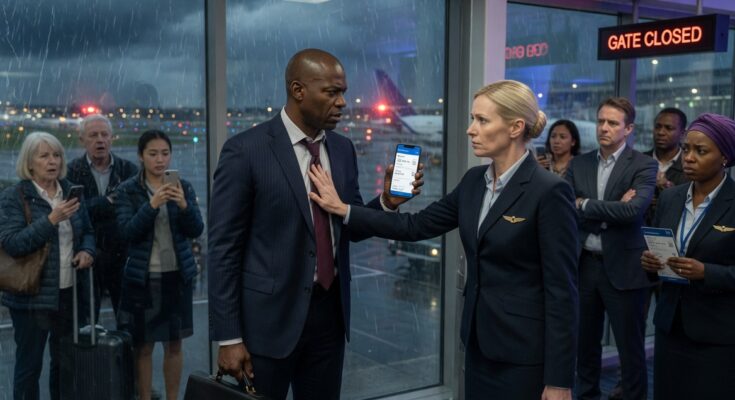
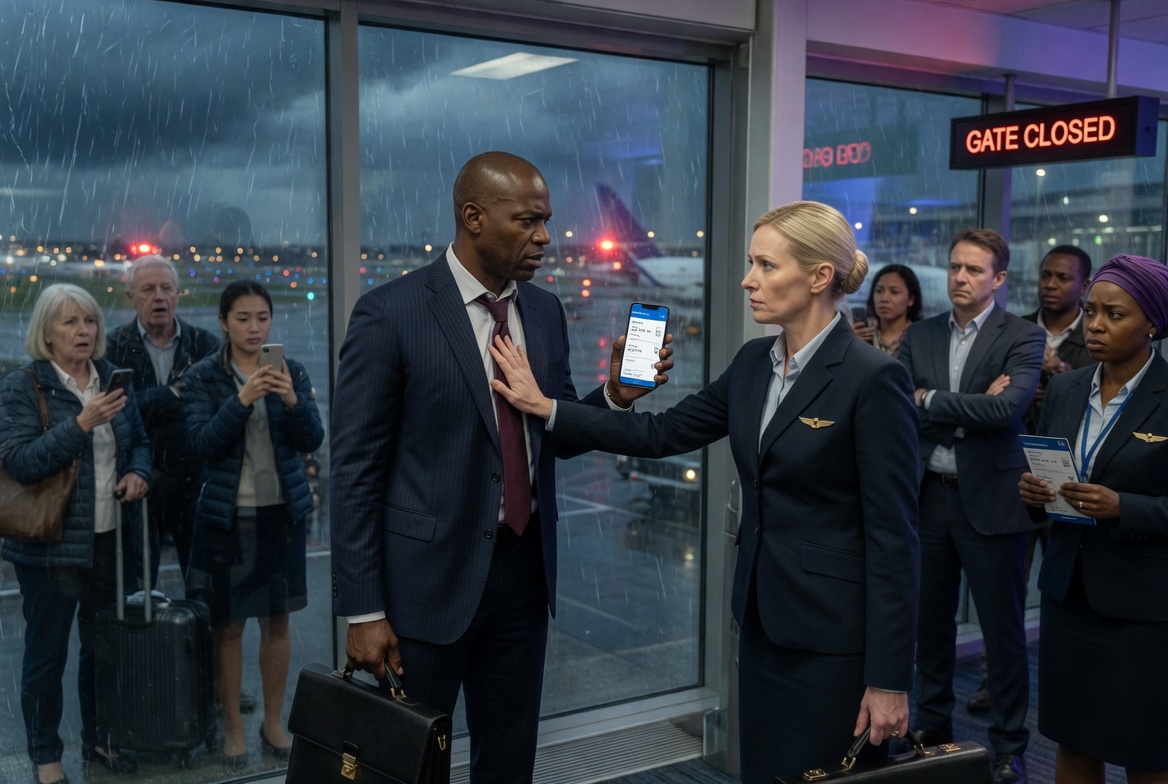
Agent Miller stepped out from behind the podium and planted herself directly in front of me. Her hand rose flat between us, firm and dismissive.
Stop.
“Sir,” she said, loud enough for the people behind me to hear, “we are only boarding First Class and Group 1 at this time.”
For one second, everything inside me went still.
I looked at her hand. Then at her face. Then at the phone in my own hand.
I held it out slightly so the screen was impossible to miss.
“I am in First Class,” I said. “My boarding pass is right here.”
She did not look down.
Not even by accident.
Her eyes stayed fixed on me, cold and certain, like she had already decided what I was before I opened my mouth.
“The general boarding line is over there,” she said, pointing behind me without taking her eyes off my face. “You need to step aside so priority passengers can board. You’re blocking the lane.”
A slow heat climbed up the back of my neck.
The suit did not matter.
The title did not matter.
The years did not matter.
In her eyes, I was not a priority passenger. I was an interruption. A mistake. A man standing where she did not believe I belonged.
Around us, the crowd began to shift.
People always sense tension before they understand it. A few passengers turned their heads. Others pretended not to stare while staring anyway. I heard the first whispers then, faint but unmistakable.
What’s going on?
Doesn’t he have the wrong line?
Why is he arguing?
That was how fast it starts. Not with facts. With assumptions.
And that was the real danger.
Because in spaces like this, a Black man is never just having a disagreement. He is one raised voice away from being called aggressive. One flash of frustration away from becoming the story people
think they saw.
I knew the trap immediately.
If I reacted emotionally, I would confirm whatever she had already decided about me.
If I stayed quiet, I risked letting her bury me.
“Ma’am,” I said, forcing my voice into a calm I did not feel, “if you scan the code, you’ll see I’m in seat 2A.”
Her expression hardened. She folded her arms.
“I’m not arguing with you,” she snapped. “I know how to read a manifest. Step out of the line immediately, or I’ll call security to remove you from the gate.”
Security.
The word did not just land. It tightened around my throat.
Because if security came, they would not simply verify my ticket and wave me through. They would stop me. Delay me. Question me. Search me if they felt like escalating. And if they searched me, they
would find the drive.
If they found the drive, everything could collapse.
The deal.
The board meeting.
My leverage.
My future.
What looked from the outside like a boarding dispute was, to me, suddenly something far more dangerous. Every minute mattered. Every interruption mattered. I had people waiting in New York for what was
inside my jacket. Men who would not forgive a delay, and others who might have been counting on one.
I studied her face again.
No hesitation.
No curiosity.
No interest in being corrected.
That was when the feeling changed.
Up to that point, I had told myself this might still be incompetence. Bias, yes. Profiling, probably. But maybe still a misunderstanding wrapped in certainty.
Then I saw the faintest thing, the tiny shift in her mouth when she said security, the almost invisible confidence of someone who knew exactly what that threat would do.
Not to any passenger.
To me.
And suddenly it clicked.
This was not just about being denied a boarding lane.
This was about creating an incident.
A scene.
A delay.
A stain.
One public moment, witnessed by dozens, maybe recorded by a few, and by the time the truth caught up, the damage would already be done. The board would not care whether I had technically been right.
They would care that my name had become complicated.
That I had become inconvenient.
That I had become risky.
I tightened my grip on the handle of my briefcase.
Behind Agent Miller, the scanner sat idle.
Behind me, the crowd waited.
Inside my jacket, the drive felt heavier than metal should.
And for the first time that morning, I allowed myself to think the thought I had been resisting since I stepped out of the lounge.
This was not random.
This was not bad luck.
And this was definitely not just a misunderstanding.
Someone needed me slowed down.
Someone needed me embarrassed.
Someone needed me off that plane.
I looked into Agent Miller’s eyes and saw no confusion there at all.
Only certainty.
Only control.
Only the cold satisfaction of a person doing exactly what she had already decided to do.
And in that moment, standing at Gate B14 with a valid first-class ticket in my hand and a life-altering secret in my pocket, I understood the truth.
I was not in the middle of an accident.