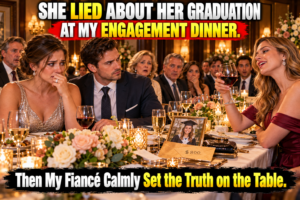
My sister had a habit of turning every important moment in my life into a joke at my expense. Promotions, birthdays, graduations—she always had an embarrassing story ready. At my engagement dinner, she started again.
This time, my fiancé didn’t laugh.
He slowly put down his glass, looked directly at my sister, and said, “Actually, I think it’s time everyone heard what really happened.”
The smile vanished from her face before he even finished the sentence.
Part 1
My sister, Lauren, had a little habit whenever attention landed on me for too long.
Promotions.
Birthdays.
Graduations.
Family dinners.
Within minutes, she’d drag out some humiliating story from years earlier and tell it like a comedy routine until everyone was laughing at me instead.
My parents always called it “just teasing.”
I called it exhausting.
At my engagement dinner, I spent the whole drive there dreading it.
My fiancé, Ethan, noticed.
“You’re quiet.”
“I’m fine.”
“You’ve said ‘I’m fine’ four times.”
I looked out the passenger window.
“My sister is going to do something.”
“What?”
“I don’t know yet.”
Ethan reached over and squeezed my hand.
“Then we’ll deal with it.”
“You don’t understand Lauren.”
“No.”
He smiled.
“But I understand you.”
That helped.
For the first hour, everything actually felt nice.
My mother kept staring at my engagement ring.
Dad ordered champagne.
My aunt cried when Ethan told everyone how he’d proposed beside the lake where we’d had our first date.
Even Lauren behaved.
She sat across from me wearing a dark green dress, sipping wine and smiling.
I started thinking maybe I’d worried for nothing.
Then my father raised his glass.
“To Emily and Ethan.”
Everyone lifted their drinks.
Dad looked at me.
“I’m proud of you, sweetheart.”
And there it was.
Attention.
On me.
For longer than Lauren could tolerate.
She leaned back in her chair with that familiar grin.
“Oh my God, Ethan, did Emily ever tell you about the graduation party?”
My stomach dropped.
Two cousins immediately started laughing.
They knew.
Lauren lifted her wine glass dramatically.
“No, no, wait. The BEST part was when she—”
“Lauren.”
I tried to keep my voice calm.
“Not tonight.”
She grinned.
“Oh, come on.”
“Please.”
“It’s funny.”
“Not to me.”
Mom sighed.
“Emily, she’s only teasing.”
Exactly.
The same sentence I’d heard since childhood.
Lauren laughed.
“See? Mom gets it.”
She turned toward Ethan.
“So Emily was nineteen, and she was completely obsessed with this guy named Ryan—”
“Lauren.”
She ignored me.
“She spent basically the whole graduation party following him around, and then—”
“Stop.”
Lauren rolled her eyes.
“God, you’re sensitive.”
A few relatives looked uncomfortable.
But nobody intervened.
They never did.
Lauren continued.
“The best part was when she disappeared upstairs for like half an hour because Ryan rejected her, and then she came down crying with mascara everywhere—”
I felt my face burning.
That wasn’t what happened.
It had never been what happened.
But Lauren had told the story so many times that her version had become family history.
Usually, I’d sit there and take it.
I’d smile weakly.
Wait for everyone to finish laughing.
Then change the subject.
But this time Ethan didn’t smile awkwardly.
He didn’t stare at his plate.
He slowly set down his glass.
Then he turned toward Lauren.
“Actually,” he said, “I think it’s time everyone heard what really happened.”
The table went silent.
Lauren’s smile flickered.
“What?”
Ethan remained calm.
“You’ve told that story three times since Emily and I started dating.”
Lauren laughed.
“Because it’s hilarious.”
“No.”
His expression didn’t change.
“It isn’t.”
Mom immediately jumped in.
“Ethan, it’s just an old family story.”
“Then nobody should mind hearing the accurate version.”
My heart started pounding.
I looked at him.
“Ethan.”
He glanced at me.
“Only if you’re okay with it.”
That mattered.
He wasn’t taking over.
He was giving the decision back to me.
I looked across the table at Lauren.
Her smile was gone.
For fifteen years, she’d told that story whenever she wanted to embarrass me.
Maybe it was time.
I nodded.
“Tell them.”
Lauren put down her wine.
“Emily, seriously?”
I looked directly at her.
“Yes.”
Ethan turned toward my family.
“Emily didn’t go upstairs because Ryan rejected her.”
Nobody moved.
“She went upstairs because Lauren had locked her purse in a bedroom.”
Lauren’s face changed.
My father frowned.
“What?”
Ethan continued.
“And inside that purse were Emily’s car keys, phone, and the envelope containing the money she’d saved for her first semester’s books.”
Dad slowly turned toward Lauren.
“How much money?”
I answered.
“Eight hundred dollars.”
Mom looked confused.
“But you told us you lost that money.”
“I didn’t lose it.”
Lauren’s chair creaked.
“Emily, don’t.”
That was the first time all evening she sounded afraid.
I looked at her.
“Why?”
And suddenly everyone at the table realized the funny graduation story had never been funny at all.
Part 2
Dad stared at me.
“What happened to the money?”
I hadn’t talked about it in years.
Not properly.
At nineteen, I’d barely been able to explain it to myself.
“Lauren took it.”
Mom immediately shook her head.
“No.”
Lauren jumped in.
“That’s not what happened.”
Dad looked between us.
“Then somebody explain.”
I took a breath.
The graduation party had been at our aunt’s house.
Lauren was twenty-two.
I was nineteen.
Ryan wasn’t some boy I’d been obsessively chasing.
He was a friend from school.
He had offered to drive me home because I’d suddenly discovered my purse was missing.
Lauren found it twenty minutes later in an upstairs bedroom.
At least, that’s what she’d claimed.
When she handed it back, the envelope containing my $800 was gone.
“So why didn’t you tell us?” Dad asked.
“I did.”
Mom frowned.
“You said you’d misplaced it.”
“No. That’s what Lauren said.”
I remembered the conversation perfectly.
I had been crying.
Lauren stood beside me telling Mom:
“Emily was drinking. She probably dropped it somewhere.”
I hadn’t been drinking.
But Mom believed her.
Lauren had always been more confident.
More convincing.
I was the anxious younger sister.
The “sensitive” one.
“What does this have to do with Ryan?” one cousin asked.
“Nothing,” I said.
Lauren had added Ryan later.
Every year, the story grew.
Eventually, I’d supposedly been chasing him.
Then he’d supposedly rejected me.
Then I’d supposedly hidden upstairs crying.
The missing money disappeared entirely from the story.
All that remained was the embarrassing part.
Lauren crossed her arms.
“This is ridiculous. You still think I stole your money?”
“I know you did.”
“How?”
Ethan didn’t answer for me.
Good.
This part was mine.
“Because six years ago you admitted it.”
Mom stared at Lauren.
“What?”
Lauren’s face went pale.
“I did not.”
“You were drunk at Aunt Susan’s Christmas party.”
“That proves nothing.”
“You told me you took it because you needed to pay your phone bill and you’d planned to replace it before I noticed.”
Silence.
Lauren looked around the table.
Nobody laughed now.
Then she did something predictable.
She attacked me.
“So you’ve been holding this against me for fifteen years?”
I almost smiled.
“That’s what you’re worried about?”
“Eight hundred dollars, Emily.”
“At nineteen, that was almost everything I had.”
“I was going to pay it back.”
“You didn’t.”
“I was struggling.”
“So was I.”
Mom interrupted.
“Lauren, did you take the money?”
Lauren looked at her.
“I don’t remember.”
I laughed softly.
That phrase.
People remembered everything until remembering became inconvenient.
Dad wasn’t laughing.
“Did you take it?”
Lauren looked down.
“I might have borrowed it.”
“Borrowed?”
“I intended to replace it.”
Dad leaned back.
“Jesus Christ.”
Lauren became defensive.
“It was fifteen years ago!”
“Yes,” I said. “And you’ve spent fifteen years turning what you did into a joke about me.”
That finally silenced her.
Because that was the part that mattered.
Not $800.
Not anymore.
She had taken something from me.
Then she had rewritten the story so I became the embarrassing one.
And my family had laughed along.
Mom looked at me.
“Why didn’t you tell us later?”
“I tried.”
“When?”
“Do you really want the list?”
She looked hurt.
I immediately felt guilty.
That reflex was so deeply trained I almost apologized.
Then Ethan touched my hand beneath the table.
Not stopping me.
Just reminding me I wasn’t alone.
I continued.
“My twenty-first birthday.”
Mom’s face changed.
“My college graduation.”
Dad looked down.
“Christmas at Grandma’s.”
Lauren interrupted.
“You never said anything about the money.”
“No. I said I hated you telling humiliating stories about me.”
“That’s different.”
“No, Lauren. It isn’t.”
I looked around the table.
“Every time I asked her to stop, somebody told me I was sensitive.”
Nobody spoke.
“Every time she embarrassed me, somebody said that’s just how sisters are.”
My mother whispered:
“We didn’t know.”
“You knew I hated it.”
That hurt her.
I could see it.
But it was true.
Lauren pushed her chair back.
“I can’t believe you’re doing this at your engagement dinner.”
I stared at her.
“I’m doing this?”
She stood.
“You’re humiliating me in front of everyone.”
And that sentence was so astonishing that even Dad looked at her in disbelief.
I slowly stood too.
“No, Lauren.”
My voice was steady.
“For the first time, I’m correcting the story you used to humiliate me.”
She grabbed her purse.
“Congratulations.”
“On what?”
“You got what you wanted.”
“What did I want?”
“Everyone feeling sorry for you.”
She turned toward Ethan.
“And congratulations to you too. You’ve known her for what, two years? You think you understand our family?”
Ethan remained seated.
“No.”
His voice was calm.
“But I understand what ‘stop’ means.”
Lauren froze.
Ethan continued.
“She asked you to stop tonight. You didn’t.”
Nobody had anything to say to that.
Lauren left.
Mom immediately started crying.
Dad stared at his untouched champagne.
My perfect engagement dinner was destroyed.
At least that’s what I thought.
Then Aunt Susan, who had barely spoken all evening, leaned forward.
“Emily?”
“Yes?”
“There is something you should know about Lauren and that graduation party.”
My stomach tightened.
“What?”
Susan looked toward my parents.
“I saw her upstairs with your purse.”
Part 3
The entire table seemed to stop breathing.
Mom stared at Aunt Susan.
“You knew?”
Susan looked ashamed.
“I didn’t know money was missing.”
“What did you see?” I asked.
“She was coming out of the guest bedroom carrying your purse.”
I remembered that room.
Blue wallpaper.
White bedspread.
The place where Lauren later claimed she’d “found” my bag.
“Why didn’t you say anything?”
Susan looked at me.
“Because she told me you asked her to get it.”
Of course she did.
Lauren always had an explanation ready.
Dad rubbed his forehead.
“This is unbelievable.”
But I believed it.
Completely.
The strange thing was, I didn’t feel vindicated.
I felt tired.
Fifteen years.
So many jokes.
So many times wondering whether maybe I really was too sensitive.
All because everyone preferred the easiest version of events.
Mom reached for my hand.
“Emily, I’m sorry.”
I looked at her.
“For what?”
“For not listening.”
That answer mattered.
Not “I’m sorry you’re upset.”
Not “I’m sorry things got out of hand.”
She actually named it.
Not listening.
Dad nodded.
“Me too.”
I sat down.
Nobody knew how to restart an engagement dinner after that.
So Ethan did something simple.
He raised his glass.
“To Emily.”
I looked at him.
“Again?”
“Again.”
A few people smiled.
He continued.
“To someone who spent way too many years being told she couldn’t take a joke.”
My cousin Hannah lifted her glass.
“To Emily.”
Dad followed.
Then Mom.
Soon everyone did.
It wasn’t the engagement toast I’d imagined.
It was better.
Because for once, nobody laughed at me afterward.
Lauren didn’t contact me for nine days.
Then she sent a message.
Hope you’re happy.
I didn’t respond.
An hour later:
Mom and Dad won’t stop talking about this.
Still nothing.
Then:
You turned everyone against me.
I finally replied.
I told the truth. What they do with it is their decision.
Her response came immediately.
Ethan has changed you.
I stared at that sentence.
She meant it as an insult.
But maybe Ethan had changed something.
Not by controlling me.
Not by telling me what to do.
He’d simply treated my boundaries as reasonable.
Once you experience that, it’s difficult to go back to pretending disrespect is normal.
I wrote:
He didn’t change me. He believed me.
Lauren didn’t answer.
Two weeks later, Mom invited us to Sunday dinner.
I almost refused.
“Do you want to go?” Ethan asked.
“No.”
“Then don’t.”
That simple.
No guilt.
No lecture about family.
No “be the bigger person.”
I called Mom.
“We’re not coming.”
She was quiet.
“Because Lauren will be here?”
“Yes.”
“She wants to apologize.”
“Then she can call me.”
“She says you’d hang up.”
“I might.”
Mom sighed.
“Emily.”
There it was.
The tone.
The old warning that I was making things difficult.
I closed my eyes.
“Mom, don’t.”
She stopped.
“Don’t what?”
“Don’t make me responsible for making Lauren’s apology comfortable.”
Silence.
Then Mom said:
“You’re right.”
I nearly dropped the phone.
“Okay.”
“Okay?”
“Yes.”
She sounded sad.
“But I miss you.”
“I miss you too.”
“Can we have dinner another night? Just us?”
“Yes.”
Progress didn’t arrive dramatically.
Sometimes it sounded like one person saying:
You’re right.
A few days later, Dad came to my house.
Alone.
He carried an old cardboard box.
“Found this in the attic.”
Inside were photographs from my graduation party.
I hadn’t seen them in years.
We sat at the kitchen table going through them.
There I was at nineteen.
Laughing with friends.
Standing beside Ryan.
Cutting cake.
Then Dad found one photograph.
He stopped.
“What?”
He handed it to me.
The photograph showed the hallway upstairs.
Aunt Susan was in the foreground.
Behind her, slightly blurred, was Lauren.
She was carrying my purse.
Dad stared at it.
“I should’ve believed you.”
I looked at the picture.
“Dad, I didn’t have proof.”
“You were my daughter. I could’ve at least listened.”
My eyes filled.
He reached across the table.
“I’m sorry.”
I nodded.
“Thank you.”
Then he pulled another photograph from the box.
His expression changed.
“What?”
He turned it toward me.
Lauren was standing beside a man I recognized.
Ryan.
They were arguing.
On the back, someone had written a time.
8:42 p.m.
That was almost exactly when Lauren claimed Ryan had been upstairs rejecting me.
The story hadn’t merely been exaggerated.
The entire timeline was false.
And when I called Ryan to ask what he remembered, his answer revealed why Lauren had worked so hard to make me the joke.
Part 4
Ryan answered on the fourth ring.
We hadn’t spoken in years.
After the usual awkward catching up, I explained why I was calling.
There was a long silence.
Then he said:
“Wow.”
“What?”
“She’s still telling that story?”
“Until recently.”
Ryan sighed.
“Emily, I always wondered whether you knew.”
“Knew what?”
“Lauren asked me out that night.”
I sat straighter.
“What?”
“She’d been flirting with me most of the party.”
I almost laughed from disbelief.
Lauren was three years older than me.
Ryan and I were friends.
Nothing romantic had ever happened.
“She thought you and I were together,” Ryan said.
“We weren’t.”
“I told her that.”
“What happened?”
“She asked if I wanted to leave with her.”
“And?”
“I said no.”
Suddenly the photograph made sense.
Lauren and Ryan arguing.
8:42 p.m.
“What did she do?”
“She got embarrassed.”
“Did she take my purse?”
“I didn’t see that.”
“Did you reject me?”
Ryan laughed.
“No offense, but you never asked me anything.”
“Exactly.”
“Where did that story even come from?”
“Lauren.”
He went quiet.
Then:
“Oh.”
We both understood.
The story she’d spent fifteen years telling about me was suspiciously close to what had happened to her.
She’d been rejected.
She’d been embarrassed.
And somehow, by the end of the night, I became the punch line.
I thanked Ryan.
Before hanging up, he said:
“Emily?”
“Yeah?”
“You weren’t crying because of me.”
“I know.”
“You were panicking about the money.”
“Yes.”
“I remember helping you look.”
That detail hit me unexpectedly.
Someone remembered.
The real version had existed all along.
It had simply been quieter than Lauren’s.
That evening, I told Ethan.
He listened.
Then asked:
“Are you going to confront her?”
“I don’t know.”
“You don’t have to.”
“I know.”
That was another thing I was learning.
Not every truth needed a showdown.
Sometimes knowing was enough.
But Lauren eventually created the showdown herself.
Three days later, she appeared at my front door.
Ethan was at work.
I almost didn’t answer.
Then she knocked again.
I opened the door but didn’t invite her inside.
“What?”
She looked exhausted.
“Can we talk?”
“You can talk.”
“Outside?”
“Yes.”
She laughed bitterly.
“Wow.”
“What?”
“Nothing.”
She crossed her arms.
“Mom told me Dad found pictures.”
I said nothing.
“And you called Ryan.”
“Yes.”
Her face hardened.
“You’re investigating me now?”
“No.”
“Sure feels like it.”
“I wanted to know what happened.”
“You already decided what happened.”
“No. That’s why I asked him.”
She looked away.
Then I asked:
“Did you ask Ryan out?”
Her silence answered.
“Lauren.”
“Yes.”
“Did he reject you?”
She swallowed.
“Yes.”
“Did you take my purse?”
Her eyes filled.
For a moment, she looked like my sister again.
Not the loud woman at family dinners.
Not my lifelong antagonist.
Just someone ashamed.
“Yes.”
There it was.
No “borrowed.”
No “maybe.”
Yes.
“Why?”
“I needed money.”
“You took $800.”
“I know.”
“You never paid it back.”
“I know.”
“Then you told everyone I was upstairs crying over Ryan.”
She wiped her cheek.
“I didn’t plan that.”
“How do you accidentally invent a fifteen-year story?”
“It started that night.”
“How?”
She looked toward the street.
“People saw me upset.”
“Because Ryan rejected you.”
“Yes.”
“And?”
“You were crying too.”
“Because my money was gone.”
“I know.”
“So you switched us.”
Her face crumpled.
“I made a joke.”
“One joke?”
“No.”
“You repeated it for fifteen years.”
“I know!”
She finally raised her voice.
“I know, Emily!”
We stared at each other.
Then she whispered:
“The first time everyone laughed, I felt better.”
That was the most honest thing she’d ever said to me.
“And after that?”
“It became the story.”
“Because you kept telling it.”
“Yes.”
I felt no satisfaction.
Only sadness.
“Why always me?”
Lauren started crying.
And the answer she gave wasn’t what I expected.
“Because you were the one person I knew wouldn’t fight back.”
Part 5
That hurt more than the theft.
Not because it was cruel.
Because it was accurate.
I hadn’t fought back.
Not really.
I complained privately.
I asked politely.
I sometimes cried afterward.
But at the table?
I smiled.
Lauren knew it.
“So you embarrassed me because it was safe?”
She nodded.
“I know how horrible that sounds.”
“It is horrible.”
“I know.”
I waited.
This was usually where someone in our family would rush to comfort her.
Nobody was there.
Just us.
Lauren reached into her purse.
For one terrible second, the irony almost made me laugh.
She removed an envelope.
“I know this doesn’t fix anything.”
Inside was a cashier’s check.
$4,000.
I stared at it.
“What is this?”
“The $800 plus what I figured it might mean after fifteen years.”
“I don’t want four thousand dollars.”
“Then donate it.”
“That’s not the point.”
“I know.”
She held it out.
“Please.”
I didn’t take it.
“Why now?”
“Because Ethan was right.”
I frowned.
“About what?”
“I don’t understand ‘stop.’”
She looked down.
“I thought if I was funny enough, it didn’t count as hurting people.”
I didn’t know what to say.
Lauren continued.
“Mom and Dad laughed, so I thought it was okay.”
“That isn’t an excuse.”
“No.”
Good.
She wasn’t trying to make it one.
“I was jealous of you.”
That surprised me.
“Of me?”
“You think I was the favorite.”
“You were.”
She shook her head.
“I was the entertaining one.”
“There’s a difference?”
“Yes.”
She laughed sadly.
“You were the dependable one. Dad trusted you. Mom called you when something mattered. You finished college. You built a career. You didn’t need rescuing every six months.”
I stared at her.
All those years, I’d envied Lauren’s confidence.
She’d apparently envied my stability.
Neither of us knew.
“When something good happened to you,” she said, “I felt smaller.”
“So you made me smaller.”
“Yes.”
It wasn’t a good reason.
But it was a reason.
And sometimes understanding the mechanism of someone’s cruelty makes it easier to stop believing their cruelty defines you.
“I can’t pretend we’re okay,” I said.
“I know.”
“I don’t trust you.”
“I know.”
“And you’re not giving a speech at my wedding.”
For the first time, Lauren almost smiled.
“Probably wise.”
I looked at the check.
Then took it.
Not as forgiveness.
As repayment.
“I’ll take the $800.”
“What about the rest?”
“I’ll donate it.”
“To what?”
I thought for a moment.
“Our old high school’s scholarship fund.”
Lauren nodded.
“Okay.”
She turned to leave.
“Lauren.”
She stopped.
“If we ever have a relationship again, there’s one rule.”
“What?”
“When I say stop, you stop.”
She nodded.
“Okay.”
“No jokes. No argument. No telling me I’m sensitive.”
“I understand.”
I studied her.
“I hope you do.”
Then she left.
I stood on the porch holding an envelope.
Fifteen years earlier, she’d taken one from my purse.
Now she’d returned one.
It didn’t erase anything.
But maybe it closed something.
Part 6
The wedding was seven months later.
Lauren was invited.
She wasn’t a bridesmaid.
That caused another family argument.
Not between Lauren and me.
Between Mom and me.
“People are going to ask questions.”
“Then tell them the truth.”
Mom looked horrified.
“Emily.”
“What?”
“We don’t need everyone knowing family business.”
I smiled.
“Interesting.”
“What?”
“For fifteen years, my embarrassing stories were family entertainment. Now privacy matters?”
Mom went quiet.
Then she sighed.
“You’re right.”
She’d been saying that more often.
So had I.
Not every disagreement required somebody to win.
Sometimes it simply required someone to notice an old pattern.
Lauren attended the wedding quietly.
No surprise toast.
No humiliating childhood slideshow.
No jokes about ex-boyfriends.
When people asked why she wasn’t in the bridal party, she simply said:
“Emily chose the people she wanted beside her.”
That was it.
At the reception, Dad gave a speech.
I braced myself.
Old habits.
He smiled.
“I spent many years believing teasing was harmless if everybody else laughed.”
The room became quiet.
“I learned something recently.”
He looked at me.
“The person being laughed at gets to decide whether the joke is harmless.”
My eyes filled.
Dad raised his glass.
“To Emily and Ethan. May your home always be a place where both of you can say what you mean and know you’ll be heard.”
Ethan squeezed my hand.
Across the room, Lauren lifted her glass.
She didn’t make a face.
Didn’t interrupt.
Didn’t turn the moment toward herself.
She simply smiled.
Afterward, she approached me.
“Nice wedding.”
“Thank you.”
“I have a joke.”
I stared at her.
She immediately raised both hands.
“Kidding.”
I laughed despite myself.
Then she looked nervous.
“Was that okay?”
Surprisingly:
“Yes.”
Because this time she checked.
That mattered.
“Okay.”
She started to leave.
I touched her arm.
“Want cake?”
Her eyes widened slightly.
“Sure.”
We ate cake together.
We didn’t magically become best friends.
Healing isn’t a movie montage.
There were awkward dinners.
Moments when Lauren slipped into old habits and caught herself.
Moments when I assumed the worst before she’d actually done anything.
But slowly, something changed.
At my thirty-fifth birthday dinner, Dad started telling an embarrassing childhood story.
Lauren interrupted him.
“Does Emily like this story?”
Dad stopped.
Everyone looked at me.
I considered it.
“That one’s okay.”
Lauren nodded.
“Proceed.”
We laughed.
Including me.
That was the difference.
I wasn’t against jokes.
I was against being told my discomfort didn’t matter.
Six months later, Lauren called.
Her voice sounded strange.
“Can I ask you something?”
“Sure.”
“My company is giving me an award.”
“Congratulations.”
“Thanks.”
She hesitated.
“Would you come?”
I smiled.
“Of course.”
“Really?”
“Yes.”
Another pause.
Then:
“I’m scared.”
“Of what?”
“Being the center of attention.”
That surprised me.
“You love attention.”
“I thought I did.”
She sighed.
“Now I’m worried somebody’s going to embarrass me.”
The irony wasn’t lost on either of us.
Lauren laughed nervously.
“Yeah. I hear it.”
I could’ve made a joke.
A sharp one.
Something about karma.
Fifteen years earlier, maybe I would have wanted that.
Instead, I said:
“I’ll be there.”
“Thanks.”
At the ceremony, Lauren received her award.
I clapped.
Nobody humiliated her.
Nobody dragged out an old mistake.
Nobody stole the moment.
Afterward, she hugged me.
“I get it now.”
“What?”
“Why it hurt.”
I hugged her back.
That was the first time I truly believed she did.
Part 7
A year after my wedding, Mom found another box.
Our family apparently preserved every piece of paper except the ones that mattered when they mattered.
Inside were old school records, photographs, birthday cards, and one folded note.
Mom called me.
“You need to see this.”
I went over.
Lauren was already there.
Mom handed me the note.
It was from fifteen years earlier.
My handwriting.
Mom,
Someone took the money from my purse. I think it was Lauren. Please believe me. I didn’t lose it.
I stared at it.
“I wrote this?”
Mom nodded.
“I found it inside an old cookbook.”
Then she started crying.
“I don’t remember seeing it.”
Lauren sat completely still.
Dad came into the room.
He read it.
His face fell.
For years, my parents had genuinely believed I’d never clearly accused Lauren.
But I had.
I had written it down.
Somehow the note had disappeared.
I looked at Lauren.
“Did you hide this?”
“No.”
Her answer was immediate.
And for the first time, I believed her without suspicion.
Mom wiped her eyes.
“I probably put it there.”
“Why?”
“I don’t know.”
She looked devastated.
“Maybe I was cooking when you gave it to me. Maybe I told myself I’d deal with it later.”
That was possible.
Ordinary negligence can hurt almost as much as intentional cruelty.
Mom reached for me.
“I am so sorry.”
I let her hug me.
Then Lauren said:
“Can I see it?”
I handed her the note.
She read it.
Her eyes filled.
“You were begging them to believe you.”
“Yes.”
“I didn’t know.”
“No.”
She folded it carefully.
Then gave it back.
“I wish I’d admitted it.”
“So do I.”
The strange thing was that finding the note didn’t reopen the wound.
It confirmed something I’d finally stopped questioning.
I had not imagined it.
I had not been too sensitive.
I had not failed to communicate.
Sometimes I’d communicated perfectly.
People simply hadn’t wanted to hear something inconvenient.
That distinction changed me.
I became better at speaking directly.
At work.
With friends.
With Ethan.
Especially with Ethan.
One night, we argued about money.
Nothing major.
He wanted to replace our patio.
I thought we should wait.
The conversation became tense.
Then Ethan said:
“Okay. We’re getting nowhere.”
Old me would’ve panicked.
Conflict meant danger.
Someone might become angry.
Someone might withdraw affection.
Instead, I said:
“I need twenty minutes.”
“Okay.”
Twenty minutes later, we continued.
Nobody mocked anyone.
Nobody recruited relatives.
Nobody turned it into a story at Thanksgiving.
We disagreed.
Then resolved it.
That was marriage.
Not never hurting each other.
Not never fighting.
Knowing the other person wouldn’t weaponize your vulnerable moments later.
That realization made me think about Lauren.
She hadn’t just embarrassed me.
She’d taught me that anything awkward I did could become public entertainment.
So I became cautious.
Private.
Hyperaware.
For years, I thought that was simply my personality.
Maybe some of it was.
But some was learned.
Once I recognized that, I started unlearning it.
I gave presentations without rehearsing every sentence twenty times.
I spoke up in meetings.
I stopped prefacing opinions with “Sorry, but…”
And when someone interrupted me, I didn’t automatically surrender the floor.
Small changes.
Huge difference.
Then, two years after my engagement dinner, something happened that tested every bit of progress our family had made.
Dad turned sixty-five.
Mom planned a large surprise party.
Almost eighty people.
Relatives.
Friends.
Former coworkers.
Mom asked Lauren and me to prepare a joint speech.
I stared at her.
“You’re serious?”
Mom immediately realized the problem.
“Oh.”
Lauren laughed.
“No.”
Mom looked embarrassed.
“I wasn’t thinking.”
Lauren turned to me.
“What if we did it?”
I raised an eyebrow.
“You want to?”
“Yes.”
“Why?”
She smiled.
“Because maybe we can tell stories about someone else for once.”
Dad shouted from the next room:
“I CAN HEAR YOU.”
We laughed.
Then Lauren became serious.
“You approve every story.”
“Every one?”
“Every one.”
“And you?”
“Same rule.”
I considered it.
“Okay.”
We wrote the speech together.
And while searching through old photographs, Lauren found one from my graduation party.
The one with her carrying my purse.
She stared at it.
Then looked at me.
“What should we do with this?”
I thought about it.
“Keep it.”
“Why?”
“Because it happened.”
She nodded.
Then placed it back in the box.
Not every painful memory needs to be destroyed.
Sometimes it simply needs to stop controlling the story.
Part 8
Dad’s birthday party went perfectly.
Mostly.
Lauren and I stood together at the microphone.
Dad looked terrified.
“This feels dangerous.”
Lauren smiled.
“It is.”
Everyone laughed.
Then she looked at me.
“Approved joke.”
I nodded.
“Approved.”
More laughter.
We told stories about Dad burning Thanksgiving rolls.
Getting lost on a family vacation while refusing to ask directions.
Accidentally sending Mom a text meant for his fishing buddy.
Before each slightly embarrassing story, Lauren dramatically looked toward Dad.
“Consent?”
Dad eventually shouted:
“STOP ASKING!”
The room erupted.
Even I couldn’t stop laughing.
It was funny because Dad was laughing too.
That night showed me something important.
Lauren hadn’t lost her personality.
She was still loud.
Still funny.
Still capable of commanding a room.
She had simply learned that humor didn’t require a victim.
After the speech, Dad hugged us both.
“My girls.”
Lauren whispered:
“We didn’t ruin it.”
“High standards.”
She elbowed me.
Later, we sat outside.
Just the two of us.
Lauren looked toward the house.
“Do you ever wish you’d exposed me sooner?”
I thought about it.
“Yes.”
She nodded.
“Fair.”
“But I also wish you hadn’t needed exposing.”
“Also fair.”
She looked at me.
“Do you forgive me?”
She’d never asked directly before.
I took my time.
“Yes.”
Her eyes filled.
“But.”
She laughed.
“Of course there’s a but.”
“Forgiveness doesn’t mean it didn’t matter.”
“I know.”
“And it doesn’t mean I would’ve trusted you immediately.”
“I know.”
“But yes. I forgive you.”
She wiped her eyes.
“Thank you.”
Then she smiled.
“Can I finally tell Ethan the story about when you drove Dad’s car into the mailbox?”
I stared at her.
“You promised never to mention that.”
“Worth asking.”
“No.”
“Fine.”
We laughed.
And she never told him.
That mattered more than she probably knew.
Part 9
Five years after that engagement dinner, Ethan and I returned to the same restaurant.
Same private room.
Same long table.
This time, we were celebrating our anniversary.
Mom and Dad were there.
Aunt Susan.
Several cousins.
Lauren arrived late.
“Traffic.”
“Sure.”
“Seriously.”
She sat beside me.
Halfway through dinner, Dad raised his glass.
I immediately looked at Lauren.
She noticed.
“Relax.”
Dad smiled.
“To Emily and Ethan.”
Everyone raised their glasses.
“For building a marriage where listening matters.”
Ethan squeezed my hand.
Then Dad added:
“And for surviving this family.”
Everyone laughed.
Including me.
Lauren leaned closer.
“You know what I was thinking?”
“What?”
“The first engagement dinner.”
“So was I.”
“I was awful.”
“You were.”
“Thanks.”
“You brought it up.”
She smiled.
Then she became serious.
“If Ethan hadn’t stopped me, do you think you ever would’ve?”
I thought about it.
“Eventually.”
“You sure?”
“No.”
She nodded.
“Me neither.”
I looked across the table at Ethan.
He wasn’t some heroic man who’d rescued me from my family.
That wasn’t the story.
He had done something simpler.
When I said something hurt, he believed me.
That gave me enough support to believe myself.
After dinner, Lauren handed me a small box.
“Anniversary present.”
Inside was a framed photograph.
Not the purse photo.
A different graduation picture.
I was nineteen.
Standing in the backyard.
Laughing.
No tears.
No Ryan.
No missing purse.
Just me.
On the back, Lauren had written:
This is how I should have remembered that night.
I couldn’t speak for a moment.
“Where’d you find it?”
“Aunt Susan.”
I hugged her.
“Thank you.”
Lauren whispered:
“I’m sorry I made your worst moment the story everybody remembered.”
I held her tighter.
“You don’t anymore.”
“No.”
She pulled back.
“Now Dad’s mailbox is the story.”
I stared at her.
“Lauren.”
“Sorry.”
I started laughing.
“Okay. That one was good.”
“Approved?”
“Approved.”
Part 10
Years later, when people ask why my sister and I are close now, I never say we always were.
We weren’t.
I don’t rewrite history just because the ending improved.
For years, Lauren used me as the punch line whenever she felt insecure.
My parents minimized it.
I stayed quiet because I thought objecting would make me difficult.
Then one evening, at the dinner that was supposed to celebrate my engagement, the pattern finally broke.
Not because Ethan humiliated Lauren back.
He didn’t.
Not because he shouted.
He didn’t.
He simply put down his glass and said:
“Actually, I think it’s time everyone heard what really happened.”
Then he looked at me and asked whether I wanted the truth told.
That was the part I’ll always remember.
He asked.
The entire problem with my family had been that nobody asked.
Was I okay with the joke?
Did I want the story repeated?
Had anyone listened when I said the money was stolen?
Did I want my embarrassing moments turned into entertainment?
Nobody asked.
They assumed.
Ethan didn’t.
That tiny difference gave me the courage to say:
“Tell them.”
The truth wasn’t dramatic in the way Lauren’s version had been.
A nineteen-year-old girl hadn’t been hysterically chasing a boy who rejected her.
She had been panicking because $800 she’d worked for had disappeared from her purse.
Her older sister had taken it.
Then, embarrassed by her own rejection that night, that sister created a joke.
People laughed.
So she repeated it.
Again.
And again.
Until fiction became family memory.
The money was eventually repaid.
But the more important thing Lauren returned wasn’t cash.
It was ownership of my own story.
Today, if Lauren tells a joke about me, she watches my face.
If I laugh, she continues.
If I don’t, she stops.
Immediately.
No argument.
No “you’re too sensitive.”
No parents telling me to lighten up.
And I do the same for her.
Because we finally learned something our family should’ve understood all along:
A joke stops being harmless when the person you’re joking about asks you to stop.
At our parents’ fortieth anniversary dinner, Lauren stood to give a toast.
She looked at me.
For just a second, that old familiar grin appeared.
My stomach instinctively tightened.
She noticed.
Then she smiled softly.
“Don’t worry. You’re safe.”
Everyone laughed.
So did I.
Lauren raised her glass.
“To Mom and Dad—and to learning that loving somebody also means listening when they tell you you’ve hurt them.”
Mom wiped her eyes.
Dad lifted his glass.
I looked at Ethan.
He smiled.
Then Lauren looked directly at me.
“And to my sister, who gave me another chance after I spent too many years turning her into the punch line.”
I raised my glass.
She didn’t tell an embarrassing story.
She didn’t steal the room.
She gave the moment back.
And maybe that was the real ending.
My sister had spent years believing attention was something we had to compete for.
Eventually, we learned there was enough room at the table for both of us.
Nobody had to become smaller.
Nobody had to become the joke.
And nobody had to laugh just to keep the peace.