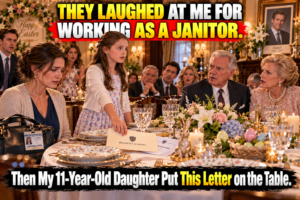
My in-laws laughed at me for working as a janitor at Easter dinner.
I could handle them looking down on me. I’d been doing that for three years.
What I wasn’t prepared for was my eleven-year-old daughter slowly pushing back her chair, standing in front of the entire family, and saying:
“No. You need to listen carefully, Grandma and Grandpa… because you have no idea what my mother has done for this family.”
My mother-in-law’s smile disappeared.
Then Audrey reached into her little Easter purse and placed a folded envelope beside her grandfather’s plate.
What was inside finally revealed why I’d spent three years cleaning classrooms at night—and why I had never told them the truth.
Part 1 — After Daniel
My husband, Daniel Whitmore, died three years before that Easter dinner.
He was thirty-eight.
I was thirty-five.
Our daughter, Audrey, was eight.
Daniel came from money.
Not private-jet money, but the kind of comfortable old family wealth where nobody worried about mortgages, college tuition, or whether the car could survive another winter.
His father, Richard, owned Whitmore Development.
His mother, Margaret, organized charity galas and somehow knew exactly how much everyone’s shoes cost.
I came from a town with one grocery store and a high school football field beside a cornfield.
My father repaired farm equipment.
My mother worked at a pharmacy.
When Daniel introduced me to his parents, Margaret smiled politely and asked where I’d attended college.
When I told her I hadn’t finished, her smile changed.
Daniel noticed.
He squeezed my hand beneath the table.
That night he told me:
“You never have to prove yourself to them.”
I believed him.
Because while Daniel was alive, he stood between me and their judgment.
Then he died.
And everything changed.
The first few weeks were casseroles, flowers, sympathy cards, and people telling me to call if I needed anything.
Then everyone returned to their lives.
Including Daniel’s family.
Richard told me Daniel’s business interests were “complicated.”
Margaret said they were grieving and needed space.
Phone calls became shorter.
Then less frequent.
Financial help stopped.
I had enough savings to survive for a while, but not forever.
There was still a mortgage.
Utilities.
Insurance.
Groceries.
School expenses.
And Audrey.
One evening, about four months after Daniel died, I sat at the kitchen table with $312 in my checking account.
Audrey was asleep upstairs.
Three bills were spread in front of me.
I cried for exactly ten minutes.
Then I opened my laptop and started applying for jobs.
Anything.
Receptionist.
Cashier.
Hotel desk clerk.
Warehouse assistant.
I eventually took two part-time positions.
Six months later, a private school offered me full-time custodial work with benefits.
I accepted immediately.
Some people would’ve been embarrassed.
I was relieved.
It meant health insurance.
Predictable hours.
A paycheck.
Stability.
So every weekday, I put on navy work pants, tied back my hair, and cleaned classrooms.
I emptied trash.
Mopped hallways.
Scrubbed bathrooms.
Removed gum from desks.
Some nights I came home smelling like disinfectant and bleach.
Audrey never complained.
She’d run to the door.
“Mom!”
Then she’d hug me like I’d returned from a year overseas instead of an eight-hour shift.
That was enough.
I was keeping us afloat.
What Margaret and Richard didn’t know was that the janitorial job had also placed me somewhere very important.
And it was there, late one rainy October night, that I found something Daniel had left behind.
Something that had nothing to do with cleaning floors.
Part 2 — The Box
The school where I worked was called Bellmont Academy.
Daniel had attended it as a boy.
So had his father.
The Whitmore family name was engraved on a brass donor plaque inside the library.
I walked past it every night.
At first, I hated that plaque.
Then it became just another thing to dust.
One evening, the facilities director, Mr. Ellis, asked me to help clear an old storage room.
The school was renovating.
We spent hours moving filing cabinets, broken chairs, yearbooks, and boxes.
Near the back wall was a cardboard archive box marked:
WHITMORE SCHOLARSHIP FUND — 2008–2016
I stopped.
Daniel had once mentioned a scholarship.
Not often.
He said he’d started something after college but stopped talking about it when his father objected.
“Can I look at this?”
Mr. Ellis shrugged.
“School records. Don’t throw anything away.”
Inside were applications.
Thank-you letters.
Photographs.
And a folder with Daniel’s handwriting.
I recognized it instantly.
For students who need a chance, not students whose parents need another tax deduction.
That sounded exactly like him.
I sat on the floor.
There were records showing Daniel had quietly funded scholarships for students whose families couldn’t afford Bellmont.
Not through Whitmore Development.
Personally.
Then I found a letter addressed to me.
Claire.
My hands started shaking.
The letter had apparently been included with documents Daniel left with the school years earlier.
It wasn’t some dramatic final message written before his death.
It was instructions related to the scholarship program.
But one paragraph stopped me.
Daniel wrote that if anything ever happened to him, he hoped I would decide whether the program should continue.
Not his father.
Not his mother.
Me.
I took copies of the relevant records after getting permission.
Then I went home and cried at the kitchen table.
The scholarship fund had almost no money remaining.
Daniel hadn’t been able to contribute during his final year.
I couldn’t replace what he’d once donated.
I was cleaning toilets to pay my mortgage.
But I could do something.
I started small.
Twenty dollars from one paycheck.
Thirty from another.
When I picked up an extra Saturday shift, I sometimes put $50 aside.
Nobody knew.
Not even Audrey.
At least, I thought she didn’t.
By the next spring, I had contributed enough to help one student with books and activity fees.
It wasn’t much.
But when I saw the thank-you letter, I understood why Daniel had done it.
The following year, I helped again.
Then something unexpected happened.
Other school employees heard about the fund.
A teacher contributed.
Then another.
An alumnus matched our donations.
Mr. Ellis organized a staff fundraiser.
Nobody called it the Whitmore family fund anymore.
We simply called it Daniel’s Fund.
By the third year, it was helping several children.
I never told Margaret or Richard.
Why would I?
They’d barely called Audrey.
We saw them at Christmas and Easter.
That was essentially it.
Which brought us to that Easter Sunday.
And the longest dining table I’d ever wanted to crawl under.
Part 3 — “Still Cleaning Toilets?”
Margaret’s Easter dinners were formal enough to make you afraid of using the wrong fork.
Twenty-two people attended that year.
Ham.
Roasted vegetables.
Crystal glasses.
Fresh flowers.
Margaret seated Audrey and me toward the far end.
I didn’t care.
I was there because Audrey wanted to see her cousins.
Halfway through dinner, Margaret asked:
“So, Claire, what are you doing these days?”
She knew.
I’d told her at Christmas.
“Still at Bellmont.”
Her eyebrows lifted.
“Oh, yes.”
Then came the smile.
“Still cleaning toilets?”
Two people laughed.
Not loudly.
But enough.
I felt Audrey stop eating beside me.
I kept my voice calm.
“I’m still working in facilities, yes.”
Margaret took a sip of wine.
“Well, work is work.”
That would’ve been enough.
But Richard joined in.
“My son had such a brilliant future.”
The table became quieter.
He shook his head.
“It’s painful sometimes to see what was left behind.”
I looked at him.
“What does that mean?”
Margaret immediately said:
“Richard.”
But he continued.
“Daniel worked very hard to build a certain life.”
My cheeks burned.
I understood perfectly.
Daniel had married the small-town girl.
Then Daniel died.
And now the small-town girl cleaned bathrooms.
Apparently, I was the sad epilogue to his successful life.
I could have defended myself.
I could have told them about the double shifts.
The nights I stayed awake calculating bills.
The mornings I packed Audrey’s lunch after sleeping four hours.
But I didn’t owe them my résumé.
So I said:
“I’m proud of my work.”
Margaret gave a tiny laugh.
“Of course you are.”
That’s when Audrey put down her fork.
I felt it immediately.
“Audrey.”
She looked at me.
Her eyes were wet.
Then she stood.
Every head turned.
Richard frowned.
“Sweetheart, sit down.”
“No.”
I’d never heard her speak to him like that.
Margaret looked embarrassed.
“Audrey.”
My daughter looked directly at her grandparents.
“No. You need to listen carefully, Grandma and Grandpa.”
The entire table went silent.
“Because you have no idea what my mother has done for this family.”
My heart stopped.
“Audrey—”
She reached into the little purse she’d brought with her.
And pulled out an envelope.
I recognized the logo.
Bellmont Academy.
I whispered:
“Where did you get that?”
“Mr. Ellis gave it to me Friday.”
She placed it on the table.
Richard looked at it.
“What is this?”
Audrey answered:
“Something Dad started.”
Nobody laughed anymore.
Part 4 — Daniel’s Fund
Richard opened the envelope.
Inside was a letter from Bellmont Academy.
He read silently.
Then read it again.
Margaret became impatient.
“What does it say?”
Richard didn’t answer.
His face had changed.
Finally, he handed her the letter.
Bellmont Academy was announcing that Daniel’s Fund had reached a new milestone.
Through employee contributions, alumni matching, community fundraising, and small regular donations, the program had funded educational assistance for multiple students.
At the bottom was a recognition section.
Program Steward: Claire Whitmore
Margaret looked at me.
“What is this?”
“A scholarship program Daniel started.”
“I’ve never heard of it.”
“I know.”
Richard looked stunned.
“Daniel started this?”
“Yes.”
“When?”
“Years ago.”
“Why wasn’t it part of the family foundation?”
I almost laughed.
“Because he didn’t want it to be.”
Richard’s expression hardened.
“How would you know?”
Before I could answer, Audrey pulled out another folded sheet.
“Because Dad wrote it.”
That one I hadn’t expected.
“Audrey.”
She looked at me apologetically.
“I found your copy.”
She unfolded Daniel’s note.
I didn’t let her read all of it aloud.
Some things belonged to us.
But I allowed her to read one sentence:
If Claire ever continues this, she’ll do more good with a hundred dollars than most people do with ten thousand, because she remembers what needing help feels like.
Silence.
Margaret lowered her eyes.
Richard stared at his plate.
My throat tightened.
I hadn’t read that sentence in months.
Audrey continued.
“My mom works at Bellmont all day.”
“Audrey, sweetheart—”
“No, Mom.”
She looked at me.
“You always tell me I should speak when something is wrong.”
There wasn’t much I could say to that.
Then she turned back toward her grandparents.
“My mom cleans bathrooms because that’s the job that gave us insurance after Dad died.”
Nobody moved.
“She works extra shifts when I need something.”
Her voice shook.
“She fixed our washing machine from a video because we couldn’t afford a new one.”
I hadn’t known she’d noticed that.
“She says we’re okay even when she’s tired.”
My eyes filled.
“And she still puts money into Dad’s scholarship.”
Margaret stared at me.
“You donate your salary?”
“Not much.”
Audrey shook her head.
“It is much.”
That nearly broke me.
She continued.
“Grandpa said Dad left something bad behind.”
Richard looked up.
“I didn’t mean—”
“Yes, you did.”
“Audrey,” I said gently.
She stopped.
I stood and put my hand on her shoulder.
She looked up at me.
I could’ve told her to sit.
Instead I said:
“Finish.”
She faced Richard.
“My dad left me.”
Her voice cracked.
“And he left Mom.”
She touched the Bellmont letter.
“And he left this.”
Then she looked at Margaret.
“But Mom is the person who kept all of it going.”
Nobody at the table made a sound.
Audrey sat.
I kissed the top of her head.
Then Richard said something I’d never heard from him before.
“Claire.”
I looked at him.
“I owe you an apology.”
Part 5 — The Truth About “Support”
Margaret stared at her husband.
Richard didn’t look at her.
He looked at me.
“When Daniel died, I thought you wanted distance from us.”
I couldn’t believe what I was hearing.
“You stopped calling.”
“You stopped coming.”
“Because every time I called your office, your assistant said you were unavailable.”
Richard frowned.
“What?”
Margaret suddenly looked uncomfortable.
There it was.
A tiny change.
But I saw it.
So did Richard.
He turned toward her.
“Margaret?”
She picked up her water glass.
“This isn’t the time.”
“Did Claire call?”
“Richard.”
“How many times?”
I felt cold.
Margaret set down her glass.
“She called several times.”
Richard stared at her.
“You told me she wanted independence.”
“I thought it was best.”
“For whom?”
“Everyone was grieving.”
I couldn’t speak.
Three years.
I’d believed they had simply abandoned us together.
But apparently the truth was more complicated.
Richard turned toward me.
“I didn’t know.”
I wanted to be furious.
Part of me was.
But Audrey was beside me.
So I chose my words carefully.
“I asked for help once.”
Richard closed his eyes.
“What did you need?”
“The mortgage was two months behind.”
Margaret whispered:
“Claire.”
“No.”
I looked at her.
“You mocked me for cleaning toilets. You don’t get to be uncomfortable with the reason I took the job.”
Her face reddened.
“I asked whether Daniel had any remaining benefits or anything that could temporarily help Audrey and me.”
Richard looked at Margaret.
“What did you tell her?”
Margaret said nothing.
I answered.
“She said Daniel had made his choices and I needed to make mine.”
Someone at the table gasped.
Richard pushed his chair back.
“Margaret.”
“I was grieving!”
“So was she!”
It was the first time I’d ever heard Richard shout at his wife.
Margaret’s eyes filled.
“I lost my son.”
“And Audrey lost her father.”
Richard’s voice broke.
“And then we disappeared from her life.”
Audrey reached for my hand.
I squeezed it.
Margaret began crying.
I didn’t enjoy it.
I didn’t feel victorious.
Grief had damaged all of us differently.
But grief wasn’t a free pass for cruelty.
Richard turned back to me.
“Why didn’t you contact me directly?”
“I tried.”
“I mean personally.”
“I didn’t have your private number.”
He looked stunned.
Then ashamed.
Of course I didn’t.
For fifteen years, all family communication had gone through Margaret.
Another realization settled over the table.
This family wasn’t as close as it pretended to be.
It simply had one person controlling the doors.
Richard looked at Audrey.
“I’m sorry.”
Audrey didn’t answer.
He continued.
“I should’ve checked on you myself.”
“Yes,” she said.
Eleven years old.
No diplomacy.
Just truth.
“Yes, you should have.”
I almost smiled.
Part 6 — What Audrey Knew
We left early.
Not dramatically.
No screaming.
No slammed doors.
I thanked the host, collected our coats, and drove home.
Halfway there, I looked at Audrey.
“Where did you really get that letter?”
“Mr. Ellis.”
“Why?”
“I asked him.”
“You asked him for what?”
“Proof.”
I nearly missed the turn.
“Proof of what?”
“That you’re important.”
My heart cracked.
“Audrey.”
“Grandma always acts like your job is embarrassing.”
“Sweetheart, listen to me.”
I pulled into a parking lot.
Turned off the engine.
Then faced her.
“You never need paperwork to prove I’m important.”
“I know.”
“And being a janitor isn’t something I need defending from.”
“I know.”
“There is nothing shameful about cleaning a school.”
“I know, Mom.”
“Then why the letter?”
She looked down.
“Because I wanted them to know you weren’t what they said.”
I reached across the console.
“They don’t decide what I am.”
She nodded.
Then whispered:
“I hate when they make you quiet.”
That sentence hit me harder than everything said at dinner.
“What do you mean?”
“You get different around them.”
Different.
She was right.
At work, I laughed.
At home, I sang badly while cooking.
With Audrey, I was myself.
Around the Whitmores, I shrank.
I became careful.
Apologetic.
Quiet.
Because some part of me was still the small-town twenty-three-year-old woman meeting Daniel’s wealthy parents for the first time.
I had spent years trying to prove I deserved a seat at their table.
My eleven-year-old had noticed.
“I’ll work on that,” I said.
Audrey smiled.
“Okay.”
Then she reached for the radio.
“Can we get ice cream?”
“You just ate Easter dessert.”
“That wasn’t real dessert.”
“What was it?”
“Grandma dessert.”
I laughed so hard I cried.
We got ice cream.
Part 7 — Richard’s Visit
Three days later, Richard appeared at Bellmont Academy.
I was cleaning fingerprints from glass doors when the receptionist called me.
“Claire? Someone’s here for you.”
I walked into the lobby wearing my work uniform.
Richard stood beneath the Whitmore donor plaque.
For once, I wasn’t embarrassed.
“Richard.”
He looked at my uniform.
Then at the mop bucket.
I waited for the expression I’d seen so many times.
It never came.
Instead he said:
“I was wrong.”
“About?”
“You.”
I folded my arms.
“That covers a lot.”
Surprisingly, he smiled.
“Fair.”
Then he looked toward the plaque.
“I donated money to this school for twenty-two years.”
“I know.”
“I never knew about Daniel’s scholarship.”
“He wanted it separate.”
“Because of me?”
“You’d have to ask him.”
We both knew we couldn’t.
That silence hurt.
Richard swallowed.
“I spent my life believing writing checks made me generous.”
I said nothing.
“He apparently disagreed.”
“He admired you.”
Richard looked surprised.
“He did.”
“Daniel disagreed with you because he cared what you thought.”
Richard’s eyes filled.
That was the first time I understood something about him too.
He hadn’t just lost a son.
He’d lost the chance to repair whatever had existed between them.
“I want to contribute to the fund.”
I immediately shook my head.
“No.”
He blinked.
“No?”
“Not if you’re buying your way out of what happened.”
He looked almost offended.
Then considered it.
“Fair.”
“If you want to help, learn how the program works.”
“What does that mean?”
“Come Thursday.”
“Why?”
“Scholarship committee meets at six.”
Richard stared at me.
“You want me on the committee?”
“No.”
I smiled.
“You can listen.”
For the first time since I’d known him, Richard laughed at himself.
“Six o’clock?”
“Six.”
He came.
He listened.
And three months later, when he finally donated, he did it anonymously.
That mattered to me.
Part 8 — Margaret
Margaret was harder.
She didn’t call for almost a month.
Then a handwritten letter arrived.
I expected excuses.
Instead, the first sentence read:
I was cruel to you because blaming you was easier than admitting Daniel had built a life that no longer centered on me.
I read it twice.
She wrote that after Daniel married me, she felt replaced.
When Audrey was born, she felt even further removed.
Then Daniel died.
Grief turned resentment into something uglier.
She convinced herself I had taken Daniel away.
So when I needed help, she withheld it.
Not because I didn’t deserve help.
Because hurting me briefly made her feel like she had control over something.
The letter didn’t ask for forgiveness.
It ended:
I have no right to ask Audrey to see me. If she ever chooses to, I will be grateful.
I showed Audrey.
“What do you think?”
She read it slowly.
“Do I have to forgive her?”
“No.”
“Do you?”
“No.”
“Are you going to?”
“Maybe eventually.”
She thought about that.
“Can I see Grandpa without Grandma?”
“Yes.”
And for several months, that’s what happened.
Richard came to Audrey’s soccer games.
School performances.
A science fair where he spent twenty minutes pretending to understand her model of the respiratory system.
He never missed one after that.
Margaret stayed away.
Then Audrey made the decision herself.
“I want Grandma at my birthday.”
“You sure?”
“Yes.”
“Why?”
Audrey shrugged.
“I want to see if she’s different.”
Eleven-year-old logic.
Direct and terrifying.
Margaret came.
No expensive gift.
No dramatic speech.
She brought a small photo album filled with pictures of Daniel as a child.
Audrey loved it.
When Margaret saw me, she hesitated.
“Claire.”
“Margaret.”
Then she said:
“I won’t ask you to tell me it’s okay.”
That was probably the best thing she could have said.
“Thank you.”
We weren’t healed.
But we had started.
Part 9 — The Scholarship Ceremony
The following spring, Bellmont held a small ceremony.
Daniel’s Fund had grown enough to support a larger group of students.
Mr. Ellis asked me to speak.
My immediate answer was no.
Then Audrey said:
“You have to.”
“Why?”
“Because you tell me not to be scared.”
Children are incredibly inconvenient when they remember your parenting.
So I agreed.
I stood at a podium wearing a simple blue dress.
Not my work uniform.
But I almost wished I had worn it.
Because I wasn’t ashamed of it anymore.
Audrey sat in the front row.
Richard beside her.
Margaret beside him.
When I began speaking, I didn’t talk about sacrifice.
I didn’t talk about wealthy families or Easter dinners.
I talked about work.
I told the students there was dignity in honest work.
Whether you were a doctor.
A teacher.
A carpenter.
A cafeteria worker.
Or the person cleaning the room after everyone went home.
Then I talked about Daniel.
“He believed circumstances shouldn’t determine how much opportunity someone deserves.”
My voice shook.
“He also believed the person doing quiet work matters just as much as the person whose name is on the building.”
Richard lowered his head.
When I finished, everyone stood.
I hated standing ovations.
Too much attention.
But then I saw Audrey.
She was clapping harder than anyone.
So I let myself enjoy it.
Afterward, Margaret approached me.
“I owe you something.”
“What?”
“An apology without an excuse.”
She took a breath.
“What I said at Easter was cruel. Your work was never beneath Daniel. It was never beneath us. And you were never what was ‘left behind.’”
Her voice broke.
“You were the person holding everything together after he was gone.”
I felt tears rise.
“Thank you.”
She nodded.
“I am sorry, Claire.”
This time, I believed her.
Part 10 — What Daniel Left Behind
People sometimes imagine the strongest moment of that story was Audrey standing at Easter dinner.
It wasn’t.
That was the loudest moment.
The strongest came almost a year later.
I arrived home after work one Thursday.
Audrey was at the kitchen table doing homework.
I put down my bag.
“What’s for dinner?”
She looked at me.
“You’re asking me?”
“Yes.”
“I’m eleven.”
“Very observant.”
She laughed.
Then she noticed my uniform.
“Mom?”
“Yeah?”
“Do you still like your job?”
I thought about it.
“I like what it gave us.”
“What?”
“Stability.”
She frowned.
“That’s a boring answer.”
“It usually is.”
I sat beside her.
“That job let me keep this house. It gave us health insurance. It let me be home most nights. And it accidentally led me back to something your dad cared about.”
“Daniel’s Fund.”
“Exactly.”
She smiled.
“Then it’s a good job.”
“Yes.”
“It always was.”
That stopped me.
Because she understood something I’d taken years to learn.
A job doesn’t become respectable because wealthy people finally approve of it.
It doesn’t become meaningful because someone attaches a scholarship to it.
There was dignity in my work before Richard apologized.
Before Margaret changed.
Before anyone at that Easter table stopped laughing.
I had simply allowed their judgment to make me forget.
A few weeks later, I was promoted to facilities coordinator.
I accepted.
Not because I needed a better title to prove anything.
Because it came with better hours and more money.
I’m still practical.
Richard remained involved with Daniel’s Fund.
Margaret slowly rebuilt her relationship with Audrey.
Mine with her remained more cautious.
Some relationships heal with scars.
That’s okay.
And Audrey?
She never became shy about defending people.
Sometimes I had to remind her that not every disagreement required a closing argument.
But I never wanted to extinguish that fire.
On the next Easter, we returned to Margaret and Richard’s house.
Same dining room.
Same long table.
Margaret served dessert.
Then she looked toward me.
“How’s work?”
For half a second, the entire table became quiet.
Everyone remembered.
I smiled.
“Busy.”
Margaret nodded.
“Bellmont is lucky to have you.”
No sarcasm.
No laughter.
Just respect.
Audrey looked at me from across the table.
She raised one eyebrow.
I knew exactly what she was thinking.
I smiled back.
Later, while everyone cleared the dishes, I found Audrey carrying plates toward the kitchen.
“Hey.”
“What?”
“You don’t have to do that.”
She shrugged.
“Somebody has to.”
I laughed.
Then Margaret appeared behind us.
She took several plates.
“So do I.”
The three of us walked into the kitchen together.
Nothing dramatic happened.
No speech.
No revelation.
Just three people cleaning a table.
And strangely, that was the ending I preferred.
Because three years earlier, Margaret had treated cleaning as evidence that I’d failed.
Now she stood beside me doing the same work.
Daniel once told me I never had to prove myself to his family.
It took me years to understand what he meant.
He wasn’t promising they would eventually approve of me.
He was telling me their approval had never been the measure of my worth.
That Easter, my eleven-year-old daughter understood it before I did.
When her grandfather said it was painful to see what Daniel had left behind, Audrey stood and corrected him.
Daniel had left behind a daughter brave enough to speak.
A scholarship that kept helping children.
And a wife who had done whatever honest work was necessary to keep their little family standing.
But Audrey was right about one more thing.
Her grandparents had no idea what her mother had done for the family.
Not because I had some secret fortune.
Not because I secretly owned the school.
Not because being a janitor was merely a disguise for something more impressive.
The truth was simpler.
When everything collapsed, I stayed.
I worked.
I raised our daughter.
I kept Daniel’s kindness alive.
And every night, no matter how tired I was, I came home.
That was enough.
More than enough.